Imagine your company has a memory. It’s a vast collection of every lesson learned, every clever shortcut discovered, and every hard-won insight your team has ever had. That, in a nutshell, is institutional knowledge.
It's the unwritten playbook that helps everyone solve problems, innovate, and keep things running smoothly without constantly reinventing the wheel.
What Is Institutional Knowledge, Really?

Often called organizational or corporate knowledge, institutional knowledge is the unique blend of information, experiences, and skills that a company accumulates over time. It’s so much more than what you'll find in an official training manual; it's the living, breathing expertise that people gain just by doing their jobs.
Think of it as your organization's collective intelligence. This includes everything from a salesperson's intuitive grasp of a client's needs to an engineer's knack for spotting a recurring software bug in minutes. It’s the "how we do things around here" that goes far beyond any documented process.
The Real Value of Your Company's Collective Memory
This collective memory is an incredibly powerful business asset, directly fueling your efficiency and growth. When you manage it well, it keeps the wheels turning, even as people join or leave the team.
For instance, a solid understanding of why a past project failed can stop a new team from making the same expensive mistakes. That saves time, money, and a lot of frustration.
For remote and global teams, having access to this shared wisdom is absolutely essential. It bridges geographical gaps, allowing a new hire in one country to tap into the hard-earned lessons of a veteran team member halfway across the world. In a complex sales cycle, this shared history provides the context needed to build stronger client relationships and close bigger deals.
This idea is a cornerstone of any smart business strategy. To see how it fits into the bigger picture, check out our guide on what knowledge management is and why it matters. Grasping these principles is the first step toward building a more resilient and intelligent organization.
The Core Components of Institutional Knowledge
So, what makes up this powerful asset? It’s a mix of tangible information you can write down and intangible expertise that lives in people's heads. Each piece plays a unique role in keeping your operations on track and sparking new ideas. Breaking it down helps you see exactly where your company’s most valuable information might be hiding.
This table gives a quick overview of the different facets of institutional knowledge and why each is so critical for a business.
| Component Type | What It Includes | Why It's Critical |
|---|---|---|
| Processes & Workflows | Documented procedures, unwritten shortcuts, and the best ways to get tasks done. | Ensures consistency, efficiency, and quality control across all your teams. |
| Company Culture & Values | Shared beliefs, communication styles, and the "unspoken rules" of how you work together. | Shapes how people behave, collaborate, and represent the company to the outside world. |
| Historical Context | The stories of past project successes and failures, key decisions, and client relationship histories. | Provides valuable lessons that inform future strategies and prevent repeating old mistakes. |
| Technical Expertise | Specialized skills, deep system knowledge, and practical problem-solving abilities. | Drives innovation, product development, and the ability to solve tough technical challenges. |
Understanding these components is the first step. The real challenge—and opportunity—is figuring out how to capture and share this knowledge so it doesn't walk out the door when your people do.
The Recipe vs. The Chef's Instinct
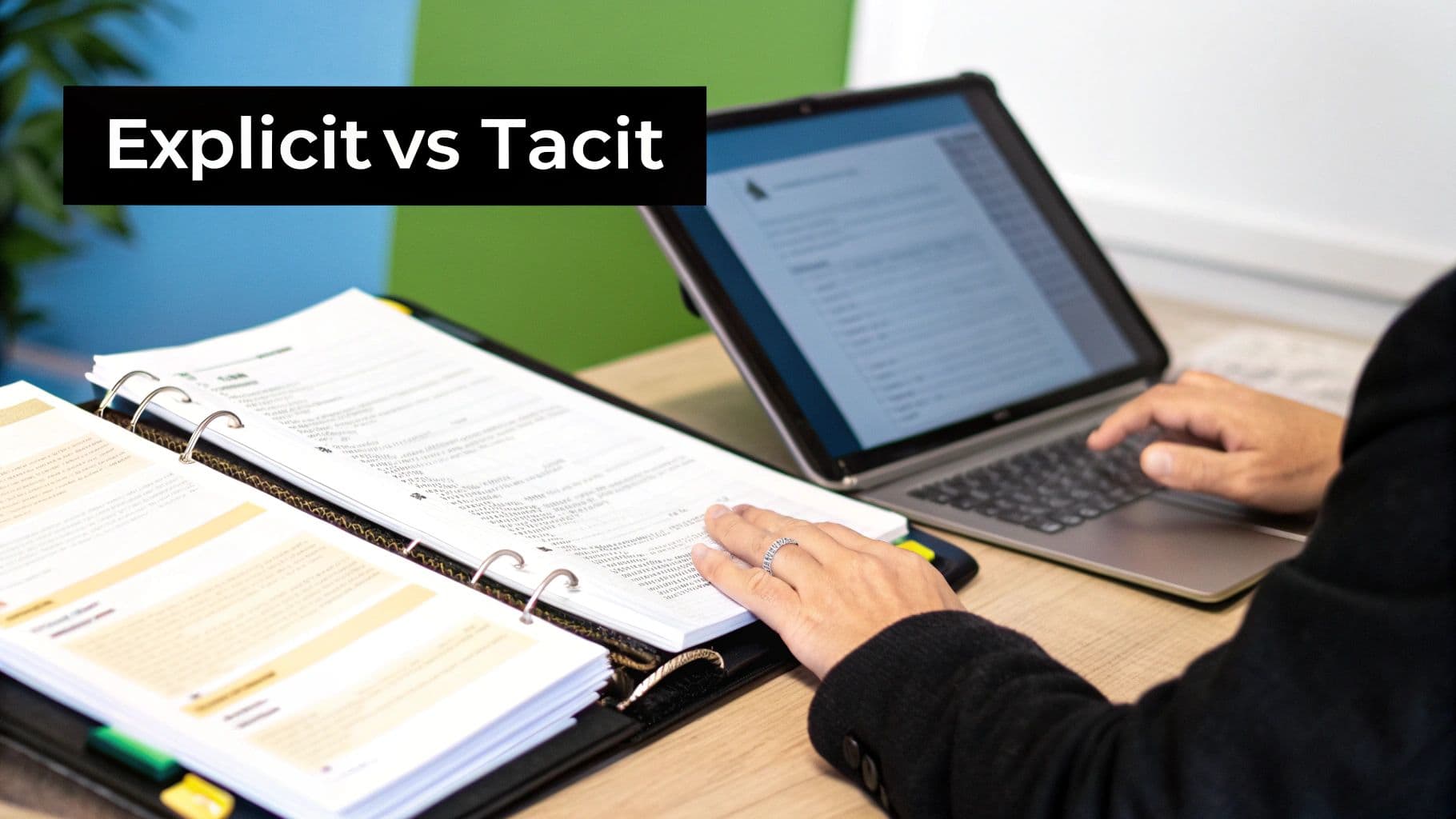
To really get a handle on institutional knowledge, you have to understand that it comes in two very different flavors. A great way to think about it is the difference between a detailed recipe and a master chef's intuition. One is easy to write down and pass around; the other is an art form, learned only through years of practice.
The first kind is explicit knowledge. This is your company’s cookbook. It’s all the clear, documented information that anyone can pick up and follow.
Think of things like training manuals, process documents, databases, and those handy onboarding checklists. Explicit knowledge is structured, tangible, and simple to transfer. It's the "what" and the "how-to" that keeps your daily operations running smoothly.
Understanding Explicit Knowledge
Explicit knowledge is the foundation for consistency and training. It makes sure that every single team member, whether it's their first day or their tenth year, has a reliable source of truth for standard procedures.
A customer support team, for instance, leans heavily on a detailed knowledge base filled with scripted answers and troubleshooting guides. That’s pure explicit knowledge in action. It ensures every customer gets the same level of service, no matter who they talk to.
This type of knowledge is fairly straightforward to manage because it can be:
- Written down: You can capture it in documents, wikis, and software.
- Stored centrally: It's easy to organize in a shared drive or a proper knowledge management system.
- Shared instantly: A quick link can give the entire team access to the same information.
But as vital as it is, explicit knowledge is only half of the picture. The real gold—the insights that drive innovation and give you an edge—is much trickier to pin down. And that brings us to the chef's instinct.
The Power of Tacit Knowledge
The second, and often more valuable, type is tacit knowledge. This is the master chef’s secret sauce. It’s the unwritten wisdom, the gut feelings, and the deep expertise that people build up over years of doing the work.
It’s the salesperson who can read the slightest hesitation in a client's voice and knows exactly what to say to close the deal. It's the engineer who just has a "feeling" that a certain line of code will cause headaches later on. You won't find this stuff in a manual; it lives inside your people.
Trying to capture this knowledge is a massive challenge. Because it's so personal and tied to specific situations, you can't just write it down in a step-by-step guide. It’s usually passed on through storytelling, mentorship, and working side-by-side. When a seasoned employee walks out the door, this is the knowledge that’s most likely to be lost forever.
Why Both Types Matter
Any successful company needs both the recipe and the chef's instinct. Explicit knowledge provides the structure and consistency for efficient operations. Tacit knowledge, on the other hand, is what fuels the creativity, problem-solving, and adaptability you need to truly thrive.
This table breaks down the key differences between these two crucial forms of knowledge.
| Characteristic | Explicit Knowledge (The Recipe) | Tacit Knowledge (The Chef's Instinct) |
|---|---|---|
| How it's Stored | Documents, databases, guides, wikis | In people's heads, through experience |
| How it's Shared | Easily transferred via text, video, training | Mentorship, storytelling, observation |
| Key Attribute | Objective and easy to articulate | Subjective and difficult to explain |
| Business Value | Creates consistency and efficiency | Drives innovation and expert problem-solving |
Without the recipes, your kitchen would be pure chaos. But without the chef's instinct, you’d never create a dish that wows anyone. The whole point of smart knowledge management is to build systems that not only document your recipes but also create ways to capture and share the priceless wisdom of your master chefs.
Your Company's Most Valuable Hidden Asset
Think of institutional knowledge as your company's collective memory. It’s far more than a dusty library of old documents; it's a living, breathing asset that gives you a serious competitive edge and has a real impact on your bottom line.
When all that wisdom your team has built up over the years is captured and easy to find, it fuels smarter, faster decisions across the entire organization.
Imagine a new product team struggling with a problem that another team already solved two years ago. Without that shared memory, they're stuck reinventing the wheel, wasting weeks of time and money. But with it, they can learn from past successes, sidestep known pitfalls, and get to market that much faster. That’s the real-world power of holding onto what your people know.
Driving Faster and Smarter Decisions
When historical context and expert insights are at everyone's fingertips, your teams can act with confidence. They don't have to second-guess every move or waste precious time hunting down that one person who holds the key piece of information.
This ability to tap into shared experience dramatically boosts a company's speed and improves outcomes. Good institutional knowledge ensures business continuity, allowing teams to repeat what works and avoid what doesn't. In fact, organizations that get this right see 25% faster decision-making and 20% higher profitability. Why? Because past experiences inform current strategies, leading to process improvements that can slash operational costs by 15-30%. You can see more on how companies achieve this in this great article on the impact of institutional knowledge on business performance.
The efficiency gains create a ripple effect. Customer support can solve tickets faster, sales teams can better anticipate a client's needs, and your operations folks can fine-tune workflows based on proven methods.
Fueling Innovation and Consistency
Real innovation rarely happens in a vacuum. It happens when teams can stand on the shoulders of past work, taking solid ideas and pushing them to the next level. A well-kept archive of project histories, brainstorming notes, and customer feedback becomes a goldmine of inspiration.
Your engineers can look back at previous development cycles to inform new features. Your marketing team can analyze the results of old campaigns to launch much more effective ones. This creates a powerful cycle of continuous improvement, where every new project is smarter than the last. For a closer look at how this works day-to-day, check out our guide on what team collaboration truly means for your business.
This consistency also directly benefits your customers. When everyone, from sales to support, has access to the same client history and product knowledge, the customer experience feels seamless and professional. That's how you build the trust and loyalty essential for long-term growth.
Accelerating Onboarding and Employee Growth
One of the most obvious wins from strong institutional knowledge is how it transforms the new-hire experience. Gone are the days of a slow, frustrating onboarding process where newcomers have to constantly tap colleagues on the shoulder for basic information. Instead, they can dive into a rich repository of knowledge and get up to speed in record time.
This has a huge effect on both productivity and morale. New employees feel empowered and useful from day one, which drastically shortens their ramp-up time and sets them up for long-term success.
It's not just for new hires, either. For your current employees, having access to the company’s collective brain opens up countless opportunities for growth. They can learn from other departments, study what made past projects successful, and deepen their own expertise without ever leaving their desks. This doesn't just make them more valuable to the company—it boosts job satisfaction and helps you keep your best people. This hidden asset doesn't just make your company smarter; it makes your people better.
The True Cost of Forgetting
When an experienced employee walks out the door, a piece of your company's brain walks out with them. This isn't just about feeling the loss of a great colleague; it's a real business threat that creates a kind of "organizational amnesia." The consequences are far more painful than a simple inconvenience.
Failing to hold onto what your team knows leads to serious financial and operational damage. It’s that moment when productivity tanks because new hires spend weeks hunting for information that used to be a quick question away. Worse, it’s the sheer frustration of watching teams repeat expensive mistakes that were solved years ago—all because the solution was never written down.
The Ripple Effect of a Single Departure
Think about a classic, and dangerous, scenario. Your top salesperson, who’s been with the company for a decade, decides to move on. All the subtle details about her key accounts—their business cycles, the personalities of the decision-makers, the unwritten history of past negotiations—exist only in her head.
The new account manager starts from square one, armed with just the raw data in the CRM. They miss subtle cues, misunderstand client needs, and can easily damage relationships that took years to build. This isn't just a sales problem. It's a company-wide crisis that hits your revenue, customer loyalty, and reputation in the market.
This knowledge gap creates a domino effect:
- Customer Experience Suffers: Clients get tired of re-explaining their history and needs, leading to frustration and a loss of trust.
- Operational Drag Increases: Simple processes get bogged down as the team struggles to piece together how things used to work.
- Team Morale Drops: The remaining employees get swamped with questions, pulling them away from their own work and leading to burnout.
Quantifying the Financial Damage of Knowledge Loss
The costs of losing institutional knowledge aren't abstract; they are very real and can be measured. When people leave, the operational gaps they create are especially tough for revenue teams and operations managers who rely on the historical context from meetings and deals to make smart decisions. High turnover can cause organizations to lose up to 20% of their productivity annually.
The replacement costs are just as staggering, hitting an average of $15,000 for a single mid-level employee and climbing into the millions for senior executives. These figures throw a spotlight on the massive financial strain that knowledge loss puts on a business. You can find more insights on the hidden costs of employee turnover on Coveo.com. This isn't just about hiring a new person; it's about the expensive, time-sucking process of rebuilding lost expertise from scratch.
A Critical Threat from HR to the C-Suite
The risk of organizational amnesia is a universal threat that should keep every department leader up at night. HR and training coordinators see it in painfully long onboarding times and higher new-hire turnover. Operations managers see it in process bottlenecks and the same old inefficiencies cropping up again and again.
For the C-suite, the stakes are even higher. A steady leak of core knowledge undermines strategic planning, weakens your competitive edge, and makes the whole company more fragile. When expertise is locked away in the minds of a few key people without a system to capture it, you're basically building your business on a house of cards.
This makes it crystal clear: understanding institutional knowledge and actively preserving it isn't just a "knowledge management" task. It's a fundamental pillar of business resilience and sustainable growth. The true cost of forgetting isn't just the price of replacing a person; it's the cost of rebuilding your company's memory, one expensive mistake at a time.
How To Capture Your Team's Collective Wisdom
Turning your team's collective brainpower into a real, lasting asset isn't something that happens by accident. You can't just hope people will share what they know; you need to build a system that actively captures their wisdom before it walks out the door. It all starts with creating a supportive culture and then backing it up with the right tools to make sharing knowledge a natural part of everyone's day.
Think about it: the foundation of any good system is a culture that actually values collaboration. When people feel that their experience is appreciated and that sharing it helps everyone win, they're far more likely to open up. This means getting proactive about knowledge transfer, not just passively hoping someone writes things down.
Fostering a Knowledge-Sharing Culture
First things first, you need to create clear pathways for expertise to flow between team members. You'd be surprised how much of a difference a few simple, structured programs can make in capturing that valuable tacit knowledge—the kind that's often hardest to pin down.
Here are a few methods I’ve seen work time and time again:
- Mentorship and Buddy Programs: Pair your seasoned pros with newer folks. This is hands-down one of the best ways to transfer that nuanced, experience-based wisdom you simply can't get from a manual.
- After-Action Reviews (AARs): When a big project, campaign, or sales deal wraps up, hold a quick meeting. Talk about what went well, what didn't, and what you learned. Documenting these takeaways creates an invaluable playbook for the next team up to bat.
- Internal Wikis and Knowledge Hubs: A central, searchable home for process docs, project histories, and best practices is a must. The trick is making it ridiculously easy for anyone to add to it and find what they need.
A really effective way to do this is to build an internal knowledge base from courses and other existing training materials. By making these practices a priority, you start building a culture where sharing becomes second nature.
This image really drives home the high stakes involved, showing how an employee's exit can directly tank productivity and drive up costs when their knowledge isn't captured first.
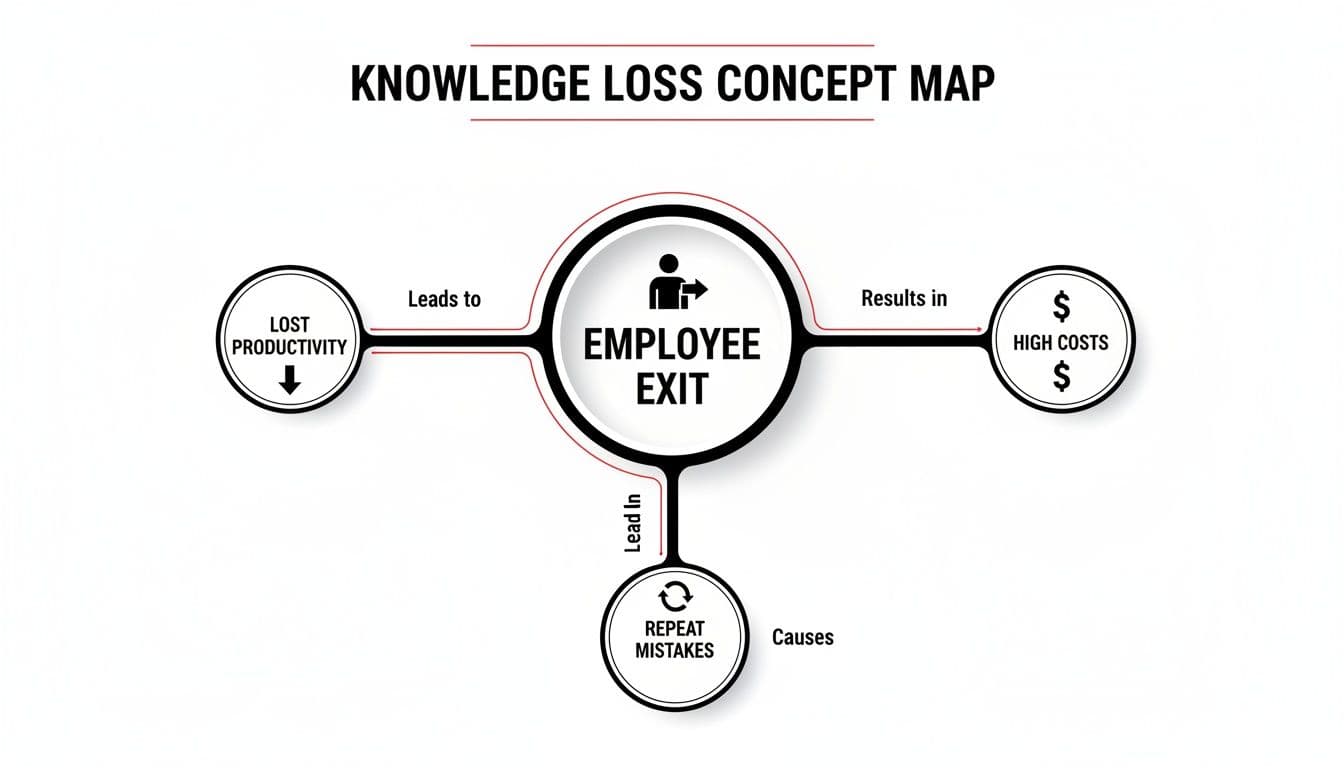
It’s a stark reminder that losing an employee isn't just a staffing change—it’s a direct hit to your operational efficiency and your bottom line.
Using Technology to Capture Spoken Knowledge
While wikis and mentorship programs are great, a huge chunk of institutional knowledge gets shared out loud—in brainstorming sessions, on client calls, and during project check-ins. Historically, those conversations were fleeting, their insights gone the moment the meeting ended. This is where modern tech has completely changed the game.
AI-powered meeting transcription and summarization tools are built to solve this exact problem. They can automatically record, transcribe, and summarize spoken conversations, effectively turning them into a permanent, searchable library of your company’s collective intelligence.
These tools are a massive step forward in preserving expertise. With the average large US business losing an estimated $47 million a year in productivity from poor knowledge sharing, it's easy to see why tools from companies like Notta, Fireflies, and Otter.ai are becoming so critical for capturing this vital asset.
Choosing the Right AI Tools for Your Team
With so many options out there, you need to look past the marketing and evaluate tools based on features that actually help with knowledge capture. A simple transcript isn't enough; you need a tool that helps you organize information and find the golden nuggets later. For a deeper look, check out our guide on knowledge sharing best practices to boost your team's performance.
To help you get started, here's a quick look at what to look for when choosing an AI tool to help preserve your team's knowledge.
Evaluating AI Tools for Knowledge Capture
| Feature | Why It Matters for Knowledge Capture | Top Tools Offering This |
|---|---|---|
| High-Accuracy Transcription | If the transcript is full of errors, the knowledge is corrupted. You need a reliable record of what was actually said. | Notta, Otter.ai |
| Speaker Identification | Knowing who said what provides crucial context. This is vital for understanding decisions and action items. | Fireflies.ai, Notta |
| Searchable Transcripts | This turns your meeting archive into a database. Anyone can search for keywords to find specific discussions or decisions. | Otter.ai, Fireflies.ai |
| AI-Generated Summaries & Chapters | Saves time by pulling out the key takeaways, decisions, and action items, making the knowledge instantly digestible. | Notta, Fireflies.ai |
| Integration with Knowledge Hubs | The ability to automatically push summaries and notes to your wiki (like Confluence or Notion) closes the loop. | Fireflies.ai, Otter.ai |
Choosing a tool that fits your team's workflow is the final piece of the puzzle. By turning your everyday conversations into a structured, accessible archive, you ensure that your company's collective wisdom doesn't just survive—it thrives, powering smarter decisions and future success.