In today's fast-paced business environment, crucial decisions, insights, and action items from meetings often vanish into thin air just days after they happen. This isn't a personal failing; it's a predictable pattern known as the "forgetting curve." The cost of this lost knowledge is immense, leading to repeated work, missed opportunities, and strategic misalignment across teams. The information discussed one day is gone the next, forcing everyone to reinvent the wheel instead of building momentum.
But what if you could systematically reverse this trend? This guide cuts through the noise to deliver a roundup of powerful, evidence-based knowledge retention strategies that modern teams can implement immediately. We'll move beyond theory and provide actionable steps to make learning stick. To effectively combat the tendency to forget, adopting a mindset rooted in active learning principles is crucial for designing impactful strategies. This article provides the framework to do just that.
You will learn how to transform fleeting meeting discussions into durable, actionable organizational memory. We will explore eight distinct methods, from Spaced Repetition to the Feynman Technique, complete with practical tips on using tools like AI meeting summarizers to support each one. By adopting these techniques, you can ensure that valuable information sticks, empowering your team to build on past knowledge instead of constantly starting over. Let’s dive into the strategies that will help your organization stop forgetting and start retaining the knowledge that drives success.
1. Spaced & Distributed Learning (Spaced Repetition & Distributed Learning)
Instead of cramming information into a single session (and forgetting it just as quickly), this strategy leverages the "spacing effect" to cement knowledge in long-term memory. It works by revisiting information at increasing intervals over time, strategically interrupting the natural process of forgetting. This approach combines two powerful concepts:
- Spaced Repetition: Reviewing information at strategically timed, increasing intervals (e.g., 1 day, 3 days, 7 days, 14 days).
- Distributed Learning: Spreading learning sessions out over a longer period rather than massing them together in a single "bootcamp" style event.
Together, they form one of the most effective, evidence-based knowledge retention strategies available. By forcing your brain to repeatedly retrieve information just as you start to forget it, you strengthen the neural pathways associated with that memory.
How to Implement Spaced & Distributed Learning
This method is ideal for retaining critical details from meetings, training sessions, or strategic planning discussions. It ensures that key decisions, client needs, and action items aren't lost after the initial conversation.
A sales team, for example, can use this to retain vital client information. Instead of just reading meeting notes once, they would review them on a schedule:
- Day 1: Immediate review of the meeting summary and action items.
- Day 3: A quick second review to refresh key details.
- Day 7: A third check-in to solidify understanding of client pain points.
- Day 14: A final review before the next follow-up.
This spaced-out approach transforms fleeting notes into durable knowledge, significantly improving follow-up conversations and client relationship management.
Actionable Tips for Teams
- Automate Your Review Schedule: Use AI meeting summarization tools that integrate with your calendar or task manager. Set up automated reminders to prompt team members to review a meeting summary at optimal intervals (e.g., 24 hours, 3 days, 1 week).
- Use Summaries as Source Material: The concise, AI-generated summary of a meeting is the perfect source material for these quick review sessions. It provides the essential information without requiring a full re-watch of the recording.
- Create Team Review Rituals: For critical projects, schedule recurring 15-minute "Action Item Reviews" on the team calendar. This formalizes the process and ensures everyone stays aligned on decisions made in previous weeks.
- Rethink Training Delivery: Instead of a one-day training marathon, distribute the content into shorter, monthly sessions. This gives teams time to absorb and apply the information before building on it, leading to much higher long-term retention.
2. Active Recall
Instead of passively re-reading or listening to information, active recall is the practice of deliberately retrieving knowledge from your memory. This "pulling out" action strengthens neural connections far more effectively than simply "putting in" information again. It's the difference between reading your notes and being asked to explain what your notes say without looking at them.

This mental effort signals to your brain that the information is important and needs to be easily accessible, solidifying it in long-term memory. This is one of the most powerful knowledge retention strategies because it directly mimics how you'll need to use information in the real world: recalling it on demand during a client call or a project discussion. Active recall transforms fragile, short-term awareness into robust, usable knowledge.
How to Implement Active Recall
This strategy is highly effective for ensuring teams internalize critical decisions and action items from meetings. Instead of just reading an AI-generated summary and nodding along, active recall forces genuine engagement with the content.
A customer success team, for instance, can use this to master a new product update discussed in a training session. Rather than just reviewing the meeting notes, the team lead could start the next huddle with a simple prompt:
- "Without looking at your notes, can someone explain the three key changes to the billing module we discussed yesterday?"
- "What was the main client concern that prompted this update?"
- "Walk me through the new workflow for handling a refund request."
This forces team members to retrieve the information from memory, immediately revealing any gaps in understanding and reinforcing the correct procedures. This approach ensures they are prepared for real customer conversations, not just familiar with a document. For a deeper dive into preparing for these recall sessions, see our guide on how to take better meeting notes.
Actionable Tips for Teams
- Implement "Explain-it-Back" Sessions: After reviewing an AI meeting summary, schedule a brief follow-up where team members must explain the key decisions or action items in their own words to a colleague or manager.
- Start Meetings with a Recall Question: Begin project check-ins or team huddles by asking a question about a decision made in the previous meeting. This makes recall a regular team habit.
- Create Mini-Quizzes from Summaries: Use the key points from an AI-generated summary or transcript to create a quick, two or three question quiz in your team's communication channel (like Slack or Teams).
- Encourage Peer Teaching: Assign different sections of a complex project update to different team members. Have each person become the "expert" responsible for teaching their section back to the group, which forces them to deeply understand and recall the material.
3. The Feynman Technique
True understanding isn't about using complex jargon; it's about explaining a concept in the simplest terms possible. This is the core of the Feynman Technique, a powerful mental model for learning named after Nobel laureate Richard Feynman. It forces you to deconstruct information and rebuild it from the ground up, exposing any gaps in your own knowledge along the way.
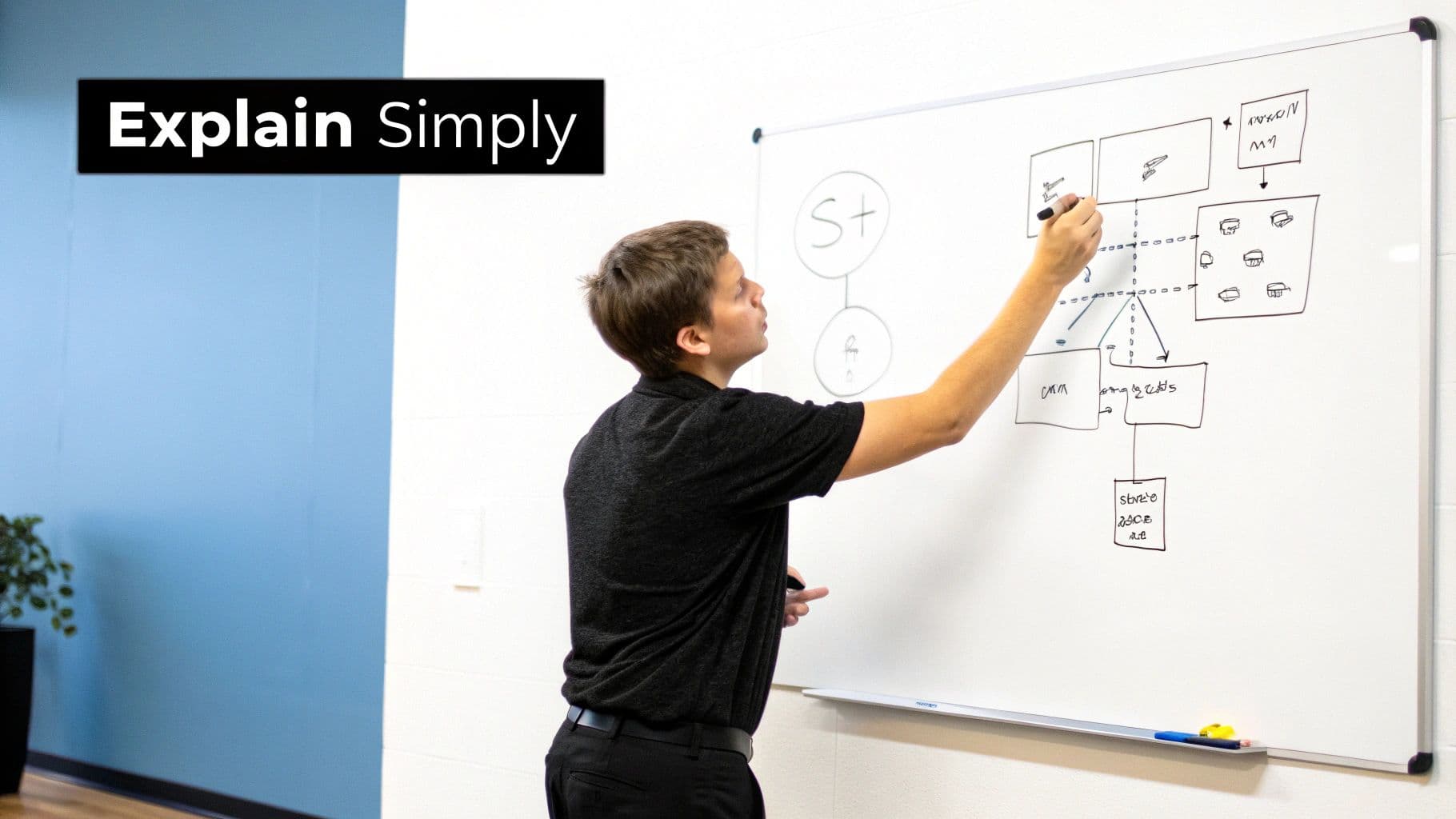
The technique is a four-step process designed to test and deepen your understanding of any topic:
- Choose a concept you want to understand (e.g., a key decision from a project kickoff).
- Explain it in simple terms, as if you were teaching it to a child who has no prior context.
- Identify knowledge gaps whenever you struggle to simplify or have to resort to jargon.
- Review and refine your explanation by going back to the source material to fill those gaps.
This process is one of the most effective knowledge retention strategies because it transforms passive listening into active processing. Instead of just hearing a decision, you are forced to internalize its logic, making the memory far more durable.
How to Implement The Feynman Technique
This method is perfect for ensuring that complex decisions, technical specifications, or strategic shifts are understood by everyone, regardless of their role or expertise. It acts as a powerful jargon-buster and promotes genuine team alignment.
An engineering team, for instance, can use this to explain a critical architecture decision to non-technical stakeholders in marketing or sales. Instead of presenting a dense technical document, they would distill the "why" into a simple narrative:
- Step 1: Choose the concept: "We are migrating from a monolithic to a microservices architecture."
- Step 2 (Teach): "Instead of having one giant, interconnected application, we are breaking it into smaller, independent services. Think of it like swapping a single multi-tool for a dedicated toolbox with a separate hammer, screwdriver, and wrench."
- Step 3 (Identify Gaps): The team realizes they can't simply explain why this is better. They need to revisit the business impact.
- Step 4 (Refine): "This lets us update one part (like the 'hammer') without affecting the others, so we can release new features faster and fix bugs without risking a total system shutdown."
This simplified explanation solidifies the engineers' own understanding while ensuring stakeholders grasp the business value. These insights are a crucial part of broader knowledge management efforts. You can learn more about key strategies and benefits on summarizemeeting.com.
Actionable Tips for Teams
- Add a "Simple Explainer" Section: In your meeting summaries, include a dedicated section where the primary decision-maker explains the key outcome in 2-3 simple sentences. This forces clarity at the source.
- Record Simplified Explanations: After a technical meeting or a complex strategy session, have the project lead record a 60-second video explaining the outcome as if they were talking to a new hire. Attach this to the meeting notes for easy consumption.
- Use it for Cross-Functional Debriefs: When teams with different expertise meet (e.g., engineering and marketing), ask each representative to explain their key takeaways to the other group. This immediately surfaces misunderstandings and misaligned terminology.
- Practice with Onboarding: Use the Feynman Technique to create training materials. Ask your subject matter experts to write documentation as if they were explaining it to a complete beginner, ensuring new team members can get up to speed quickly.
4. Elaborative Interrogation
This technique moves beyond simply memorizing facts and pushes for a deeper level of understanding. Elaborative interrogation involves asking "why" and "how" questions about new information to create meaningful connections with existing knowledge. By exploring the underlying reasons and mechanisms, you force your brain to process the information more deeply, encoding it into long-term memory.
- Elaboration: The process of adding more information to existing memories.
- Interrogation: The act of asking probing questions to uncover details and context.
Together, these principles transform passive information intake into an active, analytical process. Instead of just knowing what decision was made in a meeting, the team understands why it was made and how it will be implemented. This context is crucial for making future decisions and is one of the most powerful knowledge retention strategies for complex topics.
How to Implement Elaborative Interrogation
This method is highly effective for post-mortem reviews, strategic planning sessions, and any meeting where the rationale behind decisions is as important as the decisions themselves. It ensures that the team's collective wisdom and strategic thinking are captured and retained, not just the final action items.
For a product team discussing a new roadmap, instead of just noting that "Feature X was prioritized," they would use elaborative interrogation to document the full context:
- Question 1: "Why was Feature X prioritized over Feature Y?" (Answer might involve customer data, competitive analysis, or resource constraints.)
- Question 2: "How will this feature impact our user retention goals?" (Answer connects the decision to broader company objectives.)
- Question 3: "Why did we choose this specific technical approach?" (Answer captures critical engineering trade-offs.)
This deeper questioning creates a rich, interconnected understanding that prevents knowledge gaps and ensures alignment long after the meeting ends.
Actionable Tips for Teams
- Generate "Why" Sections in Summaries: Configure your AI meeting assistant to specifically create a "Rationale & Context" section in every summary. This section should answer key "why" questions raised during the discussion.
- Prepare Probing Questions: After a critical meeting, task the team lead or project manager with preparing 3-5 elaborative questions. These can be shared in a follow-up email or Slack channel for the team to answer asynchronously.
- Document Answers for Posterity: Store the answers to these "why" and "how" questions in a central knowledge base (like Confluence or Notion). This creates an invaluable resource for onboarding new team members and referencing historical decisions.
- Train Meeting Facilitators: Coach facilitators to pause during discussions and ask elaborative questions like, "Can you explain why that's the best approach?" or "How does that align with our quarterly goals?" This builds the habit of deep thinking directly into your meeting culture.
5. The Method of Loci (Memory Palace)
This ancient mnemonic strategy transforms information into a memorable journey. It works by associating pieces of data with specific locations along a familiar, imagined physical route. By mentally "walking" this path, you can retrieve complex information, lists, or sequences with remarkable accuracy. This technique leverages your brain’s powerful spatial memory to anchor abstract facts in a concrete, visual context.
The Method of Loci, or Memory Palace, isn't just for memory champions; it's one of the most powerful knowledge retention strategies for professionals who need to recall structured information without constantly referring to notes. By placing concepts, action items, or client details into distinct rooms or landmarks in your mind, you create strong, durable associations that are easy to revisit.

How to Implement the Method of Loci
This method is perfect for remembering the flow of a presentation, key takeaways from a complex meeting, or a multi-step project plan. It allows you to organize and recall information in a specific order, which is crucial for delivering structured arguments or following a strategic agenda.
An executive, for instance, could use their daily commute as a memory palace to retain the four key pillars of a new quarterly strategy discussed in a planning session:
- Pillar 1 (Increase Market Share): Mentally "place" this concept at their front door.
- Pillar 2 (Improve Customer Retention): Visualize it at the first major intersection they cross.
- Pillar 3 (Launch New Product Line): Associate it with the coffee shop they pass.
- Pillar 4 (Enhance Team Skills): Link it to the entrance of their office building.
By mentally traveling this route, the executive can effortlessly recall each strategic pillar in the correct order during subsequent discussions, without fumbling for notes.
Actionable Tips for Teams
- Choose a Highly Familiar Location: The best memory palaces are places you know intimately, like your home, office layout, or a familiar walking path. The more detailed your mental map, the better.
- Create Vivid, Absurd Associations: To make memories stick, the mental images should be exaggerated, unusual, or even comical. Imagine a client's key pain point (e.g., slow software) as a giant snail blocking the hallway in your mental office.
- Use Meeting Summaries as a Blueprint: An AI-generated summary provides a structured list of key decisions, action items, or topics. Use this list as the "source material" to populate your memory palace after a meeting.
- Practice Your Mental Walk-Through: Regularly "walk" through your memory palace to strengthen the neural pathways. A quick mental review before a follow-up meeting can bring all critical details back to the forefront of your mind.
6. Interleaving
While blocking similar topics together feels intuitive, interleaving deliberately mixes different subjects or skills within a single session. This strategy forces the brain to constantly switch gears, a process that strengthens memory and improves the ability to differentiate between concepts. Instead of mastering one topic in isolation, you learn to recognize which strategy or solution applies to a specific problem.
Interleaving builds mental agility. By constantly loading and reloading different mental models, your brain becomes more flexible and adept at applying knowledge in novel situations. This is one of the more advanced knowledge retention strategies because it moves beyond simple recall and into the realm of true, adaptable understanding. It prevents the "autopilot" mode that often occurs during blocked practice.
How to Implement Interleaving
Interleaving is highly effective for cross-functional teams and strategic reviews where connecting disparate ideas is crucial. It breaks down silos and encourages a more holistic view of the business, ensuring decisions in one area are informed by context from another.
Consider a quarterly business review. Instead of dedicating separate, blocked hours to marketing, then sales, then operations, an interleaved agenda would look different: