So, is it legal to record a conversation in California? Let's get straight to the point: no, not unless you have permission from everyone involved. California is a strict "two-party consent" state, which means hitting 'record' on a private conversation without telling anyone is illegal and comes with some hefty penalties.
Why California Recording Laws Matter for Your Business

If your business interacts with anyone in California—even a single client or remote team member—you absolutely have to get this right. It’s not just about being polite; it’s a legal minefield.
The law behind this is the California Invasion of Privacy Act (CIPA), and its mission is simple: protect people's privacy. The central idea is that you cannot record a confidential conversation unless every single person in that conversation agrees to it.
This rule is a huge deal for businesses today, especially with the rise of tools like Otter.ai or Fireflies.ai that transcribe and summarize meetings. If your team records a sales call with a client in Los Angeles without getting their explicit consent first, you're breaking the law.
And the consequences are serious. Under CIPA (found in Penal Code § 630 and the following sections), violations can trigger statutory damages of up to $5,000 per violation. On top of that, you could even face criminal charges.
Understanding the California Invasion of Privacy Act
At its core, CIPA makes it a crime to eavesdrop on or record any private conversation without everyone's okay. This applies whether you're talking on a cell phone, a landline, or a video call on Zoom.
This creates a real compliance headache for businesses. Think about it: if just one employee in San Diego joins a national sales call, the entire recording falls under California's strict rules. To explore this topic further, you can find a helpful breakdown in our guide on the legality of recording conversations.
To give you a quick snapshot of the key legal points, here's a simple table.
California Recording Law at a Glance
| Legal Requirement | What It Means for Your Team | Governing Law |
|---|---|---|
| All-Party Consent | You must get permission from everyone on the call or in the meeting before you start recording. | CIPA (Penal Code § 632) |
| Confidential Communication | The law applies to conversations where people have a reasonable expectation of privacy. | CIPA (Penal Code § 632) |
| Significant Penalties | Violations can lead to civil lawsuits (up to $5,000 per violation) and potential criminal prosecution. | CIPA (Penal Code § 637.2) |
This table helps boil it down, but the takeaway is clear: when in doubt, always get consent.
The actual text from California Penal Code § 632 is very direct. It explicitly prohibits using any electronic device to record a confidential chat without the consent of all parties. The state simply doesn't mess around when it comes to privacy.
Decoding California's Two-Party Consent Law
To get to the heart of whether it's legal to record a conversation in California, you have to understand the law that governs it all: the California Invasion of Privacy Act (CIPA). The entire framework, especially Penal Code § 632, hinges on a single, powerful idea: the "confidential communication."
What does that actually mean? Think of it this way: a conversation is considered confidential if the situation suggests that at least one person believes it's private. A one-on-one performance review in a closed office? Definitely confidential. A team brainstorming session at a busy coffee shop where anyone could listen in? Not so much.
The law protects conversations where there's a reasonable expectation of privacy. This isn't just a fuzzy concept; it's the legal yardstick. If the people talking believe their discussion is just between them and not for a wider audience, recording it without getting everyone's permission is against the law.
All-Party vs. One-Party Consent
One of the biggest points of confusion, especially for teams spread across the country, is the difference between "all-party" and "one-party" consent laws. Getting this right is non-negotiable for staying compliant.
- One-Party Consent: In states like New York or Texas, things are simpler. As long as one person in the conversation knows it's being recorded (and that person can be you), you're in the clear. You can legally record a call you're on without telling anyone else.
- All-Party Consent: California is an "all-party" consent state. This means every single person in a confidential conversation has to agree to be recorded. You'll often hear this called "two-party consent," but that's just shorthand. If there are five people on a call, all five need to give their consent.
For any business with remote or national teams, this creates a simple, hard-and-fast rule: if even one person on the call is in California, you must follow California's all-party consent law. It’s the only way to operate safely.
What Legally Counts as a "Confidential Communication"?
So, how does the law decide if a conversation is officially "confidential"? CIPA looks beyond just the location and considers the entire context.
This means a manager can't just secretly record a tough conversation with an employee, even if they're using a company phone. That employee has a reasonable expectation that their private discussion isn't being captured without their knowledge. It’s a critical detail that trips up a lot of businesses.
The stakes are getting higher, too. California's 2026 privacy deadlines amplify CIPA recording risks. With the stall of SB 690, businesses remain exposed to two-party consent lawsuits until at least January 1, 2027. Hundreds of claims filed since 2023 have targeted AI-powered tools, applying the steep $5,000 per-incident damages from the original 1967 law to today's web technology.
For leaders comparing AI summarization apps like Notta versus Fireflies, the pressure is on. New breach laws now require notifications within 30 days and broaden the definition of 'personal info' to include biometrics. You can find more details on how the 2026 data breach law updates impact California businesses.
Real-World Examples of Confidential Conversations
Let's bring this out of legal theory and into the real world. Here are a few everyday business scenarios where California's all-party consent rule applies:
- A sales call with a potential customer based in San Francisco.
- An internal HR investigation with an employee working from Los Angeles.
- A remote team meeting on Zoom where one person dials in from their home in San Diego.
- A customer support call with a user troubleshooting an issue from Sacramento.
In each of these cases, getting consent from everyone before you hit "record" isn't just good manners—it's a legal requirement. Skipping this step can expose your company to serious legal and financial trouble, which we'll dive into next.
The Real Cost of Breaking Recording Laws

It’s one thing to know the law, but it’s another thing entirely to appreciate the real-world consequences of ignoring it. Sidestepping California's recording laws isn't a minor foul. It's a serious gamble with your company's bank account and its reputation. The penalties are harsh for a reason and fall into two buckets: civil lawsuits and criminal charges.
For most businesses, the civil side is where the immediate danger lies. The California Invasion of Privacy Act (CIPA) gives any person who was illegally recorded the right to sue. And we're not talking about a small slap on the wrist.
Think about that for a second. Every single illegally recorded conversation is a potential $5,000 lawsuit waiting to happen. The numbers can get out of hand, fast.
How Civil Penalties Can Snowball
Let's walk through a common scenario. Imagine your sales team uses an AI tool to record and transcribe all client calls for training. The team lead is busy and never turns on the consent notifications, not realizing the implications for California-based clients.
In just one month, the team has 30 calls with different prospects in California. If just one of those prospects finds out they were recorded without permission and decides to sue, the liability clock starts ticking.
- One Illegal Recording: A single call could trigger a $5,000 lawsuit.
- Ten Illegal Recordings: If ten different clients were involved, you're suddenly looking at $50,000.
- Thirty Illegal Recordings: For that one month alone, the company's potential liability could hit $150,000.
This simple example shows how a minor operational oversight can mushroom into a massive financial problem. It's why understanding is recording a conversation legal in California isn't just a legal curiosity—it's a core business risk.
The Criminal Consequences of Illegal Recording
On top of the financial threat, CIPA has criminal teeth. A violation of the eavesdropping statute (PC 632) is what's known as a "wobbler." This gives prosecutors the power to charge it as either a misdemeanor or a felony, depending on the specifics of the case.
For a Misdemeanor Conviction:
- Up to one year in county jail
- A fine of up to $2,500
For a Felony Conviction:
- Up to three years in state prison
- A fine of up to $2,500
While a felony charge is less likely for a first-time business mistake, it's not impossible, especially if the recording was done maliciously. And if you have a prior conviction for a similar offense, the fine can jump to $10,000.
But the damage goes beyond court fees and potential jail time. A criminal charge can permanently stain a company's reputation, shattering the trust you've built with customers and partners. The takeaway is simple: the price of ignoring the law is far higher than the effort it takes to get consent.
How California's Old-School Wiretapping Law Governs Your AI Meeting Bot
It’s easy to think of the California Invasion of Privacy Act (CIPA) as a relic. Written back in the 1960s, it was designed for a world of landlines and clunky tape recorders. So how on earth does it apply to the slick AI meeting assistants your team uses every day, like Fireflies.ai or Otter.ai?
The answer is surprisingly simple: the core principle is exactly the same, even if the tech has changed completely.
These AI tools are built to transcribe, summarize, and analyze conversations, creating an incredibly detailed record of what was said. While fantastic for productivity, they are, in the eyes of the law, an "electronic recording device." When your AI assistant pops into a Zoom call to take notes, it's legally no different than someone secretly hitting the record button on a cassette player.
This is why CIPA is suddenly a huge deal for modern businesses. Using an AI bot to capture a conversation with a California resident without getting a clear "yes" from everyone involved isn't some clever tech loophole—it’s a direct violation of the law.
The "Eavesdropping" Net Just Got a Lot Wider
Lately, we've seen courts stretch CIPA's definition far beyond just recording phone calls, and this is where things get tricky for businesses. This old-school wiretapping law is now being used to challenge modern website tools. Think about the chatbots, session replay software, and analytics pixels on your site—courts are starting to view them as forms of illegal "eavesdropping" if they capture user interactions without explicit consent.
This trend is causing major headaches. The recent explosion in CIPA lawsuits over website tracking tools is a red flag for any company that records customer interactions. We're talking hundreds of cases filed since 2023, with plaintiffs demanding $5,000 per violation for things as common as pixels and search bars that "intercept" communications. The argument is that sharing user data with a third-party service like Google Analytics is a privacy violation, and several courts have allowed these claims to move forward.
The risk is no longer just about a simple audio recording. It now covers any technology that captures and analyzes conversational data in a way people wouldn't reasonably expect.
The "One Californian" Rule Your Remote Team Can't Ignore
For remote and global teams, this brings us to a simple but crucial compliance rule: it doesn't matter where your business is headquartered or where most of your team sits.
If even one person on a call is physically in California, the entire meeting falls under CIPA's all-party consent rule. Period.
This "one-Californian rule" is a non-negotiable standard for any distributed company. You have to default to the strictest privacy standard in the room.
- Sales Teams: That product demo with a prospect in San Francisco? You need consent from everyone.
- Customer Support: A troubleshooting call with a customer in Los Angeles? CIPA rules apply.
- Internal Meetings: A quick team sync with your developer who works from their home in San Diego? Yep, that falls under the law, too.
There’s no gray area here. The moment a Californian joins, they legally "pull" the entire conversation into CIPA's jurisdiction. This makes ensuring your AI meeting tools are secure and compliant not just a good idea, but a legal must-have for any team that works with people in the Golden State.
What IT and Ops Managers Need to Do Right Now
If you're an IT or operations leader rolling out these AI tools, you can't just hand over the software and hope for the best. The legal risks demand a proactive, structured approach.
First, dig into the settings of your AI tool and turn on every single consent feature available. Most platforms like Fireflies and Otter have automated bots that can join meetings and announce themselves, which serves as an explicit notification that the call is being recorded and transcribed. Enable them.
But technology alone isn't enough. You have to follow it up with clear, consistent training. Every single employee using a recording tool needs to understand that getting consent isn't just polite—it's a mandatory step in their workflow any time a Californian is on the line.
A Practical Guide to Compliant Call Recording
Knowing the law is one thing, but putting it into practice day-to-day is a whole different ballgame. For any manager or team lead, understanding that California is an all-party consent state is just the first step. The real work is creating a simple, repeatable process that makes sure every single recorded call is compliant. This isn't just about avoiding lawsuits—it's about building trust with your customers and your own team.
The trick is to make compliance second nature, not a last-minute scramble. You don't need a law degree; you just need a clear set of rules that everyone can follow without even thinking about it.
Getting Clear Verbal Consent
The most straightforward way to stay on the right side of the law is to ask for permission right at the start of the conversation. Getting a clear "yes" on the recording itself removes any doubt.
You don't need to sound like a lawyer reading a script. A simple, natural-sounding announcement works best. Here are a few examples you can adapt for your team:
- For AI Note-Takers: "Just a heads-up, we're using an AI assistant to take notes on this call. Is everyone comfortable with that?"
- For Internal Training: "Before we dive in, I want to let everyone know I'm recording this session for our training library. Hope that's okay with everyone."
- For Client Calls: "To make sure I don't miss any important details, would it be alright if I recorded our call today? Do I have your permission?"
A quick "yes" or even just an audible agreement from everyone is all you need. The key is to ask upfront and get that confirmation before you get into the meat of the conversation. For businesses that rely heavily on call data, implementing call recording solutions with built-in compliance features can make this process seamless.
Let Your Tools Do the Heavy Lifting
Most modern meeting platforms have built-in features to help with this—so use them! Tools like Zoom, Otter.ai, and Fireflies can all be set up to automatically announce that the meeting is being recorded.
This is crucial because, as the image below shows, a law written back in the 1960s is now being used to sue companies over how their modern AI tools work.
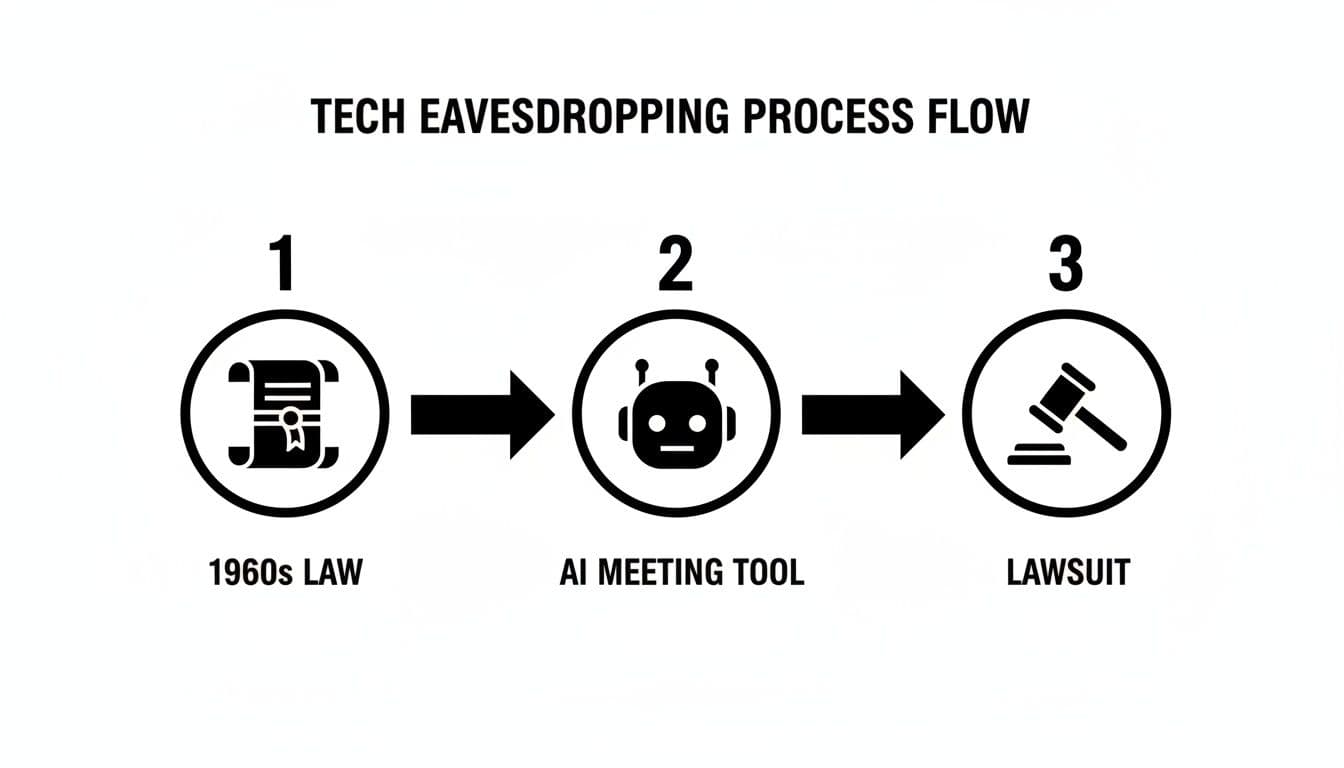
That flowchart makes it pretty clear: there's a direct line from CIPA's old-school wiretapping rules to the legal headaches tech companies face today. It's not a risk you want to take.