So, what exactly is Revenue Intelligence?
Think of it as a system that collects and makes sense of all the data your sales and revenue teams create every single day. It then uses technology—often powered by AI—to automatically surface insights about your team's performance, what's working, and where the biggest opportunities are hiding.
It’s about moving away from gut feelings and hunches and instead making critical decisions based on real, hard data.
Your Revenue Engine's GPS
Imagine you're on a long road trip using only a paper map. You can see the main roads, but you have no clue about traffic jams, detours, or that faster shortcut everyone else is taking. That’s what it's like for many sales teams who rely solely on their CRM data—it's a static, often outdated picture.
Revenue Intelligence is the GPS for your entire revenue operation. It doesn't just hand you a map; it pulls in live, real-time information from every source imaginable to give you a complete, dynamic view of the road ahead.
This isn't just another buzzword; it's a fundamental shift in how modern revenue teams operate.
No More Flying Blind
For years, sales leaders had to rely on whatever data reps manually punched into the CRM. We all know how well that works. This old-school method is riddled with problems:
- Spotty Data: Reps are focused on selling, not data entry. As a result, CRM data is often incomplete or updated days later, giving you a foggy view of your pipeline's health.
- Guesswork and Hope: Forecasts often become a blend of wishful thinking and overly optimistic projections. The real context from customer calls and emails gets lost in the shuffle.
- Playing Catch-Up: By the time a problem shows up in a weekly report, the damage is often done. You're left reacting instead of getting ahead of the issue.
Revenue Intelligence flips the script by automatically capturing activity data straight from the source. Every email, every meeting, every phone call is logged and analyzed, giving you an unbiased, 360-degree view of every single deal.
For a deeper look into how this all comes together, check out this comprehensive guide on Revenue Intelligence.
This automation brings a level of clarity that was impossible before. Managers can instantly see which deals are actually moving forward and which have stalled. They can pinpoint the exact habits of their top reps and use those insights to coach the rest of the team more effectively.
Ultimately, revenue intelligence is the system that replaces ambiguity with certainty, giving everyone on your team the confidence and insights they need to crush their goals.
How the Revenue Intelligence Engine Works
So, how does all this actually work? Let's pop the hood and see what makes a revenue intelligence system tick. It’s not some black-box magic; it’s a methodical, three-step process that transforms messy, scattered data into a clear roadmap for hitting your targets.
Think of it as an engine with three core parts all working in sync. The goal is to take all the manual, error-prone tasks that slow sales teams down and automate them, turning chaotic activity into a predictable system for growth.
This flow is pretty simple but incredibly powerful. It all comes down to collecting the raw data, making sense of it, and then using those insights to guide your team's next move.
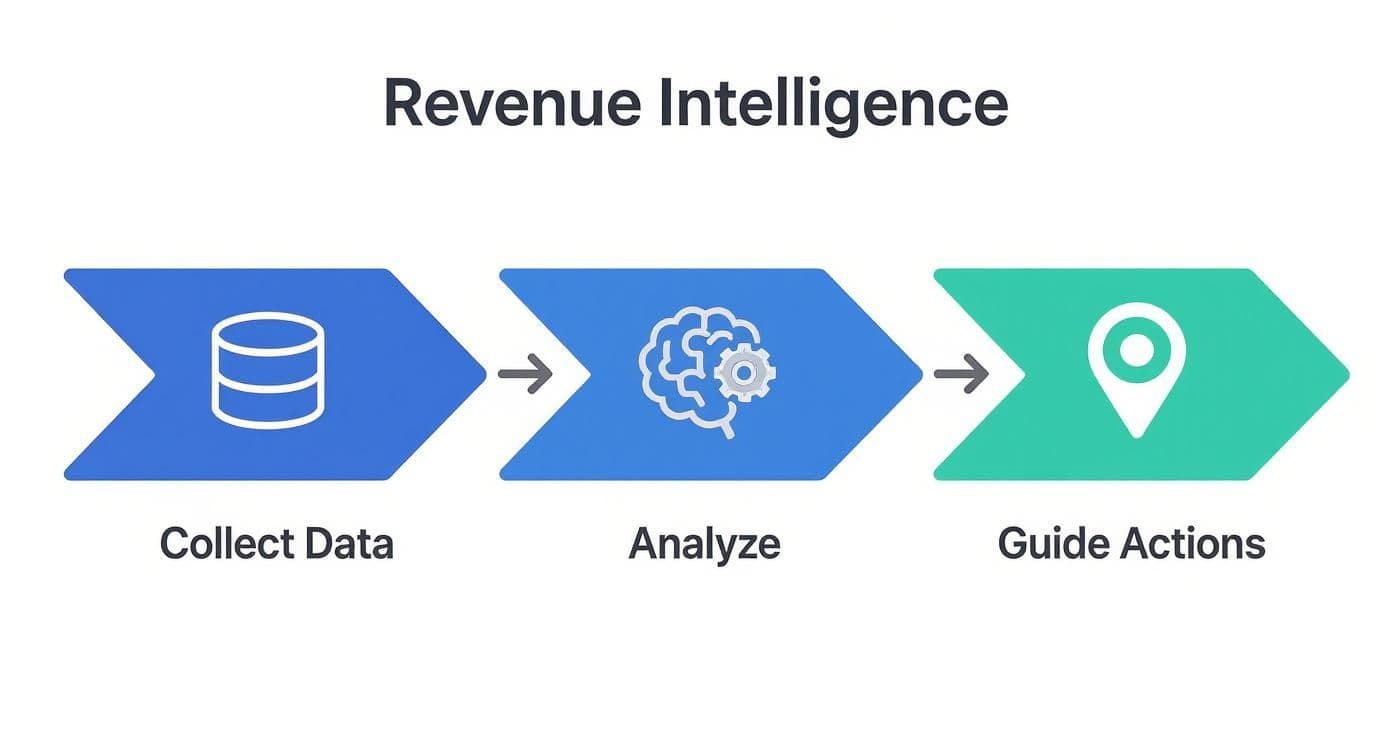
As you can see, it’s a continuous loop. The process moves from gathering broad information to delivering specific, actionable advice, which then fuels the next round of improvements.
Stage 1: Data Aggregation
First things first, you need a single source of truth. A revenue intelligence platform starts by connecting to all the different places your team interacts with customers. It hoovers up data from every source automatically, making sure nothing gets lost or forgotten.
This automated capture is a huge time-saver. It frees reps from the drudgery of manual data entry, which can eat up a staggering 20% of their time.
Where does it pull from?
- CRM Systems: It syncs directly with your CRM, adding rich context to your existing contact and deal records.
- Email & Calendar: Every single email, meeting invite, and calendar event is automatically logged against the right account.
- Communication Tools: It taps into calls made on platforms like Zoom or other VoIP systems, capturing the conversation itself.
This process builds a complete, unbiased timeline of every single customer touchpoint. It’s the foundation for everything else, replacing spotty CRM notes with a full history of what actually happened.
Stage 2: Conversation and Activity Analysis
With all the data in one place, the real intelligence work begins. This is where AI and machine learning step in to analyze every interaction, especially the unstructured goldmine of conversations.
It’s about going way beyond just counting calls and emails. The AI actually listens to and reads the content of these interactions to find the context that used to be invisible.
For instance, the system can pinpoint things like:
- Key Topics: It flags every mention of a competitor, a budget hold-up, or a specific product feature your prospect is asking about.
- Customer Sentiment: The AI analyzes tone and word choice to figure out if a customer is leaning in or pulling away.
- Rep Performance: It can track practical metrics like talk-to-listen ratios or how often your top reps bring up pricing.
This analysis is what turns messy, qualitative chats into hard, quantifiable data. A sales manager no longer has to guess why a deal is stalling; they can see that the word "budget" came up three times with no clear resolution.
Stage 3: AI-Powered Insights
The final step is where all that analyzed data becomes genuine guidance. This is the moment a revenue intelligence tool goes from being a simple reporting dashboard to a trusted strategic advisor. The platform puts all the pieces together to give you predictive forecasts and real-time coaching.
Instead of just showing you charts of what your team did last quarter, the system actively helps them make smarter decisions right now.
It delivers insights like:
- Real-Time Deal Health Scores: Every deal in your pipeline gets a dynamic score based on the latest activity and conversation sentiment, instantly flagging at-risk opportunities.
- Predictive Forecasting: By looking at all your historical data and current pipeline activity, the AI can generate incredibly accurate sales forecasts.
- Actionable Recommendations: The platform might suggest a specific follow-up for a stalled deal or alert a manager that a high-value opportunity needs their attention.
This kind of smart guidance gives everyone—from reps on the front lines to the CRO—the clarity to focus their energy where it will make the biggest difference.
Revenue Intelligence vs. Business Intelligence and RevOps
You’ve probably heard these terms thrown around in meetings: Revenue Intelligence, Business Intelligence, RevOps. They sound similar, and while they’re all related to growth, they play very different roles. Getting them mixed up is common, but knowing the difference is crucial for building a team that actually hits its numbers.
Let's use an analogy. Think of your revenue engine as a high-performance race car. Each of these disciplines is a key part of your crew, but you wouldn't ask your data analyst to change the tires in a pit stop.
They all need to work together, but they have distinct jobs. Let’s break down who does what.
Business Intelligence: The Rearview Mirror
Business Intelligence (BI) is your company’s historian. It’s all about looking backward to understand what happened across the entire business—finance, operations, HR, you name it. BI answers the big question: "What happened?"
BI tools are fantastic for creating dashboards that summarize past performance. For instance, a BI report can tell you things like:
- What was our total revenue last quarter?
- Which product was our bestseller last year?
- What was our customer churn rate over the past 24 months?
It gives you that 10,000-foot view of the company's health based on historical data. It’s descriptive, not predictive. Think of it as your company's report card; it shows you the grade you got, but it doesn't tell you how to ace the next exam.
Revenue Intelligence: The Forward-Looking GPS
If BI is the rearview mirror, Revenue Intelligence (RI) is your forward-looking GPS, specifically for your revenue teams. It’s hyper-focused on the sales process and customer interactions to answer the question, “What’s going to happen, and what should we do about it right now?”
This is where things get prescriptive. Revenue intelligence dives into real-time activity from calls, emails, and meetings to give your team actionable advice. A huge piece of this puzzle is what is conversation intelligence, which analyzes what’s actually being said in customer conversations to spot deal risks and hidden opportunities.
This focused approach helps sales leaders stop reacting to last quarter's numbers and start proactively managing their pipeline with a whole new level of precision.
RevOps: The Flight Plan and Crew Chief
So, what about RevOps? Revenue Operations (RevOps) is the operational engine that gets your sales, marketing, and customer success teams working as one cohesive unit. If RI is the GPS, RevOps is the crew chief who designs the race strategy, tunes the car, and makes sure the pit crew is perfectly coordinated.
RevOps is all about process, technology, and people. They’re the ones who define the sales process, manage the tech stack (including the BI and RI tools), and make sure the whole revenue machine runs smoothly and can scale without breaking.
Simply put, RevOps builds the high-performance system. Revenue Intelligence provides the real-time data and insights that allow your team to execute that system flawlessly and close more deals.
To make it even clearer, let's break down how these three disciplines compare side-by-side.
Comparing Key Business Disciplines
| Discipline | Primary Focus | Key Question Answered | Primary Users |
|---|---|---|---|
| Business Intelligence | Historical, company-wide performance | "What happened in the past?" | C-Suite, Finance, Operations |
| Revenue Intelligence | Real-time and future go-to-market performance | "What will happen and what should we do next?" | Sales, Marketing, Customer Success |
| Revenue Operations | Aligning systems, processes, and people | "How can we make our revenue process more efficient and scalable?" | GTM Leadership, Ops Teams |
Each one provides a different lens for viewing the business. While BI gives executives a wide-angle view of the past, RI gives go-to-market teams the focused, forward-looking insights they need to hit their targets. And RevOps is the operational glue holding it all together, ensuring the strategy can actually be executed day in and day out.
What This Actually Means for Your Revenue Teams
Enough with the theory. What does revenue intelligence actually do for you and your team? This isn't just about another dashboard to stare at; it’s about getting real, measurable results that hit the bottom line. It turns a messy pile of data into a clear roadmap for winning more deals, closing bigger contracts, and finally making growth predictable.
Let’s get into the practical, day-to-day wins your teams will see. It all starts by fixing one of the oldest and most frustrating problems in sales: forecasting that feels like a shot in the dark.

Finally Get Sales Forecasts You Can Trust
Let’s be honest, traditional forecasting is often a blend of guesswork, hope, and a rep’s gut feeling. Sales leaders are forced to rely on subjective opinions and CRM data that’s spotty at best, which leads to projections that consistently miss the mark. That inaccuracy sends ripples through the entire company, from missed targets to misallocated resources.
Revenue intelligence throws that old model out the window. It replaces hunches with hard data. By analyzing what’s actually happening in every customer interaction—every call, email, and meeting—the system builds a forecast based on reality, not just optimism. It knows which deals are truly moving forward and which have gone completely cold.
This shift means leaders can finally call their number with real confidence. The data backs this up, with market research showing that organizations using this tech see a 41% improvement in forecast accuracy and a 23% reduction in sales cycle length.
Turn Every Manager into a Top-Tier Sales Coach
Ever wish you could just clone your top performers? Revenue intelligence essentially gives you the blueprint to do it. By dissecting the calls and meetings of your best reps, it uncovers the exact words, questions, and tactics that win deals. Think about the specific value props they highlight or how they elegantly handle tough objections.
This creates a "game film" library that managers can use for laser-focused coaching. No more generic advice like, "You need to be more consultative." A manager can now say, "I noticed you didn't mention our integration features. Our top reps bring that up in 75% of discovery calls with this exact type of customer." That kind of data-backed coaching is specific, actionable, and incredibly effective.
- Spot Skill Gaps: See exactly where individual reps are struggling in their sales conversations.
- Share Winning Plays: Easily clip and share snippets of best-in-class calls for the whole team to learn from.
- Measure Real Improvement: Track whether reps are actually adopting the new behaviors and if it's impacting their results.
Give Your Reps More Time to Actually Sell
One of the first things you’ll notice is the time everyone gets back. Reps spend way too much of their day on mind-numbing admin work—logging calls, updating CRM fields, and typing up meeting summaries. It's a productivity killer.
Revenue intelligence platforms put all of that on autopilot. Every customer interaction is automatically captured, transcribed, and synced to the right opportunity in the CRM without the rep having to do a thing. This frees them up to do what they were hired for: building relationships and closing business. As a bonus, your CRM data becomes complete and reliable, which benefits everyone. When you're ready to see what's possible with that data, our guide to https://summarizemeeting.com/feature/sales-analytics is a great place to start.
Get Deals Unstuck and Shorten Your Sales Cycle
Every sales pipeline has those deals that just… stall. They go dark for no apparent reason, and by the time you notice, it's often too late. Revenue intelligence works like an early-warning system, flagging at-risk opportunities before they fall through the cracks.
It does this by keeping a close eye on engagement. Has a key decision-maker gone silent on an email thread? Has a deal gone more than a week without a meaningful interaction? The system will alert the rep and manager. This visibility allows your team to jump in, re-engage the customer, and get the deal back on track. For a closer look at the metrics involved, this 2026 Guide: Sales, Marketing Performance Metrics, KPIs, Dashboards & AI Insights is a fantastic resource.
A Practical Roadmap to Implementation
Jumping into revenue intelligence feels like a big commitment, but with a solid plan, it can be a surprisingly smooth—and massively rewarding—process. Think of it less like a chaotic launch and more like a structured upgrade to your entire revenue engine. This isn't just about plugging in new software; it's about fundamentally changing how your sales and marketing teams operate for the better.
The whole journey starts with one simple question: "What problem are we actually trying to solve?" If you don't have a clear answer, even the most powerful technology will just gather digital dust. Before you even think about looking at a demo, you have to get specific about your business goals.
Are you dealing with forecasts that are all over the map? Is your sales cycle dragging on forever? Maybe your reps aren't getting the coaching they need to perform at their best. Nailing down your most pressing challenge will be your north star, guiding every decision you make from here on out.