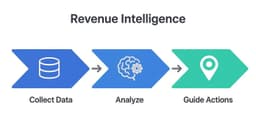
Imagine having a smart co-pilot sitting next to your sales team, listening in on every call, reading every email, and attending every meeting. That’s the essence of a revenue intelligence platform. It’s designed to automatically uncover the real story behind why you win or lose deals by analyzing the conversations you're having with customers.
This is a huge step up from the old days of manual data entry. Instead of just seeing what's been logged in a CRM, you get an unbiased, real-time look at your entire pipeline based on actual interactions.
What Exactly Is a Revenue Intelligence Platform?
Think of all your sales conversations—calls, emails, video meetings—as a massive, unorganized pile of notes. Your CRM might tell you who you talked to and when, but it doesn't capture the substance of those conversations. The most valuable insights are buried in that messy pile, completely untapped.
A revenue intelligence platform is like having a genius analyst who can sift through that entire pile in seconds. It automatically records, transcribes, and analyzes every interaction, turning unstructured conversations into clean, actionable data.
Instead of relying on a rep's memory or gut feeling about how a call went, you get the hard facts. The platform connects what was said in a demo last week to how the deal is progressing in your pipeline today. It brings the full context of your customer relationships into sharp focus. For a more detailed breakdown, you can check out our guide on what is revenue intelligence.
From Guesswork to Growth
For years, sales management has been a mix of art and science, with a heavy dose of guesswork. Pipeline reviews were often based on subjective opinions and incomplete CRM data. A revenue intelligence platform changes that entirely by replacing ambiguity with objective reality. It shows you which deals are healthy based on real buyer engagement, not just what a rep entered into a field.
This shift from guesswork to data-driven decision-making is why the market is exploding. Projections show the revenue intelligence space growing from USD 2.1 billion to USD 10.8 billion by 2032. It's not just hype; 87% of high-growth companies are already using this technology to get ahead, creating a major advantage over competitors who are still stuck in the old way of doing things.
Let's look at the practical shift that happens when a team adopts revenue intelligence.
From Guesswork to Growth
A quick look at the common sales challenges solved by a revenue intelligence platform.
| Problem Without Revenue Intelligence | Solution With Revenue Intelligence |
|---|---|
| Inaccurate sales forecasts based on "happy ears." | Data-backed forecasts based on real buyer engagement and sentiment. |
| Top performer "magic" is a mystery. | Pinpoint what your best reps do differently and scale it across the team. |
| Deals stall for unknown reasons. | Identify at-risk deals early by flagging competitor mentions or low engagement. |
| Sales coaching is generic and inconsistent. | Provide targeted, personalized coaching based on actual call recordings. |
| CRM data is incomplete or unreliable. | Automatically capture and sync all activity data, ensuring a single source of truth. |
| Reps spend hours on manual data entry. | Free up sellers' time to focus on what they do best: selling. |
This table really just scratches the surface. The core idea is moving from reactive problem-solving to proactive, data-informed strategy.
How It All Works
So, what's the engine driving all of this? At its heart, a revenue intelligence platform runs on sophisticated AI. It analyzes massive volumes of interaction data to find patterns and signals that humans would miss. To really get a handle on what these systems are capable of, it helps to have a basic understanding of Intelligent Automation, which is the foundation for how these insights are generated and delivered.
This technology finally allows revenue teams to answer their most critical questions with confidence:
- Are buyers actually engaging with our new messaging?
- What are the key differences in how our top reps handle objections?
- Is that big deal we're counting on really on track to close this quarter?
By connecting the dots between sales activities and business outcomes, these platforms provide the clarity every company needs to build a predictable, scalable revenue machine.
The Core Features That Power Growth
A revenue intelligence platform isn't just one tool; it's more like a powerful suite of capabilities working together. Think of it as a high-performance engine with four critical components firing in unison to push your business forward. Each feature shines a light on a different blind spot in the typical sales process, swapping out guesswork for data-backed clarity.
Getting a handle on these core pillars is the key to understanding how these platforms turn a messy pile of sales activities into predictable, repeatable revenue. They work together to capture, analyze, and surface insights that would otherwise stay buried in disconnected systems like your CRM, email, and call logs. This is all about creating a single, intelligent view of what's really happening.

As you can see, a revenue intelligence platform essentially acts as a central brain. It processes information from all these different sources to build a unified picture of your entire revenue operation.
Let's break down the core features and see what they actually do for your team.
Feature Breakdown of Revenue Intelligence Platforms
Here’s a detailed look at the key features and the specific value each one delivers to sales teams.
| Core Capability | What It Does | Primary Benefit |
|---|---|---|
| Conversation Intelligence | Automatically records, transcribes, and analyzes every customer call and email. | Uncovers what top reps do differently and provides specific, data-driven coaching moments for the entire team. |
| Pipeline Analytics | Analyzes engagement and deal progression to assess the true health of your pipeline. | Identifies at-risk deals before they slip through the cracks, ensuring no opportunity is left behind. |
| AI-Powered Forecasting | Uses historical data and real-time deal activity to generate accurate revenue predictions. | Replaces gut-feel forecasting with reliable, data-driven projections that leadership can actually trust. |
| Buyer Engagement Signals | Tracks customer interactions (email opens, replies, meeting attendance) to score interest levels. | Provides an early warning system for deals that are going cold, allowing reps to re-engage at the perfect time. |
Each of these capabilities solves a distinct problem, but their real power comes from how they work together to give you a complete and honest view of your sales reality.
Unlocking Insights with Conversation Intelligence
At the very heart of any revenue intelligence platform is conversation intelligence. This is the engine that automatically records, transcribes, and analyzes every single customer interaction—from Zoom calls to emails. It’s like having a dedicated analyst listening in on every sales call, catching every crucial detail you might have missed.
Instead of relying on a rep's fuzzy memory or scribbled notes, the system captures what was actually said. It can automatically flag key moments, such as:
- Competitor Mentions: Get an instant heads-up when a prospect brings up a competitor. This allows managers to jump in with timely coaching on how to navigate that specific landmine.
- Buying Signals: The AI spots phrases like "What are the next steps?" or "When can we get started?" that signal strong purchase intent.
- Objections: It pinpoints the most common objections your team faces, giving you the raw material to refine your sales playbook and training.
This is so fundamental that sales teams are now the biggest adopters of this technology, using it to dissect what works and find hidden opportunities. Industry players like Outreach and People.ai are pushing the envelope here, especially with tools that integrate seamlessly with CRMs like Salesforce and HubSpot. For a deeper dive, you can explore the latest revenue intelligence platform trends.
Gaining Control with Pipeline Analytics
Your CRM might show you a static list of deals, but a revenue intelligence platform gives you a dynamic, living view of your pipeline. This is pipeline analytics and management in action. It goes way beyond just looking at deal stages to assess the genuine health of every single opportunity.
The platform analyzes both the quality and quantity of interactions for a deal. So, if a high-value opportunity hasn't had any real contact in two weeks, the system flags it as at-risk—even if the rep keeps pushing the close date out.
Predicting the Future with AI Forecasting
Let's be honest, traditional sales forecasting is often a messy mix of hope, gut feelings, and last-minute scrambling. AI-powered forecasting throws that old model out the window and replaces it with mathematical precision. The platform crunches historical win rates, current deal engagement, and even individual rep behaviors to generate revenue predictions you can actually count on.
It sifts through thousands of data points to answer the one question every sales leader obsesses over: "Are we going to hit our number?" This isn't just a simple roll-up of what reps have committed. The AI weighs factors like:
- Did the executive buyer actually show up to the last call?
- Is the prospect replying to emails in minutes or in days?
- Does this deal's timeline and engagement pattern match up with opportunities we've won in the past?
This gives leadership a forecast they can trust, which helps them make much smarter decisions about hiring, spending, and overall business strategy.
Reading the Room with Buyer Engagement Signals
Finally, buyer engagement signals give you a brutally honest look at a prospect's real interest level. A rep might feel like a deal is going great, but the data can tell a very different story. The platform tracks every single touchpoint to create an objective engagement score for each opportunity.
This score isn't based on feelings; it's based on facts. It measures things like email open rates, reply times, and meeting attendance from the buyer's side. If a prospect who was once all-in suddenly goes quiet, the system alerts the rep immediately. This gives the sales team a chance to re-engage before the deal completely goes cold, turning potential losses into saves.
How Is This Different From Your Current Sales Tools?
If you're a sales leader, you might be looking at this and thinking, "My CRM already does this, right?" It’s a great question, and the answer gets to the heart of how top-tier sales teams are evolving. A revenue intelligence platform isn't here to replace your existing tools; it's here to make them dramatically more powerful.
Think of your sales tech stack as a crew of specialists. Each tool has its specific job. Revenue intelligence acts like the strategic leader, taking all their individual inputs and weaving them into a single, cohesive picture. Let's break down where it fits in and why it's a game-changer.
Your CRM Is a Database, Not an Insight Engine
Your Customer Relationship Management (CRM) system is the bedrock of your sales operation. It’s a fantastic system of record, perfectly designed to track the "what" and "who" of your sales pipeline. It tells you which accounts you're working, who the contacts are, and what stage each deal is in.
But a CRM is inherently passive. It only knows what your reps tell it, and it can't read between the lines. It won't tell you why a promising deal suddenly went cold or what was actually discussed on that critical call last Tuesday.
Sales Engagement Platforms Drive Action, Not Analysis
Tools like Salesloft or Outreach are built for execution. They are masters of outreach, helping reps automate email sequences, manage call cadences, and generally run their plays at scale. Their entire focus is on the action of selling.
A revenue intelligence platform, on the other hand, zeroes in on the effectiveness of those actions. While your sales engagement tool helps you send 1,000 emails, revenue intelligence analyzes the responses to tell you which messages are actually hitting the mark and which are being ignored. It connects the dots between effort and outcome.
- Sales Engagement Platform: Helps you do the work (e.g., send more cold emails).
- Revenue Intelligence Platform: Tells you if the work is working (e.g., are those emails actually booking meetings?).
This feedback loop is what allows you to refine your entire strategy, not just crank up the volume on activities.
Conversation Intelligence Is One Piece of the Puzzle
This is probably the most common point of confusion. Many people see the call recording and analysis features in a revenue intelligence platform and think it's just another conversation intelligence tool. They’re related, but their scope is completely different.
Conversation intelligence is laser-focused on analyzing what happens inside calls and meetings. It’s fantastic for coaching reps, improving talk tracks, and spotting keywords. You can get a deeper dive in our guide on what is conversation intelligence.
The problem is, it operates in a vacuum. It can tell you what was said on a call, but it can’t automatically link that conversation to the deal's overall health, its place in your pipeline, or how it might affect your forecast.
A revenue intelligence platform treats conversation intelligence as a vital data source, but not the only one. It combines insights from calls and meetings with data from your CRM, email, and calendar to build a true 360-degree view of every deal. It connects the dots between a specific conversation and that deal's forward momentum.
It’s the difference between analyzing a single play on the field and understanding the strategy for the entire game.
Unlocking Tangible Business Results
Let's be honest: new tech is only worth it if it delivers real-world results. A revenue intelligence platform isn't about adding another flashy dashboard to your stack; it's about making a direct impact on your bottom line. It shines a light on the hidden patterns in your sales process, giving your entire team the insights they need to turn potential into predictable revenue.
The real magic happens when those insights lead to measurable improvements. From forecasts you can finally trust to a sales team that closes deals faster, the benefits ripple across the organization and drive real, sustainable growth.

Achieve Drastically Improved Forecast Accuracy
One of the first things you'll notice is the shift from "best guess" forecasting to data-driven prediction. We've all been there—relying on a rep's gut feeling about a deal, only to face unpleasant surprises at the end of the quarter.
Revenue intelligence swaps that guesswork for objective reality. It looks at what's actually happening—real buyer engagement, deal progression history, and rep activity—to build a forecast grounded in facts, not feelings. Imagine taking your forecast variance from a shaky 20% down to a solid 5%. That's the kind of precision that gives leaders the confidence to invest in hiring, product, and growth.
Accelerate Sales Cycles and Boost Win Rates
Every sales leader's goal is to shorten the path to "closed-won." Revenue intelligence helps you do just that by finding and fixing the hidden friction points in your sales process. By analyzing thousands of interactions, the platform shows you what works and what doesn't.
For instance, you might discover that deals involving a specific technical demo close 30% faster, or that your top reps always bring in an executive sponsor before sending a proposal. Armed with these insights, you can create a winning playbook and scale it across the team. The results?
- Shorter Sales Cycles: Reps follow the most efficient path to a signed contract, because it's based on proven patterns.
- Higher Win Rates: Your team knows the right things to say and do to handle objections and outmaneuver the competition.
- Increased Quota Attainment: When more reps are closing deals faster, the whole team's performance improves, making quota attainment more predictable.
Build a Powerhouse Sales Coaching Program
Great coaching is what separates good sales teams from great ones, but it's often too generic to be effective. Revenue intelligence turns coaching from a subjective art into a precise science. Managers can stop guessing and start targeting the exact skills that need work.
Instead of just saying, "You need to be better at handling objections," a manager can pull up a specific call recording and say, "Right here, when the prospect mentioned our competitor, let's work on a better response." This kind of specific, evidence-based feedback is what actually changes behavior. You can pinpoint the habits of your top 10% and build a training program to help the other 90% level up.
Calculating Your Potential Return on Investment
Justifying the cost of a revenue intelligence platform is simpler than you might think when you connect it to clear business impact. You don't need a complex spreadsheet to get started.
Think about it this way: what's the value of closing just one additional enterprise deal each quarter? For many companies, that alone pays for the platform for the whole year. Or, consider the impact of boosting your team's average win rate by a mere 3%. Across hundreds of deals, that small bump can translate into millions of dollars in new revenue.
To see how the numbers could work for you, check out our guide on a straightforward revenue intelligence ROI calculation. When you focus on these clear financial gains, building a business case that any CFO will understand becomes much, much easier.
How to Choose the Right Platform
Picking a revenue intelligence platform is a lot more than just a software purchase—it's like choosing a strategic partner for your company's growth. Get it wrong, and you're stuck with frustrated reps, a tool nobody uses, and a chunk of your budget down the drain. But get it right? The platform becomes the central nervous system for your entire go-to-market team, fueling efficiency and creating predictable revenue.
To make the right call, you need a solid evaluation checklist. I like to think of it like hiring a key employee. You wouldn't just look at their resume; you'd assess their skills (features), see how they’d mesh with your team (integrations), check their references (support), and make sure they’re a good cultural fit (ease of use).
Start with Seamless CRM Integration
First things first: your CRM integration has to be rock-solid. This is an absolute dealbreaker. A shallow, one-way data sync is basically worthless and will only cause headaches. You need a platform that has a deep, two-way conversation with your CRM, automatically enriching every record with valuable activity and engagement data.
Think of your CRM as a filing cabinet. A great revenue intelligence platform is the automated assistant who not only files everything perfectly but also adds sticky notes to each folder with the critical context your team needs. Look for native, robust integrations with CRMs like Salesforce or HubSpot to ensure you have a single, reliable source of truth.