When we talk about improving active listening, it's not just about hearing the words someone says. It's about getting the full picture—the message, the intent, and even the feeling behind it. At its core, this skill really comes down to three things: paying undivided attention, holding back on jumping to conclusions, and reflecting on what was said to make sure you've got it right.
Why Active Listening Is Your Hidden Superpower

It’s easy to write off listening as a "soft skill"—nice to have, but not critical. I’ve seen firsthand how big of a mistake that is. Active listening isn't just a nicety; it's a fundamental business skill with a direct, measurable impact on performance, morale, and the bottom line. It’s what powers clear communication and catches misunderstandings before they turn into major problems.
The cost of not listening is huge. Think about this: over 60% of mistakes at work are a direct result of poor communication. For some companies, ineffective listening can cost them up to $62.4 million a year. It's also the source of 80% of workplace conflicts, which creates a tense environment that kills productivity. You can dig into more of these stats over at Wordsrated.com.
The Real-World Impact of Listening
Let’s make this real. Imagine a product launch. The development team hears "we need a simple, intuitive interface," but the marketing team hears "we need a feature-rich product to justify the price." Both teams get to work, totally convinced they're on the right track. What do they end up with? A confusing, bloated product that nobody wants. This isn't just a hypothetical scenario; I've seen versions of this play out time and time again, wasting a ton of time and money.
Now, imagine that same meeting with a skilled project manager who truly listens. They don't just nod along; they dig in.
- "When you say 'simple,' what are the absolute must-have functions for the user?"
- "Can you help me understand which features are most important for our marketing message?"
- "Okay, so what I'm hearing is we need a clean user experience that showcases three key, powerful features. Did I get that right?"
This is what active listening can do. It's not a passive activity; it’s a strategic tool that turns potential chaos into focused, effective work. It builds collaborative relationships, smooths over friction, and taps into the true brainpower of your team. Investing in this skill pays off in a big way, making it one of the most valuable things you can bring to the table.
Setting the Stage for Genuine Conversation
Great listening doesn’t just happen. It’s an intentional act, and the real work starts long before anyone else even says a word. If you want to get better at active listening, you first have to prepare your mind and your space for a real exchange. This groundwork is what lets you move past simply hearing sounds and start truly understanding the message.
What's the biggest roadblock to listening? Usually, it's our own inner chatter—that non-stop monologue about what we’re going to say next, what’s for dinner, or that deadline hanging over our head. To be truly present, you have to consciously turn down the volume on that noise. It’s all about creating the mental space to fully take in what someone is trying to share.
Clear Your Mind and Minimize Distractions
Before you jump into an important conversation, take a deliberate moment to shift gears. If you're constantly rushing from one call to the next, your brain is still stuck processing the last one. The easiest fix I've found is to schedule just five minutes of buffer time between meetings.
Use that short break to:
- Do a quick mindfulness reset. Seriously, just close your eyes and take three deep breaths. It’s a simple trick that can calm your nervous system and pull your focus into the here and now.
- Get rid of the obvious distractions. Silence your phone and all your desktop notifications. Close out those extra browser tabs. One study found that just having your phone nearby can drain your cognitive capacity, making it that much harder to connect with someone.
- Stand up and stretch. A quick physical reset helps create a mental one. It’s like telling your brain, "Okay, time to focus on something new."
You don't need to achieve a state of perfect zen. This is just about giving yourself a fighting chance to be fully attentive.
Set a Clear Intention for the Conversation
It’s just as important to know why you're listening in the first place. Before you dial into a call or sit down with a colleague, ask yourself a simple question: What is my main goal here? Your intention completely shapes how you listen and what you listen for.
Are you trying to:
- Solve a specific problem? Then you'll be listening for obstacles, details, and potential solutions.
- Gather information or learn something? Your focus will naturally shift to asking clarifying questions and absorbing new ideas.
- Build rapport and trust? In that case, you'll be listening for personal stories, shared values, and common ground.
Defining your purpose helps you filter everything more effectively. For example, in a project planning session, setting an intention to "gather information" keeps you from jumping into problem-solving mode too early. This kind of focus is a core part of what makes for effective team meetings that drive results, because a clear purpose gets everyone's listening efforts pointing in the same direction.
By prepping your mind and setting a clear intention, you turn listening from a passive activity into an active, strategic skill.
7 In-Conversation Techniques to Master Active Listening
Once you've done the prep work, the real practice of active listening kicks in the moment the meeting starts. This is about so much more than just keeping quiet while others talk. It’s about fighting that natural urge to jump to conclusions, engaging with your full attention, and truly making sure you get what the other person is saying.
This is where you turn active listening from a concept you know into a skill you actually use.
1. Give Your Undivided Attention
This is the foundation. It means your focus is 100% on the speaker—not on the Slack notification that just popped up, your mental to-do list, or what you plan to say next. It's about listening with everything you have: your ears, your eyes, and even your body language.
Simply leaning in a little or maintaining natural eye contact sends a powerful signal. It tells the speaker, "I'm here with you. What you're saying matters."
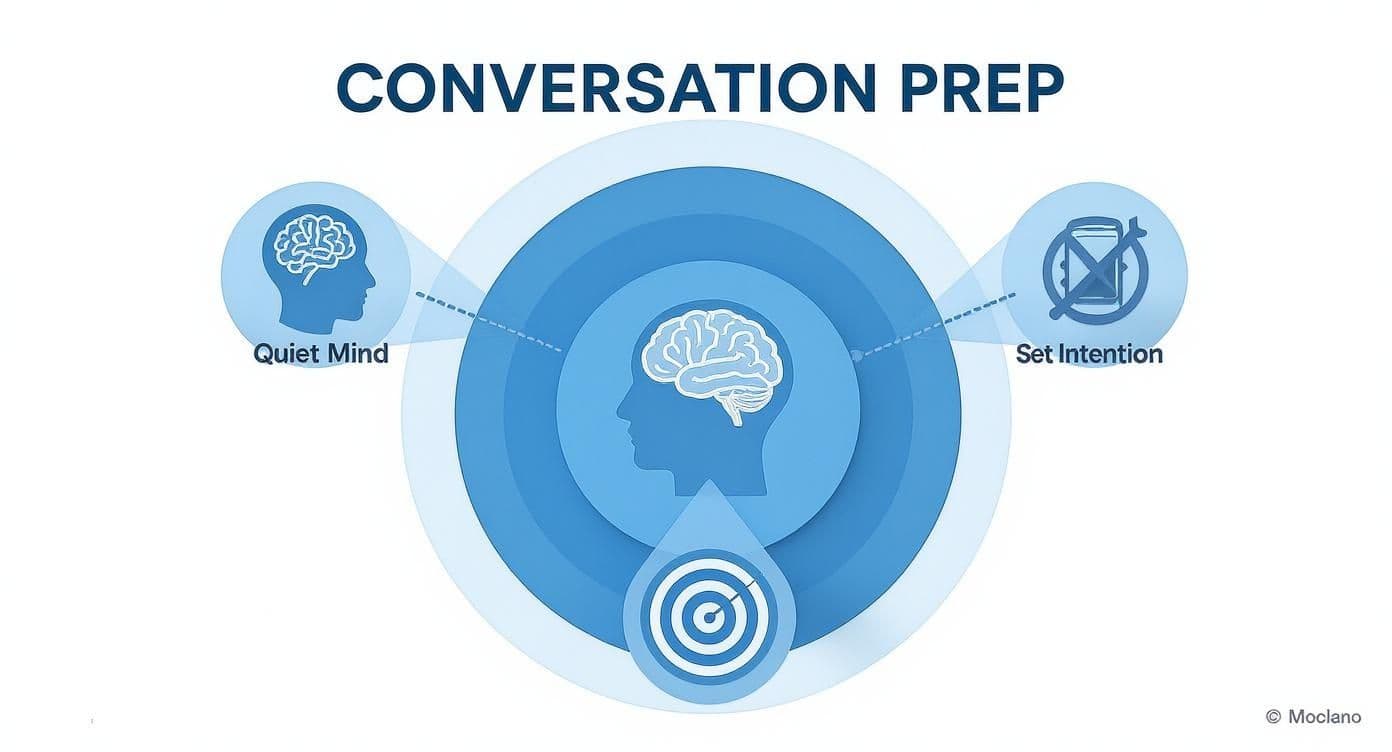
As you can see, giving your full attention isn't an accident. It’s a deliberate choice you make before the conversation even begins by quieting your mind and setting a clear intention.
2. Put a Pause on Judgment
We're all wired to form opinions and jump to solutions instantly. A truly great listener learns to hit the pause button on those impulses. Your goal in the moment isn't to agree or disagree; it’s simply to understand the other person's reality.
Imagine a team member says, "This new deadline is completely impossible." The knee-jerk reaction is to defend it: "No, it's not. We just need to work smarter." An active listener sees this differently. They get curious.
That small shift from judging to understanding is everything. It stops you from solving the wrong problem and builds the trust needed for people to be truly honest.
3. Reflect and Clarify to Be Sure
This is how you close the communication loop and make sure you're both on the same page. It’s a two-part process: paraphrasing what you've heard in your own words, then asking smart, open-ended questions to dig a little deeper.
Get rid of generic questions like "Does that make sense?" Instead, try specific prompts that encourage the other person to elaborate. For a masterclass in this, look at something like the SPIN selling framework, which is entirely built around asking the right questions to uncover needs.
Here are a few phrases you can start using today:
- "Could you walk me through how you got to that conclusion?"
- "From your perspective, what would a perfect outcome look like here?"
- "Okay, let me see if I've got this right. The main roadblock is X because of Y. Do I have that correct?"
This isn’t just about proving you were paying attention. It’s about making sure the message sent was the message received. This simple act of verification can head off countless misunderstandings down the road.
To help you put this all together, here’s a quick guide for swapping out those common passive habits for a more active, engaged approach.
Transforming Passive Habits into Active Listening Skills
This table offers a direct comparison of common passive listening behaviors and the active, engaged alternatives you can practice to improve communication.
| Common Passive Habit | Active Listening Alternative | Why It Works |
|---|---|---|
| Interrupting with a solution | "That's a key point. Help me understand the impact of that issue." | It shows you value their perspective over your impulse to fix things, leading to better-informed solutions. |
| Mentally forming your rebuttal | Focusing on the speaker's exact words and body language. | It keeps you present and allows you to absorb the full message, not just the parts you want to argue against. |
| Nodding along without processing | Paraphrasing back: "So, it sounds like the priority is..." | This confirms your understanding, catches misinterpretations early, and makes the speaker feel heard. |
| Thinking about what to say next | Asking an open-ended question: "What factors led to that decision?" | It keeps the focus on the speaker, encouraging them to share more detail and giving you a richer understanding. |
By consciously choosing the active alternative, you move from simply hearing words to truly understanding the meaning behind them. It's a small change in behavior that makes a huge difference in the quality of your conversations.
Using Listening to Build a Stronger Team

While the techniques we've discussed are great in the moment, the real power of active listening comes alive when you use it to build a stronger, more connected team. It's the foundation of psychological safety—that feeling everyone has when they know it's okay to take risks, voice a wild idea, or even admit a mistake without fear of blame.
When leaders genuinely listen, they signal that every voice matters. This isn't just a nice-to-have; it's a game-changer for performance.
The data backs this up. High-quality listening skills are linked to a 16% jump in employee satisfaction. And when managers are attentive, their teams report much higher job satisfaction. In fact, a manager who really listens can even help calm job insecurity during tough times like a re-org. You can find more details on these findings and how listening impacts job satisfaction.
Navigating High-Stakes Conversations
You really see the power of listening when the pressure is on. High-stakes conversations are where trust is either forged or shattered. Your ability to listen here makes all the difference.
Think about these common, and often dreaded, scenarios:
- Delivering Tough Feedback: As soon as you give critical feedback, defenses go up. It’s human nature. An active listener's first move is to understand their reaction. Instead of just delivering the news and moving on, try asking, "How does this feedback land with you?" Then, just listen.
- Discussing Organizational Change: Nothing creates anxiety like uncertainty. When you're rolling out a big change, make space to hear people’s worries. Acknowledging their feelings—"I understand this change brings up a lot of questions about your role"—shows you respect them, even if you don't have every answer yet.
In both situations, listening turns a potentially damaging monologue into a two-way street. It makes people feel seen and respected, which is everything when it comes to morale.
From Team Cohesion to Customer Loyalty
A team culture built on listening doesn't just stay within the office walls; the effects ripple outward. When people feel heard by their leaders, they're far more likely to listen to each other—and, crucially, to your customers. If you want to dig deeper into this, check out our guide on how to improve team communication skills.
A listening culture naturally fosters empathy and collaboration. These aren't just internal benefits; listening is a critical muscle for all your external interactions. You can explore actionable customer service best practices to see how this translates into loyalty and growth. Ultimately, a team that listens well is a team that can understand customer needs, solve tricky problems, and create an experience that keeps them coming back.
How to Measure and Reinforce Your Listening Skills
Getting better at active listening isn't a one-and-done deal. It's a skill you have to keep sharpening. And just like with any other skill, you can't really improve what you don't measure. The trick is to build a simple feedback loop to see your progress, spot your weak points, and double down on what’s actually working.
One of the easiest ways to start is with a quick self-check after any important conversation. Seriously, just take two minutes. Ask yourself: Did I cut anyone off? Did I ask good questions to make sure I understood? Was I actually present, or was my mind off planning my next email? That kind of honest reflection is where real growth begins.
Another fantastic method is to just ask for feedback. Pull aside a colleague you trust and respect. Ask them to keep an eye on you in the next big meeting and give you one or two pointers afterward on how you could be a better listener. It's amazing what a fresh pair of eyes can catch—you'll often uncover blind spots you never knew you had.
Using Technology as Your Personal Coach
These days, technology can be a surprisingly powerful coach for improving how you listen. Take AI meeting summarizers, for instance. They do way more than just spit out notes; they create an objective, word-for-word record of the entire conversation. Reviewing that transcript is like watching game film after a match.
You can analyze your own patterns with a level of detail that was impossible before. You can see the exact moments where you might have:
- Jumped in and interrupted someone, potentially derailing their train of thought.
- Missed a chance to ask a follow-up question when something wasn't totally clear.
- Talked more than you listened, hogging the airtime instead of making space for others.
This kind of review also naturally sharpens your focus on clear communication, which is the bedrock for anyone learning how to take better meeting notes and capturing the insights that count.
Creating a System for Continuous Improvement
To make sure your new skills stick, you have to build measurement right into your weekly routine. A simple checklist can do wonders for keeping you honest and tracking your progress over time.
| Weekly Listening Checklist | This Week's Goal | Did I Meet It? (Yes/No) |
|---|---|---|
| Limit Interruptions | Interrupt no more than twice per meeting. | |
| Ask Open-Ended Questions | Ask at least one "why" or "how" question per call. | |
| Practice Paraphrasing | Summarize someone's point back to them once per day. |
When you break down a big goal like "improve active listening" into small, manageable actions like these, it suddenly feels achievable. Over time, these deliberate practices become second nature, turning you into a more thoughtful, effective, and empathetic communicator in every single meeting.
Common Questions About Active Listening
As you start putting these skills into practice, you're bound to hit a few real-world snags. It's totally normal. Let's walk through some of the most common questions that pop up when people get serious about becoming better listeners.
How Can I Practice Active Listening in a Virtual Meeting?
Let's be honest, listening on a video call is just plain harder. You can't rely on the subtle body language you get in person, so you have to be much more intentional with your actions.
First thing's first: close every other tab. Silence your notifications. Give the person on the other side of the screen your undivided attention—they can tell when you're distracted. Turning your camera on is another small but powerful move; it signals you’re present and accounted for.
Since you're missing those physical cues, you need to provide verbal ones. Simple affirmations like, "I see," or "That makes sense," go a long way in showing you're still with them.
Don't be afraid to use the chat for clarifying questions that aren’t urgent enough to interrupt the speaker's flow. And make summarizing your go-to move. Try saying something like, "Just to make sure I'm tracking, the main priority is X, and the key obstacle is Y, correct?" This not only confirms you've got it right but proves you were actually listening.
What If I Disagree with What the Person Is Saying?
This is where the real work begins. It’s crucial to remember that active listening is not the same as agreeing. Your goal is simply to understand where the other person is coming from, completely and without judgment, before you even think about sharing your own side.