Let's start at the beginning. What is meeting facilitation, really?
At its heart, meeting facilitation is the skill of guiding a group through a discussion to get them to a specific goal. It’s less about leading the charge and more about making sure the conversation flows smoothly, everyone gets a voice, and the whole process feels productive and inclusive. Think of it as turning a meandering chat into a focused, collaborative session.
Unlocking Your Team's True Potential
A good facilitator is like the conductor of an orchestra. The conductor doesn't play a single instrument. Instead, their job is to bring all the individual musicians together, ensuring they play in harmony and follow the same rhythm. Without them, you just have a lot of talented people making noise. With them, you get music. That’s exactly what a facilitator does for a team meeting.
And let's be honest, we need this skill now more than ever. We've all been in those meetings that feel like a waste of time, draining our energy and slowing down actual work.
The numbers don't lie. Executives now spend nearly 23 hours per week in meetings, a massive increase from what it used to be. The cost of all these bad meetings is shocking—U.S. companies lose an estimated $37 billion annually because of them.
This is precisely why facilitation is no longer a "nice-to-have." It’s a core skill that turns a dreaded calendar invite into a session that actually solves problems and produces results.
The Core Difference A Facilitator Makes
So, what sets a facilitator apart from the person who just runs the meeting? It’s a complete shift in mindset.
A traditional meeting chair often comes in with an agenda and a specific outcome they're pushing for. They control the content. A facilitator, on the other hand, is neutral. They aren’t invested in the final decision; they're invested in the process of getting there. Their job is to make sure the conversation is fair, inclusive, and stays on track.
Here's a quick look at how the roles stack up.
Meeting Chair vs. Meeting Facilitator: A Quick Comparison
| Aspect | Traditional Meeting Chair | Modern Meeting Facilitator |
|---|---|---|
| Primary Focus | Content and agenda | Process and participation |
| Main Goal | Reach a predetermined decision | Help the group find its own best solution |
| Role in Discussion | Directs the conversation | Guides the conversation |
| Stance on Content | Has a vested interest in the outcome | Remains neutral and objective |
| Approach | Often top-down and directive | Collaborative and inclusive |
This table shows the fundamental pivot from controlling the "what" to managing the "how."
This difference is everything. By focusing on the process, a facilitator helps the team sidestep common traps like one person dominating the discussion, good ideas getting shut down too early, or the entire meeting going off on a tangent.
For anyone wanting to build this skill, learning how to run effective team meetings is the perfect place to start. A great facilitator taps into the collective brainpower of the entire room, which almost always leads to better ideas and a team that genuinely buys into the final decision.
The Three Hats of a Great Meeting Facilitator
A skilled facilitator plays three distinct roles over the life of a meeting. Their work isn't just about what happens in the room; it starts long before anyone logs on and continues well after the meeting wraps up.
Think of it as three interconnected jobs that happen before, during, and after. Each phase sets the stage for the next, guiding a team from a fuzzy concept to a solid plan of action.
Before the Meeting: The Architect
Long before the meeting officially kicks off, the facilitator is hard at work as its architect. This planning phase is where the magic really begins. A well-designed meeting is already halfway to a successful outcome.
The facilitator’s main goal here is achieving crystal-clear clarity. They’ll partner with the meeting owner to pin down the real purpose. Are we here to brainstorm wild ideas? Make a critical decision? Or simply share an update? Getting this right from the start prevents those pointless meetings that drift aimlessly.
From there, they help map out a logical, time-bound agenda. This isn't just a laundry list of topics; it's a strategic roadmap for the conversation, built to get the group where it needs to go. Key tasks include:
- Defining the Purpose: Nailing down a sharp, one-sentence goal for the meeting.
- Setting Achievable Goals: What does a "win" look like in tangible terms?
- Building a Logical Agenda: Sequencing topics so they flow naturally and build on each other.
- Inviting the Right People: Making sure every single person in the room (or on the call) has a specific reason to be there.
This foundational work makes sure everyone shows up aligned and ready to hit the ground running.
During the Meeting: The Guide
Once the meeting starts, the facilitator swaps their architect hat for that of a guide. They step back and become the neutral guardian of the process, steering group dynamics and keeping the conversation on the rails. Their focus isn't on what is being said, but on how the team is working together.
They're the timekeeper, gently nudging the discussion along to honor the agenda. More importantly, they're a participation manager. They’ll draw out the quieter folks who often have brilliant insights and deftly redirect the more dominant voices to make sure the floor is shared.
When things get tense, they don’t take sides. Instead, they guide the group through the conflict to find common ground. For instance, if a discussion starts to spiral, a facilitator might jump in with, "That's a great point. Let's capture that in our 'parking lot' for later and get back to the current topic."
After the Meeting: The Archivist
When the meeting ends, the facilitator’s work still isn't done. The final phase is all about locking in the results and making sure things actually happen. Here, the facilitator becomes an archivist, ensuring all the progress made doesn't just evaporate.
They’re responsible for capturing the key outputs—documenting decisions, spelling out clear action items, and assigning each task to a specific owner with a deadline.
A quick, clear summary is then sent out to everyone. This creates a single source of truth about what was decided and what happens next. This follow-up is what turns talk into action, and it’s the final, critical piece of the puzzle.
5 Practical Facilitation Techniques You Can Use Today
Knowing the theory is great, but the real magic happens when you start using facilitation techniques in your meetings. These aren’t complicated, high-level strategies reserved for professional consultants. They're simple, practical tools you can start using right now to get better results from your team discussions.
Picking the right technique at the right time can completely turn a meeting around. It can get a stalled conversation moving, turn a conflict into a constructive debate, or simply make sure everyone gets a chance to speak.
Simple Tools for Everyday Meetings
Let's start with a couple of foundational techniques that are incredibly easy to pick up and immediately effective for managing those common meeting hiccups.
- The Parking Lot: Think of this as your secret weapon against tangents and off-topic conversations. When someone brings up a great idea that isn't relevant to the current agenda item, you don't shut it down. Instead, you validate it by "parking" it on a whiteboard or a shared doc to address later. This makes the person feel heard and keeps the meeting on track. Simple, but so effective.
- Round Robin: This is the best way to break the cycle of the same 2-3 people dominating every conversation. You simply go around the room (or the Zoom screen) and ask each person for their thoughts on the topic. It creates a dedicated space for quieter team members to contribute and ensures you hear from everyone, not just the loudest voices.
The facilitator's job isn't just about what happens during the meeting. It's a complete cycle of preparation, execution, and follow-up, as this diagram shows.
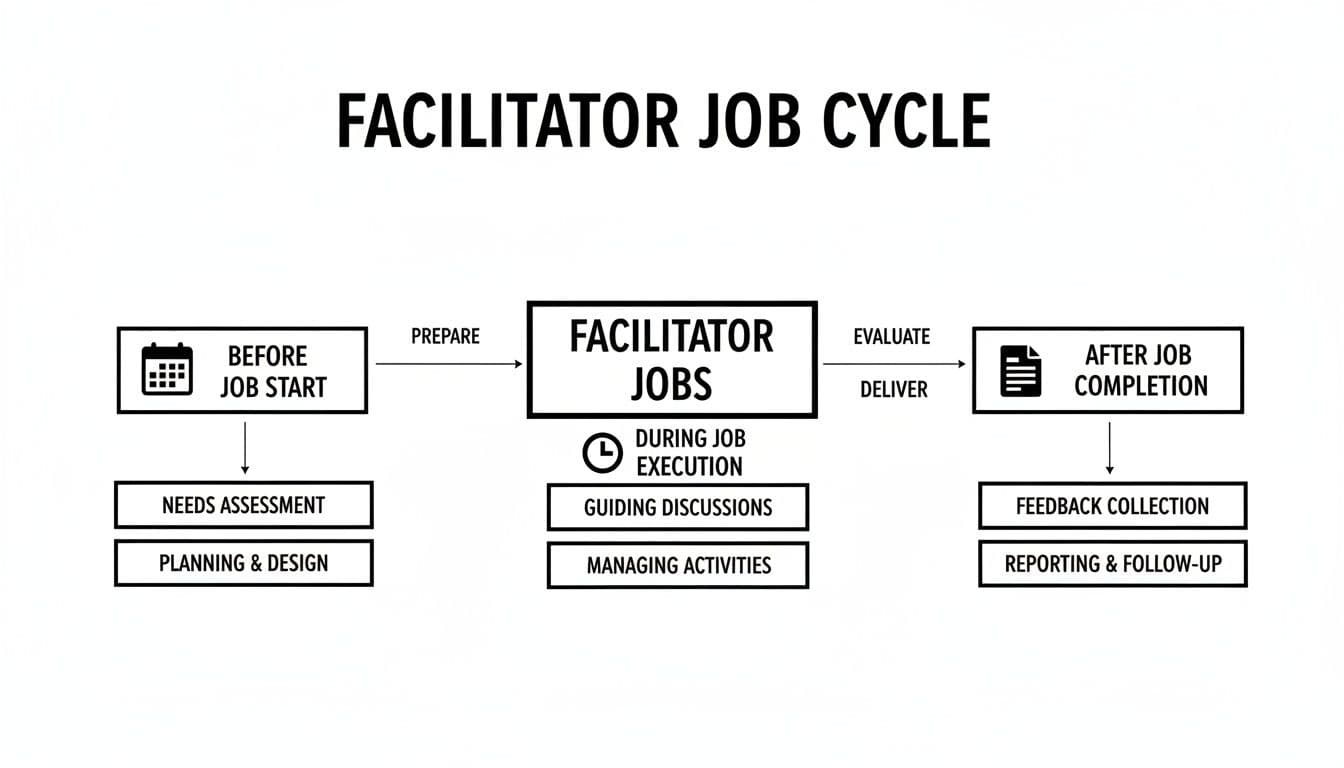
As you can see, a great outcome is built on what you do before, during, and after the meeting itself. Each stage is just as important as the next.
Techniques for Building Consensus and Prioritizing Ideas
Sometimes, you need to do more than just manage the conversation—you need to guide the group toward a decision. These next techniques are perfect for brainstorming, checking for agreement, and ranking priorities in a fair, structured way.
Dot Voting
This is a wonderfully simple and democratic way to prioritize a list of ideas generated during a brainstorming session.
- List all ideas on a whiteboard or shared document.
- Give each participant a set number of "dots" (usually 3-5).
- Participants "spend" their dots by placing them next to the ideas they support most. They can put all their dots on one idea or spread them out.
- Count the dots to see which ideas have the most support. This gives you a clear, visual ranking of the group's priorities.
Fist to Five
Need a quick, visual gut-check on where the group stands on a decision? Fist to Five is your go-to. Ask everyone to show their level of agreement by holding up their hand:
- 5 fingers: "I'm all in and will champion this!"
- 4 fingers: "I strongly agree."
- 3 fingers: "I'm on board. I can support this."
- 2 fingers: "I have some reservations."
- 1 finger: "I have major concerns."
- Fist (0 fingers): "I will block this. This is a hard no."
For a deeper dive, check out our guide on how to use the Fist to Five method to build genuine team consensus.
Nominal Group Technique
This is a more structured brainstorming process designed to prevent "groupthink," where one or two influential opinions sway the whole room.
It works in distinct steps: participants first write down their ideas silently and individually. Then, in a round-robin style, each person shares one idea at a time until all ideas are on the board. Only then does the group start discussing and evaluating the options. This process ensures every single idea gets a fair hearing on its own merits.
These are just a few of the tools you can use. For more inspiration, it's worth exploring other engaging discussion group topics and facilitation strategies to add to your toolkit.
Common Meeting Challenges and Facilitation Solutions
Meetings can go off the rails for many reasons. The good news is that for every common problem, there's a facilitation technique designed to solve it.
| Common Challenge | Facilitation Technique | How It Helps |
|---|---|---|
| A few people dominate the conversation | Round Robin | Guarantees that every participant gets a dedicated turn to speak, balancing out contributions. |
| Discussions go off-topic | The Parking Lot | Acknowledges and saves off-topic ideas for later, respectfully redirecting the group back to the agenda. |
| Group can't decide on priorities | Dot Voting | Provides a quick, visual, and democratic way to rank a list of options based on collective preference. |
| You need to gauge agreement quickly | Fist to Five | Offers an instant visual poll to see the level of consensus in the room without lengthy discussion. |
| Fear of "groupthink" stifles ideas | Nominal Group Technique | Ensures all ideas are generated and shared before any discussion or evaluation begins, promoting diverse thought. |
By having these solutions in your back pocket, you can confidently steer your meetings toward productive outcomes, no matter what challenges pop up.
When You Absolutely Need a Meeting Facilitator
Look, not every daily huddle needs a formal facilitator. That would be overkill. But some meetings are just too important to leave to chance, and knowing when to bring in a neutral guide can be the single most important factor that determines success or failure.
These are the moments where meeting facilitation isn't a nice-to-have—it's a necessity. Think about any high-stakes situation where strong personalities, complex problems, or competing priorities could easily send the whole conversation off the rails. A skilled facilitator is the buffer that keeps the process fair, focused, and productive, even when the topic gets tough.
Identifying High-Stakes Scenarios
Certain meetings just carry more weight. If your upcoming discussion falls into one of these categories, it’s a massive signal that you need a facilitator to steer the ship and get the best possible outcome.
Consider bringing in a facilitator for meetings like these:
- Annual Strategic Planning: You're setting the company's direction for the next year. You can't afford to have the CEO's opinion drown out brilliant insights from other leaders. A facilitator ensures every voice is heard and considered.
- Navigating Team Conflict: When tensions are running hot, a neutral third party is a must. They can de-escalate emotional reactions and guide the group toward a real resolution without ever taking sides.
- Major Project Kickoffs: Launching a complex, cross-functional initiative demands perfect alignment from the get-go. A facilitator helps different teams build a shared vision and agree on who does what by when.
- High-Impact Brainstorming: If you need genuinely new ideas, you have to break down the usual pecking order. A facilitator creates a safe space where even the quietest person on the team feels comfortable sharing a game-changing concept.
Your Quick Facilitation Checklist
So, what about your next meeting? It's not always about hiring a pro from the outside. Sometimes, it just means assigning a neutral team member to wear the facilitator hat.
Use this simple checklist to figure it out:
- Is the topic emotionally charged? If yes, a neutral guide is your best friend.
- Are there significant power imbalances in the room? A facilitator can level that playing field.
- Is the outcome unclear or the problem super complex? They provide the structure needed to cut through the fog.
- Have past meetings on this topic failed miserably? A facilitator brings a new process that can finally break that cycle of frustration.
Answering "yes" to even one of these questions is a clear sign that investing in facilitation will pay off in a big way.
How AI Tools Are Changing the Facilitation Game
Let's be clear: technology isn't here to replace good facilitators. It’s here to give them superpowers. Think of a modern AI tool as the perfect co-pilot, handling all the tedious administrative work that can pull a facilitator's focus away from the people in the room.
This shift allows facilitators to get back to what they do best—reading the room, managing group dynamics, and making sure every voice is heard.
Imagine running a workshop and not having to be the designated note-taker. That’s the reality now. AI platforms can produce live transcripts and whip up automated summaries, freeing you up to pay attention to body language, notice who’s been quiet too long, and gently pull a meandering conversation back on topic.


