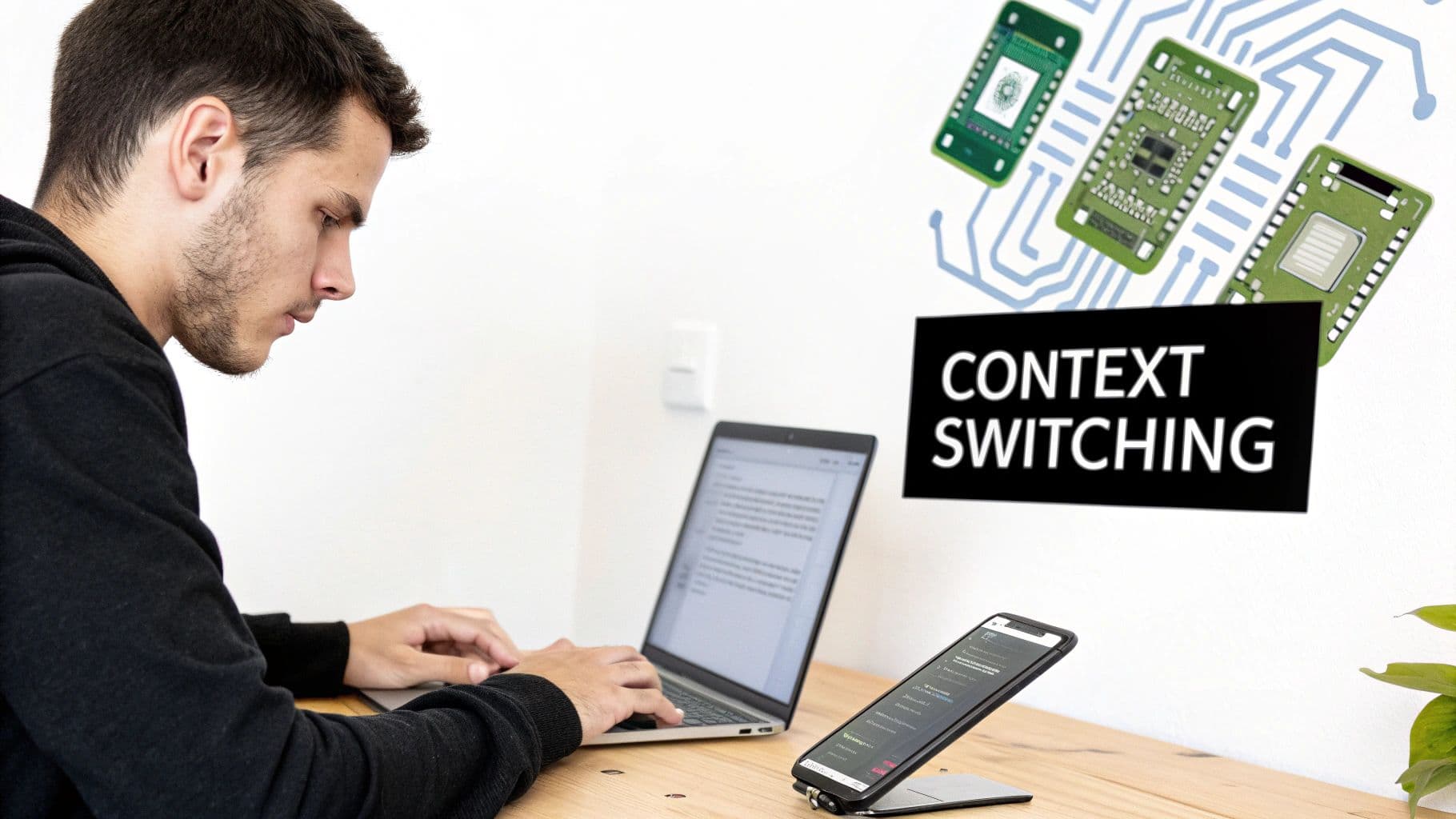
Picture a developer deep in code, a sales rep meticulously updating their CRM, or a manager laser-focused on finalizing a report. Suddenly, a notification pings. That mental jump you make from one task to another is what is context switching—it's the cognitive price you pay every time you shift your attention between unrelated activities.
Understanding the Hidden Costs of Context Switching
Think of your brain like a computer’s processor. When you have just one application running, it’s fast and smooth. But the moment you open dozens of programs and start flipping between them, everything slows to a crawl, performance craters, and the whole system becomes prone to errors. That’s exactly what context switching does to our brains.
Every time you pivot from a focused task—like writing a complex proposal—to answer a "quick question" on Slack, your brain has to drop everything it was holding onto and load up an entirely new set of information. This isn't an instant switch. It creates mental friction, a brief period where you're not fully engaged in either task, and the productivity loss is staggering. In fact, studies show it can take over 23 minutes to get back on track after even a minor interruption, completely derailing any chance of deep work.
The Snowball Effect of Small Interruptions
These "harmless" little shifts really add up. Over the course of a day, they create a massive drain on mental energy and, ultimately, on business resources. We're not just talking about losing a few minutes here and there; we're talking about a compounding effect that hammers performance, quality, and even morale.
The costs hit on every level, from the personal to the organizational:
- For employees: It leads straight to increased stress, mental fatigue, and full-blown burnout as they constantly struggle just to regain focus.
- For businesses: It translates directly into missed deadlines, lower-quality work, and a very real hit to the bottom line from all that wasted time.
Really getting a handle on this dynamic is the first step toward reclaiming focus for your team.
The Hidden Costs of Context Switching at a Glance
To put it in perspective, the small, moment-to-moment interruptions create significant, long-term problems. This table breaks down exactly what those costs look like.
| Impact Area | Key Statistic or Effect | What This Means for Your Business |
|---|---|---|
| Productivity Loss | Employees can lose up to 5 work weeks per year to context switching. | A huge waste of payroll and the root cause of delayed projects. |
| Employee Fatigue | 43% of employees report feeling fatigued from toggling between apps. | Higher risk of burnout, increased turnover, and plummeting morale. |
| Reduced Quality | Frequent interruptions lead to a significantly higher rate of errors. | Costly rework, potential damage to your reputation, and subpar results. |
As you can see, the price of constant task-switching is far higher than most leaders realize, affecting everything from individual well-being to the company's financial health.
The Cognitive Toll of Juggling Unrelated Tasks
Have you ever tried to jump from one task to another, only to feel like your brain is still stuck on the last thing you were doing? That’s not just a feeling. It's a real cognitive phenomenon called attention residue, and it's the mental ghost of your previous task that keeps you from fully engaging with the new one.
Think of your brain like a radio. When you switch channels, you don't instantly get a clear signal. You have to turn the dial, push through the static, and wait for the new frequency to come in clearly. Your brain goes through that same "static" every single time it's forced to shift gears. This mental friction makes deep, focused work feel next to impossible.
This cognitive slowdown isn't just a minor annoyance; it directly degrades the quality of work and hurts the bottom line.
From Mental Fog to Real-World Errors
The mental static from context switching isn't abstract—it creates tangible problems that show up in day-to-day work. The constant toggling between different modes of thinking, like switching from analytical to creative to communicative, simply drains our cognitive batteries. The consequences are predictable, and they're costly.
Take a developer deep in complex code who gets pulled away for a "quick" question about a project timeline. They don't just lose five minutes. Their brain has to completely unload the intricate logic of the code and then load the entirely different context of the project update. When they finally get back to coding, they have to painstakingly reload all that complex information, which is exactly when bugs get introduced.
This isn't just a tech problem. A salesperson finalizing a detailed proposal who gets sidetracked by a team chat will struggle to get back into their persuasive flow. This cognitive friction shows up in a few key ways:
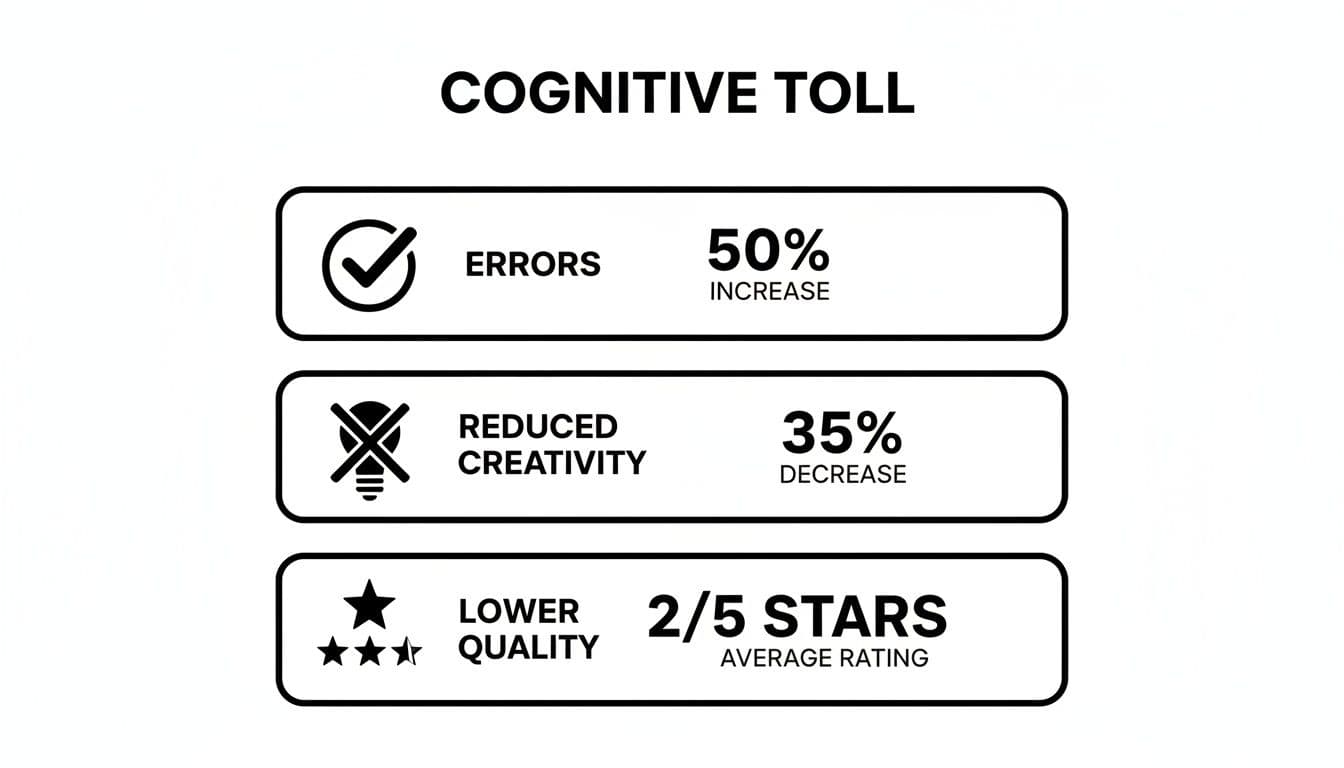
- Increased Error Rates: When your focus is fractured, your attention to detail is the first thing to go. This leads to more mistakes, from simple typos to critical errors in calculations.
- Reduced Creative Problem-Solving: Real creativity needs uninterrupted time to let ideas connect. Context switching shatters that state, making it much harder to find those innovative solutions.
- A Noticeable Drop in Work Quality: Ultimately, work done under constant interruption is just less thoughtful, less thorough, and less effective.
Understanding this cognitive toll is the first step. Frequent context switching forces your team to work with a persistent mental handicap. To learn more about this related challenge, check out our guide on what is information overload and how to manage it. Cutting down on these interruptions isn't a perk; it's essential for enabling the high-quality, focused work your business depends on.
Putting a Price Tag on Lost Focus
That mental fog you feel after bouncing between meetings, emails, and Slack messages isn't just in your head. It feels draining, sure, but the real impact shows up on the bottom line. When you start to translate that lost focus into hard numbers, the damage becomes shockingly clear.
These aren't just a few lost minutes here and there. The constant toggling creates a massive drag on efficiency that quietly eats away at your team's output. For modern teams—especially remote and global ones juggling a dozen different tools—this relentless attention-shifting adds up to a staggering loss of productive time.
The Staggering Cost of a Distracted Workforce
Research from the Harvard Business Review paints a pretty stark picture. The average employee bounces between different apps and websites nearly 1,200 times every single day. All that digital whiplash adds up to a massive 9% loss of annual time, which is the same as losing almost five full work weeks per person, per year. If you want to dig deeper, you can explore the full productivity impact research.
This isn't just a minor annoyance; it's a systemic problem bleeding resources. Studies show that 45% of employees feel context switching just kills their productivity, and another 43% say it leaves them exhausted. The real kicker? Every time an employee gets pulled away from a task, it can take up to 23 minutes for them to fully get their head back in the game.
How Lost Focus Hurts Different Teams
This productivity tax hits every team a little differently, but the result is always the same: wasted time and weaker results. The damage isn't just theoretical—it shows up in very real ways.
- Sales Teams: Every minute lost to switching between a CRM, email, and call software is a minute not spent building relationships or closing deals. It means fewer calls, slower follow-ups, and a direct hit to the sales quota.
- Operations Teams: When project managers and coordinators are constantly sidetracked, timelines start to slip. Details get missed, leading to costly mistakes, blown deadlines, and bottlenecks that jam up the entire company.
- Engineering Teams: Just one poorly timed interruption can completely derail a developer who's deep in complex code. This doesn't just push back release dates; it also makes it much more likely they'll introduce bugs that take even more time to fix down the road.
The data is clear: frequent interruptions lead directly to lower-quality work, more mistakes, and a serious drop in creative problem-solving.
Ultimately, that cognitive cost translates directly into poor business outcomes. Getting a handle on context switching isn't just a personal productivity hack. It’s a crucial business strategy for protecting your most valuable asset: your team’s focused attention.
How Context Switching Shows Up in Your Workday
It's one thing to talk about context switching in theory, but where does it actually show up? The real damage happens in those small, chaotic moments that have somehow become a normal part of the modern workday. These interruptions are the silent killers of productivity, quietly draining your team's focus and energy.
This problem usually takes a few common, yet destructive, forms.
The Pain of Meeting Whiplash
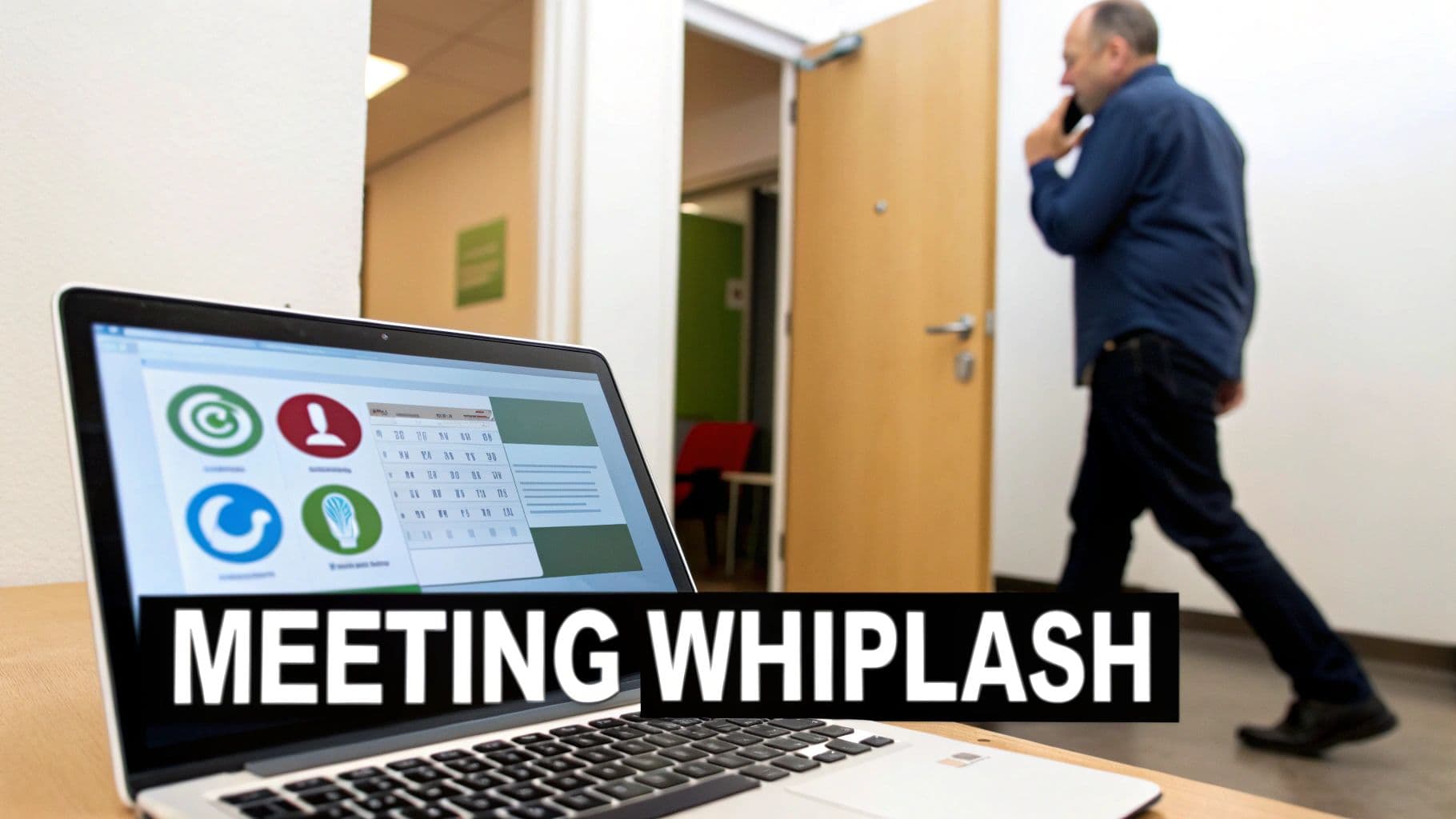
One of the most jarring examples is what I call meeting whiplash. Picture this: a team member walks out of a high-energy brainstorming session, their mind buzzing with creative ideas. The moment they get back to their desk, they have to dive headfirst into something completely different—like a detailed budget forecast or a tricky piece of code.
That transition is anything but smooth. The brain struggles to dump the creative mindset and load up the analytical one, and in that messy gear shift, those valuable, fleeting ideas from the meeting simply vanish. It’s frustrating for the employee and it's exactly where great ideas go to die.
Living in a Notification-Driven World
Another all-too-common scenario is notification-driven work. Instead of working through a planned set of priorities, an employee's day is hijacked by a constant barrage of alerts. A Slack ping, an email pop-up, a project management update—each one pulls their attention away from the deep work that actually matters.
This constant toggling between platforms is a massive source of mental fatigue.
The Unique Challenges for Remote Teams
Remote and hybrid teams are caught in a perfect storm for context switching. The combination of tool overload and asynchronous communication creates an environment where constant mental gear-shifting is the default.
- Tool Fatigue: Employees are constantly bouncing between video calls, chat apps, project boards, and cloud docs, each demanding a different kind of attention.
- Communication Gaps: Without the quick clarifications you get in person, people tend to over-communicate across multiple channels just to stay on the same page, which only adds to the digital noise.
This digital fragmentation isn't just a feeling; the numbers back it up. A staggering 43% of workers feel fatigue just from switching between apps, and 45% say it’s one of the biggest drags on their productivity. Other data shows employees can lose up to five hours a week hopping between tools, with 17% of workers switching tabs more than 100 times a day. You can learn more about the hidden costs of context switching to see just how deep the problem goes.
Actionable Strategies to Reclaim Your Team's Focus
Knowing what context switching is doing to your team is the first step. Actually fixing it, though? That takes a conscious effort to change both personal habits and the systems your team relies on every day. It’s about fighting back against the constant pull of interruptions that have become the norm.
Here are some proven ways to help your team get their time and attention back.

It all starts with giving individuals the tools to protect their own focus. From there, you can build a company culture where deep, meaningful work is the default—not the exception.
Fortifying Individual Focus
Individuals can build a powerful defense against context switching with just a few simple, effective habits. Think of these as ways to create structure in an otherwise chaotic digital world, carving out dedicated time for real work.
- Time Blocking: Don't just work from a reactive to-do list. Proactively schedule specific blocks of time for specific tasks right on your calendar. This treats your focus time like an appointment you can't miss.
- The Pomodoro Technique: This classic method is simple for a reason: it works. You focus intently for 25 minutes, then take a short break. It’s a great way to train your brain to concentrate in short sprints, making it easier to ignore the urge to jump to another task.
- Creating a Digital Sanctuary: It's time to get aggressive with your notifications. Turn off all non-essential alerts on your phone and computer, close out those extra browser tabs, and actually use your device's "focus mode." It signals to everyone, including yourself, that you're off-limits.
Building Team-Wide Systems for Deep Work
Individual efforts are fantastic, but they can easily get steamrolled by a culture that expects you to be available 24/7. Real change happens when you make focus a shared priority. A big part of this is learning how to manage multiple projects simultaneously without letting everything devolve into chaos.
Here are a few team-wide strategies that can make a huge difference:
- Smarter Communication Protocols: Set clear rules for what tools are used for what. For instance, maybe email is for non-urgent updates that can wait, while Slack is reserved for truly time-sensitive questions. This simple change can drastically cut down on noise.
- Standardize Core Tools: Application chaos is real. Reduce it by agreeing on one primary tool for major functions like project management or team communication. Fewer apps mean less toggling and a much cleaner workflow.
- Implement 'Focus Blocks': Encourage everyone to block out "no-meeting" periods on the shared calendar. This gives the whole team permission to disconnect and concentrate without feeling guilty about not responding immediately.
These kinds of solutions are all about minimizing the switches that drain our mental batteries. For sales, HR, and ops teams, this is especially critical, as it can prevent the 9% yearly productivity drain that comes from constantly hopping between tasks.
Want to learn more about improving your team's workflow? Check out our guide on meeting productivity tips.
Using AI Tools to Reduce Meeting Whiplash
One of the worst types of context switching has to be the mental whiplash from jumping out of a meeting and trying to dive back into deep work. It’s a jarring transition.
Key decisions, action items, and important details discussed just moments ago can evaporate, forcing you to chase down colleagues later for a recap. That post-meeting scramble is a massive productivity killer.
This is exactly where technology can step in to help. AI meeting assistants work like a cognitive safety net, capturing the entire conversation so you don't have to.
Creating an Instant Knowledge Base
Think about it. You finish a sales call, and a perfect, searchable summary of your client’s needs is already waiting for you, maybe even automatically logged in your CRM. You don't have to waste the next 20 minutes trying to piece together your scattered notes. The context is perfectly preserved and ready to go.
This completely changes the post-meeting workflow. These tools improve agent productivity with AI-powered support by offloading the mental burden of remembering every detail, making the switch back to your next task far less taxing.
This is a game-changer for any team struggling with a meeting-heavy schedule. Instead of losing momentum trying to recall what was decided, your team can act immediately. It creates a fluid process where conversations feed directly into productivity instead of derailing it.
By automating how meeting intelligence is captured and organized, you give your team their focus back for the high-value work that actually matters. If you want to see what's out there, our guide on the best AI meeting assistants is a great place to start.
Got Questions? We've Got Answers
Still wondering how all this plays out in the real world? Let's tackle some of the most common questions managers and teams have about context switching.
Is Multitasking Just Another Name for Context Switching?
Not quite, but they're very closely related. People love to say they’re great at multitasking, but what they’re actually doing is just switching between tasks really, really fast. Our brains aren't built to do two complex things at once.
That feeling of being frazzled and making silly mistakes after trying to juggle a bunch of things? That's the mental fatigue from all that rapid-fire context switching.
How Can I Get My Manager to Take This Seriously?
The key is to talk about it in terms of business results, not just how you feel. It's not about complaining; it's about pointing out a major drain on resources.
Data is your best friend here.