What is an Objective Summary? Definitions, Examples, and How to Write One
Ever tried to explain a three-hour meeting in just three sentences? Or needed to capture the heart of a complex report for a busy colleague? That’s where the magic of an objective summary comes in. It’s your shortcut to clarity in a world overflowing with information. Writing summaries is a skill that everyone can benefit from, whether you’re summarizing a meeting, an article, or a report. The key is to condense the content while staying true to its original meaning, without adding personal opinions or emotional language.
But what exactly is an objective summary, and why is it so important? In this article, we’ll break down the concept of an objective summary, explore the key elements that make a strong one, and walk you through the steps to write it. Plus, we’ll include examples to help you master the technique. Let’s get started!
What Exactly Is an Objective Summary?
Think of an objective summary as being a neutral news anchor rather than a color commentator. It is a short statement or paragraph that tells what something is about but does not include your opinions, judgments, or feelings.
When you write objectively, you are reporting the facts exactly as the original author or speaker presented them. You aren't arguing with the text, and you aren't praising it. You are simply condensing the "who, what, when, where, and why" into a digestible format.
Key Elements of a Strong Objective Summary
When writing an objective summary, it’s essential to focus on a few key elements that make the summary both clear and accurate. Let’s break these down.
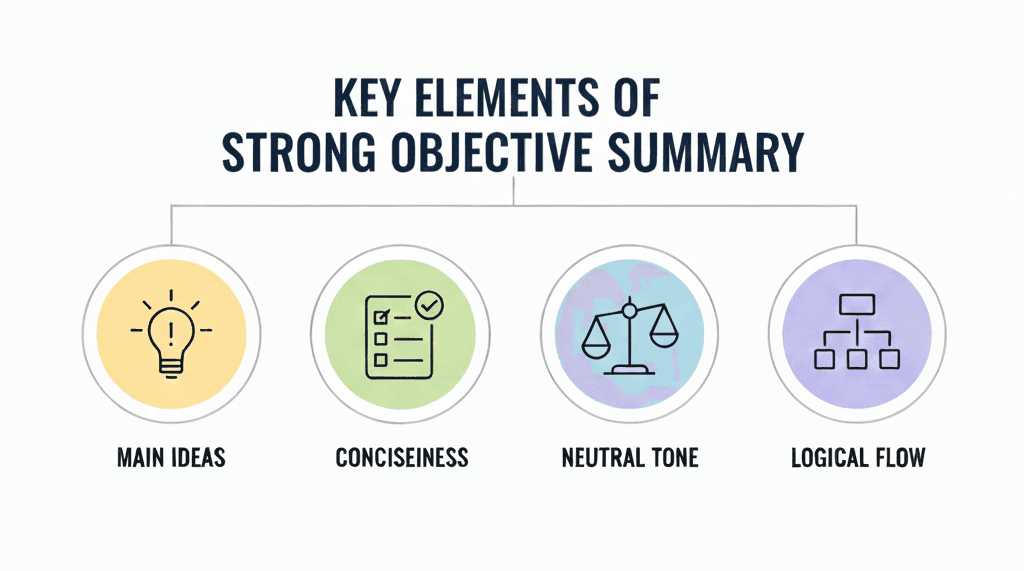
- Main Ideas: The central ideas of the original content should be highlighted. A summary isn't about every single detail but about capturing the essence.
- Conciseness: Keep it short and to the point. Aim for clarity and brevity without losing the core meaning.
- Neutral Tone: An objective summary avoids any personal judgment. It’s strictly about the facts.
- Logical Flow: Your summary should follow the same logical structure as the original, so readers can easily understand the flow of the content.
Objective vs. Subjective: What’s the Real Difference?
This is where people get tripped up. Let’s make it crystal clear.
| Feature | Objective Summary | Subjective Summary |
| Core Purpose | To inform and report facts. | To analyze, critique, or react. |
| Content | Main ideas and key details from the source. | Facts mixed with personal opinions, feelings, or judgments. |
| Language | Neutral, factual, impersonal. | Evaluative, emotional, personal. |
| Phrases to Look For | "The data shows...", "It was decided that...", "The author describes..." | "I believe...", "Unfortunately, the report...", "The brilliant part was..." |
Steps to Write an Objective Summary
If you’re unsure how to start writing an objective summary, don't worry! We’ve broken it down into five simple steps that will make the process easier for you.
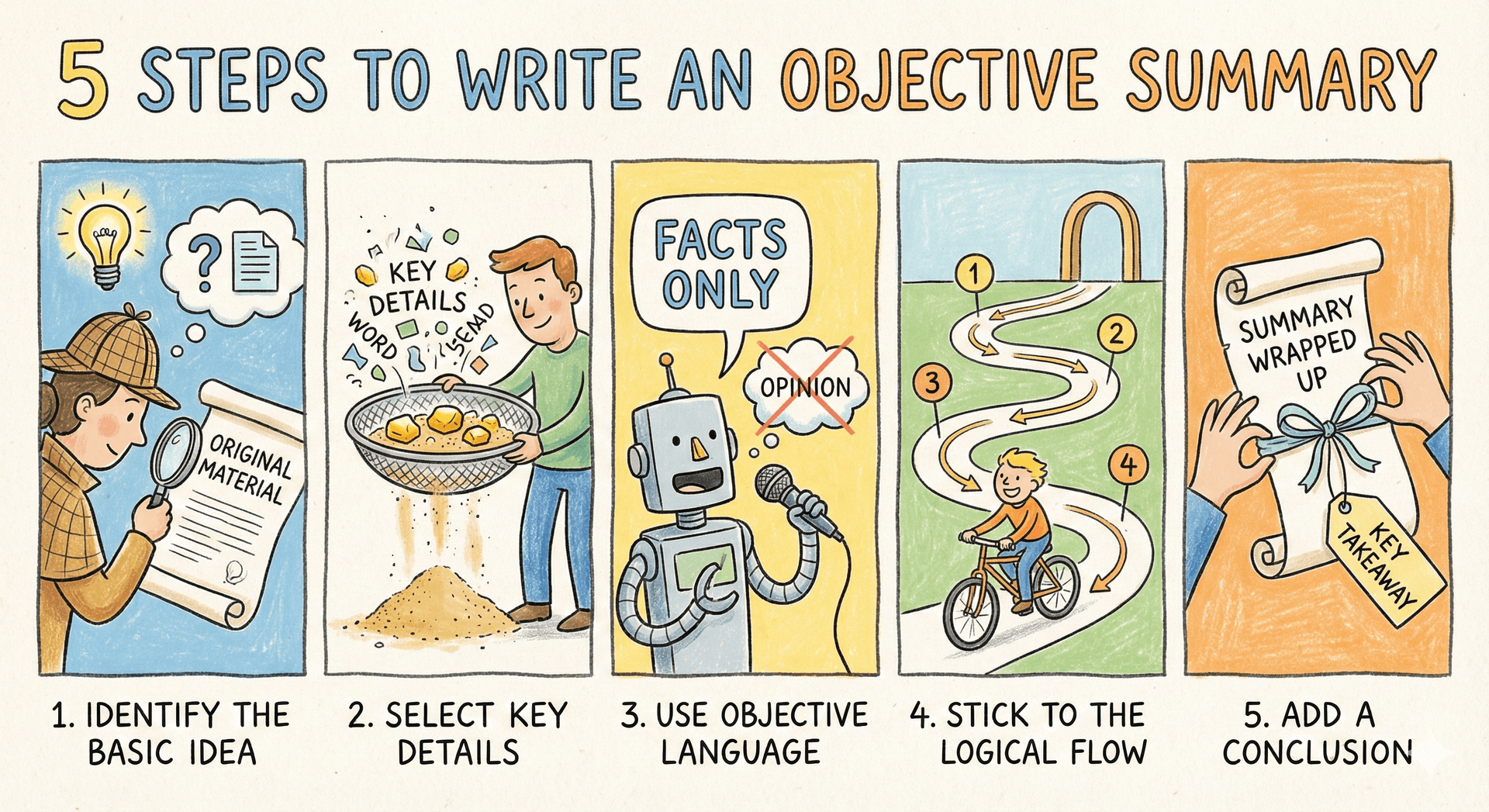
- Identify the Basic Idea
Start by reading the original material carefully. What is the content trying to communicate? Is it a report, a meeting discussion, or an article? Pinpoint the core message before diving deeper.
- Select Key Details
Not everything in the original content needs to be summarized. Focus on the most important details, those that contribute to the main message.
- Use Objective Language
Avoid using words or phrases that reflect personal opinion or emotion. Stick to the facts and describe the content as it is, without any embellishment.
- Stick to the Logical Flow
Follow the structure of the original content to ensure your summary makes sense. Avoid jumping around or leaving out important sections that might confuse your readers.
- Add a Conclusion
Finally, wrap up the summary by reiterating the key takeaway. This should be a concise statement that ties everything together.
Common Mistakes When Writing an Objective Summary
It’s easy to make a few missteps when summarizing content. Here are some of the most common mistakes you’ll want to avoid:
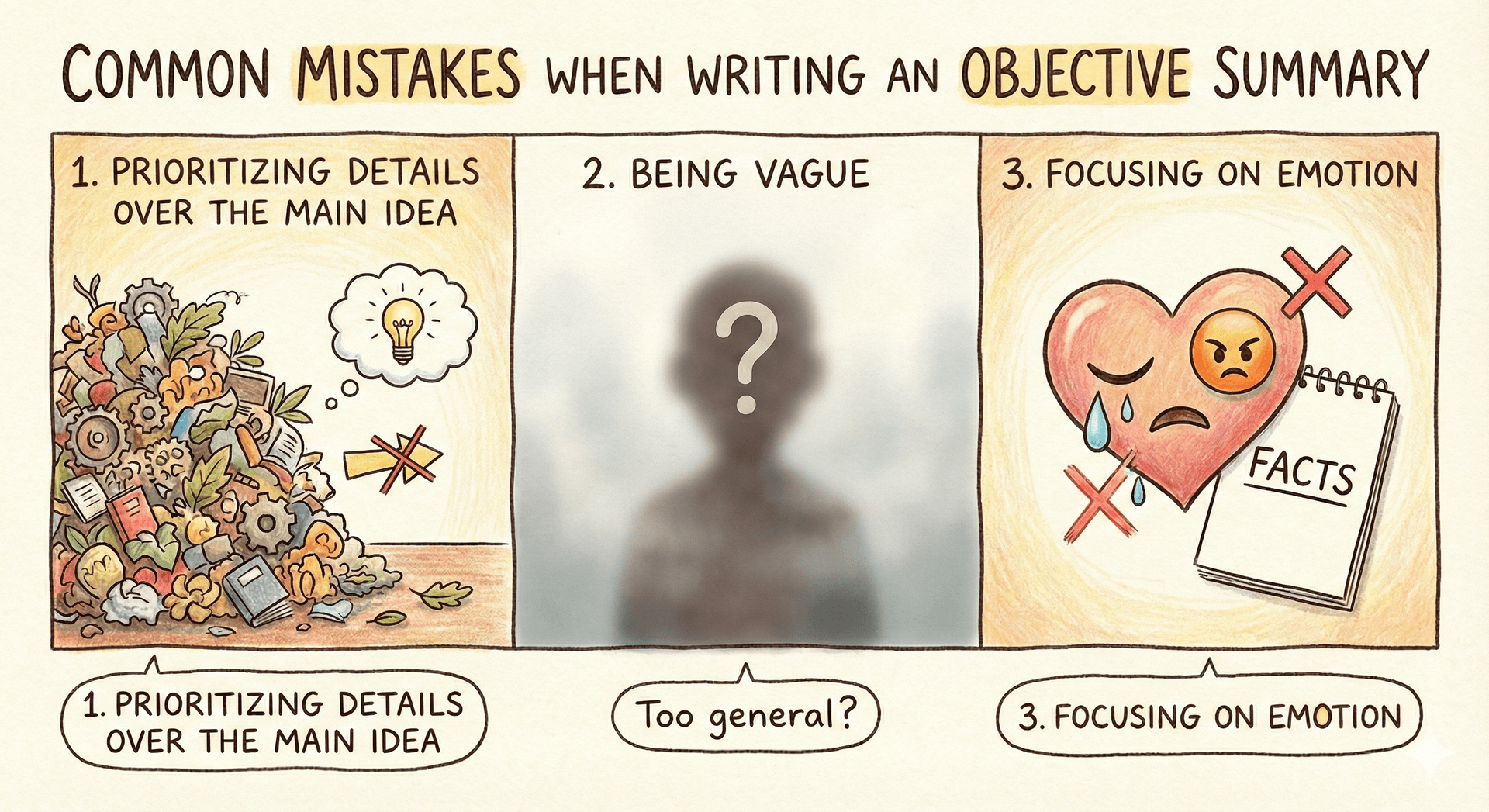
- Prioritizing Details Over the Main Idea
Sometimes, it’s tempting to include lots of details in a summary, but that can actually clutter the key message. Instead, focus on the most important points.
- Being Vague
An objective summary should be clear and specific. Avoid being too general or vague. Readers should easily understand what the original content is about after reading your summary.
- Focusing on Emotion
An objective summary should be about facts, not feelings. Keep your emotions out of the summary and focus solely on what was communicated in the original material.
Best Practices When Writing an Objective Summary
Writing a strong objective summary takes practice, but with these tips, you’ll be on the right track in no time:
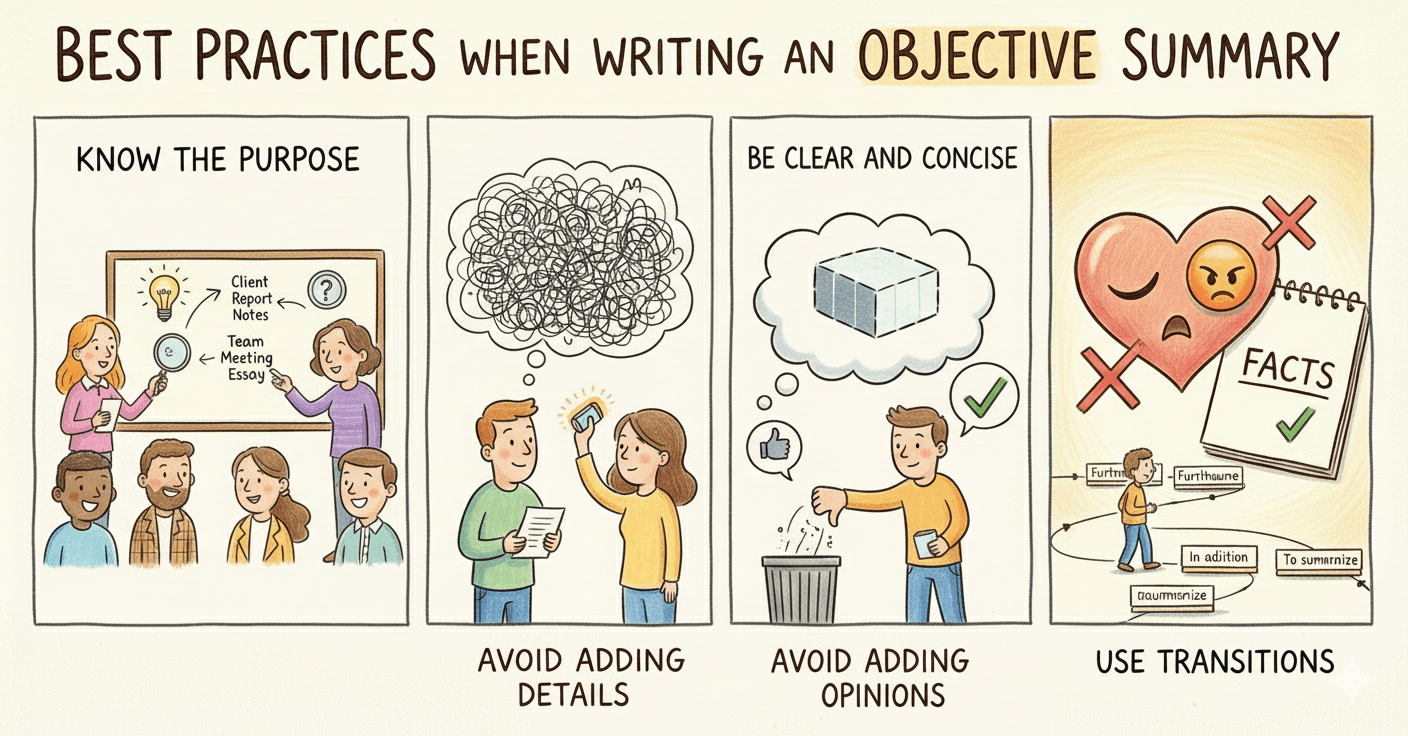
- Know the Purpose: Understand why you’re summarizing and who will read it.
- Be Clear and Concise: Shorter doesn’t always mean better, but keep your language precise.
- Avoid Adding Opinions: Stick to the facts and avoid any emotional language or subjective views.
- Use Transitions: Clear transitions between sentences and ideas make your summary easier to read.
Examples That Show Objective Summaries in Action
Sometimes the best way to learn is by seeing concrete examples. Let's look at three common scenarios where objective summaries make all the difference.
Example 1: The Business Meeting Summary That Prevents Miscommunication
Original meeting discussion: "I really feel like our marketing budget is being wasted on channels that don't convert. Sarah's team has been pushing Facebook ads for months, but the ROI is terrible. We should pivot immediately to TikTok, that's where the real engagement is happening! I'm frustrated that we keep throwing good money after bad."
Objective summary: "The team discussed marketing budget allocation. Current Facebook ad campaigns have generated a 2.3% conversion rate over the past quarter. Sarah's team presented data showing 15% audience growth on TikTok. The group agreed to reallocate 30% of the Facebook budget to test TikTok advertising in Q4, with performance reviews scheduled monthly."
Example 2: The Research Summary That Stays True to Science
Original research conclusion: "Our groundbreaking study proves beyond doubt that this new treatment is the future of cancer care. Patients were overjoyed with the results, and we believe this could save millions of lives. The medical establishment has been too slow to adopt innovative approaches like ours."
Objective summary: "The study examined a new cancer treatment protocol involving immunotherapy combination therapy. 42 patients participated in the 6-month trial, with 68% showing tumor reduction of 30% or more. Side effects were reported in 23% of participants, primarily fatigue and nausea. The researchers recommend larger-scale trials to confirm these preliminary findings."
Example 3: The Customer Feedback Summary That Drives Real Improvement
Original customer comment: "I'm absolutely furious about my experience with your terrible customer service! I waited on hold for an eternity, and when I finally got through, the representative was rude and unhelpful. This is the worst company I've ever dealt with, I'll never shop here again!"
Objective summary: "Customer reported a 28-minute wait time for phone support during peak hours. The interaction was transferred twice before reaching a resolution specialist. The customer indicated dissatisfaction with the initial responses to their product return request. The case was escalated to a supervisor who approved the return with waived restocking fees."
Wrapping Up
Writing an objective summary is more than just a writing exercise; it is a critical business skill. It demonstrates that you can listen, process information, and relay it accurately without clouding the message with your own bias.
Whether you are summarizing a 50-page report or a 30-minute client call, the goal remains the same: Clarity over clutter, and facts over feelings.
FAQs
- What is the difference between an objective summary and a subjective summary?
An objective summary focuses strictly on the facts, removing personal opinions or emotions, while a subjective summary may include personal thoughts, feelings, or interpretations of the original content.
- How long should an objective summary be?
An objective summary should be concise but comprehensive. Typically, it’s one to two paragraphs long, depending on the original material’s length and complexity.
- Why is an objective summary important?
An objective summary is valuable because it allows readers to quickly grasp the main points of a document without wading through unnecessary details, saving time and ensuring clarity.
- Can I use my own words in an objective summary?
Yes, an objective summary should be written in your own words. However, it should faithfully reflect the original content’s meaning without adding personal opinions.
- How do I make sure my summary is objective?
To ensure your summary is objective, focus on the main ideas, use neutral language, and avoid any emotional or subjective terms. Stick to the facts presented in the original content.
- What’s the best way to avoid adding bias in my summary?
To avoid bias, make sure to summarize the content based on the author’s intentions and key points rather than your own interpretations. Keep your language neutral and factual.
- Can an objective summary be used for any type of content?
Yes, objective summaries can be used for any type of content, from meeting notes and reports to articles and presentations. The key is to focus on the main message and leave out unnecessary details.