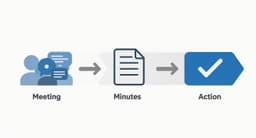
We’ve all been there. You leave a committee meeting buzzing with brilliant ideas and clear next steps, but a week later, it feels like it all just… evaporated. What was decided? Who was supposed to do what?
Effective minutes of a committee meeting are the antidote to that organizational amnesia. They're far more than just a bureaucratic chore; they're the roadmap that turns talk into action, a tool for accountability, and a vital legal safeguard. Let's break down how to get this right.
Why Great Meeting Minutes Are Your Secret Weapon

It’s easy to dismiss minute-taking as just another admin task, but that’s a huge mistake. Well-crafted minutes are your organization's memory. They ensure decisions stick, action items get tracked, and everyone is clear on the path forward. Without them, you're just spinning your wheels.
This official record is the engine that drives progress and protects your organization.
- It Creates Clarity and Alignment. A good set of minutes acts as the single source of truth, summarizing key discussions and decisions. This simple act nips misunderstandings in the bud and keeps everyone on the same page.
- It Drives Accountability. When action items are clearly written down with names and deadlines next to them, follow-through isn't just a hope—it's an expectation.
- It Provides Legal Protection. For corporations, nonprofits, and many other entities, meeting minutes are legal documents. They prove that you followed proper procedures and did your due diligence, which can be invaluable in protecting the board and the organization from liability.
- It Preserves Institutional Knowledge. Minutes create a historical record of why decisions were made. This context is gold for new leaders and helps prevent the team from having the same arguments over and over again.
The Challenge of Modern Meetings
Getting this right is more important than ever. Meetings are longer, and our attention spans are shorter. Think about it: research shows that 55% of meetings in the US last between 30 and 60 minutes, with a whopping 40% going even longer.
The problem? Attendee engagement takes a nosedive after just 30 minutes. This makes a clear, concise record absolutely essential. Understanding why meeting minutes matter for business success is the first step to ensuring those great ideas actually turn into results.
The Real Work Starts Before the Meeting Even Begins
Here's a little secret from someone who's taken a lot of minutes: crafting a great record isn't about being a lightning-fast typist. It's about the prep work you do before anyone even dials in.
Walking into a meeting unprepared is like trying to build furniture without looking at the instructions—you'll end up with a mess of disjointed parts and have no idea how they fit together. A little forethought transforms a frantic, stressful job into a smooth, professional process.
It all starts with treating the agenda as your roadmap, not just a list of topics.
Get on the Same Page as the Chair
Your first move should always be to connect with the person running the meeting. Don't just skim the agenda—really dig into it with them. This is your golden opportunity to ask about any confusing jargon, internal acronyms, or cryptic project names that are bound to come up.
For instance, if you see a line item like "Project Nightingale Update," a quick chat with the chair can give you the context you need. A simple "Hey, can you give me the 30-second version of Project Nightingale?" saves you from scrambling for information while a critical vote is happening.
A solid agenda is your best friend. If you want to build a truly effective one from scratch, our complete guide on how to write a meeting agenda is a great place to start. This prep work helps you anticipate where the important discussions and decisions will happen, keeping you one step ahead.
Build Your Template (It's Non-Negotiable)
Never, ever start with a blank page. Creating a simple template beforehand is the single best thing you can do to make your life easier. This isn't about creating some elaborate document; it's about getting all the boring, static information down so you can focus your brainpower on the actual conversation.
Your template should have these basics locked in before go-time:
- The Obvious Stuff: Committee name, date, time, and the physical location or virtual meeting link.
- The Roster: List all the expected attendees. As people show up, you can just put a checkmark next to their name. This makes tracking attendance and noting who was absent a breeze.
- The Framework: Copy and paste the agenda items directly into your document. Leave plenty of space under each one for your notes.
This preparation is especially crucial today. We all know that 50% of meetings start late. And with remote work, teams are now wrestling with meetings that span multiple time zones—a challenge that has shot up by 35% since 2021. Having a template ready means you can hit the ground running the second things kick off, no matter how delayed they are.
Capturing What Matters During the Meeting

Alright, the meeting has started, and now it’s your time to shine. Your job isn't to be a court reporter, capturing every single word. Forget transcription. You're there to actively listen and pull out the essential bits: the decisions, the votes, and the tasks that come out of the discussion.
Think of yourself as a journalist reporting the key facts. What actually happened? What was decided? This mindset shift—from transcriber to fact-recorder—is the secret to creating truly valuable minutes of a committee meeting.
Documenting Motions and Votes with Precision
When a formal motion hits the table, your focus needs to be razor-sharp. These are often the most legally important moments in a meeting, and you need a consistent way to record them every single time.
For every single motion, make sure you capture three key pieces of information:
- The Mover: Who formally proposed the motion? Get their full name down.
- The Seconder: Who seconded it? This is just as important.
- The Outcome: What was the final tally? Note the number of ayes, nays, and any abstentions.
For example, a solid entry would look something like this: "MOTION: Jane Smith moved to approve the Q3 budget as presented. John Doe seconded the motion. VOTE: The motion passed with 7 in favor, 1 opposed, and 1 abstention." This simple formula leaves no room for doubt about what the committee decided.
Distilling Discussions and Defining Action Items
Committee discussions can meander. It’s natural. But your minutes shouldn't. Your job is to summarize the core points that led to a decision, not to document the entire winding path of the conversation. Focus on the why behind the vote without getting tangled in a play-by-play of the debate.
A good summary is brief and objective. It might read: "The committee discussed two marketing vendor proposals. Key arguments for Vendor A centered on their lower cost, while Vendor B's supporters highlighted their deep industry experience." See? It captures the substance without the fluff.
As discussions wrap up, listen for those crucial action items. This is where decisions turn into action and where accountability begins. A task without an owner and a deadline is just a wish.
Your format for action items needs to be direct and crystal clear:
- Task: What, specifically, needs to be done? (e.g., "Draft the new social media policy.")
- Owner: Who is on the hook for getting it done? (e.g., "Assigned to: Alex Chen.")
- Deadline: When is it due? (e.g., "Due by: October 31st.")
When the minutes of the committee meeting go out with this level of clarity, everyone knows exactly what they’re responsible for and when it needs to be completed. No excuses.
Turning Raw Notes Into a Polished Record
The meeting’s over, but for the person taking minutes, the real work is just getting started. Your notes—a messy collection of shorthand, half-finished sentences, and bullet points—are the raw clay. It's time to shape them into a clean, professional document that’s not just readable but legally sound.
This isn’t about just fixing typos. It’s about transforming a chaotic stream of information into a structured, logical record. When you do it right, the minutes of the committee meeting become the official story of what happened, a single source of truth for everyone involved.
Building a Logical and Readable Structure
Consistency is your best friend here. Don't start from scratch every time—lean on a template. Get the foundational details down right at the top so anyone can immediately grasp the context of the document.
You absolutely need to include these essentials:
- Committee Name: The full, official title.
- Meeting Type: Was it a regular, special, or annual meeting?
- Date and Time: Be precise with the date, start time, and end time.
- Location: Note if it was in-person, virtual, or a hybrid setup.
- Attendees and Absentees: Use two separate lists to make it crystal clear who was there and who wasn't. Don't forget to list any guests, too.
Once you’ve covered the basics, the body of the minutes should follow the meeting's agenda. Each agenda item gets its own section. Under each heading, you’ll summarize the discussion, note any motions that were made, and clearly record the vote counts. This logical flow makes it incredibly easy for someone to scan the document and find exactly what they’re looking for.
From Jargon to Clarity
This is where you shift from note-taker to editor. Go through your notes and strip out any personal opinions, casual language, or judgmental phrasing. The final document has to be a completely neutral, factual account of the proceedings.
Now is also the time to translate any shorthand or internal jargon. While a term like "Project Phoenix update" makes perfect sense to the team right now, a new board member or an external auditor reading this a year from now will be completely lost. Spell things out clearly for anyone who might read it in the future.
Think about it: organizations spend about 15% of their time in meetings. And with 45% of those meetings lasting exactly 30 minutes, you need to be efficient in documenting what came out of that time. The same principles that help you create an engaging executive summary apply here—focus on clarity, brevity, and getting to the point. A solid, consistent template makes this process much smoother and ensures the minutes are a valuable asset for years to come.
Using AI to Modernize Your Minute Taking
Let's be honest, the traditional way of taking minutes can feel stuck in the past, especially when modern tech offers a much smarter approach. AI tools like Notta, Fireflies, and Otter.ai aren't here to make the minute-taker obsolete. Think of them as a powerful assistant, one that supercharges your ability to capture what really matters.
These platforms are fantastic at generating accurate, real-time transcripts. They can even identify who said what, which is a lifesaver in a fast-paced, complex discussion.
Imagine actually being able to focus on the nuance of a debate instead of frantically trying to type every single word. The real magic, though, is their ability to create instant summaries that automatically pull out key decisions and action items.
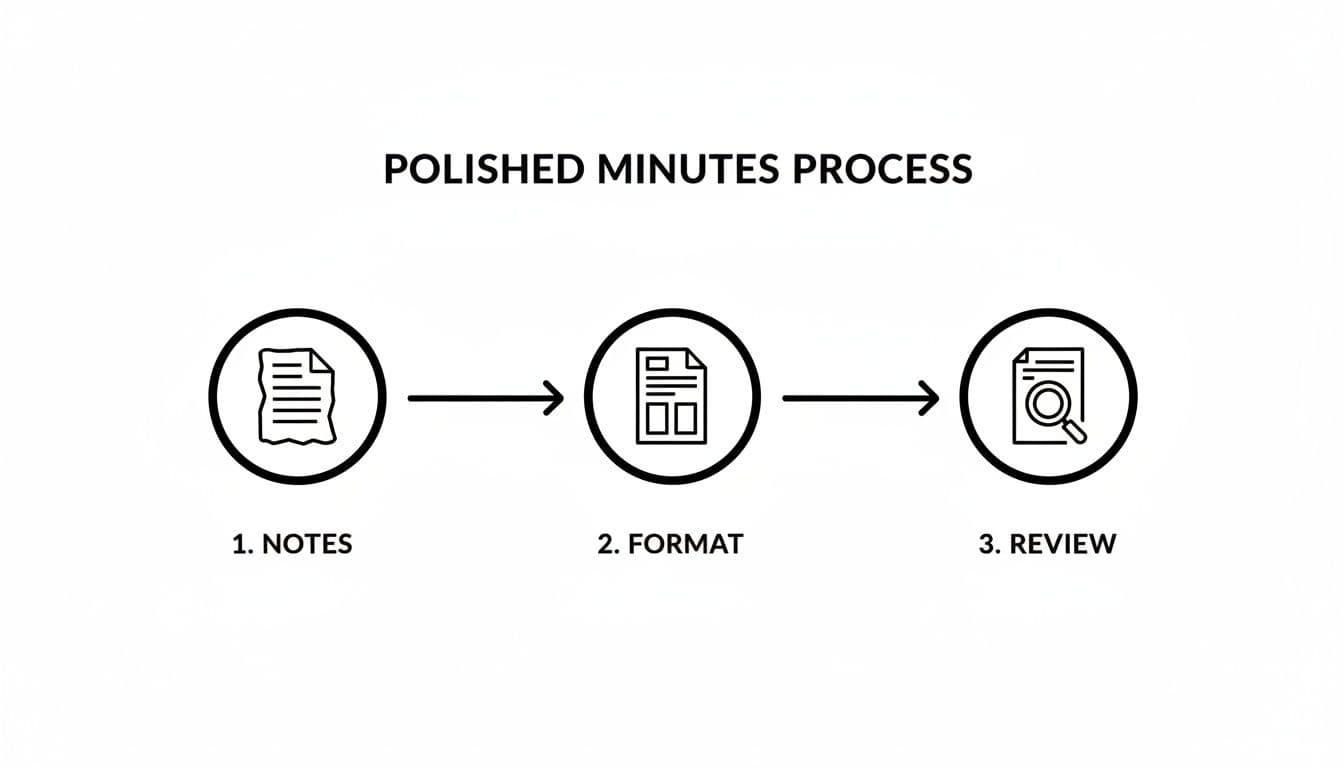
This process highlights a key point: whether you use an AI tool or a simple notepad, the core steps of formatting and reviewing your notes are what turn rough jottings into a reliable, official record.
A Practical Scenario with AI
Picture a project lead running a technical committee meeting. The conversation is dense with jargon and critical details that are incredibly easy to miss if you're typing everything by hand. By using an AI assistant to record and transcribe the call, the lead gets an instantly searchable record of the entire discussion.
Instead of spending hours scrubbing through an audio recording, they can just search for a keyword to pinpoint a specific decision. This saves a massive amount of time and ensures no critical detail ever falls through the cracks. The AI-generated summary also gives them a perfect high-level overview to share with stakeholders who don’t need the word-for-word transcript.
You can learn more about how to master meeting minutes with AI for faster, smarter meetings and see how it can truly change your workflow.
The Impact on Productivity
The time savings here are very real. With 55% of US meetings lasting between 30 and 60 minutes and companies spending around 15% of their collective time in meetings, the potential for improvement is huge.
Good AI summarization can reclaim thousands of hours across an organization. To get a wider view of how this fits into the bigger picture, you can explore various AI automation strategies. Ultimately, the time that was once spent on tedious transcription can be put back into more strategic work that directly impacts the bottom line.
Finalizing and Archiving Your Minutes
So, you’ve polished your notes and they look great. But you're not quite done yet. The final phase is just as important: getting the minutes approved, sent out, and stored safely for the long haul. Think of it like this: you've baked the cake, and now you need to ice it and put it on display.
Getting the Chair's Go-Ahead
Before you send the minutes out to the entire committee, your first stop should always be the chairperson. This is your most critical quality check. The chair can quickly catch any nuances you might have missed or correct a misinterpretation of a decision.
Getting their initial feedback saves a ton of headaches later. It ensures the draft is solid before it goes out for official review, preventing a long back-and-forth of corrections from the whole group.
Once the chair gives you the nod, it’s time to get formal approval.
Distributing for Group Approval
Your next move is to send the draft minutes to all committee members. A great time to do this is when you send out the agenda for the upcoming meeting. This gives everyone ample time to read through them and flag any potential changes.
Typically, the very first item on the next meeting’s agenda will be "Approval of Minutes from [Previous Meeting Date]." The committee will then formally vote to accept them, making them the official record. This whole process keeps things transparent and makes sure everyone is on the same page.
Building a Bulletproof Archive
After the minutes are formally approved, the last step is to archive them. This is more than just dragging a file into a folder. You're creating a permanent, organized, and legally sound record of the committee's work.
Whether you're using a secure cloud drive, a specialized board portal, or an internal server, the key is consistency. A well-maintained archive is essential for looking back at past decisions, staying compliant, and handling any potential audits.
It's easy to forget just how much time is spent in these discussions. In fact, only about 5.4% of meetings are automatically shortened, meaning most run their full, scheduled time. This makes a reliable archiving system non-negotiable—these documents are the official record of how that significant company time was spent. You can dig deeper into meeting trends and see how they impact productivity.
Properly filed minutes protect the organization's institutional knowledge and create a clear, traceable history of its decision-making.