Tired of notes that are just a wall of text? The mapping method of note taking offers a completely different, visual approach. Think of it less like writing a list and more like drawing a map of a conversation or lecture.
You start with the main idea right in the center of the page. From there, you branch out, connecting related sub-topics and details. It’s a dynamic way to see how every piece of information fits into the bigger picture.
Visualizing Connections with Note Mapping

The image above is a perfect example. Notice how the central topic is the anchor, with major ideas branching off directly. Those branches then split into smaller, more specific points, creating a clear visual hierarchy.
This non-linear structure is what makes the mapping method of note taking so powerful. It breaks free from the rigid, top-down format of traditional outlining and actually mimics how our brains work. We naturally jump from one idea to a related one, and this method lets you capture those connections as they happen. You're not just writing down words; you're building a visual model of the subject.
The Core Components of a Note Map
At its heart, the mapping technique is built on a few simple but powerful elements. Getting a handle on these is your first step to making this method work for you.
Here's a quick breakdown of what makes up a note map.
| Component | Purpose | Example |
|---|---|---|
| Central Idea | The single, core topic of your notes, placed in the middle. | A project name, a meeting's theme, or a lecture subject. |
| Primary Branches | The main sub-topics that connect directly to the central idea. | Key agenda items, main characters in a story, or core principles. |
| Secondary Branches | These extend from primary branches to add more detail. | Supporting data, specific action items, or relevant examples. |
| Keywords | Short, memorable words or phrases instead of long sentences. | Instead of "We need to increase sales," just write "Increase Sales." |
These pieces come together to create a clear, high-level overview that's easy to digest at a glance.
When you organize information this way, you create a powerful tool for studying or review that is far more memorable than pages of linear text. This makes the mapping method a fantastic choice for brainstorming sessions, summarizing meetings, or tackling complex subjects.
If you're interested in exploring more visual strategies, our guide on effective note taking methods mapping for better learning is a great next step.
How Visual Note-Taking Taps Into Your Brain's Full Potential
Think of traditional, line-by-line note-taking as a conversation that only uses half of your brain. It mainly fires up your left hemisphere—the part that loves logic, order, and sequence. That's useful, of course, but it leaves a lot of processing power on the table.
The mapping method is different. By bringing in shapes, colors, and spatial layouts, you wake up the right side of your brain. This is where your creativity, imagination, and big-picture thinking live. When you get both sides of your brain working together, you create a much stronger, more memorable understanding of the material.
Firing on All Cylinders: The Science Behind Better Recall
This whole-brain approach isn't just a neat trick; it's grounded in some solid science. A key idea here is dual-coding theory. It basically says that we learn and remember things much better when we process them in two different ways—verbally (with words) and visually (with images and structure).
When you create a note map, you’re not just writing down what you hear. You’re building a visual model of the topic in your mind at the same time.
This two-pronged attack on information gives you some serious cognitive advantages:
- You Process Information More Deeply: You have to actively think about how ideas connect, forcing you to organize and structure the information instead of just passively writing it down.
- You Create Better Memory Hooks: A specific color, a quick sketch, or even just where a topic sits on the page can act as a powerful trigger to help you recall complex details later.
- You Spot Connections Instantly: The visual layout makes it incredibly easy to see how different ideas relate to one another, often sparking brand-new insights you would have missed in a linear list.
Turning Abstract Ideas into Something You Can See
Imagine trying to understand a company's hierarchy by reading a long list of employee names and job titles. Now, picture looking at a simple organizational chart. The chart immediately shows you who reports to whom and how the teams fit together. It's instant clarity.
That's exactly what the mapping method does for any subject. It takes complicated or abstract topics and turns them into a tangible, visual story where all the pieces connect. Research has also shown that the physical act of handwriting activates parts of the brain tied to memory more effectively than typing. When you combine that with the visual power of mapping, you’ve got a seriously effective tool for making information stick.
Ultimately, by drawing out your notes as a map, you are literally building stronger connections in your brain. This makes it far easier to grasp complex relationships, think more creatively, and pull up key details right when you need them—whether you're in a high-stakes client meeting or cramming for a final exam.
Your Guide to Creating Your First Note Map
Ready to give it a try? Moving from theory to a real-life note map is much easier than it sounds. Think of it as sketching out a story or a conversation, all starting from one single idea. Let’s walk through how to get from a blank page to a clear, powerful note map in just a few simple steps.
The whole point is for the process to feel natural, letting your thoughts flow directly onto the page. It doesn't matter if you're using a pen and paper or a fancy digital app—the core ideas are exactly the same.
Step 1: Start with Your Central Idea
First things first, find the center of your page. This is where your entire map will grow from. Write down the main topic, the core theme, or the problem you're trying to solve. Try to keep it super concise—just one to three words is perfect.
Once you have it, draw a circle or a simple box around it. This small action does something important: it anchors your focus and acts as a visual signpost that says, "Everything else on this page connects back to this." It becomes the sun, and all your other thoughts will be the planets orbiting it.
Step 2: Draw Your Primary Branches
Now that you have your central idea locked in, it's time to branch out. Think about the main sub-topics that relate to it. These are like the big chapters of your story or the key items on a meeting agenda. For each one, draw a thick line extending out from your central circle.
On each of these main branches, label it with a single keyword or a very short phrase. For example, if your central idea is "Project Launch," your primary branches might be things like "Marketing," "Budget," "Timeline," and "Team Roles." This creates the basic skeleton of your map.
The process of connecting ideas this way engages both the logical and creative sides of your brain, helping you build a much stronger mental model of the information.
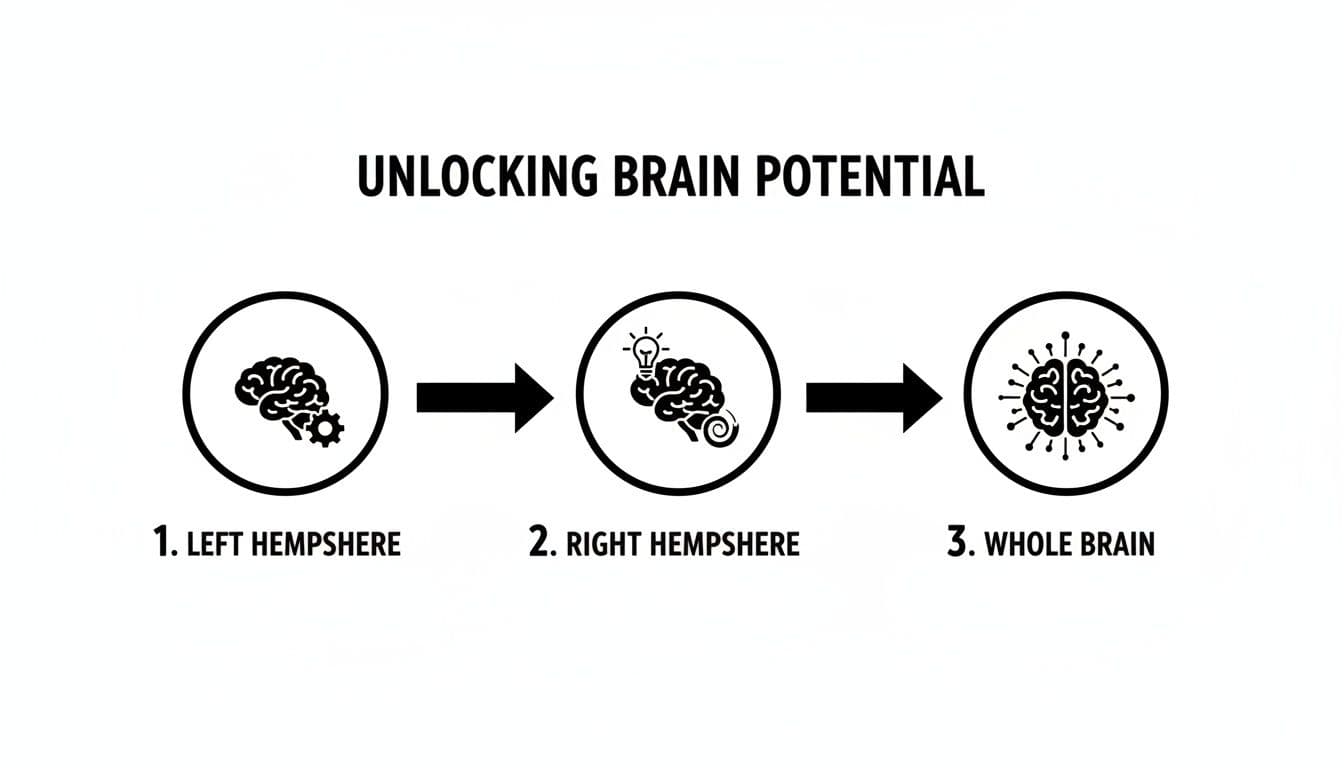
As the image shows, mapping helps you move from purely left-brain logic to right-brain creativity, pulling in your whole brain for better understanding and recall.
Step 3: Add Secondary Details
From those main branches, you can now start adding smaller, thinner lines for all the supporting details. These are your secondary (and even tertiary) branches. This is where you fill in specific stats, examples, questions that pop into your head, or action items that need to get done.
For instance, coming off the "Marketing" branch, you could add smaller branches for "Social Media," "Email Campaign," and "Blog Post." Then, from "Social Media," you could branch out again with "Content Ideas" and "Posting Schedule."
As you build out your map, keep these tips in mind:
- Keep branching out: Don't hold back. There’s no limit to how many layers you can add. Just let the ideas flow.
- Use single words: Stick to keywords whenever possible. It keeps the map clean and scannable.
- Draw curved lines: This might sound trivial, but curved lines are more visually engaging and easier for our brains to follow than stiff, straight ones.
Step 4: Use Visual Cues to Add Meaning
The last step is to make your map come alive with visual extras. This is where you really lean into the creative, right-brain power of mapping. A great way to start is by color-coding your main branches to instantly separate different topics.
You can also add simple icons or symbols to make important points stand out. Think a lightbulb for a new idea, a checkmark for a completed task, or a question mark for something that needs more research. These little visual cues act as powerful memory hooks.
Once your map is complete, you'll have a fantastic visual summary. The next step is turning it into results, and you can learn more about how to organize meeting notes for clarity and action to do just that.
When to Use the Mapping Method for Maximum Impact
While you could use the mapping method for just about anything, it really comes alive in situations where connections and context matter more than a strict, linear order. It’s not about throwing out your other note-taking systems; it’s about knowing when to pull the right tool from your toolkit.
Think of it this way: its free-flowing structure is perfect for situations that demand creativity and out-of-the-box thinking. You can get ideas down on paper as they pop into your head, without trying to squeeze them into a rigid, top-down list that can often stifle great insights.
Unlocking Creativity in Brainstorming Sessions
If there's one perfect match for the mapping method, it's brainstorming. Traditional lists can feel like a straitjacket, but a map lets ideas fly freely. Just pop the central problem or question in the middle of the page and let the thoughts branch out in every direction.
This technique is fantastic for capturing every little thought without judgment. As you add more ideas, you’ll naturally start to see unexpected patterns and themes take shape. A single keyword on one side of the map might trigger a whole new branch of thinking on the other—a connection that a simple list would never reveal.
Taming Complexity in Project Planning
Trying to plan a complex project can feel like juggling chainsaws. A note map can serve as your visual command center, giving you a bird's-eye view of the entire thing at a single glance. Place the main project goal in the center, then create major branches for key phases, teams, or deliverables.
From those main branches, you can drill down into specific tasks, dependencies, deadlines, and potential risks. The visual layout makes it incredibly clear how a delay in one area could cascade and affect another. For example, you can draw a direct line from a marketing task to a product development milestone, locking in crucial context that usually gets buried in spreadsheets or long documents.
This makes the mapping method of note taking a go-to for kickoff meetings and strategic planning sessions where everyone needs to be on the same page about the big picture.
Deepening Understanding for Study and Review
For anyone trying to learn a complex subject, mapping is a secret weapon. It’s one thing to read and memorize facts, but it’s another thing entirely to truly understand how they all fit together. Mapping forces you to actively process the information, not just passively absorb it.
It’s particularly powerful for:
- Connecting Historical Events: Go beyond dates and names. Map out the causes, key players, and long-term consequences of a historical event to see the complete narrative.
- Understanding Scientific Concepts: Visually link a biological process, like photosynthesis, to all its inputs, stages, and outputs.
- Structuring a Report or Presentation: Before you write a single slide, map out your main arguments, supporting evidence, and conclusion. This ensures your story flows logically and persuasively.
A Look at Different Note-Taking Techniques
Think of choosing a note-taking method like picking the right tool for a job. You wouldn't use a sledgehammer to hang a picture frame, right? The same logic applies here. The mapping method is an incredibly powerful and creative tool, but knowing how it stacks up against other systems helps you pick the perfect one for the task at hand.
The point isn't to crown one method as the undisputed champion. It's about building a flexible toolkit. When you understand what makes each system shine, you can confidently grab the best approach for any scenario, whether you're brainstorming a wild new project or just capturing notes from a structured meeting.
Mapping vs. Outlining vs. Cornell
So, how does the mapping method compare to other heavy hitters like the traditional Outline Method or the structured Cornell Method? Let's break it down. Each has its own distinct personality and purpose.
A Comparison of Popular Note Taking Methods
This table compares the Mapping Method with other common techniques across key criteria to help you choose the best approach.
| Method | Best For | Strengths | Weaknesses |
|---|---|---|---|
| Mapping Method | Brainstorming, understanding complex relationships, and creative thinking. | Visual clarity, flexibility, and strong memory recall through spatial connections. | Can get messy without practice; less suited for capturing dense, linear information quickly. |
| Outline Method | Structuring formal documents, lectures with a clear hierarchy, and sequential processes. | Highly organized, logical, and easy to convert into reports or presentations. | Can feel rigid and stifle creativity; tough to slot in new ideas out of sequence. |
| Cornell Method | Studying for exams, active recall, and summarizing key concepts from lectures. | Excellent for retention and review due to its built-in summary and cue sections. | Requires setup and review right after the session, so it isn't very spontaneous. |
As the table shows, if your goal is to build a neat, hierarchical structure for a formal paper, the Outline Method is a clear winner. It gives you a logical skeleton that’s simple to follow from point A to point B.
But for exploring new ideas and seeing how different concepts crash into each other, mapping is way more effective.
Ultimately, this comparison shines a spotlight on the unique role of the mapping method. It's your best bet when you need visual clarity, creative freedom, and a solid grasp of the big picture. For a deeper dive into similar visual tools, you might find value in understanding the key differences between concept maps and mind maps. This really solidifies mapping as a must-have technique in your note-taking arsenal.
Combining Note Mapping with Modern AI Tools

The mapping method is fantastic for seeing the forest, but what about the individual trees? It excels at capturing big-picture ideas, but you can sometimes miss the nitty-gritty details. This is where you can pair this classic, brain-friendly technique with some modern tech.
Think about your last important meeting. Instead of furiously typing to catch every word, imagine just being present. An AI tool can quietly record and transcribe the entire conversation, catching every single detail with perfect accuracy. This frees you up to actually think—to listen, ask smart questions, and read the room.
When the meeting's over, you’re left with a perfect, word-for-word transcript. That document is your raw material.
From Transcript to Strategic Map
Now that you have all the details captured, you can switch gears and apply the mapping method of note taking. Go through the AI-generated transcript and pull out the key themes, decisions, and action items. Use these to build a visual map that tells the story of the meeting at a glance.
This workflow completely changes your role. You’re no longer just a scribe; you’re a strategist. You let the AI handle the mechanical work of transcription so you can focus on the high-value job of making sense of it all.
The map you create isn't just a set of notes; it's a strategic document. It shows how different ideas connect, who is responsible for what, and what the key takeaways were. You can share this single visual with your team to get everyone on the same page instantly, turning a dense transcript into a clear, actionable plan.
Many of the best AI note taking apps for 2025 are designed to support this exact kind of hybrid approach. As you look into these tools, it's also worth checking out what's happening with AI chatbot platforms, as they offer other powerful ways to process information. This combination takes note-taking from a passive chore to a real strategic advantage.
Got Questions? We've Got Answers
Still have a few questions about making the mapping method work for you? Let's clear up some of the common sticking points people run into when they first start.
Can I Use the Mapping Method on a Computer or Tablet?
You absolutely can. While starting with pen and paper is fantastic for learning the ropes, digital tools like Miro, MindMeister, and XMind can take your maps to the next level.
Going digital gives you an infinite canvas, the ability to easily drag-and-drop ideas, and options to attach files or links directly to your notes. The thinking process is identical, but digital maps are a game-changer for team collaboration and brainstorming sessions.