Meetings are the engine of organizational progress, yet they often devolve into unproductive, time-consuming black holes. The culprit isn't the meeting itself, but the lack of a shared agreement on how to behave within it. This is where establishing clear, actionable ground rules of a meeting transforms chaos into collaboration. These aren't just bureaucratic formalities; they are the fundamental principles that create psychological safety, ensure focus, and drive genuine accountability.
By setting these expectations upfront, teams can eliminate common frustrations like late starts, distracting multitasking, and unresolved action items. This is particularly crucial for distributed teams where clear communication protocols are paramount. For those managing distributed teams, understanding the underlying issues can be significantly improved by reviewing broader topics like best practices for managing remote teams, which often include guidelines for effective meetings.
This guide provides a comprehensive list of eight non-negotiable ground rules of a meeting, complete with practical implementation tips, real-world examples, and strategies for enforcement. Adopting even a few of these will reclaim wasted hours and turn your meetings into the high-impact, strategic sessions they were always meant to be.
1. Rule #1: Start and End on Time, Without Exception
Punctuality is the bedrock of respect in a professional setting. Establishing and strictly adhering to meeting start and end times demonstrates that you value every participant's schedule. This ground rule prevents the common 'domino effect' where one late meeting disrupts an entire day's calendar for multiple people. It fosters a culture of accountability, ensuring discussions are focused and efficient.
By committing to a hard stop, teams are forced to prioritize agenda items and manage their time effectively. This leads to more productive outcomes in less time and is a fundamental component of effective ground rules of a meeting.
How to Implement This Rule
- Set Clear Expectations: In your meeting charter or team agreement, explicitly state: "All meetings will begin at their scheduled time and end no later than their scheduled time, regardless of who is present."
- Use the "Grace Period Lock": For virtual meetings, agree to lock the meeting one minute past the start time. This sends a clear message that tardiness is not accepted.
- Assign a Timekeeper: Designate a different person for each meeting to act as the timekeeper. Their job is to provide gentle reminders like, "We have 15 minutes left and two agenda items to cover."
Example Phrasing for Your Team
Enforcement and Follow-Up
Holding firm to this rule is critical. If a key stakeholder is late, start the meeting anyway. Cover the initial agenda items and brief them when they arrive. This reinforces the rule for everyone.
Meeting summarization tools can help enforce this by tracking attendance and logging the exact start and end times. Reviewing a summary from a tool like Summarize Meeting can highlight punctuality issues over time, providing data to address recurring problems with specific team members or meeting types.
2. One Person Speaking at a Time
This foundational rule ensures every voice is heard clearly and respectfully by allowing only one person to speak at any given moment. It eliminates cross-talk and interruptions, creating an environment where participants can engage in thoughtful listening rather than competing for airtime. This simple practice transforms chaotic discussions into organized, productive dialogue.
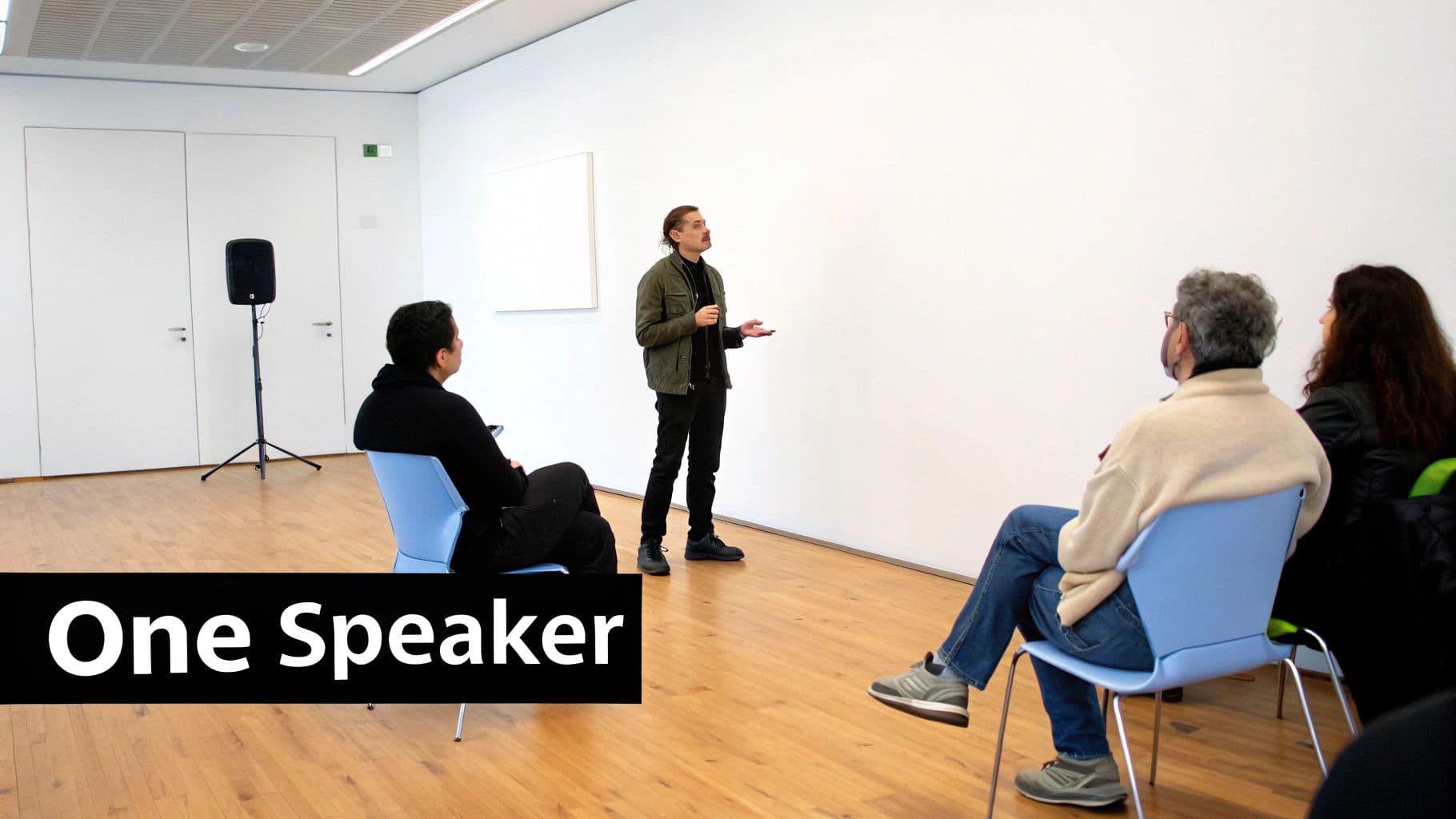
Adopting this as one of your core ground rules of a meeting builds a foundation of mutual respect and significantly improves clarity. It is a prerequisite for effective decision-making, as it ensures all perspectives are fully presented and understood before the group moves forward. Furthermore, this discipline is crucial for improving active listening skills within your team. For more on this, you can learn more about how to improve active listening.
How to Implement This Rule
- Establish a Speaking Order: For structured discussions, create a speaker list at the beginning of the topic. The facilitator calls on each person in turn.
- Use Hand-Raising Signals: Implement a clear signal, like a raised physical hand or the virtual "raise hand" feature in video conferencing tools, to indicate a desire to speak.
- Introduce a "Talking Piece": In smaller, in-person meetings, a physical object (like a pen or stress ball) can be passed to designate the current speaker. Only the person holding the object may talk.
Example Phrasing for Your Team
Enforcement and Follow-Up
The meeting facilitator is key to enforcing this rule. If an interruption occurs, they should gently intervene: "Thanks for your enthusiasm, [Name]. Let's let [Current Speaker] finish their thought first, and then we'll come to you." This validates the contribution while redirecting the flow.
Meeting summarization tools can help by providing transcripts that clearly show where conversations overlap or where one person dominates. Reviewing a summary from a tool like Summarize Meeting can highlight patterns of interruption, offering objective data to coach individuals and refine the team's adherence to this essential ground rule.
3. Rule #3: Stay on Topic and Follow the Agenda
A well-defined agenda is a meeting’s roadmap. Sticking to it ensures the discussion remains focused, productive, and concludes with the intended outcomes. This rule prevents "meeting drift," where conversations spiral into unrelated topics, wasting valuable time and derailing the decision-making process. It is one of the most critical ground rules of a meeting for maintaining efficiency.
By enforcing agenda adherence, you guarantee that every allocated minute serves a purpose. This focused approach not only respects participants' time but also dramatically improves the quality of decisions and ensures that critical topics receive the attention they deserve.
How to Implement This Rule
- Circulate the Agenda Early: Send out a clear, timed agenda at least 24-48 hours in advance. This allows participants to prepare their thoughts and contributions for specific items. For an in-depth guide, check out how to write an effective meeting agenda.
- Create a 'Parking Lot': Designate a space on a whiteboard or in a shared document as the "parking lot." When a valuable but off-topic idea arises, add it to the parking lot to be addressed at a later time.
- Appoint a Facilitator: The meeting leader or a designated facilitator is responsible for gently steering the conversation back to the agenda. Their role is to keep the discussion on track without stifling creativity.
Example Phrasing for Your Team
Enforcement and Follow-Up
Empower the facilitator to intervene when conversations stray. They can say, "That's an interesting point, let's add it to the parking lot and stick to our current agenda item to stay on schedule." This reinforces the rule in a constructive, non-confrontational way.
Meeting summary tools are excellent for enforcement. Tools like Summarize Meeting can generate a transcript and summary that clearly show how much time was spent on each agenda topic. Reviewing these summaries can highlight if meetings consistently go off-topic, providing data to help the team improve its discipline.
4. Rule #4: No Multitasking or Distractions
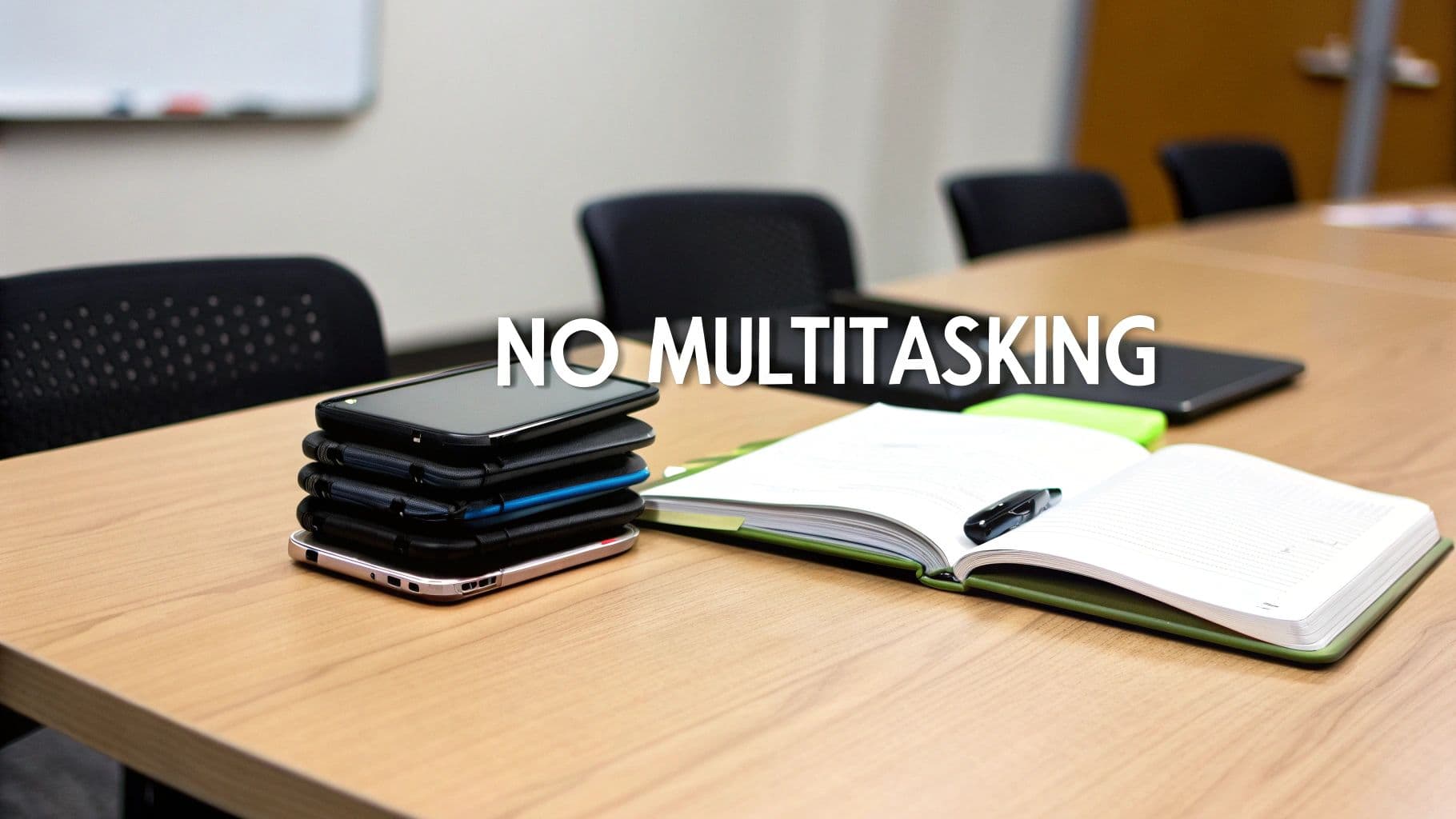
Requiring full, undivided attention is a ground rule designed to maximize the collective intelligence in the room. Prohibiting activities like checking email, using phones, or working on unrelated tasks ensures every participant can engage deeply, think critically, and contribute meaningfully. This rule is about respecting the purpose of the meeting and the value of everyone's presence.
When participants are fully present, the quality of discussion and decision-making improves dramatically. This approach, championed by thought leaders like Cal Newport in "Deep Work," transforms a passive audience into an active, collaborative team. It’s one of the most impactful ground rules of a meeting for fostering genuine engagement and innovation.
How to Implement This Rule
- Create a Device-Free Zone: Establish a clear policy, like Apple's legendary device-free leadership meetings. Have a designated basket or spot on the table where everyone places their phone, set to silent, at the start of the meeting.
- Designate a Single Scribe: Instead of every person typing on their laptop, assign one person to take official notes. This frees everyone else to focus on the conversation.
- Establish a "Video-On" Standard: For remote meetings, make cameras-on a non-negotiable standard. This increases accountability and helps participants stay engaged with the discussion rather than with other tabs.
Example Phrasing for Your Team
Enforcement and Follow-Up
Leadership must model this behavior first. If an executive is on their phone, the rule loses all credibility. If someone must be available for an urgent matter, they should state it upfront and step out of the room to take the call.
A meeting summarization tool can indirectly support this rule. When team members know a detailed summary and action items will be generated by a tool like Summarize Meeting, they feel less pressure to capture every detail themselves. This liberation from constant note-taking allows them to be more present and contribute more thoughtfully to the conversation.
5. Be Respectful and Professional
Professional courtesy is the currency of collaboration. When team members feel respected and psychologically safe, they are more willing to share honest feedback, propose innovative ideas, and engage in constructive debate. This rule is about fostering an environment where every viewpoint is treated with dignity, even during disagreement, which is fundamental to healthy team dynamics and effective ground rules of a meeting.
Inspired by Google's Project Aristotle findings, which identified psychological safety as the top predictor of high-performing teams, this rule moves beyond mere politeness. It encompasses active listening, conscious body language, and a commitment to separating ideas from the individuals who propose them, creating a space for true intellectual honesty.
How to Implement This Rule
- Establish a Civility Agreement: Drawing from models used at Harvard Business School, create a short, co-authored document that outlines specific respectful behaviors (e.g., no interruptions, no personal attacks) and unacceptable ones.
- Model the Behavior: Leaders must consistently demonstrate respect. Acknowledge valid points in opposing views, use "I" statements to express disagreement ("I see it differently because..."), and ask clarifying questions instead of making assumptions.
- Practice 'Disagree and Commit': Encourage robust debate during the meeting, but once a decision is made, everyone commits to supporting it. This separates the debate from the person and focuses on collective action.
Example Phrasing for Your Team
Enforcement and Follow-Up
Respect is non-negotiable. If a comment crosses the line, the meeting facilitator must intervene immediately and address it directly, stating, "Let's rephrase that to focus on the business problem, not the person." This reinforces the boundary in real-time.
A meeting summarization tool can discreetly help track conversational dynamics. Tools like Summarize Meeting create transcripts that can be reviewed to identify patterns of interruptions or dismissive language. This data allows a manager to provide specific, private coaching to individuals who may not be aware of their communication style's impact.
6. Rule #6: Encourage Participation and Inclusion
A meeting's success is directly tied to the quality and diversity of ideas discussed. Actively encouraging participation ensures that every voice is heard, from the most outspoken to the most introverted. This ground rule is designed to prevent groupthink, where a few dominant voices steer the conversation, and instead leverages the collective intelligence of the entire team. Creating an inclusive environment boosts psychological safety, leading to better problem-solving and more innovative outcomes.
By making space for every participant, you unlock valuable perspectives that might otherwise remain unspoken. This is a crucial element among the ground rules of a meeting because it transforms a monologue into a dynamic, collaborative dialogue, ultimately strengthening team cohesion and the quality of decisions.
How to Implement This Rule
- Establish a 'Round-Robin' Protocol: For key decisions or brainstorming sessions, go around the room (or virtual room) and give each person a chance to speak without interruption. This guarantees everyone contributes.
- Use Anonymous Input Tools: For sensitive topics, use tools like anonymous polls, digital whiteboards, or simple chat features to allow team members to share their thoughts without fear of judgment.
- Assign a Facilitator: This person's role is to monitor the conversational flow, gently redirect dominant speakers, and explicitly invite quieter members to share their thoughts.
Example Phrasing for Your Team
Enforcement and Follow-Up
The meeting leader must model inclusive behavior by thanking every contribution and validating different viewpoints. If you notice certain individuals consistently dominating, address it privately by asking them to help create space for others. This frames the feedback collaboratively rather than confrontationally.
Meeting summarization tools can provide data to support this effort. A tool like Summarize Meeting can generate a transcript that helps identify who speaks the most and who speaks the least over time. Reviewing these patterns allows you to objectively see if your participation ground rules are working and make adjustments as needed.
7. Rule #7: Maintain Confidentiality and Discretion
Trust is the foundation of open and honest communication. Establishing clear ground rules of a meeting that address confidentiality ensures participants feel safe to discuss sensitive topics, brainstorm freely, and challenge ideas without fear of their words being taken out of context or shared inappropriately. This rule is crucial for protecting proprietary information, personnel matters, and strategic plans.
By defining what stays "in the room," you create a secure environment that encourages candor and mitigates risk. This fosters psychological safety, allowing for more robust debate and better decision-making, especially in leadership, HR, or legal discussions.
How to Implement This Rule
- State Expectations Upfront: Begin any meeting involving sensitive information with a verbal reminder of confidentiality. For recurring meetings like board or executive sessions, include a confidentiality clause in the standing agenda.
- Use the "Chatham House Rule": For discussions requiring open debate, consider adopting this rule. Participants are free to use the information received, but neither the identity nor the affiliation of the speaker(s), nor that of any other participant, may be revealed.
- Segment Meeting Minutes: When creating notes, clearly separate public information from confidential decisions or discussions. This prevents accidental distribution of sensitive data.
Example Phrasing for Your Team
Enforcement and Follow-Up
Clear boundaries are key. If a breach occurs, it must be addressed directly and swiftly to maintain the integrity of the rule. For highly sensitive meetings, consider having attendees sign a simple non-disclosure agreement (NDA) as a formal acknowledgment of their responsibility.
Meeting summarization tools can assist in managing this rule by providing secure, permission-based access to meeting transcripts and summaries. For example, a summary from a tool like Summarize Meeting can be distributed to a specific user group, ensuring that confidential discussions remain contained while still allowing key stakeholders to review the outcomes securely.
8. Commit to Decisions and Action Items
A meeting without clear outcomes is just a conversation. The purpose of gathering is to make decisions and define the next steps required to move forward. This ground rule transforms discussion into tangible progress by ensuring every participant leaves with a crystal-clear understanding of what was decided, who is responsible for what, and by when. It creates a culture of execution and accountability.

By formalizing this process, teams avoid the all-too-common "I thought you were doing that" scenario that derails projects. Committing to decisions and assigning action items is one of the most critical ground rules of a meeting for turning talk into results.
How to Implement This Rule
- Designate a Scribe: Assign one person the role of documenting decisions and action items in real-time. This person should capture what was decided, who owns the action, and the deadline, displaying it on a shared screen if possible.
- Use the SMART Framework: Every action item should be Specific, Measurable, Achievable, Relevant, and Time-bound. This removes ambiguity and sets clear expectations for completion. To truly ensure your meetings lead to tangible progress, it's vital to master how to write effective meeting notes and action items that drive results.
- Verbally Confirm at Close: Before the meeting ends, the facilitator should read all decisions and action items aloud, asking for verbal confirmation from each owner. "Sarah, you're taking the lead on the Q3 budget draft, due next Friday. Is that correct?"