Think of conversation analytics software as the "game tape" for your business. It automatically records, transcribes, and, most importantly, makes sense of every single customer conversation happening across calls, chats, or emails.
This technology takes messy, unstructured conversations and turns them into clean, structured data you can actually use. It’s the difference between guessing what your customers want and knowing for sure.
Unlocking the Voice of Your Customer

Could you imagine coaching a football team without ever watching the game footage? It sounds ridiculous, but that's how many sales and support teams operate—relying on gut feelings, scattered notes, and secondhand stories.
Conversation analytics software changes all of that. It gives you a clear, unbiased look at what’s really being said on the front lines.
But these tools do more than just listen; they understand. Using AI, they dig into the nuances of language to pinpoint recurring topics, track customer sentiment, and even flag moments of buying intent. It's about finding the signal in the noise, and the insights are a goldmine for the entire company.
Who Benefits from Conversation Analytics?
The ripple effect of this technology is huge. It gives everyone a shared, accurate picture of the customer experience.
- Sales Teams: Discover the exact phrases and tactics your top reps use to close deals. You can then build coaching playbooks based on what actually works, not just theory.
- Customer Service: Keep a pulse on interaction quality, get new agents up to speed faster, and spot at-risk customers before they decide to leave.
- Product and Marketing Teams: Get raw, unfiltered customer feedback. This helps prioritize new features and tweak your marketing message to reflect the language customers are already using.
There's a reason the market for these tools is exploding. Projections show the global conversation intelligence software market growing from USD 25.3 billion in 2025 to a massive USD 55.7 billion by 2035, as more companies look for a data-driven edge.
Essentially, this software acts like a central hub for all your customer communication, turning raw conversations into smart business strategy. As we dig deeper, you might also find our guide on https://summarizemeeting.com/blog/what-is-conversation-intelligence-unlock-sales-service-insights helpful for a broader view. To get the full picture, it's also worth understanding the wider world of AI call center software where these tools play a key role.
Next, we’ll break down exactly how this technology works and show you how to put it to use for real, measurable results.
How This Technology Actually Works
So, how does this all work under the hood?
Think of conversation analytics software as a hyper-intelligent assistant who listens to every single customer conversation. But this isn't just about taking notes. This assistant figures out what the conversation actually means and turns messy, unstructured dialogue into a clear playbook you can use to improve your business. The whole thing happens in a few key steps, taking raw chatter and turning it into gold.
It all starts by pulling in the data. The software plugs into the places you talk to customers—your phone system, video platforms like Zoom, your email inboxes, and live chat tools. It grabs a copy of every interaction, creating a massive, centralized library of all your customer conversations.
From Spoken Words to Searchable Text
The first big technical hurdle is speech-to-text transcription. This is where the initial "magic" happens. The software takes the audio from your calls and meetings and, using some seriously smart algorithms, turns it into a written transcript. Getting this right is everything; accurate transcription is the bedrock for all the analysis that comes later.
It’s like building a house. If your foundation is cracked, the whole structure is compromised. In our world, the transcript is that foundation. If it's full of mistakes—misheard words or jumbled speakers—your insights will be completely unreliable. Good systems today can hit over 90% accuracy, even when dealing with thick accents, industry-specific jargon, or a dog barking in the background.
Suddenly, you have a searchable database of every single word said to a customer. Need to find every time a competitor was mentioned this quarter? Or every time a customer objected to your pricing? You can find it in seconds, without a human having to listen to a single recording.
Understanding What It All Means
Okay, so you have the words down. Now what? This is where the software gets really clever. It moves from just hearing words to understanding context, which is handled by a layer of AI called Natural Language Understanding (NLU). NLU is the brain of the operation and it's what makes this so much more powerful than a simple transcription service.
NLU figures out the intent and emotion behind the words. It doesn't just register the word "frustrated"; it understands this signals a customer is unhappy and at risk. For a deeper dive into the tech that powers this, check out our complete guide on Natural Language Processing.
This intelligent analysis breaks down into a few core capabilities:
- Topic Modeling: The software automatically detects and tags the main themes in each conversation. It learns to categorize chats into buckets like "billing questions," "bugs and glitches," or "positive feedback," giving you an instant overview of what’s on your customers' minds.
- Sentiment Analysis: This feature acts like an emotional barometer, gauging the tone of the conversation. By analyzing word choices and even the pace of speech, it can label interactions as positive, negative, or neutral. It can even spot when sentiment shifts during a call—for example, seeing a customer go from angry to happy once their problem is solved.
- Call and Interaction Segmentation: The platform automatically slices and dices each conversation into its key stages. For a sales call, it might identify the introduction, discovery, demo, and negotiation. For a support call, it might pinpoint troubleshooting steps and the final resolution. This makes it incredibly easy to jump to the moments that matter most.
At the end of the day, this technology is about decoding the DNA of your customer interactions. It goes way beyond just spotting keywords to deliver a deep, contextual understanding of what’s really going on. This is how you stop guessing and start making confident decisions based on the actual voice of your customer.
How to Use Conversation Analytics to Actually Grow Your Business
Knowing the tech behind conversation analytics is one thing, but how does it actually make a difference to your bottom line? This is where the magic happens. This software isn't just about listening in; it's about turning thousands of daily customer chats into a clear roadmap for growth, better efficiency, and even risk management.
Think of it this way: different departments can finally stop guessing and start making decisions based on what customers are really saying. The key is to see every conversation not as a one-off event, but as a constant stream of crucial business intelligence.
This simple workflow shows how it all comes together, turning raw chatter into a strategic advantage.
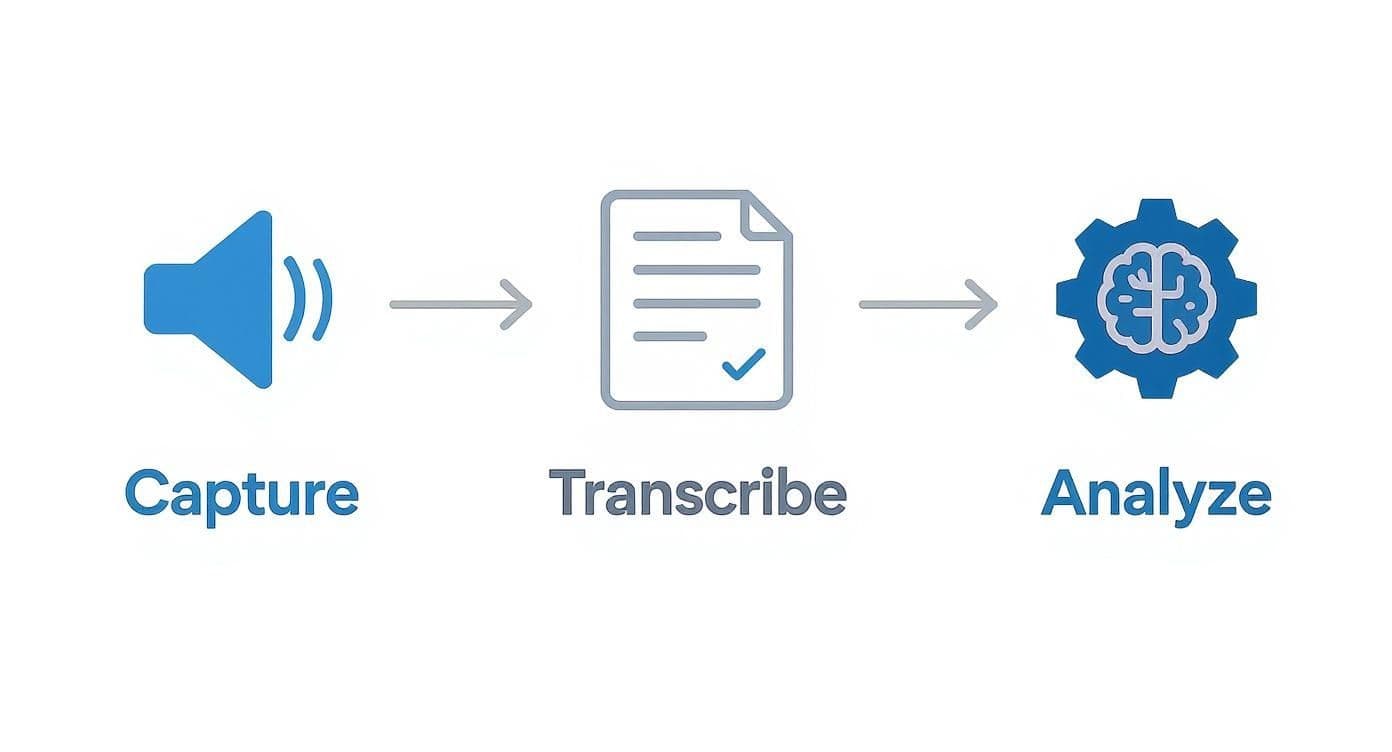
As you can see, the software captures the raw audio from a call, turns it into text, and then runs its analysis to pull out the patterns and insights that matter.
Give Your Sales Team a Data-Driven Playbook
For most sales managers, coaching is an art form built on gut feelings and watching a few calls. Conversation analytics software flips that script and turns it into a science. By analyzing every single sales call, the platform can pinpoint the exact phrases, questions, and objection-handling tactics your top performers use to close deals.
This creates an incredible feedback loop for the entire team. Instead of offering generic advice like "be more confident," managers can give specific, evidence-based coaching.
- Bottle the Magic: Find out which talk tracks have the highest win rates. You can then build a "greatest hits" library to get new hires up to speed faster and help reps who are struggling.
- Forecast with Confidence: Get an honest look at deal health. The software tracks customer sentiment and buying signals, giving you a much clearer picture than a rep’s hopeful summary.
- Shorten the Sales Cycle: By spotting the most common hurdles and questions, your team can get ahead of them and keep deals moving forward.
This data-first approach is central to modern sales. It's a huge piece of a bigger puzzle, which you can read about in our guide on what revenue intelligence is and how it works.
Shift Customer Support from Reactive to Proactive
Great customer support is all about solving problems fast and making the customer feel heard. Conversation analytics acts like an early warning system, helping teams spot friction before a small issue becomes a big one.
The software can automatically flag calls where a customer’s tone becomes negative or they use trigger words like "cancel" or "frustrated." This gives a supervisor the chance to jump in and save the relationship, either in real-time or with a quick follow-up.
This total coverage makes quality assurance consistent and fair. It also shines a light on bigger problems, like a recurring product bug or a confusing policy that’s flooding your support lines.
Uncover Priceless Product Insights from Real Conversations
Your product and marketing teams spend a ton of time and money on surveys and focus groups trying to capture the "voice of the customer." But the most honest, unfiltered feedback is already there—it’s happening every single day on your sales and support calls.
Conversation analytics software unlocks this feedback and makes it easy to measure.
- Track Competitor Mentions: Get alerts whenever a competitor comes up. You can dig into the context to see what your customers think their strengths and weaknesses are.
- Quantify Feature Requests: Stop guessing what to build next. The system can automatically tag and count how many times customers ask for a specific feature, giving your product team hard data for their roadmap.
- Find Your Customers’ Language: Hear the exact words customers use to describe their problems. This is gold for your marketing team, allowing them to write copy that truly connects.
These tools are becoming standard for a reason. Around 72% of Fortune 500 companies now use conversation intelligence to sharpen their sales and support. But it's not just for the big players. Thousands of smaller businesses are analyzing millions of calls to get an edge. By turning every conversation into a data point, companies of all sizes can make smarter decisions across the entire organization.
How to Choose the Right Software for Your Team
Picking the right conversation analytics software can feel overwhelming, but it doesn't have to be. The secret is to ignore the flashy marketing and focus on what actually matters for your team. You're not just buying another dashboard; you're investing in a tool that needs to deliver real, measurable value from day one.
Before you look at a single feature, start with the most fundamental element: transcription accuracy. Everything else—topic analysis, sentiment scores, and coaching recommendations—is built on this foundation. If the software can't tell the difference between "cancel" and "pencil," or if it garbles names and technical terms, the insights it produces will be worthless.
Think of it this way: garbage in, garbage out. A platform that can’t consistently deliver 90% or higher accuracy on your actual calls isn't worth considering.
Evaluating Core Performance Beyond the Demo
Sales demos are designed to look perfect. To understand how a platform will really perform, you need to lift the hood and ask some tough questions. A successful tool doesn't just have cool features; it fits into your workflow and grows with you.
Your evaluation should really boil down to three things:
- Seamless Integrations
- Intuitive User Experience (UX)
- Reliable Support and Scalability
Get these right, and you'll have a powerful asset. Get them wrong, and you'll have expensive shelfware.
Must-Have Integrations and Why They Matter
No software works in isolation. Its real magic comes from how well it talks to the other tools your team relies on every single day. Without solid integrations, you’re just creating more work, forcing people to juggle apps and manually copy-paste information.
At a minimum, your chosen platform needs to connect with your core systems:
- CRM (like Salesforce or HubSpot): This is non-negotiable. The software must automatically log call notes, discussion topics, and key moments directly into the right customer record. This keeps your CRM as the single source of truth, without anyone lifting a finger.
- Communication Tools (like Slack or Microsoft Teams): Imagine being able to share a "perfect pitch" moment from a call directly into a team channel for instant praise and learning. That’s what good integration looks like.
- Calendars (Google or Outlook): This is all about automation. The tool should know when meetings are happening, join them automatically, and record them without anyone having to remember to click a button.
The Make-or-Break Importance of User Experience
You could have the most powerful analytics engine in the world, but if your team finds it clunky or confusing, they simply won't use it. A steep learning curve is a recipe for low adoption, and soon enough, everyone will go back to their old ways.
When you're testing the user experience, ask yourself:
- Is the dashboard actually intuitive? Can a manager find key trends or review a team member's calls without needing a two-hour training session?
- How good is the search? You should be able to find every call where a specific competitor was mentioned in just a few clicks. It needs to be fast and accurate.
- Does it feel quick and responsive? Nothing kills enthusiasm faster than a slow, buggy platform.
Don't make this decision in a vacuum. Bring your sales managers and a few top reps into the demo process. If they get excited about how it can make their jobs easier, you’re on the right track. For a deeper dive into specific tools in this space, this voice charting software comparison guide is a fantastic resource to check out.
Vendor Evaluation Checklist
To help you stay organized and compare vendors apples-to-apples, use a checklist. This simple framework ensures you cover all the critical bases and don't get distracted by features you'll never use.
| Evaluation Criteria | Questions to Ask | Importance (High/Medium/Low) |
|---|---|---|
| Transcription Accuracy | What is your average accuracy rate with industry-specific jargon? Can we test it with our own call recordings? | High |
| Core Integrations | Does it offer a deep, two-way sync with our CRM? What about Slack/Teams and our calendar system? | High |
| User Experience (UX) | Is the interface clean and easy to navigate? How many clicks does it take to find a specific call or insight? | High |
| Coaching & Collaboration | Can managers create coaching playlists? Is it easy to comment on and share call snippets with reps? | Medium |
| Search & Analytics | How powerful is the search functionality? Can we build custom trackers for competitor mentions or product feedback? | Medium |
| Onboarding & Support | What does your onboarding process look like? What are your support SLAs and customer satisfaction scores? | Medium |
| Security & Compliance | Are you SOC 2 Type II certified? How do you handle data privacy and GDPR/CCPA compliance? | High |
| Scalability & Pricing | What does the pricing model look like? Does it scale fairly as our team grows? Are there hidden fees? | Low |
By systematically asking these questions, you can cut through the noise and find a partner, not just a vendor, who will truly help your team succeed.
Your Roadmap for a Successful Rollout
Buying conversation analytics software without a solid plan is like getting a pile of gym equipment delivered to your house and hoping you'll magically get in shape. The real value—the actual return on your investment—comes from a smart implementation that gets your team on board and is tied to real business goals. When done right, this isn't just another tool; it's an engine for growth.
The first step has nothing to do with technology. It’s all about defining what “success” actually means for you. Vague goals like “get better at sales” won’t cut it. You need specific, measurable targets that the software can help you hit.
Start thinking in terms of concrete Key Performance Indicators (KPIs). For example:
- Cut new hire ramp-up time by 25% in the next six months.
- Increase the team’s average deal size by 10% this quarter.
- Boost our customer satisfaction (CSAT) scores by 15 points.
- Slash compliance-related flags in QA reviews by 50%.
Setting clear targets like these from day one gives you a benchmark. It’s how you’ll measure progress and prove the software was worth it, turning a tech project into a strategic win for the business.
Winning Over Your Team with Change Management
Let’s be honest: the biggest obstacle you'll face isn't a technical glitch. It's people. If your team thinks this software is a "big brother" tool for spying on them, they’ll push back, and the whole initiative will fall flat. That’s why you can’t skip change management.