Conversation intelligence (CI) platforms are essentially AI-powered tools that listen in on and analyze customer conversations. Whether it's a sales call, a video meeting, or an email exchange, these systems dig through the dialogue to pull out actionable insights. They go way beyond just recording a call; they use natural language processing to spot trends, gauge customer sentiment, and highlight those critical moments that can make or break a deal.
Basically, CI tools turn all that raw voice and text data into a real strategic asset.
Unlocking the Value of Customer Conversations
Think about it: in any business, customer conversations are a goldmine of information. But most of that gold remains buried. Teams are often stuck relying on scattered notes, hazy memories, and CRM entries that don't tell the whole story. Conversation intelligence changes the game by systematically capturing, transcribing, and analyzing every single interaction. This creates a reliable, single source of truth about what your customers actually want and need.
At its core, any good CI platform has to be excellent at generating accurate transcripts, because turning spoken words into clean text is the foundation everything else is built on.

This space is booming for a reason. The global market for these platforms was valued around USD 6.3 billion in 2023 and is on track to hit an incredible USD 26.5 billion by 2033. That explosive growth is all about the power of AI and machine learning finally being applied to conversations at scale.
How CI Platforms Drive Business Growth
Instead of leaving you with a library of call recordings to sift through, these platforms deliver deep analysis that gives different teams a serious edge. This strategic approach makes every conversation a chance to get better and grow. If you want to go deeper into the specifics, check out our guide on what conversation intelligence is and how it unlocks insights.
Here’s how it breaks down for different departments:
- For Sales Teams: CI is a game-changer for coaching. It helps you figure out what your top performers are doing differently so you can replicate their success. The system can automatically flag deals at risk, pick up on competitor mentions, and make sure follow-up items never fall through the cracks. The result? Shorter sales cycles and more reliable forecasting.
- For Marketing Teams: These platforms are the ultimate focus group. They capture the authentic voice of the customer, giving marketers unfiltered feedback to confirm product-market fit, sharpen their messaging, and craft content that truly connects with their audience.
- For Support and Success Teams: By analyzing customer sentiment and spotting common frustrations, support teams can get ahead of problems, boost customer satisfaction, and ultimately reduce churn. It’s about moving from reactive to proactive.
By turning messy, unstructured conversations into clean, structured data, these platforms give leaders a clear-eyed view of what’s really happening on the front lines. This empowers them to make data-driven decisions that benefit the entire organization.
Evaluating Core Platform Capabilities
When you’re looking at conversation intelligence platforms, it’s easy to get distracted by flashy marketing claims. The real test is what’s under the hood. Not all tools are built the same, and the quality of their core features will make or break the value you get. A platform with a shaky foundation just can't deliver reliable insights.
The whole point of conversation intelligence starts with turning spoken words into text. This is your first and most important checkpoint. Pay close attention to speech to text accuracy, because it affects everything else. If your transcript is full of mistakes, any analysis built on top of it—like tracking sentiment or keywords—is going to be wrong.
Transcription and Speaker Identification
First things first, a solid CI platform has to give you clean, time-stamped transcripts. The best tools do this almost instantly, letting you follow along with a call as it happens. This is the bedrock feature. If you want to dive deeper into why this matters so much, check out our guide on meeting transcription.
But a raw transcript isn’t the full picture. The platform also needs to be excellent at speaker identification—knowing who is talking and when.
- For Coaching: You can't analyze a sales rep's talk-to-listen ratio if the platform can't tell their voice apart from the customer's or a colleague's. It's impossible to see how they handle an objection versus how their sales engineer jumps in.
- For Customer Insights: Knowing who said what helps you track feedback from specific roles. Is the VP of Finance raising a budget concern, or is it the end-user? The distinction is critical.
AI Summarization and Topic Tracking
Once the conversation is accurately captured, the real magic begins with AI analysis. No one wants to read a wall of text to find the important takeaways. Top-tier platforms use AI to boil down hours of talk into short, meaningful summaries.
This feature alone can save your team countless hours of manual note-taking and CRM data entry. But the best tools go a step further with automated topic and keyword tracking.
Let's say a sales manager wants to know how often a new competitor comes up in calls. They can just set up a tracker for that competitor's name.
- The Old Way: Manually read or search through dozens of transcripts, hoping to catch every mention.
- The CI Way: The platform automatically flags every time the competitor is mentioned, gives you the context, and even shows you if those mentions are trending up or down.
You can apply this to anything—pricing discussions, feature requests, or common objections. It transforms your call recordings from a passive archive into an active, searchable goldmine of market intelligence.
Analytics and CRM Integration
Finally, all these great insights are useless if they're stuck in a silo. A deep CRM integration is absolutely essential. I'm not just talking about linking a call recording to a contact in Salesforce or HubSpot; it has to be much smarter than that.
A great integration will automatically push key moments, sentiment scores, and action items directly into the right deal or opportunity record. This makes your CRM data so much richer, giving you a real, unfiltered view of your pipeline's health based on actual conversations, not just a rep's quick notes.
The platform's own analytics should also help you see the bigger picture. You could, for example, compare the language used by your top-performing reps to everyone else's and build a playbook of what actually works. This is what separates a simple call recorder from a true conversation intelligence platform—the ability to turn raw data from conversations into a real strategic advantage.
Comparing Top Conversation Intelligence Platforms
Trying to pick the right conversation intelligence platform can make your head spin. On the surface, a lot of them look the same, but the real difference is under the hood—in their transcription accuracy, AI models, and how well they plug into the tools you already use. The best choice for a massive enterprise sales team isn't necessarily the right fit for a fast-moving startup that needs quick customer insights.
Instead of just running down a list of features, we’re going to get practical. Let’s look at what actually separates major players like Gong and Chorus, along with some other great options. We'll dig into their core strengths and who they're really built for, helping you see past the marketing hype and find what actually works for your team.
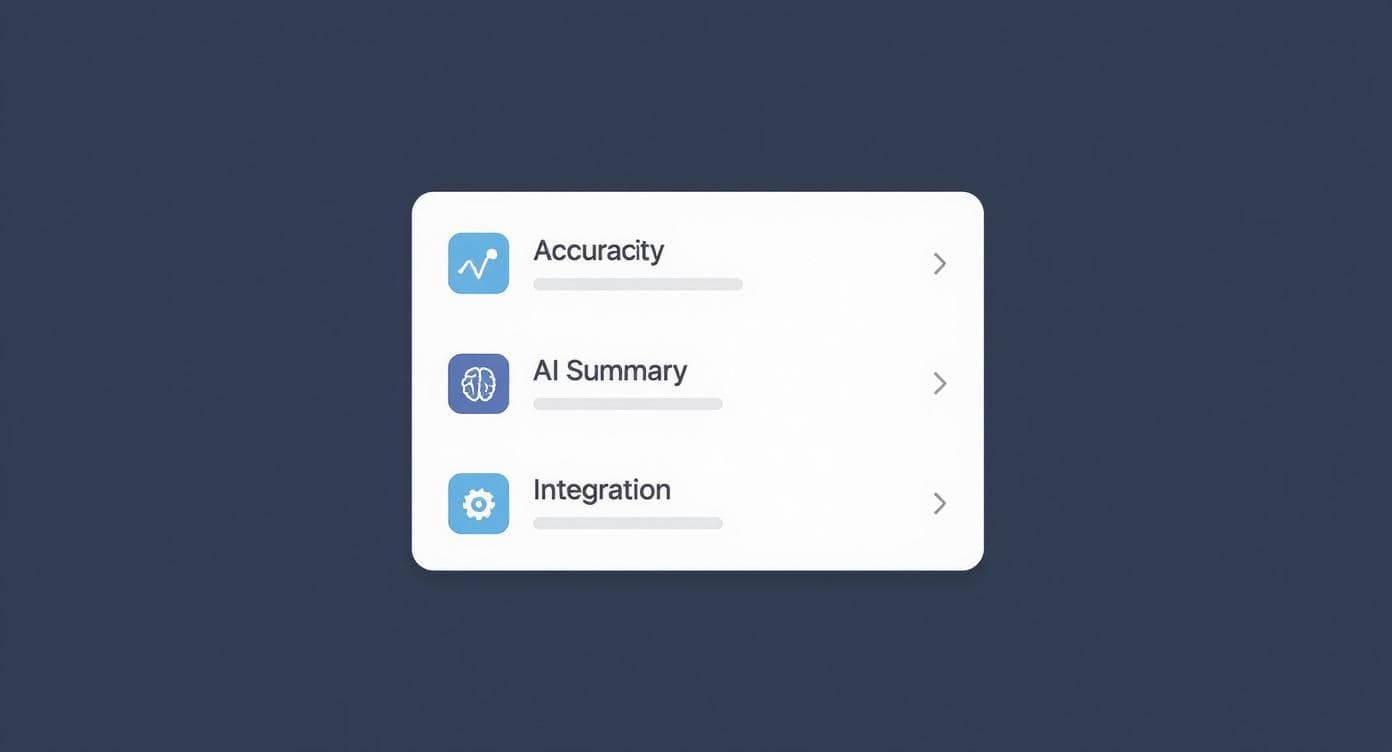
This really boils it down. Your success hangs on three things: getting the data right (Accuracy), turning that data into smart takeaways (AI Summary), and making it all work seamlessly with your CRM and other tools (Integration).
The Enterprise Titans: Gong and Chorus
For years, Gong and Chorus (which is now part of ZoomInfo) have been the two heavyweights in the conversation intelligence ring, especially for larger sales organizations. Both are incredibly powerful, but they come at the problem from slightly different angles.
Gong: The Coaching and Deal Intelligence Powerhouse
Gong built its name as the go-to platform for sales coaching and getting a crystal-clear view of your deals. It’s fantastic at spotting the patterns in conversations that separate your top performers from everyone else, then helping you teach those winning habits to the whole team.
- Key Differentiator: Its analytics are brilliant at connecting what’s said on a call to what happens in your CRM. Gong doesn’t just tell you a deal is at risk; it often tells you why, based on specific phrases, topics that were missed, or a drop-off in customer engagement.
- Best For: Enterprise sales teams that live and breathe data-driven coaching and need dead-on pipeline forecasts. If your main goal is to clone your best reps and get an honest, real-time look at deal health, Gong is tough to beat.
Chorus by ZoomInfo: The Go-To-Market Integration Specialist
Now that it’s part of the ZoomInfo world, Chorus has a unique advantage: it connects conversation insights with a massive database of B2B market data. While its coaching tools are solid, its superpower is enriching your call analysis with valuable context about who you're talking to.
- Key Differentiator: The tight integration with ZoomInfo means you can automatically pull in contact and company data. This gives you a much fuller picture of the entire buying committee and the account’s landscape right inside your call review.
- Best For: Teams already using the ZoomInfo platform. It’s also a great fit for anyone who needs to blend conversation data with market intelligence to sharpen their targeting and sales strategy.
Emerging Platforms for Different Needs
While Gong and Chorus own the enterprise space, other platforms are making a name for themselves by solving different problems, often with more flexible pricing. These aren't just simple call recorders; many offer sophisticated AI for very specific needs.
If you're curious about the broader landscape of AI tools for meetings, check out our deep dive into the top 10 AI meeting assistants. It’s a good way to see what's out there, from basic notetakers to full-blown intelligence platforms.
Here’s a look at a few alternatives and where they shine.
Platform Comparison At a Glance
To make these differences easy to see, here's a side-by-side look at how the platforms stack up. This table breaks down how each one is built to serve different business needs, from enterprise revenue teams to nimble SMBs.
| Platform | Key Differentiator | Best For | Transcription Accuracy | CRM Integration Depth | Pricing Model |
|---|---|---|---|---|---|
| Gong | Deep deal intelligence and analytics for revenue predictability. | Enterprise sales teams focused on coaching and forecasting. | Very High | Deep and contextual | Per User, Annually |
| Chorus.ai | Seamless integration with ZoomInfo's B2B data for market context. | Organizations leveraging ZoomInfo for their go-to-market strategy. | Very High | Deep with ZoomInfo | Per User, Annually |
| Avoma | All-in-one meeting lifecycle assistant with real-time coaching. | SMBs and mid-market teams needing a versatile, affordable tool. | High | Broad and functional | Per User, Monthly/Annually |
| Fireflies.ai | Broad language support and strong automation for note-taking. | Global teams and individuals needing automated meeting summaries. | High | Wide, but less deep | Freemium/Per User |
As you can see, the "best" platform is completely situational. A startup could get immense value from Avoma's blend of features and affordability, while a global corporation will benefit from Gong's enterprise-grade forecasting.
The right choice comes down to matching a platform’s strengths with your team's biggest challenges. When you get it right, you’re not just buying software—you’re giving your team insights that lead directly to better performance and real growth.
How Different Teams Drive Results with CI
It's one thing to talk about conversation intelligence in the abstract, but its real power comes to life when you see how different teams use it to solve their biggest problems. This isn't just another analytics tool; it’s a growth engine that turns everyday customer conversations into a roadmap for better decisions.
By capturing and structuring what’s actually being said on calls, these platforms help teams move past guesswork. The impact is tangible, and it’s a big reason why the market is booming. In North America alone, conversation intelligence software commands a market share of over 40.3%, bringing in USD 9.32 billion in revenue. This is largely thanks to a solid tech foundation and a culture of adopting AI-driven tools early on. You can find more data on CI software market trends at market.us.
Let's break down how this technology works in the real world for the teams on the front lines.
Sales Teams Close Deals Faster and More Predictably
For a sales organization, conversation intelligence is a game-changer. It gives leaders a way to finally understand the DNA of a successful sales call and use it to build a more consistent, high-performing team.
The most popular use case? Cloning your top performers. Instead of wondering what makes your best rep so good, you can see it. The platform analyzes their questioning techniques, how they handle tough objections, and the language they use to build rapport. This insight becomes a practical, data-backed playbook for everyone else, lifting the performance of the entire team.
It also takes the guesswork out of forecasting. Forget relying on a rep’s subjective CRM notes. Now you can get a real-time pulse on deal health based on what's said in the conversation.
- Spotting Risks: The system can automatically flag calls where a prospect mentioned budget issues that were never fully addressed, or where the next steps were left vague and non-committal.
- Tracking Engagement: It can even measure how engaged a buyer is by looking at things like their talk-to-listen ratio. Are they asking questions or just listening passively?
This gives sales managers a chance to jump in and help before a deal goes sideways, leading to shorter sales cycles and a pipeline you can actually count on.
Customer Success Proactively Reduces Churn
For customer success (CS) teams, the mission is all about retention and growth. Conversation intelligence acts as an early-warning system, helping them spot at-risk accounts long before they become a churn statistic.
You can set up the platform to listen for specific churn signals during check-ins and support calls. These could be mentions of a competitor, repeated frustrations with a feature, or a noticeable drop in positive language over a few conversations.
These tools also sharpen the onboarding experience. By analyzing calls with new customers, CS teams can pinpoint common hang-ups or features that cause confusion. That feedback flows right back into improving the onboarding process, helping new users get value faster and feel confident from day one.
Marketing Gets an Unfiltered Voice of the Customer
Marketers are always trying to get inside the heads of their customers. Conversation intelligence offers them the most direct route possible—no more relying on surveys or focus groups, which often don't capture the full story. Instead, they can tap into thousands of authentic sales and support calls.
This raw, unfiltered data is a goldmine for refining messaging and positioning. Marketers can hear firsthand which value propositions actually land with prospects and which ones fall flat. This insight helps them write website copy, ad campaigns, and emails that speak directly to what customers care about.
For instance, if the platform shows that customers consistently use a specific phrase to describe their biggest problem, the marketing team can adopt that exact language. It’s a simple but powerful way to ensure your go-to-market message truly reflects how your customers think and talk, making everything you do more effective.
How to Pick the Right Platform for Your Business
When it comes down to it, the final decision is all about matching a platform’s strengths to your business's real-world needs. The perfect tool for a startup scrambling to onboard new sales reps looks completely different from what a big enterprise needs for compliance and revenue forecasting. Your choice has to be a reflection of your team's size, what you're trying to achieve, and the tech you already use.
It’s easy to get distracted by the platform with the longest feature list. Don't fall into that trap. Instead, zoom in on the features that solve your biggest headaches right now, but also give you room to grow. Knowing what you truly need is the first step to making a smart investment.
Matching Platforms to Your Team's Reality
The "best" platform is a myth; it’s all about what's best for you. A small sales team is looking for something lean and affordable. A global organization, on the other hand, needs something that can scale and meet strict security demands.
- For Startups and Small Businesses: Your world revolves around getting new reps up to speed, closing deals, and nailing product-market fit. The sweet spot is a platform that gives you solid meeting summaries, some basic coaching analytics, and a no-fuss CRM connection. You'll want to look for flexible, per-user pricing that won't break the bank as you grow.
- For Mid-Market Companies: You've found what works—now it's time to scale it. The focus shifts to more formal coaching, figuring out what makes your top reps tick, and getting a better handle on your sales forecast. This is where a platform with stronger analytics, custom scorecards, and the ability to track things like competitor mentions becomes essential.
- For Enterprise Organizations: For big companies, security, compliance, and deep-dive data analysis are table stakes. You need a platform with tight user permissions, automatic PII redaction, and the ability to plug seamlessly into a complex tech stack, like Salesforce or your business intelligence tools. Being able to analyze calls across multiple languages and regions is often a huge deal, too.
A Practical Vendor Evaluation Checklist
Once you have a shortlist, it’s demo time. This is your chance to get past the sales pitch. Push them with pointed questions that show you how the platform will actually perform for your team day-to-day. A good checklist keeps you focused and makes sure you don't miss anything critical.
Here are the must-ask questions for every vendor:
- Implementation and Onboarding: Walk me through your onboarding process. How long does it really take? What kind of hands-on support can we expect during rollout and afterward?
- Transcription and Language Support: What are your real-world transcription accuracy numbers, especially with our industry's jargon? What languages and dialects do you cover?
- Integration Depth: How deep does the CRM integration go? Can it update custom fields and objects automatically, or are we just talking about syncing call notes?
- Security and Compliance: How do you handle data encryption and storage? What certifications do you have, like SOC 2 or GDPR? Can you show me how you handle PII redaction?
- Product Roadmap: What’s on your roadmap for the next 6-12 months? How do you actually use customer feedback to decide what to build next?
Getting Your CI Platform Up and Running for Maximum ROI
Picking the right conversation intelligence (CI) platform is half the battle; the other half is getting it implemented correctly. The real value isn't in the software itself, but in how well you roll it out. A great plan is what drives user adoption and ultimately delivers a solid return on your investment.