Is it legal to record a conversation? The short answer is a classic lawyer response: it depends. The legality of hitting that record button all comes down to where you are, who you're talking to, and a crucial legal concept called 'consent.'
Understanding the Two Worlds of Recording Consent

Think of recording laws like a social rule. Sometimes, just one person in a group can make a decision for everyone, but other times, you need a unanimous vote. This is the fundamental difference between the two main legal frameworks that govern recording conversations.
Getting a handle on these two models is the first step to staying compliant, whether you're transcribing a client call, saving a team brainstorm, or documenting an important interview.
One-Party Consent: The Simpler Approach
The most widespread rule, especially in the United States, is one-party consent. It's pretty straightforward: as long as you are part of the conversation, you can legally record it without telling anyone else.
In this scenario, you are the "one party" giving consent. This is the law in 38 U.S. states and the District of Columbia, making it easy for people and businesses to keep records for accuracy, training, or just to remember what was said.
Two-Party Consent: The Stricter Standard
The other side of the coin is two-party consent, often called "all-party consent." This is the more buttoned-up, cautious approach. In places with these laws, you need to get explicit permission from every single person on the line before you can start recording.
And they mean everyone. If you’re on a video call with 10 people, you need consent from all 10 of them. This standard puts individual privacy first, making sure nobody is recorded without knowing and agreeing to it. It’s the law in states like California, Florida, and Illinois, and it’s a core principle behind international privacy rules like Europe’s GDPR.
To make this crystal clear, here’s a quick breakdown of how these two models stack up.
One-Party vs Two-Party Consent at a Glance
| Consent Model | What It Means | Common in... | Example Scenario |
|---|---|---|---|
| One-Party Consent | Only one person in the conversation needs to know and agree to the recording (and that person can be you). | The majority of U.S. states (e.g., Texas, New York, Ohio). | A sales rep in Texas records a call with a client in Arizona for training purposes without explicitly asking the client. This is legal. |
| Two-Party Consent | Every single person in the conversation must know they are being recorded and agree to it. | A minority of U.S. states (e.g., California, Florida, Illinois) and many international laws. | A project manager in California holds a video call with a remote team. She must announce the call is being recorded and get everyone's agreement to proceed. |
Understanding which rule applies is the name of the game, especially when your team is spread out.
This is non-negotiable for remote companies. A simple team meeting can easily cross multiple legal jurisdictions, making a clear and cautious policy your best defense. We’ll get into how to build those policies and what they look like in the real world.
One-Party Versus Two-Party Consent States
In the United States, figuring out if it's legal to record a conversation isn't a simple yes or no. The country is a patchwork of state laws, creating two very different legal environments. Your first step toward compliance is knowing which set of rules you're playing by.
This legal split has its roots in The Omnibus Crime Control and Safe Streets Act of 1968, which set the federal ground rules for wiretapping. This act established a baseline requirement of one-party consent, which most states adopted. As of 2023, 38 out of 50 U.S. states and the District of Columbia follow this model, making it the most common standard. You can dig deeper into the history of call recording laws on Klenty.com.
That still leaves a dozen states that hold companies to a much higher standard.
Understanding One-Party Consent
Most states follow what's known as the one-party consent rule. You can think of this as the "participant's privilege." If you are an active part of a conversation, you have the right to record it. You don't need to tell anyone else on the call or get their permission.
You are the "one party" giving consent.
This is the law in states like Texas, New York, Ohio, and Arizona. For businesses, this makes things a bit simpler. A customer service team can record calls for training, or an internal team can record a meeting for notes, as long as at least one employee on the call knows it's being recorded.
For instance, a sales rep in Georgia (a one-party state) can legally record a discovery call with a prospect without ever mentioning it.
The Stricter World of Two-Party Consent
On the other end of the spectrum are the two-party consent states. A better name for them is "all-party consent" states, because they put every individual's privacy first. In these places, you must get clear permission from every single person on a call before you hit record.
This rule applies whether it's a one-on-one call or a 20-person video conference. States like California, Florida, Illinois, and Pennsylvania enforce this tougher standard. If you fail to get everyone's buy-in, you could be facing serious trouble, from civil lawsuits to criminal charges.
What Happens When State Lines Get Crossed
This is where it gets tricky, especially for remote teams and national businesses. What happens when your employee in one-party Texas calls a client in two-party California? Whose law wins?
Courts have landed on different sides of this issue, so there’s no single, settled answer. Because of that ambiguity, the only smart move is to always follow the strictest law that applies to anyone in the conversation.
Here's the breakdown:
- Employee Location: Texas (One-Party Consent)
- Client Location: California (Two-Party Consent)
- The Safest Action: You must get the client's consent before recording to comply with California's stricter law.
Playing it safe is the only way to minimize your legal risk. While a routine support call might seem low-stakes, a sensitive negotiation recorded without proper consent could blow up into a massive liability.
Simply announcing that the call is being recorded and waiting for everyone to acknowledge it is your best compliance safety net. The most bulletproof strategy is to make all-party consent your default company policy for every recording, no matter where people are. It's the best way to protect your organization and build trust with clients and partners.
Global Recording Laws: What Happens When Your Team Crosses Borders?
When your team members, clients, or partners are scattered across the globe, the question of whether you can legally record a conversation gets complicated—fast. You're no longer just dealing with state laws. Crossing international borders means stepping into a world of different privacy expectations and much stricter rules. A consent model that’s perfectly fine in one country could land you in serious legal hot water in another.
For any business with an international footprint, a one-size-fits-all approach to recording simply won’t cut it. Every country has its own legal playbook, and not knowing the rules can lead to steep penalties, especially in regions that put individual data privacy on a pedestal.
Europe's GDPR: The Gold Standard for Consent
The most important international framework to get your head around is the European Union's General Data Protection Regulation (GDPR). This isn't just a set of loose guidelines; it's a powerful data privacy law that sets a very high bar for handling personal data—and yes, that includes voice recordings—for anyone in the EU.
Under GDPR, a recording is considered personal data, and you can't just collect it without a valid legal reason. For most business meetings, that reason is explicit, informed consent. This is a much tougher standard to meet than a quick, automated "This call is being recorded" message.
The GDPR, which came into force in May 2018, was a game-changer. Article 6 of the regulation makes it clear: call recording is only lawful if someone has given explicit consent for a specific, legitimate purpose. In countries like Germany and France, recording without consent isn't just a mistake; it's a criminal offense that can lead to fines and even prison time. You can dig into more of the specifics in this world recording laws overview.
A Quick Tour of Key Global Regions
While the EU sets the high-water mark, other major economic hubs have their own rules you need to follow. They often share the same spirit as GDPR but come with their own unique twists.
United Kingdom
After Brexit, the UK didn't throw out the rulebook. It adopted its own version, the UK GDPR, which basically mirrors the EU's regulations. That means the same high standards for explicit consent and transparency apply. If you have employees or customers in the UK, the approach is the same: get clear, informed consent before you hit record.
Canada
Canada's federal privacy law is the Personal Information Protection and Electronic Documents Act (PIPEDA). Much like GDPR, PIPEDA requires organizations to get meaningful consent to collect, use, and share personal information, which includes voice recordings.
To stay on the right side of PIPEDA, you have to:
- Announce it: State clearly at the start of the call that it's being recorded.
- Explain why: Tell them the purpose of the recording (e.g., for note-taking or training).
- Get consent: The person must knowingly agree. While staying on the call after being told is often seen as implied consent, getting an explicit "yes" is always the safest bet.
Germany: A Case Study in Strict Rules
Germany is famous for having some of the toughest privacy laws on the planet, even by the EU's strict standards. Recording a private conversation without everyone's permission isn't just a civil issue—it's a criminal offense under Section 201 of the German Criminal Code.
This law is designed to protect the "confidentiality of the spoken word" and comes with serious consequences, including big fines and potential jail time. For businesses, this means there is zero margin for error. If even one person on a call is in Germany, you absolutely must get explicit consent from every single participant. No exceptions.
This strict stance teaches a vital lesson for global companies: never assume your home country's laws will protect you abroad. When you're operating internationally, the smartest and safest strategy is to adopt the highest standard—explicit, all-party consent—as your default policy for every recording. It doesn't just keep you out of legal trouble; it builds trust by showing your international clients and team members that you respect their privacy.
Staying Compliant with Remote Teams and AI Tools
The move to remote work has effectively turned every meeting into a potential international event. While this opens up a world of collaboration, it also makes recording compliance a real headache. When your team members and clients are scattered across different cities, states, or even countries, figuring out whether it's legal to record a conversation becomes a complex puzzle.
You can't just rely on simple one-party or two-party rules anymore. The biggest challenge is jurisdictional overlap. Imagine a single video call with participants from Texas (a one-party consent state), California (an all-party consent state), and someone dialing in from Germany (operating under GDPR).
In these mixed-jurisdiction meetings, there's only one safe way forward: you have to follow the strictest law in the group.
This isn't just about covering your legal bases; it's about building trust. A clear, upfront announcement shows respect for everyone's privacy and helps you sidestep messy legal issues down the road.
Obtaining Clear Consent in Virtual Meetings
Getting permission in a virtual meeting is actually pretty simple if you make it a standard part of your process. Where teams get into trouble is when they start making assumptions. The best approach is a layered one that ensures consent is both informed and crystal clear.
You can do this with a few combined methods:
- Verbal Announcements: Kick off every meeting with a simple, friendly heads-up. Saying something like, "Just so everyone knows, we'll be recording this session for our notes. Is everyone okay with that?" works perfectly. The key is to actually pause and wait for people to agree.
- Visual Notifications: Modern meeting platforms are built to help with this. Tools like Zoom and Google Meet automatically show a prominent "Recording" indicator that everyone can see. This visual cue acts as a constant, subtle reminder that reinforces your initial verbal announcement.
When you use both—a clear verbal statement and a persistent visual icon—you create a strong record of consent that’s hard to argue against.
The Rise of AI Meeting Assistants and Transcription Tools
Now, throw AI-powered meeting assistants into the mix. These tools are fantastic for productivity—they can automatically join calls, record the audio, and spit out transcripts and summaries. But here's the catch: they aren't exempt from recording laws.
Legally speaking, an AI bot is no different from a person hitting the record button. All the same one-party and two-party consent laws apply. The responsibility for compliance falls squarely on the shoulders of the person who invited the bot to the meeting.
This is a critical detail many people miss. If you invite an AI assistant to a meeting with participants in a two-party consent state without getting permission from everyone, you're breaking the law. It’s a crucial point to understand if you’re thinking about how to have an AI listen and take notes during your meetings.
Thankfully, most reputable AI meeting tools are designed with compliance in mind and often include features to help you meet your legal obligations.
This flowchart breaks down the basic decision-making process for whether a recording is legal. Notice how the first question is always about checking for participants in high-regulation areas like the EU.
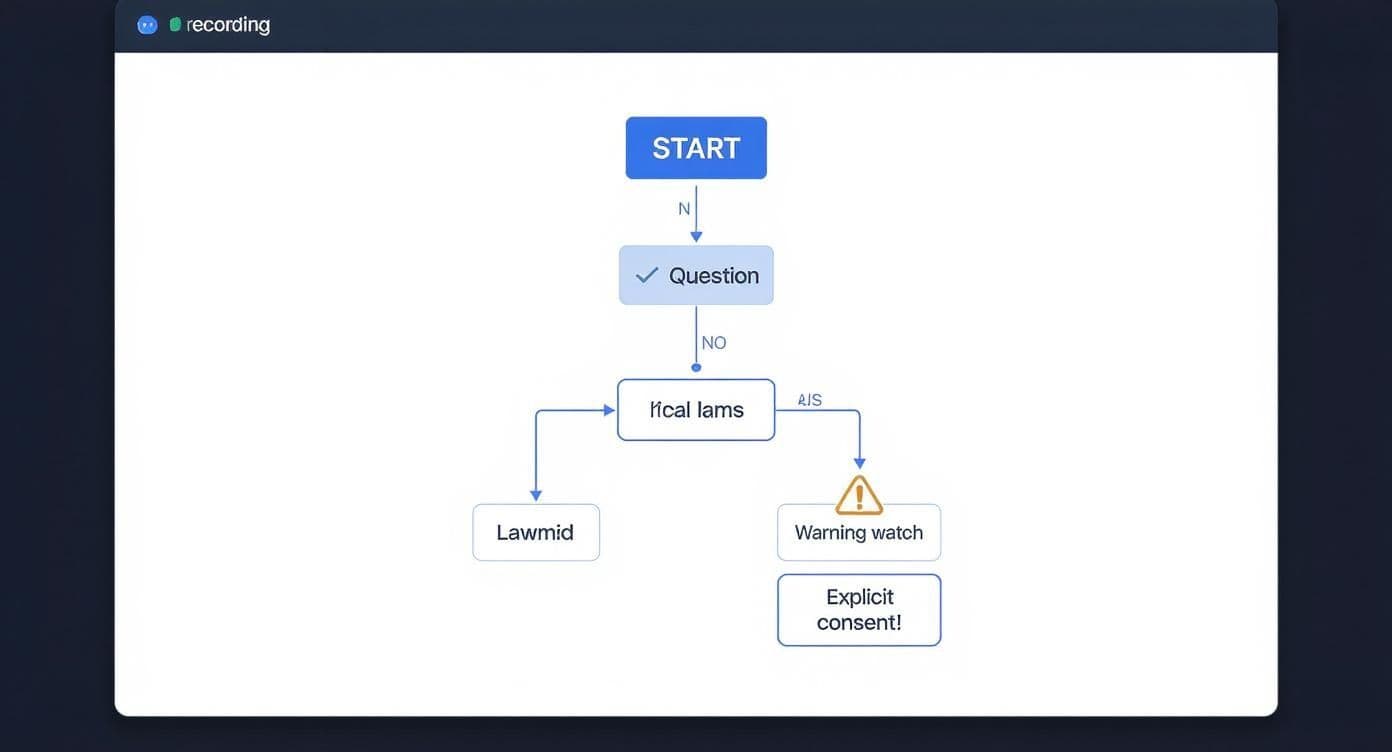
As the chart shows, the presence of just one EU participant immediately escalates the consent requirement, highlighting why knowing your audience's location is so important. When you bring in tools to record or process conversations, knowing the capabilities of AI powered transcription services is a big part of staying compliant.
To use these tools legally and ethically, you should:
- Configure Automated Notifications: Set up your AI assistant to automatically announce itself—both with a voice prompt and a message in the chat—right at the start of the meeting.
- Customize Consent Settings: Look for features that require attendees to actively consent before recording begins, like clicking an "I agree" pop-up.
- Inform Your Team: Make sure everyone in your organization who uses these tools understands that they are responsible for getting consent, just as if they were recording manually.
By treating your AI assistant like any other participant who needs to be introduced, you can take full advantage of its benefits without putting your organization at legal risk.
How to Create a Bulletproof Recording Policy

Knowing the laws is one thing, but putting that knowledge into practice is a completely different ballgame. A clear, comprehensive recording policy is your company’s best friend—it helps you sidestep legal headaches and builds a foundation of trust with everyone you interact with.
Without a formal policy, you're essentially leaving compliance up to individual employees. That’s a recipe for inconsistency and risk. A well-crafted policy, on the other hand, standardizes your approach so that every recording, from a sales call to an internal training session, is handled the right way, every time.
Think of this as your blueprint for recording conversations responsibly.
H3: Start With Purpose and Scope
First things first: before you get into the nitty-gritty rules, you need to be crystal clear on why and what you’re recording. This simple step sets the stage for everything else and helps your team understand the logic behind the policy.
The purpose statement needs to spell out the legitimate business reasons for recording conversations. Don't just say something vague like "for business purposes." That won't cut it.
Next, the scope defines exactly which conversations fall under the policy. Does it cover all external calls? Only certain internal meetings? Video conferences but not audio-only calls? A precise scope eliminates confusion and ensures everyone applies the rules consistently.
H3: Define Clear Consent Procedures
This is the most critical part of your entire policy. Your rules for getting consent have to be foolproof and easy for anyone to follow. Since your team is likely talking to people all over the world, the safest and smartest move is to make all-party consent your default standard.