A meeting summary template is just a simple, standardized way to capture what actually mattered in a meeting—the key decisions, the big discussion points, and most importantly, who’s doing what next. Think of it as creating a single source of truth so everyone walks away on the same page.
Why Your Meetings Need a Standard Summary Template
We’ve all been there. You leave a meeting where brilliant ideas were flying around, only to get back to your desk and realize no one is quite sure what was actually decided. Vital decisions and action items just seem to vanish into thin air. A standardized template meeting summary is the fix, turning a freewheeling discussion into a clear plan of attack.

This is more than a simple organizational hack; it's about getting back lost time and money. Ineffective meetings cost U.S. businesses a staggering $37 billion every year in lost productivity. The problem gets worse when you consider the sheer number of them—up to 56 million meetings happen daily, and some execs spend nearly 23 hours a week stuck in them. MyHours.com has some eye-opening stats on this if you're curious.
The True Cost of Ambiguity
When meeting outcomes are fuzzy, the ripple effects are felt everywhere. For a sales team, it might mean a confused message about new targets or a crucial lead follow-up that gets dropped. For remote teams, a lack of clear documentation is a fast track to misalignment and people accidentally redoing each other's work.
Even at the executive level, vague takeaways from a strategy session can stall major decisions or lead to flawed execution. A consistent template cuts through that fog by forcing the note-taker to boil down the conversation to its core elements:
- Decisions Made: What did we actually agree to do? This puts an end to the "Wait, I thought we decided..." debates.
- Action Items: Who owns what, and what's the deadline? This is where accountability is born.
- Key Discussion Points: What was the essential context behind the decisions?
Building a Culture of Accountability
Using a standard summary template does more than just clean up your meeting notes. Over time, it starts to shift your team's entire culture toward one of clarity and accountability.
When everyone knows to expect a concise, action-focused summary after every meeting, they start to listen and contribute differently. The focus naturally moves from just talking about ideas to actually making decisions.
This structured follow-up removes ambiguity and gives every participant—whether they were in the room or not—a reliable reference point. It’s a simple, practical change that any team can make today to stop wasting time and start getting things done. For more tips, you can also explore our guide on https://summarizemeeting.com/en/faq/how-to-run-effective-meetings.
The Anatomy of a Truly Useful Meeting Summary
Let's be honest: a great meeting summary isn't just a transcript of who said what. It's a strategic tool, a blueprint for getting things done. The best ones cut through the noise of an hour-long call and give you a scannable document that actually pushes work forward. If you want to build a template meeting summary that people will actually use, you have to understand why each piece matters.
It's all about creating clarity, not just a record.
This structure ensures that anyone—even folks who couldn't make it—can get the gist in just a few minutes. Think of it as building in accountability from the ground up.
First Things First: The Context
Every summary needs to start with the basics. This isn't just busywork; it's the context that saves you from headaches later. Getting these details down provides an instant frame of reference.
- Meeting Title: Make it specific. "Q3 Marketing Campaign Kickoff" is way better than just "Marketing Meeting."
- Date and Time: Crucial for your records and for looking back on when a conversation happened.
- Attendees and Absentees: This list immediately tells you who was in the room for a decision and who needs to be looped in afterward.
Right after the logistics, drop in a single, punchy sentence that defines the meeting’s primary goal. Something like, "The purpose of this meeting was to finalize the budget and timeline for the Project Phoenix launch." This one line sets the stage for everything else and tells the reader what a successful outcome looked like.
The Meat of It: Decisions and Key Discussions
This is the heart of your summary, where you get down to what was actually accomplished. The key here is to resist the urge to document every single comment. You're not a court stenographer; you're a facilitator of action.
Your Key Discussion Points should be a simple bulleted list of the main topics you hit. Don't write a novel. Instead of a long paragraph about the team debating a new software tool, just put: "Evaluated Pros and Cons of Software A vs. Software B."
Even more important is the Key Decisions section. This has to be crystal clear. It’s the official record of what the team agreed to. Use direct, unambiguous language. For instance: "Approved the Q4 budget of $50,000 for digital advertising." There's absolutely no room for misinterpretation there. This is how you turn a conversation into a real commitment.
The Engine Room: Action Items
This is, without a doubt, the most important part of any meeting summary. Without clear action items, meetings just become talk-fests that go nowhere. A truly solid action item has three non-negotiable parts: the specific task, a clear owner, and a firm deadline.
I always structure this section as a simple, scannable list:
- [Task]: Finalize creative assets for the social media campaign.
- Owner: Sarah J.
- Deadline: Friday, Oct 26
- [Task]: Distribute the revised project timeline to all stakeholders.
- Owner: David L.
- Deadline: EOD Today
This format leaves zero ambiguity. Everyone walks away knowing exactly who’s on the hook for what, and by when. It’s how you transform ideas discussed in a meeting into real, trackable work—which is the whole point, right?
A Simple Meeting Summary Template You Can Use Today
Alright, enough with the theory. Let's get straight to the good stuff—a practical template you can start using right now.
I've seen (and used) countless formats over the years, and this is the one I always come back to. It’s clean, effective, and works for just about any kind of meeting. Just copy and paste it into your notes, email, or Slack channel. No more staring at a blank page wondering where to start.
The Copy-and-Paste Template
The whole point here is to be quick and clear. Each section is designed to capture only what’s essential, focusing on clarity and action.
Meeting Title: [e.g., Q4 Marketing Campaign Kickoff] Date: [MM/DD/YYYY] Attendees: [List names of who was there] Absentees: [List names of who couldn't make it]
1. Meeting Goal (1-2 Sentences):
- In plain English, what were we trying to accomplish with this meeting?
2. Key Decisions Made:
- [Decision 1: Be direct. Example: "Approved the final budget of $15,000 for the social media ad spend."]
- [Decision 2: List each major agreement as its own point. No fluff.]
3. Action Items (Who, What, When):
- [Task]: Finalize the creative brief for the new landing page.
- Owner: [Name]
- Deadline: [Date]
- [Task]: Send the updated project timeline to the client.
- Owner: [Name]
- Deadline: [Date]
4. Next Meeting (Optional):
- [Date, Time, and a quick note on the purpose of the next follow-up.]
Get Your Downloadable Version
To make life even easier, I’ve put this template into a couple of popular formats. Just download the one you need, fill it out, and you’re good to go.
If you're looking for something more specific, you can explore our complete collection of meeting summary templates.
Grab your preferred format below and start sending better meeting follow-ups today.
- Download the Google Docs Version
- Download the Microsoft Word Version
How Different Teams Use the Summary Template
A good meeting summary template isn't rigid; it’s a flexible framework that adapts to how different teams actually work. After all, a sales team’s weekly huddle and an executive strategy session are worlds apart. One is about immediate action and hitting quotas, while the other focuses on long-term vision.
The real magic of a solid template is its ability to bring clarity and structure to any kind of conversation. Let's look at how three completely different teams might use the exact same template to capture what matters most to them.
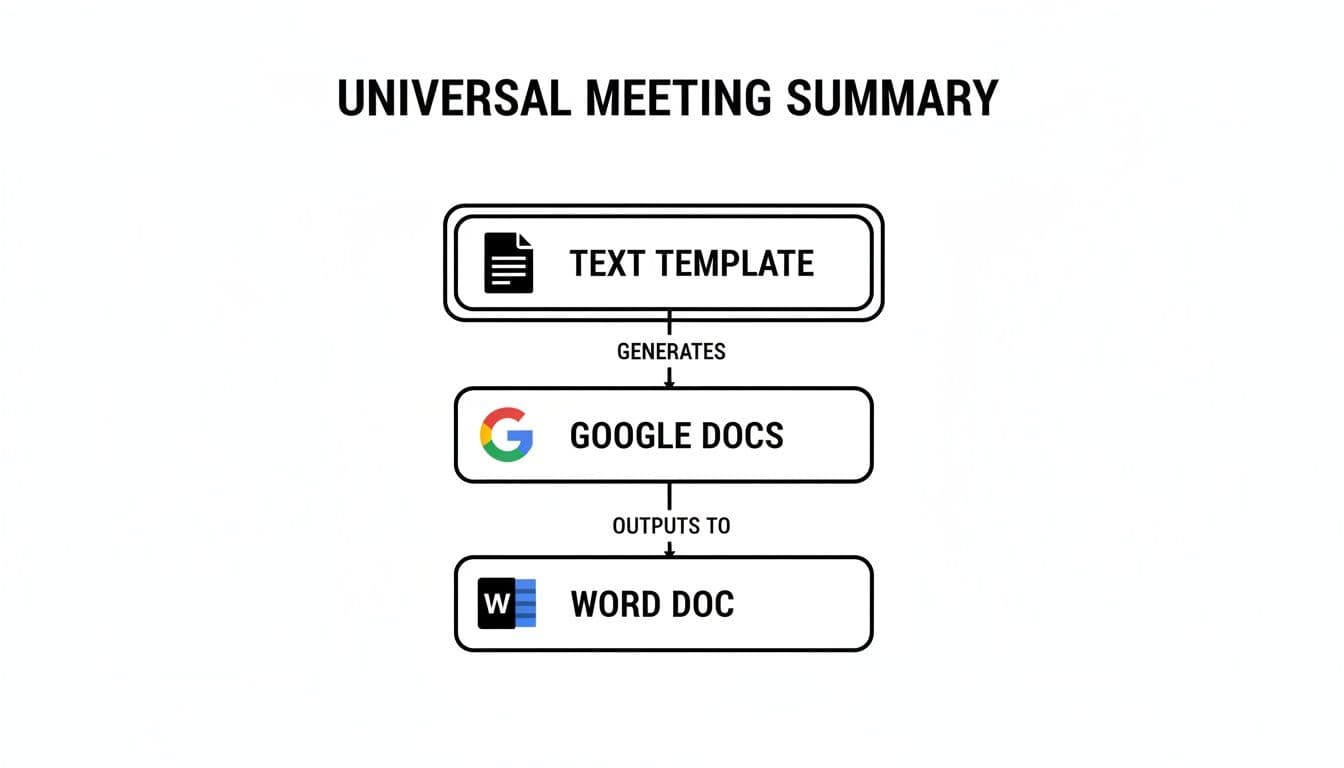
The process is simple. A basic text outline can easily be dropped into a Google Doc, a Word file, or whatever tool your team prefers. The format doesn't matter nearly as much as the framework itself.
Example 1: The Sales Team Weekly Pipeline Review
Sales teams are all about momentum and metrics. Their meetings are quick, data-heavy, and laser-focused on hitting targets. The summary has to reflect that same sense of urgency.
Meeting Title: Weekly Sales Pipeline Review - West Region Date: 10/23/2024 Attendees: Anna, Mark, Chloe, Ben Absentees: None
1. Meeting Goal:
- Review last week’s numbers against quota, pinpoint blockers in the pipeline, and set clear actions for this week.
2. Key Decisions Made:
- A 15% discount on the "Enterprise Deal X" was approved to get it closed by Friday.
- Mark’s three stalled mid-market leads will be reassigned to Chloe for a fresh approach.
3. Action Items:
- [Task]: Send the revised "Enterprise Deal X" proposal with new pricing.
- Owner: Anna
- Deadline: EOD Today
- [Task]: Schedule new demos for the three reassigned leads.
- Owner: Chloe
- Deadline: Wednesday, 10/25
This summary is short, sharp, and all about action. Every item directly connects to a revenue-generating activity. There's no fluff because there's no time for it.
Example 2: The Executive Leadership Offsite
Executive meetings are a different beast entirely. They’re high-level, strategic, and often shape the company's direction for the next year or more. The summary isn't about daily to-dos; it’s about documenting foundational decisions.
Meeting Title: Q4 Strategic Planning & 2025 Budget Offsite Date: 10/24/2024 Attendees: CEO, CFO, CTO, Head of Sales, Head of Marketing Absentees: None
1. Meeting Goal:
- Finalize the top three strategic priorities for 2025 and lock in departmental budget allocations.
2. Key Decisions Made:
- Market expansion into the APAC region is officially Priority #1 for 2025.
- An initial $1.2M budget is allocated for the APAC expansion initiative.
- Talks about acquiring Company Z are on hold until legal finishes due diligence.
3. Action Items:
- [Task]: Draft the project charter for the APAC expansion plan.
- Owner: Head of Sales
- Deadline: November 15
- [Task]: Build a revised 2025 budget model reflecting the $1.2M allocation.
- Owner: CFO
- Deadline: November 10
Example 3: The Remote Software Development Daily Stand-Up
For a remote agile team, the daily stand-up is the heartbeat of a sprint. The summary's only job is to get people unblocked and keep the project moving forward. It has to be incredibly brief and focus only on immediate problems.
Meeting Title: Phoenix Project - Daily Stand-Up Date: 10/25/2024 Attendees: Dev Team (Maria, Raj, Sam, Lisa) Absentees: None
1. Meeting Goal:
- Sync on yesterday's progress, state today's plan, and call out any blockers.
2. Key Blockers Identified:
- Sam is stuck on the API integration; he’s waiting for credentials from the vendor.
- Lisa’s local development environment keeps crashing, so she can’t work on the frontend.
3. Action Items: