The daily stand-up meeting is a cornerstone of modern team collaboration, but its effectiveness hinges entirely on its structure. A generic, repetitive format can quickly devolve into a dull status report, draining energy rather than building momentum. The key to transforming this daily ritual into a powerful alignment tool lies in choosing the right agenda for stand up meetings-one tailored to your team's specific function, culture, and goals.
A well-designed agenda moves the focus from individual status updates to collective progress and problem-solving. It ensures the conversation remains sharp, relevant, and forward-looking, preventing the common pitfalls of rambling discussions and disengaged participants. When your team knows exactly what to expect and how to contribute, the meeting becomes a high-value sync that accelerates work rather than interrupting it.
This comprehensive guide breaks down eight distinct, actionable templates designed for a variety of team needs. We will move beyond the classic three-question format to explore specialized agendas for:
- Sales and revenue teams focused on pipeline velocity.
- Customer-centric teams prioritizing user impact.
- Asynchronous, remote, and hybrid work models.
- Leadership and executive teams tracking strategic initiatives.
For each template, you will find a strategic breakdown, tactical insights, and replicable steps for immediate implementation. We'll explore who each format is best for and how to leverage modern tools, including AI summarizers, to automate note-taking and extract critical insights. It’s time to stop just going through the motions and start using a structured agenda for stand up meetings to make your 15-minute sync the most productive part of the day.
1. The Three Questions Format (What, Blockers, Next)
The Three Questions format is the most recognizable and widely used agenda for stand up meetings. Born from Agile and Scrum methodologies, its simple structure is designed for speed, clarity, and accountability. Each participant answers three core questions, keeping their update concise and focused on progress.
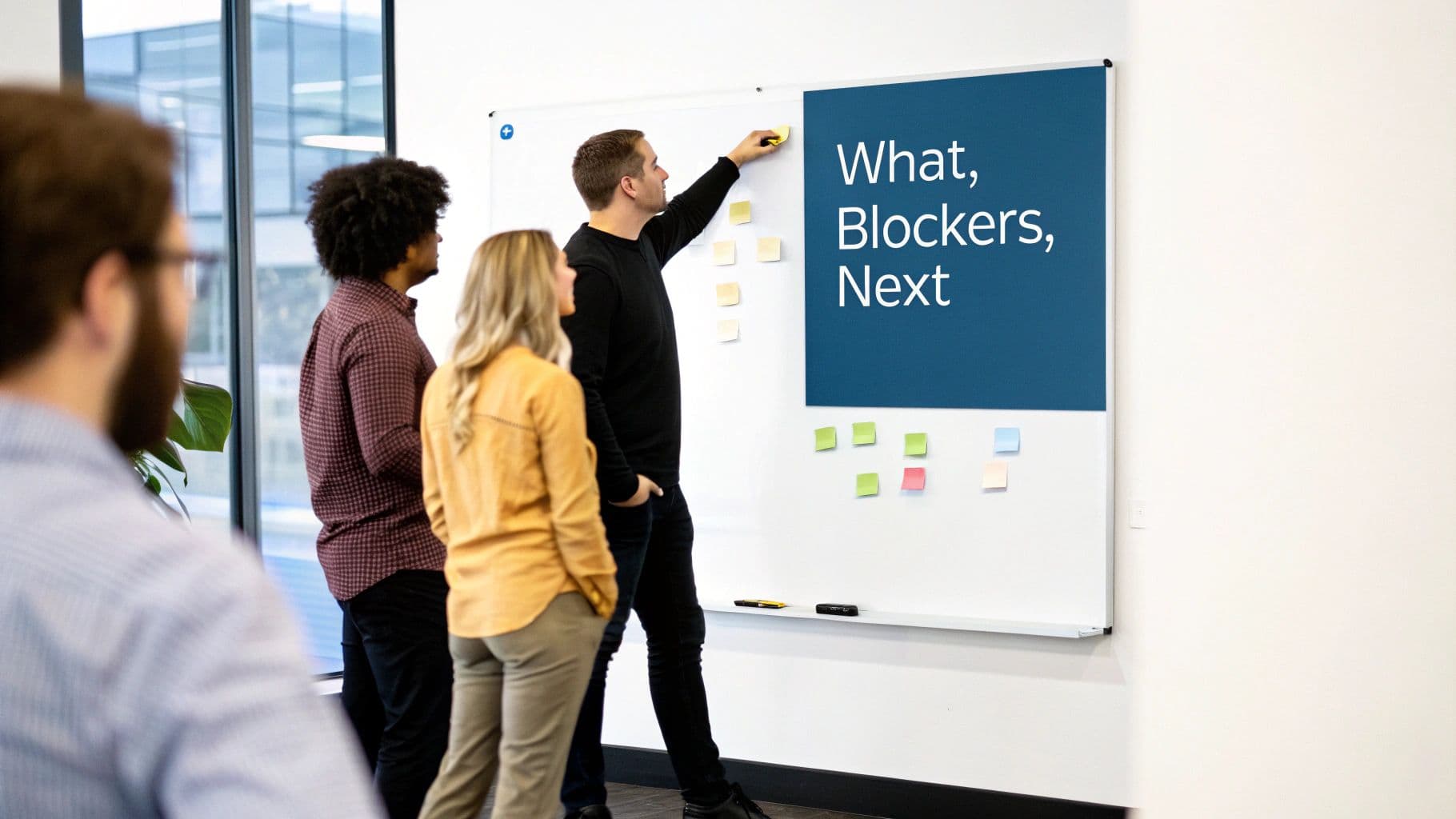
This classic template provides a predictable rhythm that teams at companies like Google, Microsoft, and Buffer rely on to synchronize daily work, especially across distributed or remote-first environments. The structured responses are also ideal for AI meeting summarization tools, which can easily parse the updates to extract tasks, blockers, and action items automatically.
Strategic Breakdown
This format’s power lies in its simplicity. It forces team members to think about their work in three distinct phases: past accomplishment, future intention, and current obstacles.
- What did I accomplish yesterday? This question builds a culture of accountability and provides visibility into daily progress. It is not a report of "being busy" but a statement of completed work.
- What will I do today? This creates a public commitment and helps team members align their daily priorities with the team's sprint or project goals.
- What blockers are in my way? This is the most critical question. It surfaces issues immediately, allowing the team or manager to swarm the problem and remove the impediment before it causes significant delays.
Actionable Takeaways & Tips
To maximize the effectiveness of this agenda for stand up meetings, implement the following tactics:
- Time-box Responses: Strictly limit each person's update to 60-90 seconds. The goal is synchronization, not deep problem-solving.
- Automate Blocker Tracking: Use a meeting summarization tool to automatically identify and log blockers mentioned during the stand-up. This creates a historical record and helps identify recurring issues.
- Take It Offline: If a blocker discussion requires a longer conversation, schedule a follow-up meeting immediately with only the relevant people. This is often called "parking lotting" the issue.
- Rotate the Facilitator: Having a different team member lead the stand-up each day keeps the energy fresh and promotes shared ownership of the process. For a more detailed guide on structuring effective meetings, you can explore this practical guide to the team meeting agenda.
2. The Sales Velocity Standup (Pipeline, Wins, Challenges)
The Sales Velocity Standup is a specialized agenda designed for sales and revenue teams. Moving beyond generic progress updates, this format focuses squarely on pipeline movement, closed deals, and customer-facing challenges. It transforms the daily huddle into a high-impact session centered on business metrics and revenue generation.
This results-driven template is critical for synchronizing distributed sales organizations that rely on platforms like Salesforce and is a staple in high-growth B2B SaaS companies like HubSpot, Intercom, and Gong. Its structure is particularly effective for AI meeting summarization tools, which can extract key deals, customer objections, and coaching opportunities, providing sales managers with near real-time intelligence.
Strategic Breakdown
This agenda’s strength is its direct link to revenue. It organizes updates around the core activities that drive sales performance, ensuring every conversation is tied to a tangible business outcome.
- Pipeline Movement: What key deals have I advanced since yesterday? This question forces reps to focus on forward momentum in their pipeline, providing visibility into the health of future revenue and identifying deals that may be stalling.
- Wins & Closed Deals: What deals have I closed? This celebrates success, boosts team morale, and creates a forum to briefly share what worked, allowing others to learn from successful tactics.
- Challenges & Blockers: What customer objections or internal hurdles are slowing me down? This brings revenue-blocking issues to the forefront immediately, enabling managers and peers to offer solutions, share resources, or unblock a deal.
Actionable Takeaways & Tips
To maximize the effectiveness of this agenda for stand up meetings, implement the following tactics:
- Focus on Velocity, Not Volume: Encourage reps to discuss the movement of key deals, not just list every call they made. The goal is to understand how the pipeline is progressing.
- Automate Coaching Insights: Use a meeting summary tool to automatically highlight common customer objections, track mentions of specific competitors, and identify deals that need coaching. This leverages the stand-up as a daily source of data. For more on this, you can explore the power of conversation intelligence in sales.
- Time-box Per Rep: Keep each representative’s update to a strict 2-3 minutes. This maintains a high-energy pace and keeps the entire meeting under 15 minutes, even with larger teams.
- Share Summaries Immediately: Distribute automated summaries to sales leadership within the hour. This enables managers to provide real-time coaching and support on deals discussed just moments earlier.
3. The Customer-Centric Standup (Customer Impact, Feedback, Health)
The Customer-Centric Standup shifts the focus from internal tasks to external impact. Designed for customer-facing teams like Support, Success, and Implementation, this agenda for stand up meetings prioritizes customer health, feedback, and outcomes. Instead of just discussing what they are working on, team members report on how their work directly affects customers.
This format is essential for companies that place the customer at the core of their strategy, such as Zendesk, Stripe, and Intercom. By centering the daily sync on customer voice, these organizations ensure that critical feedback and potential churn risks are surfaced and addressed immediately. The structured updates are also highly effective for AI meeting summarization, which can extract customer sentiment, categorize feedback, and alert stakeholders to urgent issues.
Strategic Breakdown
This format’s strength is its direct line to the end-user, transforming the stand-up from a status update into a real-time customer intelligence session. It frames daily work around three key customer-focused pillars.
- What was my key customer impact yesterday? This question moves beyond "tasks completed" to "value delivered." It could be resolving a critical ticket, onboarding a new client, or identifying a success story.
- What customer feedback or health signals did I observe? This surfaces raw, unfiltered feedback and health indicators (e.g., low usage, negative sentiment) that might otherwise get lost in a CRM.
- How will I improve customer health or address feedback today? This creates a proactive commitment to act on the intelligence gathered, closing the loop between feedback and action.
Actionable Takeaways & Tips
To get the most value from a customer-centric agenda for stand up meetings, apply these specific tactics:
- Categorize Feedback on the Fly: Encourage team members to label feedback as "product bug," "feature request," or "process issue" during their update for easier tracking.
- Automate Sentiment Analysis: Use an AI transcription and summarization tool to analyze the tone of customer feedback mentioned. This helps quantify sentiment trends over time.
- Create a "Voice of the Customer" Channel: Automatically share the AI-generated summary of customer feedback from the stand-up to a dedicated Slack or Teams channel for the product and engineering teams.
- Set Up Churn Risk Alerts: Configure your meeting AI to send an immediate notification to leadership if keywords like "unhappy," "canceling," or "escalation" are mentioned in the stand-up transcript. This enables rapid intervention.
4. The Async-First Standup with Recorded Updates
The Async-First Standup is a modern agenda for stand up meetings designed for globally distributed teams that cannot meet in real time. Instead of a live meeting, team members record brief video updates or post written check-ins on their own schedule. These updates are then compiled, shared, and often summarized by AI tools, making it a flexible yet powerful way to stay synchronized across time zones.
This asynchronous-first model is a cornerstone of remote-first companies like GitLab and Zapier, who leverage it to maintain alignment without forcing employees into inconvenient meeting times. By making meeting transcription and summarization tools a core part of the workflow, this format turns individual updates into a searchable, actionable knowledge base for the entire team.
Strategic Breakdown
This format’s strength is its ability to decouple collaboration from time. It shifts the focus from simultaneous presence to consistent, high-quality information sharing, respecting individual work schedules and deep work time.
- Time Zone Inclusivity: By removing the need for a real-time meeting, it ensures every team member, regardless of their location, has an equal opportunity to contribute and be heard without sacrificing personal time.
- Reduced Context Switching: Team members can record their update when it naturally fits their workflow, rather than interrupting a productive task for a scheduled meeting. This protects valuable focus time.
- Creates a Persistent Record: Written or recorded updates create an automatic, searchable log of progress, decisions, and blockers. This historical context is invaluable for onboarding new members and tracking project evolution.
Actionable Takeaways & Tips
To effectively implement this agenda for stand up meetings, consider the following strategies:
- Standardize the Format: Provide a clear template for updates (e.g., using the three questions) to ensure consistency and make the information easy to parse.
- Leverage AI for Summarization: Use a meeting summarization tool to automatically transcribe video updates and generate a daily digest of all team check-ins. This saves everyone time while ensuring key information isn't missed. You can master this workflow by learning how to use AI for faster, smarter meeting minutes.
- Schedule Blocker Sessions: Hold optional, twice-weekly live sessions dedicated solely to resolving blockers identified in the async updates. This provides a dedicated space for problem-solving without disrupting the daily async flow.
- Create a Central Hub: Post all updates and AI-generated summaries in a dedicated Slack or Teams channel. This creates a single source of truth and enhances visibility for the entire team.
5. The Cross-Functional Standup (Updates by Functional Area + Dependencies)
The Cross-Functional Standup is a high-level synchronization meeting designed for complex projects where multiple departments like Engineering, Product, and Marketing must work in concert. Instead of individual updates, a representative from each functional area provides a brief report, focusing explicitly on progress and inter-team dependencies. This agenda for stand up meetings is crucial for preventing silos and ensuring that work flows smoothly across the organization.
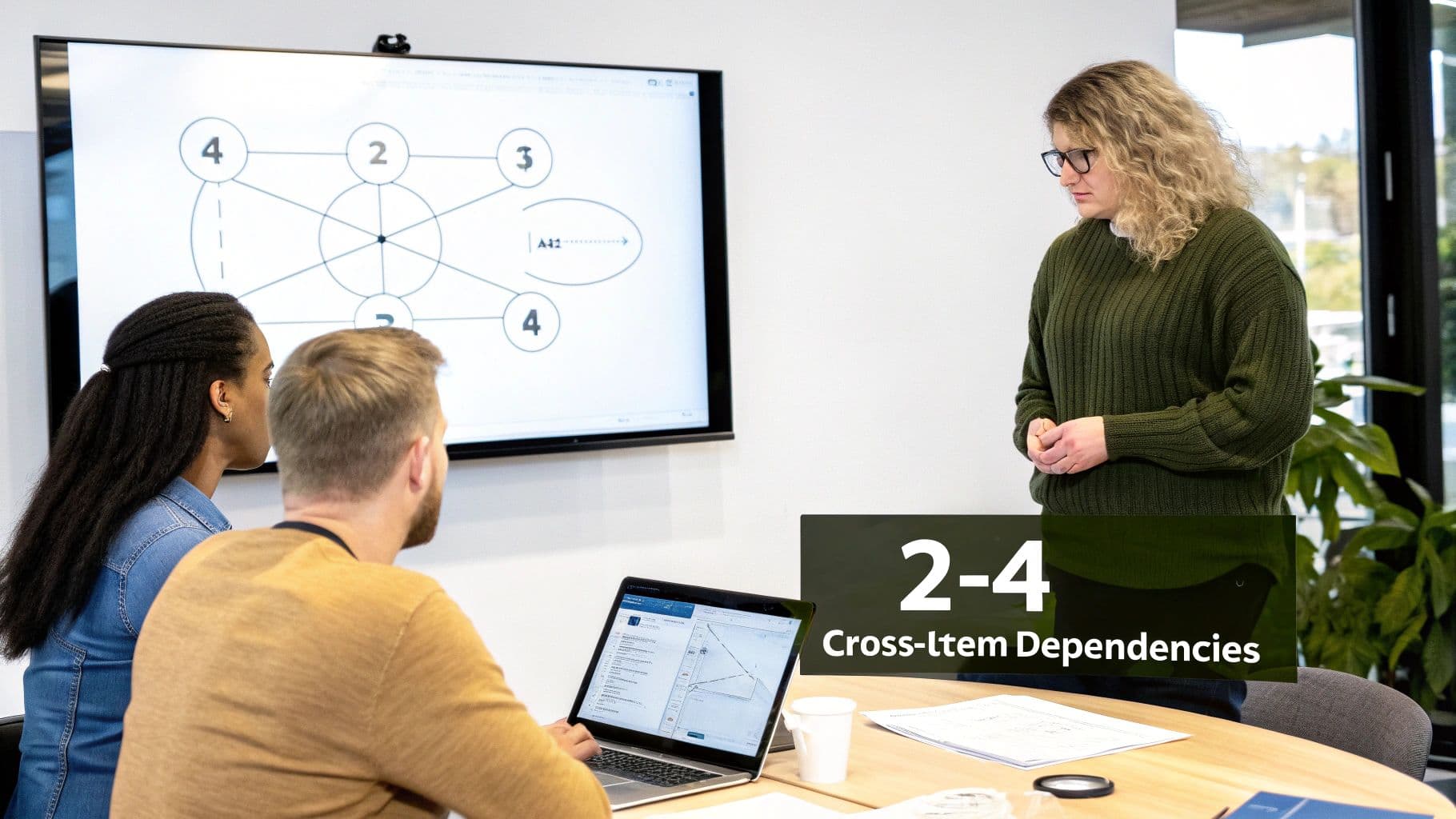
This model is a cornerstone of the Spotify Squad framework and is used by companies like Stripe and Figma to manage dependencies between platform and product teams. The structure makes it easier for AI summarization tools to map the web of dependencies, automatically highlighting who is blocking whom and where the critical path of a project is at risk.
Strategic Breakdown
This format’s strength is its focus on the intersections between teams, not just the work within them. It shifts the conversation from individual tasks to the connective tissue of a project, surfacing cross-functional risks before they escalate.
- Progress by Function: Each team lead shares their area's key accomplishments and planned work. This provides high-level visibility for all stakeholders without getting lost in granular detail.
- Dependencies Out: The representative explicitly states what their team needs from other functions. For example, "Engineering is ready to start coding the new feature but is blocked by a lack of final design assets from the Design team."
- Dependencies In: They also state what other teams are waiting on from them. For instance, "Marketing is blocking the Sales team's new campaign until we finalize the launch messaging."
Actionable Takeaways & Tips
To run an effective cross-functional standup, focus on clarity, accountability, and ruthless time management:
- Strict Time-boxing: Allocate 2-3 minutes per functional area and use an automated timer. The entire meeting should not exceed 30 minutes.
- Use AI for Dependency Mapping: Leverage meeting transcription to automatically extract "blocked by" and "blocking" statements. Use this data to generate a weekly dependency matrix or report, identifying recurring bottlenecks.
- Rotate Facilitation: Have the lead from each functional area facilitate the meeting on a rotating basis. This promotes shared ownership and a deeper understanding of the overall process.
- Immediate Blocker Sharing: Configure your meeting tools to automatically clip and share blocker discussions with the relevant teams via Slack or email as soon as they are mentioned. This ensures issues are addressed in real-time.
6. The Leadership/Executive Standup (Strategic Updates + Dashboards)
Unlike tactical team stand-ups, the leadership or executive stand-up agenda for stand up meetings prioritizes strategic alignment over daily tasks. This format, championed by figures like Andy Grove and Jeff Bezos, focuses on high-level initiatives, key performance indicators (KPIs), and critical decision-making. It is designed for speed and impact, ensuring the entire organization moves in a unified direction.
This C-suite-focused template is used by leadership teams at companies like Amazon and Salesforce to maintain a pulse on organizational health and strategic progress. Instead of individual task updates, leaders review dashboards and discuss outcomes. AI meeting summarization is particularly powerful here, as it can distill complex strategic discussions into concise executive summaries and track high-stakes action items for board-level communication.
Strategic Breakdown
The power of this format lies in its shift from activity to outcomes. It forces leaders to connect daily operations to top-level business goals, ensuring every part of the organization is aligned and contributing to the bigger picture.
- Strategic Initiatives Update: Leaders provide a brief status on their quarterly or annual strategic goals (OKRs). The focus is on progress, confidence levels, and major milestones achieved.
- Key Metrics Review (Dashboard): The team quickly reviews a pre-populated dashboard showing critical business metrics like revenue, customer acquisition cost, or system uptime. This provides an objective, data-driven view of organizational health.
- Decisions & Blockers: This segment is for raising mission-critical blockers or decisions that need immediate C-suite attention. It is not for tactical problem-solving but for unblocking major initiatives that impact the entire company.
Actionable Takeaways & Tips
To maximize the effectiveness of a leadership stand-up, implement the following tactics:
- Set a 20-Minute Maximum: Executive time is the most valuable resource. A strict time limit forces conversations to be concise and focused on what truly matters.
- Use AI for Executive Summaries: Leverage meeting tools to automatically generate a summary of decisions, action items, and key risks discussed. This summary can be distributed to the board or senior management within minutes.
- Dashboard-First Approach: All metrics should be on a shared dashboard reviewed before the meeting. The stand-up is for discussing anomalies and trends, not for reporting numbers.
- Focus on the "So What?": Encourage leaders to go beyond reporting a metric and explain its business impact. Instead of "Sales are up 5%," the update should be, "Sales are up 5% due to the new marketing campaign, validating our investment." This strategic framing is a key part of an effective agenda for stand up meetings at the executive level.
7. The Hybrid Standup (Structured Agenda + Open Discussion)
The Hybrid Standup offers a flexible template that combines the efficiency of structured updates with a dedicated window for open, collaborative discussion. This agenda for stand up meetings addresses a common pain point of rigid formats: the lack of space for immediate, deeper problem-solving. It strikes a balance between rapid synchronization and genuine teamwork.
This model is a favorite among innovative teams at companies like Basecamp and Mozilla, which champion both individual accountability and deep collaboration. By allocating distinct time blocks, typically 60% for structured reports and 40% for open discussion, the meeting maintains its pace while creating room for organic issue resolution. This structure is also highly compatible with AI meeting tools, allowing teams to generate concise summaries of the structured updates while capturing key themes and action items from the free-form discussion.
Strategic Breakdown
This format’s strength is its adaptability. It acknowledges that not all blockers can be "parked" and that some issues benefit from the immediate attention of the entire team. It empowers teams to be both efficient and effective.