Natural Language Processing, or NLP, is what happens when we teach computers to understand language the way people do. It’s a branch of artificial intelligence that lets machines read, understand, and even generate human speech and text. Think of it as the technology that powers everything from your phone’s voice assistant to the spam filter in your inbox.
What Is Natural Language Processing in Simple Terms
Imagine trying to explain a joke to a calculator. It can crunch numbers like a champion, but it has zero grasp of sarcasm, context, or why a punchline is funny. Human language is just as nuanced, packed with slang, idioms, and subtleties that we pick up without even thinking.
NLP is the bridge between our messy, creative way of communicating and a computer’s rigid, logical world. It takes our spoken words or written text and breaks it down into a structured format a machine can actually work with. This is how software can finally start doing things that, until recently, required a human brain.
The Goal of NLP
At its core, NLP is all about making technology feel more human. The big idea is to let us talk to our devices and software naturally, without having to learn clunky commands or special codes. It's about shifting the burden of translation from us to the machine.
The whole field is really pushing toward a few main goals:
- Understanding Text: Letting a computer read a document and figure out what it's about, who it’s for, and what the underlying tone is.
- Interpreting Speech: Turning spoken words into text (speech-to-text) and then figuring out the intent behind those words.
- Generating Language: Creating text or speech that sounds natural and human, like a chatbot giving a helpful answer.
To make these abstract ideas a bit more concrete, here’s a quick breakdown of what NLP is actually doing under the hood.
Core Functions Of NLP At A Glance
| Core Function | What It Does for a Computer | Everyday Example |
|---|---|---|
| Sentiment Analysis | Reads text and determines the emotional tone—positive, negative, or neutral. | A company scans online reviews to see if customers are happy with a new product. |
| Named Entity Recognition (NER) | Scans text to find and categorize key information like names, dates, and locations. | Your calendar app automatically suggests creating an event when it sees a date and time in an email. |
| Speech-to-Text | Converts audio recordings of spoken words into a written transcript. | Dictating a text message to your phone instead of typing it. |
| Language Translation | Translates text or speech from one language into another. | Using Google Translate to read a menu while on vacation. |
| Topic Modeling | Sifts through a large collection of documents to discover the main themes or topics. | A news site grouping articles about the same event together automatically. |
These are just a few examples, but they show how NLP turns complex human language into something a machine can analyze and act on.
Why NLP Matters Today
The real reason NLP has become so important is the sheer amount of data we’re creating. It’s a staggering fact that 90% of the world's data was generated in just the past few years, and most of that is unstructured language—think emails, social media updates, customer reviews, and hours of recorded meetings.
Without NLP, all that rich, contextual information would just sit there, impossible to analyze at scale. By teaching machines our language, we can finally put that data to work, automating tedious tasks and discovering insights that help us work smarter.
From Hand-Crafted Rules to Learning Machines: A Brief History of NLP
Computers didn't just wake up one day and start understanding what we say. The journey to get here has been a long and winding road, full of brilliant ideas, dead ends, and game-changing breakthroughs stretching back more than seventy years. It all started with the buzz of post-war optimism and the dawn of the computing age.
The very first seeds were planted back in the 1950s, when "artificial intelligence" was more of a philosophical concept than a field of study. Things really kicked off with pioneers like Alan Turing, whose famous 1950 test for machine intelligence was all about language. This early excitement hit a high point with the 1954 Georgetown-IBM experiment, which managed to translate over sixty Russian sentences into English. It felt like a monumental leap, sparking bold predictions that fully automated translation was just around the corner. You can learn more about this foundational period in NLP history and the origins of the field.
But as it turned out, that initial optimism ran head-on into a wall of complexity.
The Era of Rules (And Why It Didn't Quite Work)
Early stabs at NLP were almost entirely rule-based. Researchers essentially tried to teach computers language the way we learn grammar in grade school: by feeding them a giant, meticulously hand-crafted set of rules. Imagine giving a computer a dictionary and a grammar textbook and then asking it to write a novel.
This symbolic approach had its moments, especially in highly controlled environments. One of the most famous examples from this time was a program from the late 1960s called SHRDLU.
Here’s a look at the SHRDLU program, which could understand commands within its simple "blocks world."
The program could follow a command like "pick up a big red block" because its entire world was simple and every possible rule was spelled out. But the second you take a system like that and expose it to the messy, unpredictable flow of real human conversation, it completely falls apart.
This period, often dubbed the "AI winter," was a reality check. It proved that simply mapping out the rules of language wasn't going to cut it. The sheer nuance of how we communicate demanded a totally different strategy.
A Turning Point: The Rise of Statistics
By the 1980s and 1990s, the field started to pivot away from rigid rules and embrace statistical methods. This was a huge shift. Instead of trying to explicitly teach computers grammar, researchers realized they could let the machines learn patterns on their own, just by feeding them enormous amounts of text.
The new approach treated language as a game of probabilities. For instance, rather than having a firm rule, a system would calculate the statistical likelihood that the word "bank" means a financial institution versus the edge of a river, based on the other words surrounding it.
This data-first mindset built the foundation for the machine learning and deep learning models that are the bedrock of modern NLP. The focus moved from trying to create perfect, hand-crafted rules to building powerful algorithms that could learn from real-world examples. It’s this shift that paved the way for the incredible AI we use every day.
How Computers Actually Learn To Understand Language
So, how do we get a machine to understand language? It might seem like magic, but it's really a logical, step-by-step process. A computer doesn't "read" a sentence the way we do. Instead, it meticulously takes it apart, piece by piece, almost like a mechanic disassembling an engine to see how it works.
This whole journey begins with the most basic step you can imagine: breaking down a sentence into its smallest parts. A machine can't just swallow a paragraph whole; it has to start with individual words and phrases. Everything else in NLP is built on this foundation.
Tokenization: The First Step
The very first thing an NLP model does is a process called tokenization. Think of it like this: before you can build a Lego castle, you have to dump out the box and separate the bricks. Tokenization is the linguistic version of that, breaking a sentence into a list of individual words or "tokens."
For example, the simple command "Summarize this meeting for me" becomes a neat list:
- ["Summarize", "this", "meeting", "for", "me"]
This crucial first step turns a messy string of text into an organized list that a computer can actually work with. Once the sentence is split into tokens, the real analysis can begin.
This infographic gives you a bird's-eye view of how these core techniques turn raw text into structured, machine-readable data.
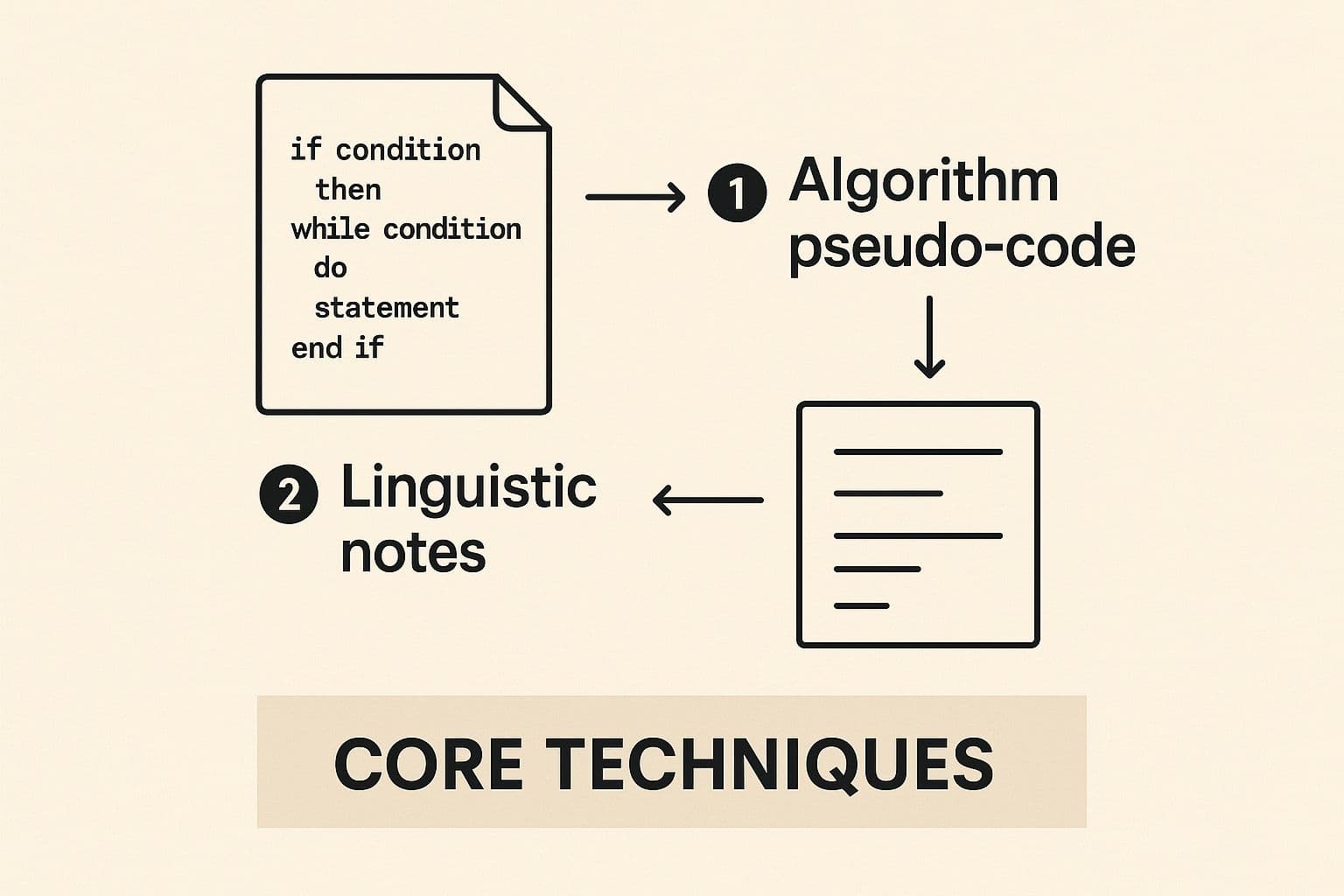
As you can see, each technique builds on the last, moving from simply separating words to understanding their complex relationships.
Learning The Rules Of Grammar
Okay, so we have a list of words. Now what? The next challenge is figuring out grammar. We do this instinctively, but a computer needs to be taught the rules from scratch. This is where Part-of-Speech (POS) tagging comes in. It's the process of assigning a grammatical role—like noun, verb, or adjective—to every single token.
Let's look at our example sentence again, this time with POS tags:
- Summarize: Verb
- this: Determiner
- meeting: Noun
- for: Preposition
- me: Pronoun
By identifying what each word is, the computer starts to see the sentence's skeleton. It now knows "meeting" is the thing (a noun) and "Summarize" is the action (a verb). This grammatical blueprint is absolutely essential for figuring out what the user actually wants.
Identifying The Key Information
With the grammar sorted out, the NLP model can move on to the really interesting part: finding the most important bits of information. This is done using a technique called Named Entity Recognition (NER). Its job is to spot and categorize key entities in the text—things like people's names, company names, locations, dates, and times.
Imagine a sentence from a meeting transcript: "Let's schedule the follow-up with Sarah from Acme Corp on Tuesday." An NER system would instantly flag these key pieces of data:
- Sarah: PERSON
- Acme Corp: ORGANIZATION
- Tuesday: DATE
You can see how incredibly valuable this is for a tool like a meeting summarizer. It can automatically pull out who was talking, which companies were mentioned, and when action items are due. NER is what turns a big wall of text into actionable, structured data.
Finally, to understand meaning that goes beyond a simple dictionary definition, NLP uses a fascinating concept called word embeddings. This technique converts words into a set of numbers (called vectors) that capture their context and relationships with other words. In this mathematical space, words with similar meanings—like "king" and "queen"—are located close to each other. It’s what allows a machine to grasp that "happy" is the opposite of "sad" or that "London" is to "England" as "Paris" is to "France." This is how AI learns the subtle nuance that makes language, well, language.
The Game-Changing Shift To Learning From Data
The early, rule-based approach to NLP had a huge flaw: human language is just plain messy. It simply refuses to stick to a neat set of rules. For every grammar law you can think of, there are a dozen exceptions, not to mention slang, typos, and sarcasm that throw a wrench in the works.
This rigidity was a major roadblock. Trying to hand-code a rule for every single linguistic quirk wasn't just hard—it was impossible. A system built this way would completely fall apart the second it came across a phrase it hadn’t been explicitly programmed to handle. The field desperately needed a new way forward.
From Manual Rules To Statistical Learning
The big breakthrough came when researchers flipped the problem on its head. Instead of force-feeding computers a grammar rulebook, what if they could let the computers figure out the patterns on their own, just by looking at real-world examples? This was the beginning of statistical methods and machine learning in NLP.
This shift, which really took off in the 1980s, was a true turning point. As computers got more powerful and huge digital text collections (think entire libraries) became available, probabilistic models began to dominate. These systems could sift through millions of sentences and learn the odds of words appearing together, essentially discovering grammar and meaning on their own.
This data-driven approach was far more resilient. It could handle the chaos of real language because it learned from that chaos. It didn't need a perfect rule; it just needed enough data to make a really good guess.
The Deep Learning Revolution
This statistical foundation set the stage for the next giant leap: deep learning. Starting in the 2010s, new models called neural networks—which are loosely inspired by the structure of the human brain—started delivering incredible results. These models could process language with a much deeper, more layered understanding.
One of the most important developments here was the Transformer architecture. This new model design was exceptionally good at grasping context—understanding how the meaning of a word changes based on the other words around it. This is the technology that powers modern AI like ChatGPT and is the engine behind the recent explosion in AI capabilities.
These advanced models are what allow today’s AI to tackle complex language tasks with almost human-level accuracy. For example, they can:
- Write coherent essays by predicting the most logical next word based on an enormous understanding of existing text.
- Translate languages fluently by mapping the contextual relationships between words across different languages.
- Summarize long documents by identifying the most statistically important sentences and key ideas.
This is precisely how modern tools can listen to and take notes during meetings. The journey from brittle, hand-coded rules to flexible, self-learning models is what made today's powerful applications possible. This entire evolution is the reason we can finally talk to our technology in our own words.
Real-World NLP Applications You Use Every Day
The true magic of Natural Language Processing isn't just in the theory—it's in the countless ways it's already woven into our daily routines and business workflows. Many of the digital tools we can't live without are powered by NLP humming away quietly in the background, making incredibly complex tasks feel effortless.
Think about it. From the moment you ask your phone for the weather forecast to the way your email provider magically filters spam out of your inbox, NLP is the engine making it happen. It’s the tech that lets you talk to your car’s GPS, translate a menu in a foreign language with a click, or get help from a customer service chatbot at 2 AM.
These examples show how NLP closes the gap between how we talk and how computers work. But beyond these everyday conveniences, NLP is creating huge value for businesses, completely rethinking how teams manage information and get things done.
Understanding Customers Through Their Own Words
One of the most powerful business uses of NLP is sentiment analysis. Most companies are sitting on a goldmine of customer feedback—online reviews, social media comments, support tickets, and survey responses. But trying to manually read through thousands of comments to get a feel for public opinion is a fool's errand.
This is where NLP comes to the rescue. Sentiment analysis algorithms can sift through massive volumes of text and instantly classify the emotional tone as positive, negative, or neutral. This gives companies a real-time pulse on what their customers are thinking and feeling.
For instance, a business can:
- Track social media reactions to a new product launch in real time.
- Flag frustrated customers from support emails before they decide to leave.
- Analyze product reviews to pinpoint exactly which features people love or hate.
By turning a flood of unstructured text into clean, simple metrics, businesses can finally make smarter decisions based on data, not just guesswork.
The Rise of Conversational AI
You’ve almost certainly interacted with another common NLP application: the chatbot. The first generation of chatbots were pretty clunky and rule-based, easily confused by simple questions. Not anymore. Today’s versions, built on modern NLP, are far more sophisticated. They can grasp the intent behind your questions, navigate complex conversations, and even remember what you talked about earlier.
This lets businesses offer 24/7 customer support, freeing up their human agents to tackle the really tough problems. It also helps streamline internal tasks, with HR bots answering common questions about benefits or IT bots guiding employees through a password reset.
This ability to process conversational language isn't just for customer service, though. It’s also the key to unlocking one of the most valuable—and overlooked—sources of business intelligence: the spoken conversations that happen in meetings every single day.
Transforming Meetings from Conversations to Action
Just think about all the critical information that gets shared in team meetings: big strategic decisions, project updates, action items, and crucial customer feedback. For years, most of this valuable data just vanished into thin air the moment the meeting ended, unless someone was tasked with taking meticulous, and often incomplete, notes.


