Ever wondered how conversations actually work? Not the textbook version, but the real, messy, back-and-forth talk we have every day. That's the core of conversation analysis: the study of real-life talk and interaction.
It’s a method for peeling back the layers of our conversations to see the hidden structures we all use to understand each other, whether we’re just saying "hello" or navigating a complex team meeting.
The Hidden Rules of Everyday Talk

Think about it: a conversation is like a game where everyone knows the rules without ever being taught them. Conversation analysis, or CA, is a bit like being a detective for that game. It involves meticulously studying recordings of actual conversations to map out how we pull it off.
This isn't about guessing what people mean to say. Instead, it’s all about focusing on what they actually do with their words, tone, and even their silences.
What CA reveals is that our everyday talk isn't random at all. It’s a highly organized, finely tuned social activity. Every pause, every "um," every time someone talks over someone else—it all has a purpose. These aren't just mistakes; they're part of the machinery of human interaction.
Why This Matters for Communication
Getting a grip on these mechanics is a game-changer for how we communicate, especially at work. Analyzing a team meeting, for example, can show you exactly why one person’s great idea gets ignored while another’s gains instant traction.
It helps answer critical questions, like:
- How do people subtly signal they want to speak next?
- What makes a question lead to a clear answer instead of more confusion?
- How do teams actually build on an idea together or work through a disagreement?
By making these invisible patterns visible, you can become a much more perceptive and effective communicator. It’s also the first step to truly improving team dynamics and learning how to take better meeting notes that capture the how and why behind decisions, not just the final outcome.
To help break this down, let's look at the basic building blocks of conversation analysis. The table below gives a quick snapshot of the key concepts.
Conversation Analysis at a Glance
| Core Component | Simple Explanation | Why It Matters |
|---|---|---|
| Turn-Taking | How people know when it's their turn to speak in a conversation. | It shows how meetings stay (mostly) orderly and prevents constant interruptions. |
| Adjacency Pairs | Paired actions like a question and its answer, or a greeting and its return. | This is the basic structure of progress in a conversation—one thing leads to the next. |
| Repair | The way speakers correct themselves or others to fix misunderstandings. | It reveals how we collaboratively ensure everyone is on the same page. |
| Preference | Some responses (like agreeing) are easier and quicker than others (like disagreeing). | Understanding this helps you see how consensus is built or why disagreements can be tricky. |
These components are the "rules" of the game we've been talking about.
From its fascinating origins to its powerful applications in the real world, this guide will walk you through how to use the principles of CA to make your own professional interactions much more effective.
A Look Back: Where Conversation Analysis Came From
To really get what conversation analysis is all about, it helps to rewind the clock a bit. The whole story kicks off in the late 1960s, not in a stuffy linguistics department, but in the field of sociology. It was a time when people were questioning everything, and a sociologist named Harvey Sacks had a radical thought: what if our daily chats aren't as messy and random as they seem?
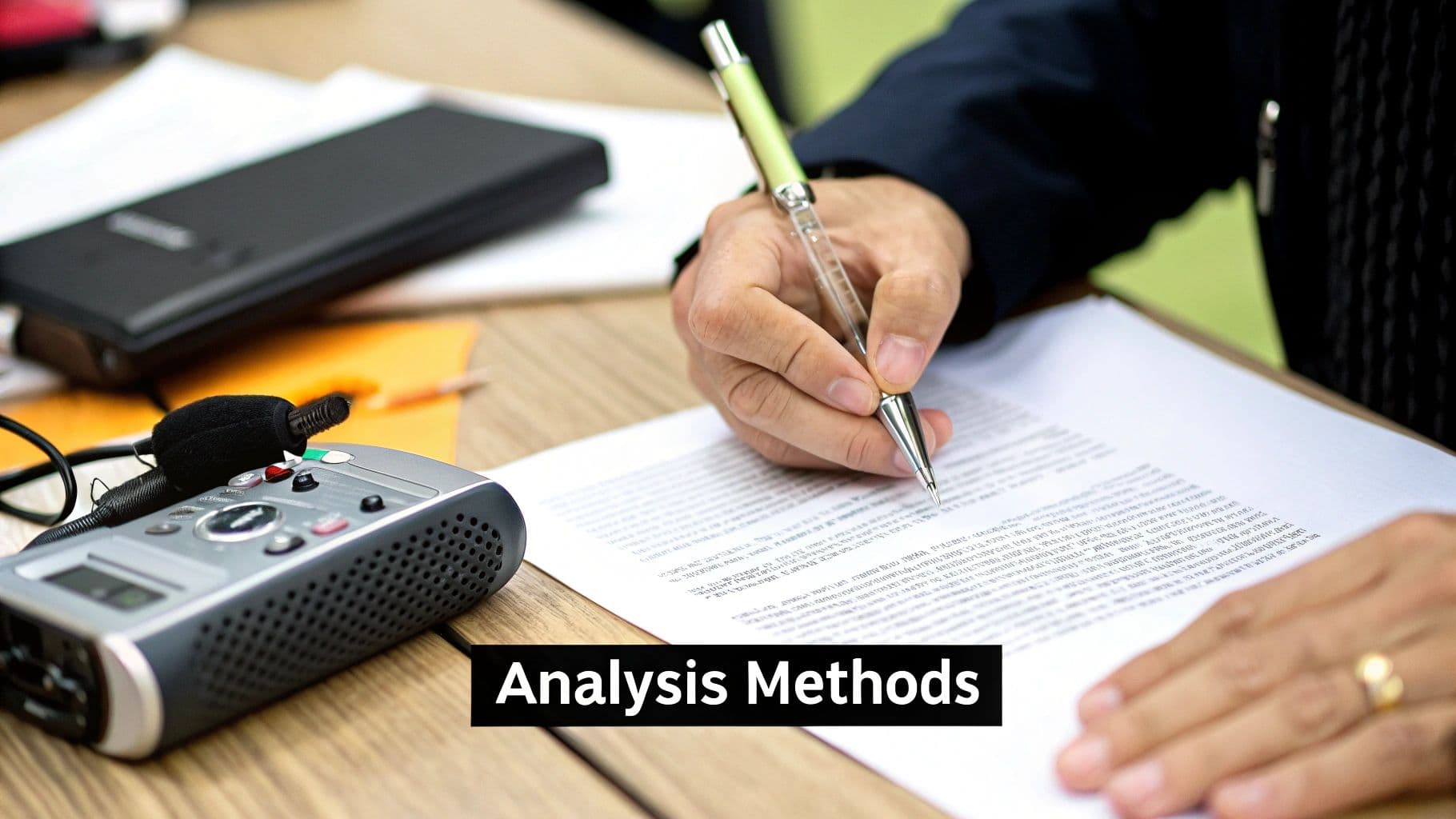
Sacks, along with his colleagues Emanuel Schegloff and Gail Jefferson, had a hunch that talk is actually incredibly organized. But to prove it, they needed to study the real thing. This was a big deal at the time. Instead of cooking up artificial scenarios in a lab, they dove headfirst into recording and analyzing actual, everyday conversations—the kind of authentic, unscripted interactions we all have.
They were convinced that within the back-and-forth of ordinary talk, there was a hidden structure, a set of unspoken rules everyone was following. This core idea—that conversation is a systematic social activity—is what built the foundation for everything that followed.
A New Way to See Conversation
Studying these interactions required a brand-new toolkit. Sacks and his team developed a super-detailed transcription method that did way more than just write down the words. This system was designed to capture all the subtle, messy details of spoken language, turning a fleeting moment into something you could study over and over again.
These weren't your average transcripts. They captured the little things that most people overlook but are actually critical for understanding what's going on:
- Pauses and Silences: Timed down to fractions of a second, these gaps can show hesitation or signal that it's someone else's turn to speak.
- Overlapping Speech: They noted who was interrupting whom, revealing the subtle power dynamics and competition for the floor.
- Intonation and Volume: The transcripts showed the rise and fall of the voice, which adds all the emotional flavor to our words.
- Laughter and Other Sounds: These non-verbal cues are huge social signals, and the system made sure to document them.
This incredibly detailed method allowed researchers to see the intricate dance of a conversation on paper. It showed, clear as day, how people work together to build meaning moment by moment, using tiny cues to navigate their social world.
The Birth of a New Field
This whole approach really took shape during the late 1960s and early 1970s, primarily at the University of California, Los Angeles. Harvey Sacks, Emanuel Schegloff, and Gail Jefferson were the key figures who pushed the idea that conversation wasn't chaos but a structured, orderly thing. If you're curious, you can explore the foundational history of CA and see how their initial ideas blossomed.
By focusing on real-world data and the tiny details of how we talk, they created a powerful new way to understand what it means to be human and social. This groundwork paved the way for decades of research into how we do everything from asking for a favor to closing a multi-million dollar deal, all through the simple act of talking.
Understanding the Building Blocks of Talk
Every conversation we have, whether it’s a quick hello at the coffee shop or a high-stakes board meeting, follows a kind of invisible blueprint. Conversation analysis gives us the tools to see this structure by breaking talk down into a few core, repeatable patterns. Once you know what to look for, you'll start noticing them everywhere.
Think of turn-taking as the traffic light system for dialogue. It's the set of unspoken rules we all follow that dictates who gets to speak and when. This is what keeps our conversations from becoming a chaotic pile-up of everyone talking at once. It’s how we intuitively know when someone is finishing a thought, pausing to let us jump in, or handing the conversational baton over to us.
This system is remarkably elegant. We use subtle cues like the pitch of our voice, our pacing, and even the grammar we choose to signal that our turn is ending. For AI tools that analyze meetings, decoding these cues is critical for accurate speaker identification. If you're curious about the technical side, you can learn more about speaker identification technology and its challenges.
This infographic gives you a quick visual of how these core concepts fit together.
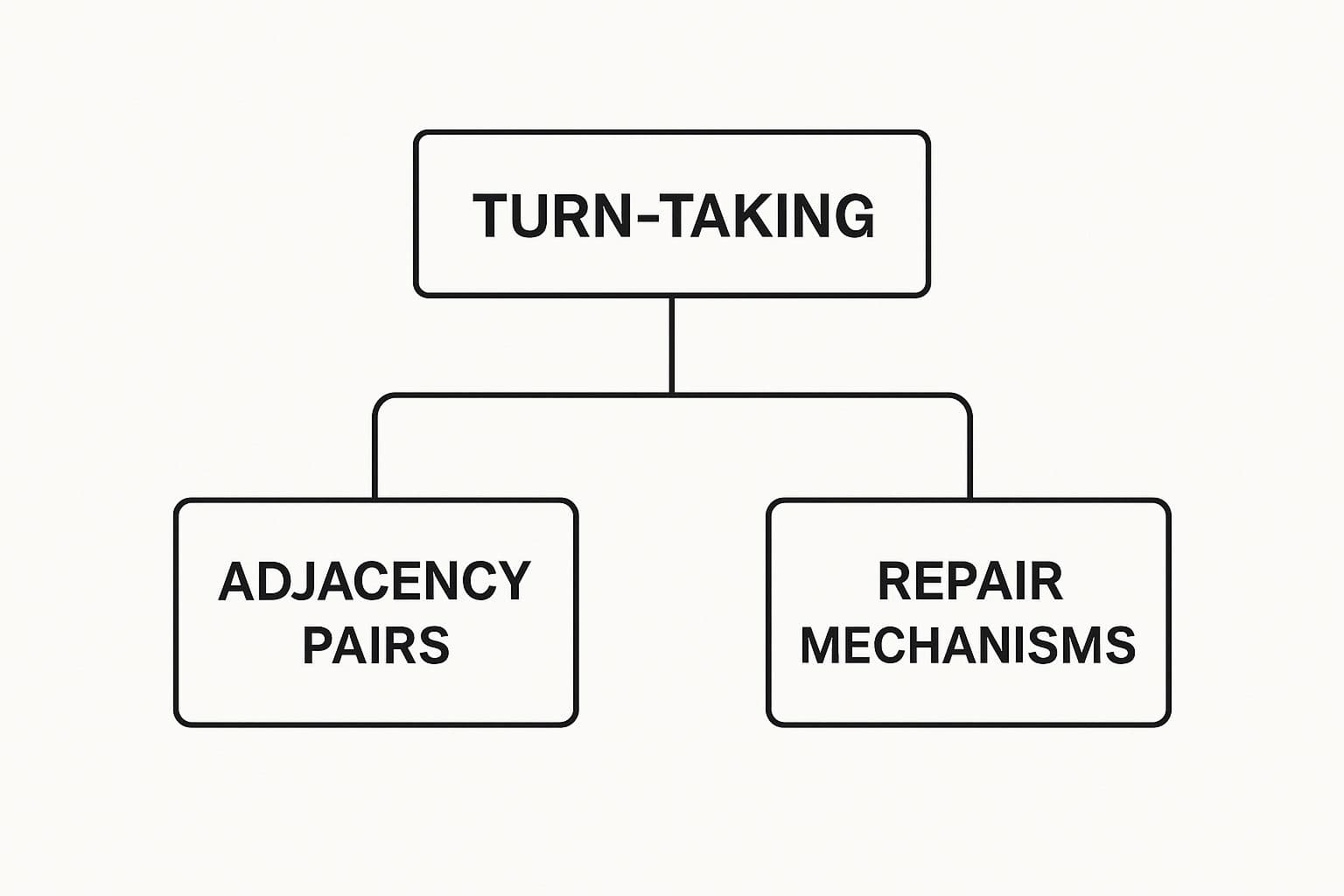
As you can see, turn-taking is the foundational layer. From there, other conversational actions, like responding or making corrections, naturally emerge.
The Power of Conversational Pairs
Working within that turn-taking system, we have something called adjacency pairs. These are the fundamental call-and-response actions that truly propel conversations forward. Think of them as linked actions where the first part sets up a strong expectation for the second.
- Greeting-Greeting: When someone says, "Hello!" you almost automatically respond with, "Hi there!"
- Question-Answer: "What time is the meeting?" creates an immediate need for an answer.
- Offer-Acceptance/Rejection: "Want some coffee?" leads directly to either a "Yes, please" or a "No, thank you."
These pairs are the engines of our interactions. They create a kind of social contract; if you don't provide the expected second part, it's immediately noticeable and carries its own meaning. A question met with total silence isn't just a missing answer—it's a significant social moment that tells everyone something is wrong.
Keeping the Conversation on Track
Of course, talk is rarely perfect. We stumble over our words, we misunderstand things, or we just plain mishear someone. This is where repair mechanisms come into the picture. Repair is simply the way we fix these little problems on the fly to make sure everyone stays on the same page.
It could be the speaker who initiates the repair ("Wait, I meant Tuesday, not Wednesday") or the listener ("Sorry, who did you say was in charge of that?").
What's really incredible is how collaborative this all is. We are constantly, and often unconsciously, working together to patch up minor conversational glitches to maintain a shared understanding. Looking at how a team handles these repairs in a meeting can tell you a lot about their communication health. Do they sort out confusion quickly and easily, or do they let misunderstandings fester and grow into bigger problems?
By getting a handle on these basic building blocks—turn-taking, adjacency pairs, and repair—you start to see the hidden order in any conversation.
Putting Conversation Analysis Into Practice
So, how do we move from the theory of conversation analysis to actually doing it? It all starts with capturing talk exactly as it happens in the real world. This isn't about staged interviews or controlled environments; it's about recording the genuine, unscripted interactions that make up our daily lives.
Think about a typical weekly team meeting, a sales call with a new client, or even a doctor's appointment. The first step is getting a high-quality recording of that interaction. This raw audio or video is the foundation for everything that follows. We're not just listening for keywords; we're trying to preserve the entire conversational scene.
Once you have the recording, the real work begins with transcription. And this isn't your average transcription service that just types out the words. A CA transcript is incredibly detailed, designed to capture all the subtle nuances that give spoken language its meaning.
The Art of Detailed Transcription
You can almost think of a CA transcript as a musical score for a conversation. It doesn't just capture the words people say (the notes), but also how they say them—the timing, the volume, and the rhythm. This is absolutely critical because, as we all know, how you say something is often more important than what you say.
Here are a few key elements you'll find in these specialized transcripts:
- Precise Timings: Pauses are measured down to the tenth of a second. That tiny hesitation before answering a question? It could signal anything from uncertainty to disagreement, and CA captures it.
- Overlapping Talk: The transcript shows the exact moment one person begins speaking over another. This helps reveal whether it's a supportive overlap (like saying "uh-huh" to agree) or a competitive interruption.
- Vocal Delivery: It also notes shifts in pitch, which words get extra emphasis, and even the quality of someone's voice, like if it sounds "creaky" or trails off into a whisper.
This disciplined approach keeps the analysis firmly grounded in hard evidence from the conversation itself. The whole point is to focus on what the participants are actually doing with their words, rather than guessing what they might be thinking or feeling. It's an analysis of the public performance of communication.
A Global Community of Practice
This systematic method isn't just some obscure academic exercise. It's a well-respected research field with a thriving global community. Organizations like the International Society for Conversation Analysis (ISCA) are central to connecting researchers and pushing the field forward.
The ISCA's website acts as a hub for the entire community, offering resources, announcing conferences, and encouraging scholarly collaboration, which solidifies the method's credibility.
The growth of this society really speaks to the discipline's influence. Back in 2002, the very first ISCA conference brought together over 300 scholars from all sorts of fields—anthropology, psychology, communications, and more. All of them were there because they were dedicated to the systematic study of how we interact.
You can learn more about the history of this global academic community to see just how wide-ranging its impact has been. This international cooperation highlights just how seriously conversation analysis is taken as a method for understanding human talk.
Putting Conversation Analysis to Work for Real Results

This is where the rubber meets the road. All the theory behind conversation analysis is interesting, but its real value comes from turning those ideas into actual improvements in the workplace. This isn't just an academic exercise; it's a practical way to get a real look under the hood of how your team communicates.
Think of it like getting a detailed diagnostic report on your team's conversations. By carefully reviewing what was said in your last big project meeting, you can see the exact moment a great brainstorming session lost momentum or notice the subtle ways certain people get talked over.
This kind of insight helps you answer the tough questions. Why do some of our meetings feel so energetic while others fall flat? How do we really make decisions, not just how we think we do? Answering these questions helps you stop guessing and start making smart, evidence-based changes to how you work together.
From Better Meetings to Stronger Teams
One of the quickest wins is making meetings better. By looking at the natural flow of conversation, you can spot the hidden snags that are killing productivity. This understanding can lead to smarter agendas, better facilitation techniques, and meeting summaries that truly capture what was decided and why.
When the summary reflects the real conversation, everyone walks away with the same understanding. This also does wonders for accountability. It makes the process of action item extraction incredibly precise because tasks are tied directly to the discussions that created them. People know what they need to do, and they remember the context.
Ultimately, this clarity creates a more inclusive and psychologically safe culture. When you fix the small conversational habits that make people feel ignored or confused, you end up building a team that's more connected, trusts each other more, and isn't afraid to share big ideas.
Proving Its Power in High-Stakes Situations
Conversation analysis really shines in fields where a single misunderstanding can have huge consequences. It’s been used to help doctors improve how they talk to patients, breaking down how they explain complex medical news and how patients signal that they're either confused or on board.
It's also been used to study the back-and-forth of broadcast news interviews. In one major study, researchers analyzed roughly 4,600 questions from TV interviews in the UK and US over two decades. They used CA to pinpoint the consistent techniques journalists use—like staying neutral or taking a more aggressive stance—to show how these conversational choices guide the entire interview and shape public opinion. You can explore the sociohistorical findings of this research for a deeper look into their methods.
Bringing It All Together: The Art of Conversation
We've peeled back the layers of everyday chatter, moving from its sociological roots to its very real impact on how we work together. If there's one thing to take away from this guide, it's that conversation analysis isn't just for academics—it’s a practical skill for anyone looking to understand what really happens when people talk.
Think of it this way: you’ve just learned to see the hidden blueprint behind every discussion. This new perspective is what helps you run meetings that actually go somewhere, build teams that click, and finally grasp why how you say something can completely change its meaning.
What to Do Next
Armed with this knowledge, you can start noticing the subtle dance of conversation all around you. This is the first, most crucial step toward making your own communication sharper and more effective, leading to real, measurable improvements in your work.
Got Questions About Conversation Analysis? We’ve Got Answers.
As you start to explore conversation analysis, you'll naturally have a few questions. This FAQ section is designed to give you clear, simple answers and help you grasp how this method truly works.
How Is This Different From Other Ways of Studying Language?
The biggest difference comes down to focus and data. Many fields, like traditional linguistics, look at language as an abstract system of rules—think grammar and syntax. But conversation analysis (or CA) studies language in action.
Here's a simple way to think about it: A linguist might diagram a sentence to show its grammatical structure. A conversation analyst, on the other hand, pulls up a recording of someone actually saying that sentence in a real conversation to see what they’re accomplishing with it. Are they making a request? Filing a complaint? Trying to build consensus?
What makes CA really stand out is its strict reliance on recordings of natural, everyday talk. It avoids hypotheticals, surveys, or interviews about how people think they talk. Instead, it focuses only on the real deal, as it happens, moment by moment.