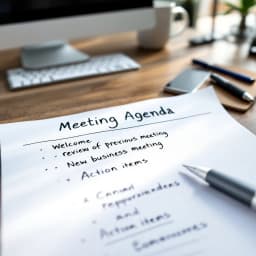
Ineffective meetings drain resources, kill morale, and stall progress. The antidote isn't fewer meetings; it's better meetings, and the foundation of every great meeting is a strategic agenda. A well-crafted agenda is more than just a list of topics; it's a roadmap that ensures every discussion has a clear purpose and every minute contributes to a meaningful outcome. Without one, even well-intentioned gatherings can devolve into directionless conversations that leave participants frustrated and confused.
This guide moves beyond generic templates to provide a detailed breakdown of six powerful business meeting agenda examples, each tailored for a specific, high-stakes scenario. We'll dissect what makes each one effective, offering strategic analysis and actionable insights you can apply immediately. You won't just see what to include; you'll understand the tactical reasoning why it works.
By the end of this article, you will have the tools to:
- Structure meetings for maximum focus and efficiency.
- Drive clear decisions and assign actionable next steps.
- Transform your meetings from obligatory time-sinks into powerful engines for collaboration and success.
We will explore everything from a classic board meeting to a fast-paced daily standup, giving you a comprehensive toolkit for orchestrating productive conversations.
1. The Classic Board Meeting Agenda
A cornerstone of corporate governance, the Classic Board Meeting Agenda is a formal, highly structured template designed for executive and board-level discussions. This format emphasizes legal compliance, fiduciary duty, and high-level strategic decision-making. Its structure often follows parliamentary procedures, such as Robert's Rules of Order, to ensure every discussion is orderly, documented, and conclusive.

This type of business meeting agenda example is indispensable for organizations where accountability and meticulous records are paramount, like Fortune 500 quarterly reviews or non-profit governance meetings. The rigid format ensures all legal and procedural bases are covered.
Strategic Breakdown
The strength of this agenda lies in its predictability and control. It moves from procedural formalities to substantive business in a logical flow, preventing chaotic discussions and ensuring focus remains on governance and strategy.
- Call to Order & Approval of Minutes: These initial steps formally begin the meeting and create an official record of past decisions, ensuring continuity and legal standing.
- Officer and Committee Reports: This section provides a structured update from key organizational pillars (e.g., CFO, committee chairs), offering a comprehensive snapshot of performance and progress.
- Old and New Business: Separating these items ensures that pending issues are resolved before new topics are introduced, preventing unresolved tasks from falling through the cracks.
- Executive Session & Adjournment: The executive session allows for confidential, sensitive discussions without junior staff present, while the formal adjournment officially closes the meeting and its minutes.
Actionable Takeaways
To effectively implement a classic board meeting agenda, focus on preparation and efficiency.
Consider these additional tips:
- Distribute Materials Early: Send the complete board packet, including reports and financials, at least 48-72 hours in advance. This respects members' time and allows them to come prepared.
- Structure for Momentum: Place less controversial topics at the beginning of the agenda to build agreement and a positive rhythm before tackling more complex or contentious issues.
- Maintain Official Records: Every board meeting requires precise documentation. For tips on capturing every critical decision, explore these best practices for taking better meeting notes.
2. The Daily Standup Agenda
Born from the world of Agile software development, the Daily Standup Agenda is a brief, highly focused format designed for quick daily synchronization. This 15-minute meeting empowers teams to align on progress, identify obstacles, and maintain momentum. The core principle is a simple, three-question structure for each participant: what did I do yesterday, what will I do today, and what is blocking my progress?
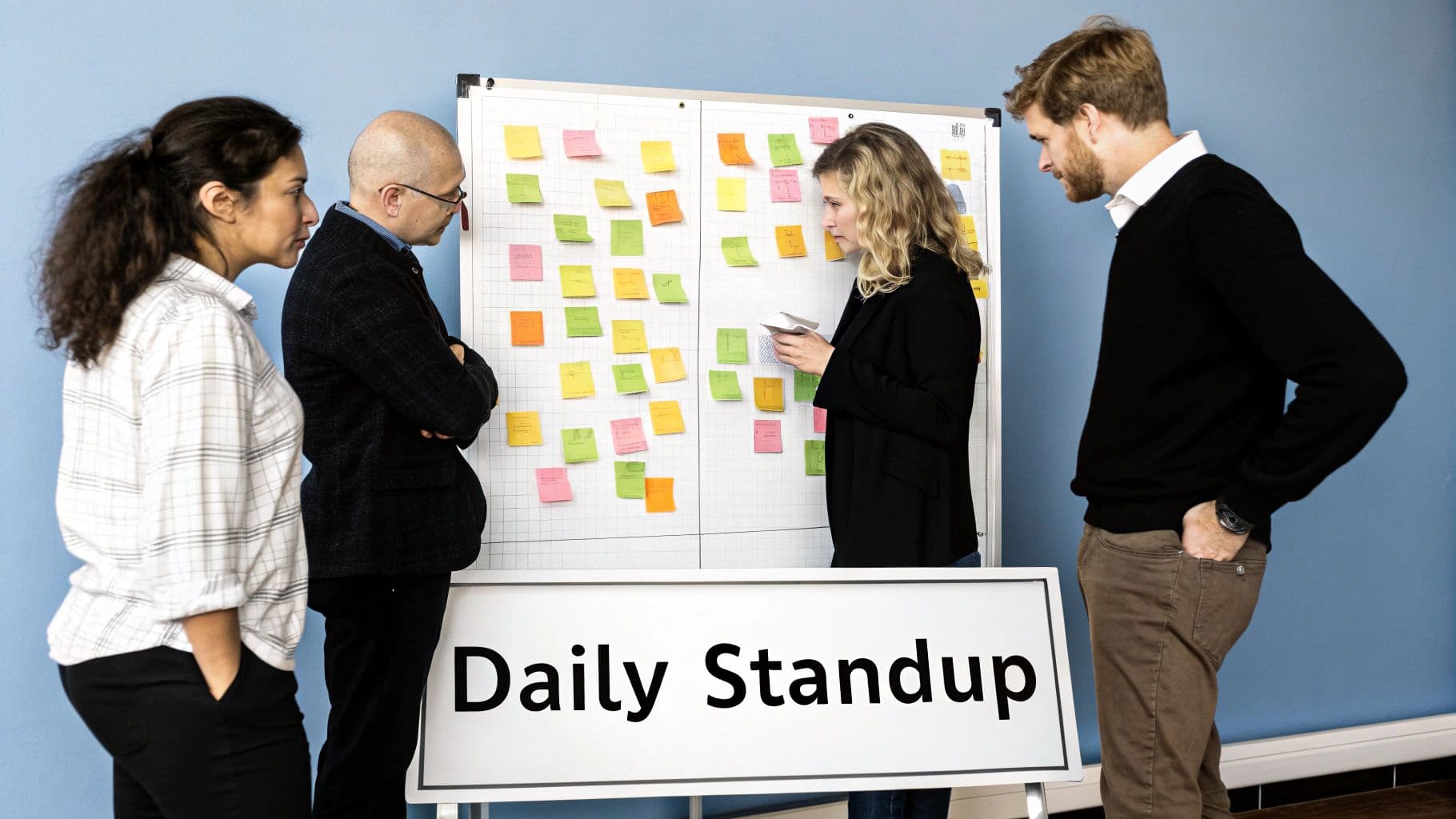
This business meeting agenda example has become a staple for fast-paced environments where daily coordination is critical. It is famously used by software teams at Microsoft and Google, but its effectiveness has led to adoption by marketing teams at HubSpot and product squads at Spotify, proving its versatility beyond just coding.
Strategic Breakdown
The power of the standup agenda is its ruthless efficiency and promotion of radical transparency. It’s not a status report for a manager but a commitment-and-coordination session for the team. Its structure is intentionally minimalist to prevent lengthy discussions and keep the focus purely on workflow and blockers.
- Yesterday's Accomplishments: This isn't about bragging; it's about closing loops and confirming that work is moving as expected. It creates a public record of progress and builds a sense of shared accomplishment.
- Today's Plan: Announcing daily goals creates immediate peer-to-peer accountability. It also allows teammates to identify opportunities for collaboration or flag potential conflicts before they arise.
- Identified Blockers: This is the most crucial part. It’s a real-time problem-solving mechanism that empowers the team to swarm on issues immediately, preventing small hurdles from becoming major delays.
- Strict Timebox (15 Minutes): The short duration forces concise communication and discourages problem-solving during the meeting. Deeper dives are "parked" for follow-up conversations with only the necessary people.
Actionable Takeaways
To execute an effective daily standup, the key is discipline and consistency. The goal is to make it a reflex, not a chore.
Consider these additional tips:
- Keep it Standing: The physical act of standing helps maintain a sense of urgency and naturally discourages long, drawn-out conversations. For remote teams, cameras on is the virtual equivalent.
- Park the "Parking Lot": Designate one person to capture any topics that require deeper discussion. These are addressed immediately after the standup with only the relevant individuals, respecting everyone else's time.
- Rotate the Facilitator: To keep the meeting from feeling like a manager's report, rotate who kicks off the meeting each day. This fosters shared ownership and keeps engagement levels high.
3. The Strategic Planning Retreat Agenda
A long-range, immersive format, the Strategic Planning Retreat Agenda is designed for deep thinking and high-stakes decision-making. This comprehensive structure typically spans one to three days, guiding leadership teams away from daily operations to focus exclusively on the organization's future direction, competitive positioning, and long-term goals.
This business meeting agenda example is essential for annual or quarterly planning, major pivots, or pre-merger alignments. It's the framework used by management consultancies like McKinsey and BCG to facilitate client strategy sessions and by forward-thinking companies like Southwest Airlines to maintain their competitive edge. The agenda’s strength lies in its phased, methodical approach to complex problem-solving.
Strategic Breakdown
This agenda is built to foster both analytical rigor and creative exploration, moving from broad environmental scanning to concrete action plans. The multi-day format allows ideas to incubate, ensuring decisions are well-considered rather than rushed.
- Environmental Scan & SWOT: The retreat opens by looking outward at market trends and inward at internal capabilities. This foundational analysis ensures all subsequent decisions are grounded in reality.
- Vision/Mission Review & Goal Setting: With a clear understanding of the current landscape, the team revisits the organization's core purpose. This phase realigns everyone on the "why" before defining ambitious, long-term objectives (the "what").
- Action Planning & Commitments: This is where strategy becomes tangible. The group translates big goals into specific initiatives, assigns ownership, and establishes clear timelines and accountability measures.
- Follow-Up Cadence: The agenda concludes by scheduling future check-ins to monitor progress, ensuring the momentum and commitments from the retreat are sustained.
Actionable Takeaways
To execute a successful strategic planning retreat, preparation and structure are paramount. The goal is to create an environment where big ideas can flourish and transform into executable plans.
Consider these additional tips:
- Limit Participants: Keep the group small, ideally 8-12 key decision-makers, to ensure high-quality discussion and efficient decision-making.
- Mix Analytical and Creative Exercises: Balance data-driven sessions like financial modeling with creative brainstorming or scenario planning to engage different modes of thinking.
- End with Concrete Next Steps: No one should leave without knowing exactly what they are responsible for. Conclude the retreat by summarizing key decisions, assigned tasks, and the date of the first follow-up meeting.
4. The Customer-Focused Problem-Solving Agenda
This agenda format flips the script on internal navel-gazing by placing the customer at the absolute center of the discussion. Popularized by companies like Amazon, the Customer-Focused Problem-Solving Agenda is designed to dissect specific customer issues, analyze feedback, and collaboratively develop impactful solutions. It moves beyond abstract goals to address tangible pain points within the customer journey.
This business meeting agenda example is perfect for cross-functional teams aiming to improve customer experience, reduce churn, or innovate a product based on user feedback. It is used effectively in settings like Zappos' customer experience sessions or Salesforce's customer success planning meetings, where understanding the user perspective is non-negotiable.
Strategic Breakdown
The power of this agenda is its empathetic, data-driven approach. It starts with the customer's reality and works backward to identify internal process failures or product gaps, ensuring that solutions are relevant and directly address the source of friction.
- Customer Story & Data Review: The meeting kicks off with a real customer anecdote or qualitative feedback, humanizing the problem. This is immediately followed by quantitative data (e.g., support tickets, NPS scores) to establish the scale and context of the issue.
- Root Cause Analysis: Instead of jumping to solutions, the team dedicates time to digging deep. Techniques like the "5 Whys" are used to move past surface-level symptoms and pinpoint the fundamental process or product flaw causing the problem.
- Brainstorming & Solution Prioritization: This is a collaborative phase where ideas are generated without judgment. The focus then shifts to prioritizing potential solutions based on impact, effort, and alignment with customer needs.
- Action Plan & Ownership: The meeting concludes with a clear, documented action plan. Every task is assigned a specific owner and a deadline, ensuring accountability and follow-through.
Actionable Takeaways
To run a successful customer-focused meeting, you must create a direct line of sight between the discussion and the customer's experience.
Consider these additional tips:
- Invite Cross-Functional Voices: Include representatives from every customer-touching team-sales, support, product, and marketing. This provides a 360-degree view of the customer journey and prevents siloed thinking.
- Visualize the Journey: Use customer journey maps or process flowcharts as a visual aid during the discussion. This helps the team identify specific friction points and understand the end-to-end experience.
- Define Success Metrics First: Before brainstorming solutions, agree on what success looks like. Will it be a 10% reduction in support calls, a 5-point increase in CSAT scores, or a shorter resolution time? Clear metrics ensure the team is solving for a specific outcome.
5. The Innovation and Brainstorming Session Agenda
Built for creativity and problem-solving, the Innovation and Brainstorming Session Agenda is a flexible format designed to generate novel ideas. This structure breaks from rigid, linear meeting styles to foster a psychologically safe environment where divergent thinking can flourish. It often incorporates principles from design thinking to guide teams from a problem statement to actionable concepts.
This type of business meeting agenda example is critical for product development teams, marketing groups, and any organization facing complex challenges that require out-of-the-box solutions. Its success is rooted in companies like IDEO and Google, which have institutionalized creative exploration to drive market-leading innovations.
Strategic Breakdown
The power of this agenda is its structured chaos, guiding participants through distinct creative phases. It intentionally separates idea generation from evaluation to prevent premature criticism from stifling creativity.
- Warm-Up & Problem Framing: The meeting begins with a creative icebreaker to shift mindsets, followed by a clear definition of the problem or challenge to focus the group's energy.
- Divergent Thinking (Idea Generation): This is the core brainstorming phase. Using techniques like round-robin or silent brainwriting on sticky notes, the goal is quantity over quality, with a strict "no criticism" rule.
- Convergent Thinking (Idea Refinement): After generating a wide array of ideas, the group shifts to organizing, clustering, and evaluating them. This phase uses methods like dot-voting to identify the most promising concepts.
- Action Planning & Next Steps: The session concludes by transforming the best ideas into concrete next steps, assigning ownership, and defining a clear path forward to ensure creative energy translates into tangible outcomes.
Actionable Takeaways
To run a successful brainstorming session, the facilitator must act as a guardian of the creative process, ensuring the environment remains open and productive.
Consider these additional tips:
- Invite Diverse Perspectives: Include participants from different departments, backgrounds, and levels of seniority. Diverse viewpoints are the fuel for true innovation.
- Make it Visual: Use whiteboards, sticky notes, and markers to capture ideas visually. This makes abstract concepts tangible and helps identify patterns and connections more easily.
- Define Clear Outcomes: Before the meeting ends, ensure every promising idea has a designated owner and a defined next step. For more templates that drive clear results, explore these powerful meeting agenda examples.
6. The Project Kickoff Meeting Agenda
A critical first step for any new initiative, the Project Kickoff Meeting Agenda is a comprehensive format designed to launch projects successfully. This agenda aligns team members, clarifies objectives, establishes communication protocols, and sets clear expectations from day one. It covers project scope, roles, timelines, and risks to ensure everyone starts with a shared understanding and commitment.

This business meeting agenda example is essential for complex undertakings like a new software implementation, a major marketing campaign launch, or a large-scale construction project. By formalizing the project’s start, it mitigates future misunderstandings and builds immediate momentum.
Strategic Breakdown
The power of this agenda is its ability to create a single source of truth before any significant work begins. It transforms an abstract project charter into a concrete, collaborative action plan, fostering buy-in from all internal and external stakeholders involved.
- Project Vision & Scope: This section clearly defines the "why" behind the project and establishes firm boundaries for what is (and isn't) included, preventing scope creep later.
- Roles & Responsibilities: By explicitly outlining who does what using a RACI (Responsible, Accountable, Consulted, Informed) chart or similar tool, this item eliminates ambiguity and promotes accountability.
- Timeline, Milestones & Deliverables: This provides a high-level roadmap, breaking the project into manageable phases with clear deadlines and tangible outcomes for each stage.
- Risks & Communication Plan: Proactively identifying potential obstacles and establishing how the team will communicate (e.g., weekly syncs, status reports) builds resilience and ensures smooth information flow.