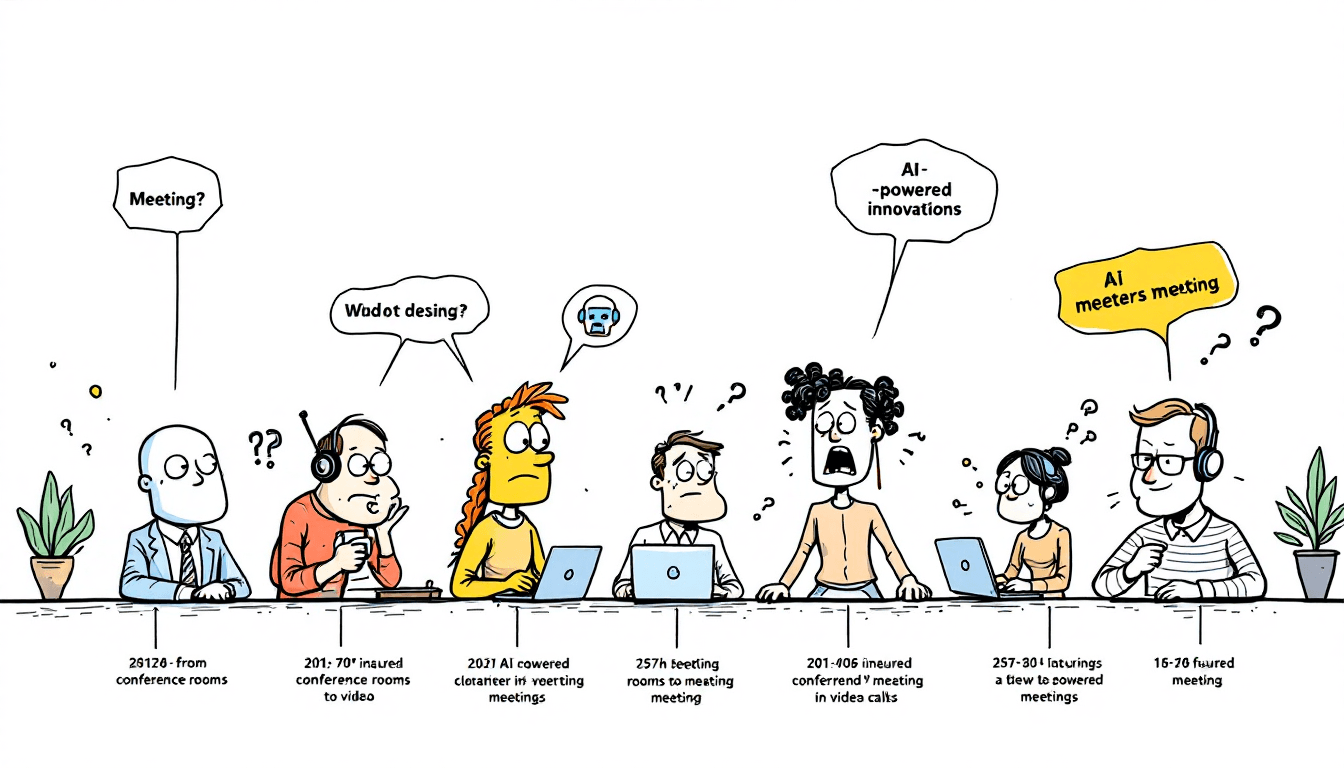
The Great Communication Revolution 📞
Imagine trying to explain to someone from 1965 that you could hold a meeting with colleagues from Tokyo, London, and New York while an AI assistant automatically takes notes and schedules follow-ups. They'd think you were describing science fiction.
Yet here we are in 2026, wheremeeting technology evolutionhas fundamentally transformed business communication in ways that seemed impossible just decades ago.
This journey through meeting technology history reveals not just technological advancement, but a complete reimagining of how humans collaborate across space and time.
Phase 1: The Conference Room Era (1960s-1980s) 🏢
The Foundation Years
Business meetings in the 1960s were simple affairs: gather everyone in a room, talk, maybe use a flip chart. The biggest technological innovation was the overhead projector, introduced in the early 1960s.
Key Innovations:
- • Overhead projectors (1961)
- • Conference phones (1964)
- • Slide projectors for presentations
- • Whiteboards replacing blackboards
- • Early intercom systems
- • Everyone had to be physically present
- • No remote collaboration possible
- • Manual note-taking only
- • Limited visual aids
- • High travel costs for distant meetings
📊 Fun Fact: The average business traveler in 1975 spent 40% of their time traveling to meetings that could have been phone calls!
Phase 2: The Telecommunication Breakthrough (1980s-1990s) 📡
Breaking Distance Barriers
The 1980s introduced the revolutionary concept that people didn't need to be in the same room to meet. Early video conferencing systems, though expensive and clunky, opened new possibilities.
Major Milestones:
1982: First Commercial Video Conferencing
Compression Labs introduced the first commercial video conferencing system at $250,000 per endpoint.
1986: Desktop Publishing Revolution
PageMaker and laser printers transformed meeting materials and presentations.
1990: PowerPoint Launch
Microsoft PowerPoint revolutionized business presentations forever.
1995: Internet Integration
Email and early web-based collaboration tools emerged.
💰 Reality Check: Early video conferencing cost $1,000 per hour in 1985 dollars - equivalent to $2,800 today!
Phase 3: The Digital Revolution (2000s-2010s) 💻
Democratizing Remote Meetings
The 2000s brought broadband internet and affordable computing power to the masses, making video conferencing accessible to small businesses and individuals for the first time.
2003: Skype Launch
Free video calling for everyone, reaching 100 million users by 2006.
2011: Zoom Founded
Eric Yuan's vision of "frictionless" video communications begins.
2013: Slack Revolution
Team communication transformed with persistent chat and file sharing.
Key Technology Enablers:
- • High-speed broadband internet
- • HD webcams and microphones
- • Cloud computing infrastructure
- • Mobile device integration
- • Screen sharing technology
- • Real-time collaboration tools
- • Social media integration
- • Calendar synchronization
Phase 4: Mobile & Cloud Era (2010s-2020) 📱
Meetings Everywhere, Anytime
Smartphones and tablets transformed meetings from desktop-bound activities to truly mobile experiences. The COVID-19 pandemic accelerated adoption like never before.
The Pandemic Acceleration (2020-2021)
Usage Explosion:
- • Zoom: 10M to 300M daily users
- • Microsoft Teams: 20M to 250M users
- • Google Meet: 25x usage increase
- • Total video calls increased 30x
New Features Born:
- • Virtual backgrounds
- • Breakout rooms
- • Live captions
- • Recording & transcription
🔥 2020 Reality: Organizations that took years to plan digital transformation implemented it in weeks during the pandemic!
Phase 5: AI-Powered Intelligence Era (2020-Present) 🤖
The Smart Meeting Revolution
Artificial Intelligence has transformed meetings from passive communication tools into intelligent, proactive assistants that enhance human collaboration.
Current AI Capabilities:
- • Real-time transcription & translation
- • Automated meeting summaries
- • Action item extraction
- • Sentiment analysis
- • Speaker identification
- • Smart scheduling optimization
- • Follow-up automation
- • Context-aware insights
📈 Impact: AI-powered meeting tools save the average knowledge worker 2.5 hours per week on meeting-related tasks!
Innovation Patterns & Trends 📊
The Innovation Cycle
Looking at 60+ years of meeting technology evolution, clear patterns emerge in how innovations develop and get adopted.
Problem Identified
Business pain point emerges
Technology Solution
Innovation addresses the need
Market Adoption
Early adopters prove value
Mass Integration
Becomes standard practice
Key Acceleration Factors
Technology Enablers
- • Internet bandwidth improvements
- • Computing power increases
- • Mobile device proliferation
- • Cloud infrastructure scaling
- • AI/ML algorithm advances
Business Drivers
- • Globalization demands
- • Cost reduction pressures
- • Remote work trends
- • Productivity optimization
- • Environmental concerns
Current State: Where We Stand Today 🌟
2026 Meeting Technology Landscape
Today's meeting technology ecosystem combines decades of innovation into sophisticated platforms that would seem magical to previous generations.
Platform Consolidation
Major players dominate:
- • Microsoft Teams (40% market)
- • Zoom (35% market)
- • Google Meet (15% market)
- • Others (10% market)
AI Integration
Smart features standard:
- • 78% include transcription
- • 65% offer summaries
- • 52% provide translations
- • 43% extract action items
Hybrid Complexity
New challenges emerge:
- • In-person + remote mixing
- • Multiple device management
- • Equity of participation
- • Technology fatigue
🎯 Current Challenge: 73% of workers report "meeting fatigue" despite having more powerful tools than ever before!
Future Predictions: The Next Decade (2026-2035) 🔮
Emerging Technologies on the Horizon
Based on current research trends and technological capabilities, here's what the next decade of meeting technology may bring.
2026-2027: Enhanced AI Intelligence
- • Predictive meeting preparation (agenda optimization)
- • Real-time emotion and engagement analysis
- • Automated conflict resolution suggestions
- • Personalized communication style adaptation
- • Cross-platform intelligent scheduling
2027-2030: Immersive Reality Integration
- • Mainstream VR/AR meeting adoption
- • Haptic feedback for remote collaboration
- • 3D holographic presentations
- • Spatial audio with directional conversation
- • Virtual presence indistinguishable from physical
2030-2035: Ambient Intelligence
- • Brain-computer interface for thought sharing
- • AI avatars representing people when unavailable
- • Automatic knowledge synthesis from all meetings
- • Predictive decision making based on communication patterns
- • Seamless human-AI collaborative thinking
Technology Convergence Trends
Hardware Evolution:
- • Lightweight AR glasses (Apple Vision successor)
- • Neural interface headbands
- • 360° camera rooms
- • Biometric mood sensors
Software Intelligence:
- • AGI meeting facilitators
- • Quantum-powered optimization
- • Blockchain-verified decisions
- • Neural network empathy modeling
Industry Transformation Impact 🏭
How Meeting Evolution Reshaped Business
Meeting technology evolution hasn't just changed how we communicate—it's fundamentally transformed entire industries and business models.
Industries Transformed
Education
Online learning, global classrooms, personalized instruction
Healthcare
Telemedicine, remote consultations, global specialist access
Legal Services
Virtual depositions, remote court hearings, global law firms
Sales & Marketing
Digital demos, webinar marketing, global pipeline management
Business Model Changes
Remote-First Companies
GitLab, Automattic, Buffer pioneering distributed teams
Global Talent Access
Companies hiring worldwide, location-independent roles
Reduced Real Estate
Office downsizing, co-working growth, flexible spaces
24/7 Operations
Follow-the-sun support, continuous development cycles
Economic Impact Statistics
Annual business travel savings from video meetings
Hours saved weekly through AI meeting tools
Reduction in time-to-decision for distributed teams
Key Lessons From 60 Years of Innovation 📚
Success Patterns
- ✓Technologies that reduce friction win (Zoom vs WebEx)
- ✓Mobile-first design becomes essential
- ✓Integration beats best-of-breed solutions
- ✓User experience trumps feature count
- ✓Crisis accelerates adoption (pandemic, travel restrictions)
Common Failure Points
- ✗Over-engineering solutions (early video conferencing)
- ✗Ignoring security concerns (many early platforms)
- ✗Focusing on technology over human needs
- ✗Platform lock-in without clear value
- ✗Underestimating change management requirements
Looking Forward: The Never-Ending Evolution 🌅
The evolution of meeting technology from 1960s conference rooms to today's AI-powered platforms represents one of the most dramatic transformations in business history. Yet we're likely still in the early chapters of this story.
Each technological leap—from conference phones to video calls to AI assistants—has fundamentally changed not just how we meet, but how we think, collaborate, and build relationships across distances.
The Human Constant
Through all these technological changes, one thing remains constant: the fundamental human need to connect, share ideas, and collaborate toward common goals. The best meeting technologies don't replace human interaction—they amplify and enhance it.
As we stand at the threshold of AI-powered meetings, VR collaboration, and ambient intelligence, we're not just witnessing technological evolution—we're participating in the next chapter of human communication itself.