A meeting ground rule is really just a simple, shared agreement on how your team promises to act during a meeting. Think of it as a playbook for making sure discussions are actually productive, respectful, and on-topic. These rules help you sidestep common frustrations and turn chaotic get-togethers into sessions where real decisions get made.
Why Meetings Fail and How Ground Rules Can Fix Them
We've all been stuck in that meeting. The one that drags on forever, has no clear point, and is completely dominated by one or two people. You walk out wondering what was accomplished and feeling like you just lost an hour of your life. With so many of us working in hybrid or remote setups, the chances of meetings going off the rails are higher than ever.
Without some kind of shared structure, it's easy for meetings to get derailed. To see why ground rules are so effective, it helps to understand the common pitfalls leading to unproductive meetings. A solid set of ground rules tackles these problems head-on by giving everyone a predictable and efficient way to work together.
The Problem With Unstructured Meetings
When you don’t have established norms, meetings almost always fall into the same predictable traps. These issues don't just waste time; they can seriously damage team morale and trust.
- Lack of Focus: Conversations wander aimlessly without a clear agenda to guide them. You end up with discussions that go in circles and never lead anywhere.
- Unequal Participation: A few dominant personalities can easily take over, leaving introverted or remote team members struggling to get a word in. Great ideas get lost in the silence.
- No Clear Outcomes: Without a process for making decisions and assigning next steps, everyone leaves the room (or Zoom call) unsure of what was actually decided.
How Ground Rules Provide the Solution
Meeting ground rules aren’t about creating a stiff, bureaucratic list of "dos and don'ts." They're a proactive agreement that empowers everyone to show up and contribute their best work. Think of them as the operating system for your team’s collaboration—they just make everything run smoother.
This simple framework turns chaos into clarity. When everyone is on the same page about how to prepare, participate, and wrap up, meetings stop being a drain on time and energy and become a powerful tool for moving forward.
The Real Benefits of a Strong Ground Rule Framework
Putting meeting ground rules in place is about much more than just making your meetings feel tidier. The effects are real, tangible, and they ripple out across your entire team, boosting everything from efficiency to morale. Think of them less as rules and more as a shared agreement on how to make your time together count.
For example, simply agreeing to have an agenda for every meeting can completely change the dynamic. That single move gets rid of the classic "So, what are we talking about today?" shuffle that eats up the first ten minutes. It’s a small tweak that has a massive impact on focus right from the start.
Fostering Psychological Safety
One of the most powerful things ground rules do is create a space where people feel safe to speak up. When your team knows what to expect and trusts that conversations will be respectful, they're far more willing to share honest feedback and even half-baked, brilliant ideas. It removes the fear of being judged or shot down.
A classic rule like, "Attack problems, not people," is a perfect example. It keeps the conversation focused on the work, so feedback feels constructive, not personal. When people aren't walking on eggshells, they can actually solve tough problems together.
Boosting Inclusivity and Engagement
A good set of ground rules ensures everyone gets a chance to be heard—not just the loudest person in the room. This is especially critical with remote and hybrid teams, where it’s all too easy for someone on a screen to get talked over or forgotten.
When everyone knows the rules of engagement, they're more likely to stay tuned in. If you're looking for more ways to keep your team focused, our guide on meeting productivity tips has some great strategies that pair perfectly with a solid ground rule system.
Driving Clearer Outcomes and Accountability
At the end of the day, ground rules are all about getting better results. They provide the structure needed to turn a meandering conversation into clear, decisive action. Rules that focus on decision-making and next steps are key to making sure a meeting actually accomplishes something.
- Designated Note-Taker: Having one person responsible for capturing key decisions and action items ensures nothing gets lost.
- End-of-Meeting Recap: A quick, two-minute summary at the close solidifies what was decided and who is doing what next.
These practices transform meetings from talk-fests into real engines for progress. They create a reliable system of accountability where the plan is clear and everyone knows their part in making it happen.
8 Unbreakable Ground Rules for a Meeting That Works
While every team has its own unique vibe, a handful of core ground rules are the secret sauce behind almost every productive meeting. These aren't complex, top-down mandates; they're simple, shared agreements that keep everyone focused, respectful, and on track. If you want to build a better meeting culture, starting here is the quickest win.
Think of it this way: a solid set of ground rules creates a ripple effect. It starts by building a foundation of safety and inclusion, which in turn fosters a sense of shared responsibility.
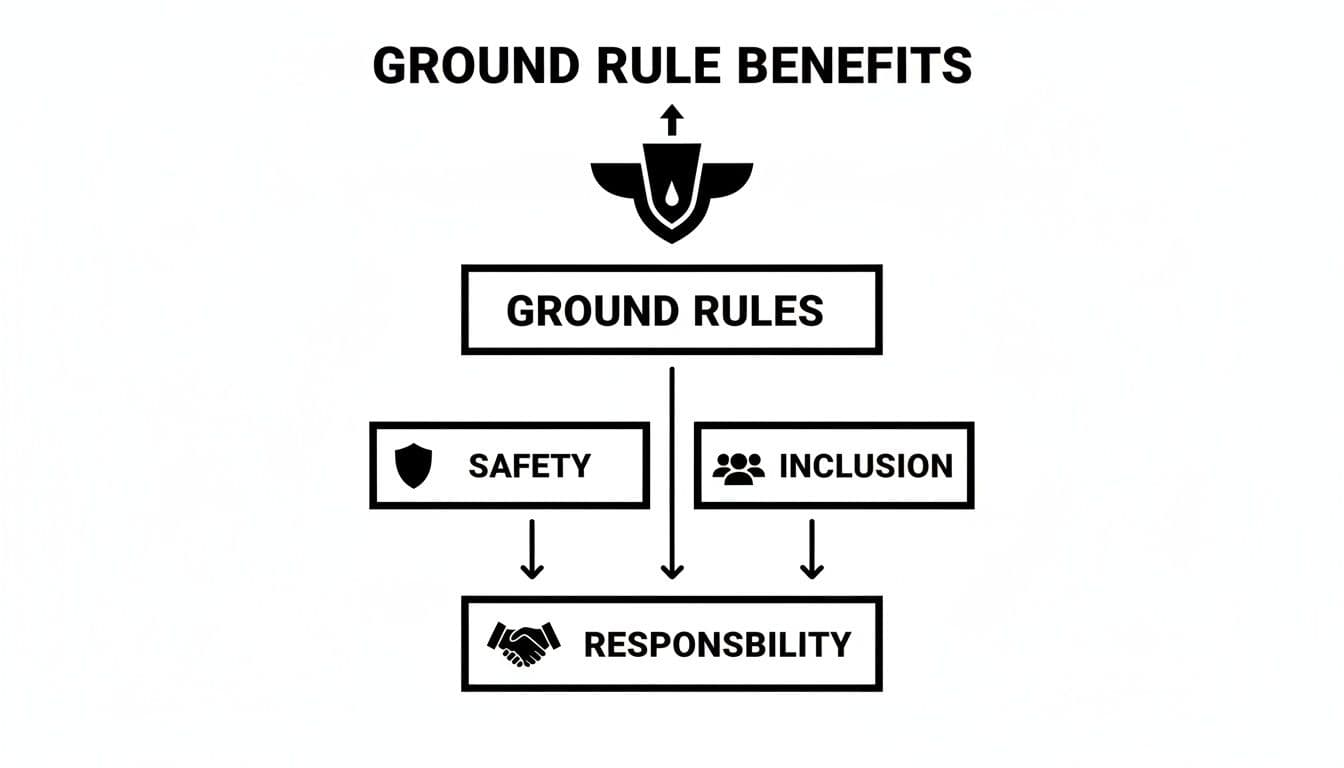
This shows that ground rules are about more than just being efficient. They're about building the trust and psychological safety that great teamwork depends on.
The Agenda Is King
If you only implement one rule, make it this one: always have an agenda. An agenda isn't just a to-do list; it's the roadmap for the entire conversation. It tells everyone where you're going, why you're going there, and how you plan to get there.
Meetings without an agenda inevitably wander. Time gets burned, and the whole point of getting together is lost. There's a huge gap here—research shows that while 79% of professionals feel a clear agenda makes meetings more productive, a shocking 37% of meetings actually have one. That disconnect is why so many meetings feel like a waste of time.
A good agenda also gives AI summarization tools the structure they need to do their job well. When topics are clearly defined, the AI can easily pick out the key discussions, decisions, and action items, giving you a summary you can actually trust.
Come Prepared to Contribute
An agenda is only as good as the people who read it. The "Come Prepared" rule is a simple ask: do the pre-reading, think about the topics, and show up ready to add value.
When preparation becomes the standard, every single person in the room becomes a valuable contributor, not just a spectator.
Designate a Facilitator
Every meeting needs a captain to steer the ship. A facilitator isn't there to dominate the conversation; they're there to enforce the ground rules, keep things moving, and make sure the agenda is honored.
A good facilitator has the green light to:
- Keep it on topic: They can gently park great-but-unrelated ideas in a "parking lot" to be addressed later.
- Encourage everyone to speak: If one person is dominating or others are quiet, the facilitator can create space for different voices to be heard.
- Push for a clear outcome: Their main job is to ensure the meeting ends with concrete decisions and clear next steps.
This role is absolutely vital for keeping the momentum going. By starting with just these three foundational rules, your team can begin to turn frustrating meetings into the valuable, collaborative sessions they were always meant to be.
To see how these essential rules fit into a larger framework, here's a quick summary of other critical guidelines and the value they bring.
Essential Meeting Ground Rules and Their Impact
| Ground Rule | Primary Purpose | Impact on Productivity |
|---|---|---|
| Start and End on Time | Respect everyone's schedule and maintain discipline. | Prevents meeting spillover and protects focused work time. |
| One Speaker at a Time | Ensure every voice is heard clearly without interruption. | Reduces confusion and makes discussions easier to follow. |
| Listen to Understand | Promote active listening over just waiting to talk. | Leads to better ideas, fewer misunderstandings, and stronger team alignment. |
| No Multitasking | Keep everyone present and fully engaged in the discussion. | Increases participation and improves the quality of contributions. |
| Be Solution-Oriented | Focus on constructive problem-solving, not just highlighting issues. | Drives progress and fosters a positive, forward-thinking mindset. |
Adopting these practices consistently will build a strong foundation for any team. For a deeper dive, check out our guide on the unbreakable ground rules for meetings that work.
How to Create Your Team's Custom Rulebook
Let's be honest: a generic list of rules copied from a blog post is doomed to fail. Why? Because the most effective ground rules are the ones your team builds together. When people have a say in creating the rules, they're genuinely invested in making them work. It’s less about a top-down mandate and more about shared ownership.
The best way to kick this off is with a dedicated workshop. Block out an hour and create a space where everyone can openly talk about what’s working—and what’s definitely not—in your meetings today. This is the time for people to air their frustrations, whether it's meetings that drag on forever or decisions that seem to vanish into thin air. From there, you can collectively turn those pain points into practical solutions.
Sparking the Conversation with Key Questions
To get the ball rolling, you need to ask the right questions. Simply asking, "So, what rules should we have?" will likely get you blank stares. Instead, you need prompts that get people thinking about specific behaviors and results.
Try these questions to guide your workshop and get a real discussion going:
- How can we best prepare for meetings so our time together is actually productive?
- What’s our official stance on multitasking or having other devices open?
- How can we make sure everyone, especially quieter team members, gets a chance to contribute?
- What’s our system for locking in decisions and knowing who is doing what afterward?
- When we disagree, how do we keep the conversation respectful and move forward?
These questions steer the conversation away from abstract ideas and toward concrete actions. It helps the team define what a great meeting actually looks and feels like for them.
A Phased Approach to Building Your Rules
A great way to organize your ground rules is to break them down by the meeting lifecycle: Before, During, and After. This creates a simple, logical flow that’s easy for everyone to remember and follow. It turns the meeting from a single event into a predictable process.
1. Before the Meeting: This is all about preparation. Good prep work sets the stage for a focused, effective meeting. * Example Rule: Agendas with clear goals will be shared at least 24 hours ahead of time. * Team-Specific Twist (Sales Team): For our weekly pipeline review, all reps must update their key metrics and client notes in the shared dashboard beforehand.
2. During the Meeting: These rules are about how you interact. They keep the conversation on track and respectful. * Example Rule: We stick to one person speaking at a time and use the "raise hand" feature on video calls. * Team-Specific Twist (Engineering Team): We’ll time-box any technical debates to 10 minutes. If we can't solve it in that time, we'll schedule a separate deep-dive session.
3. After the Meeting: This phase is about follow-through. It’s where talk turns into action. * Example Rule: A summary of key decisions and action items will be sent out within two hours after the meeting ends. * Team-Specific Twist (Global Team): To support our different time zones, all meeting recordings and notes will be posted in our shared channel immediately.
When you tailor each rule to your team’s specific workflow, you’re not just creating a rulebook—you’re building a custom playbook. It feels relevant and helpful, not restrictive, because it’s designed to solve your team’s real-world problems.
How to Enforce Rules Without Being the Meeting Police
So you’ve created a solid set of ground rules. That was the easy part. Now comes the real challenge: how do you get everyone to stick to them without sounding like a dictator?
The key is to shift your mindset. You're not the meeting police, ready to hand out tickets for every little infraction. Think of yourself as a guide, gently steering the team back to the path they all agreed to follow in the first place.

Your job isn't to push your own agenda but to protect the team's shared agreement. When you approach it this way, enforcement feels less like a confrontation and more like a supportive, collaborative effort. It all comes down to a few simple, non-aggressive techniques that keep the meeting’s energy focused on its goals.
Gentle Redirection Techniques
When a discussion veers off-topic, you don't need to slam on the brakes. Instead, you can use a couple of simple tools to acknowledge the idea's value while keeping the train on the tracks.
- Use a Parking Lot: This is just a designated spot—a corner of the whiteboard, a slide in the deck, a shared note—for important but off-topic ideas. When a tangent pops up, you can simply say, "That's a great point. Let's add it to the parking lot so we don't forget it and can circle back later." This makes the person feel heard without derailing the conversation.
- Time-Box Agenda Items: Assign a time limit to each topic on the agenda. When the clock runs out, the facilitator can announce, "Our time is up for this topic. We need to move on to stay on schedule." Suddenly, time is the "bad guy," not you.
These methods help you guide the meeting without being heavy-handed. You can dive deeper into this role by learning what meeting facilitation is and how it works.
Make the Rules Visible and Unavoidable
Out of sight, out of mind. It's a cliché for a reason. If your ground rules are buried in some forgotten document on a shared drive, they’re not doing anyone any good.
The trick is to weave them into your meeting workflow so they become a constant, gentle reminder of the team's commitment. Add a short list of your core rules to every calendar invitation. Kick off each meeting with a quick, 30-second review of them. This repetition is what builds habits and turns your rules into team muscle memory.
Another powerful enforcement practice is simply being more thoughtful about who you invite. Recent data shows that 29% of recurring meetings have seven or more people, which almost guarantees some will tune out. And with 73% of professionals admitting they multitask during meetings, it's pretty clear many are sitting in sessions where they aren't actually needed.
Keeping the invite list lean is one of the most effective ground rules you can implement. You can find more stats like these in these collaboration trends from Flowtrace.
Using AI Tools to Supercharge Your Ground Rules
Good ground rules aren't just for people; they're the operating instructions that help your AI meeting assistants shine. Think of your AI tool as a highly capable assistant who takes everything you say literally. To get accurate results, it needs clear, structured information.
When you put a solid meeting ground rule framework in place, you’re basically cleaning up the data you feed these powerful tools. This creates a fantastic feedback loop of clarity and accountability.
Feeding the AI Clean Data
Even the simplest rules can have a huge impact on the quality of your AI-generated summaries and transcripts. When your team sticks to a few key behaviors, you’re not just having a better conversation—you’re setting up your tech to win.
- One Speaker at a Time: This one is pure gold for AI. It eliminates crosstalk, which means tools like Fireflies or Otter.ai can produce much cleaner transcripts and nail speaker identification every time.
- Verbal Summary of Decisions: Asking someone to quickly recap decisions out loud before the meeting ends creates a perfect, structured moment for the AI to capture and pull out accurate action items.
To see just how much potential AI has to support your team, it helps to understand how AI agents for business are already being used to handle complex jobs. Your ground rules are what give these tools the high-quality fuel they need to work properly.
Answering Your Questions About Meeting Ground Rules
Rolling out any new process, even something as simple as meeting rules, is going to stir up some questions. That’s perfectly normal. Let's tackle some of the most common ones so your team can get on board with less friction and more confidence.