Let's get straight to it: what is operational efficiency?
Think of it as the art of getting the most bang for your buck. It’s all about using the least amount of resources—time, money, effort—to deliver the absolute best results. It's not about cutting corners; it's about finding the smartest, smoothest path from A to B.
Unpacking Operational Efficiency
At its heart, operational efficiency is about working smarter, not just harder.
Picture a professional pit crew during a Formula 1 race. Their goal isn't just to be fast. It’s about flawless execution—perfect coordination, the right tools at the right time, and zero wasted motion. Every split-second counts, and a single mistake can cost them the entire race. That's operational efficiency in action. Your business is no different.
It’s easy to mistake this for just another way to cut costs, but that's only a tiny piece of the puzzle. True efficiency is a complete overhaul of how your team works. It means equipping them with the right tools, designing clear processes, and removing the friction that gets in their way. When you do that, people can finally focus on what really matters.
If you're looking for ways to get your team working smarter, you might find these strategies to increase productivity helpful.
The Core Components of Operational Efficiency
So, what are the building blocks? Operational efficiency really comes down to mastering three key areas:
- Process Optimization: Are your workflows actually working? This is about making sure every step is logical, smooth, and free of frustrating bottlenecks.
- Resource Management: Are your people, budget, and time being put to good use? It’s about assigning resources where they'll have the biggest impact and avoiding waste.
- Quality Control: Can you deliver great results every single time? This means building systems that prevent errors and eliminate the need for costly rework.
The image below gives a more formal definition, showing operational efficiency as the relationship between what you put in (input) and what you get out (output).
It really is that simple. The whole game is to improve that ratio. You either get more output for the same input, or you get the same output with less input. Either way, you win.
Operational Efficiency at a Glance
To quickly break down these concepts, here’s a table that summarizes the essential parts of operational efficiency.
| Component | What It Means | Common Metric |
|---|---|---|
| Process Optimization | Making workflows as smooth and logical as possible. | Cycle Time: The time it takes to complete a process from start to finish. |
| Resource Management | Using your time, money, and people wisely. | Cost of Goods Sold (COGS): The direct costs of producing goods. |
| Quality Control | Ensuring your final output is consistently excellent. | First Pass Yield: The percentage of products made correctly the first time. |
This table shows how each component has a specific goal and a clear way to measure whether you're succeeding.
Understanding the Building Blocks of Efficiency
Operational efficiency isn't about one magic fix; it's about fine-tuning your entire system. Picture a high-performance engine. For that engine to deliver maximum power, every single component—from the pistons to the spark plugs—has to work together seamlessly. A single sluggish or faulty part can drag the whole system down.
Your business operates in much the same way. To really get a handle on operational efficiency, you need to see how all the pieces connect. At its heart, it comes down to three simple elements: inputs, processes, and outputs.
This infographic shows how resources (inputs) are transformed through your work (processes) to create results (outputs).
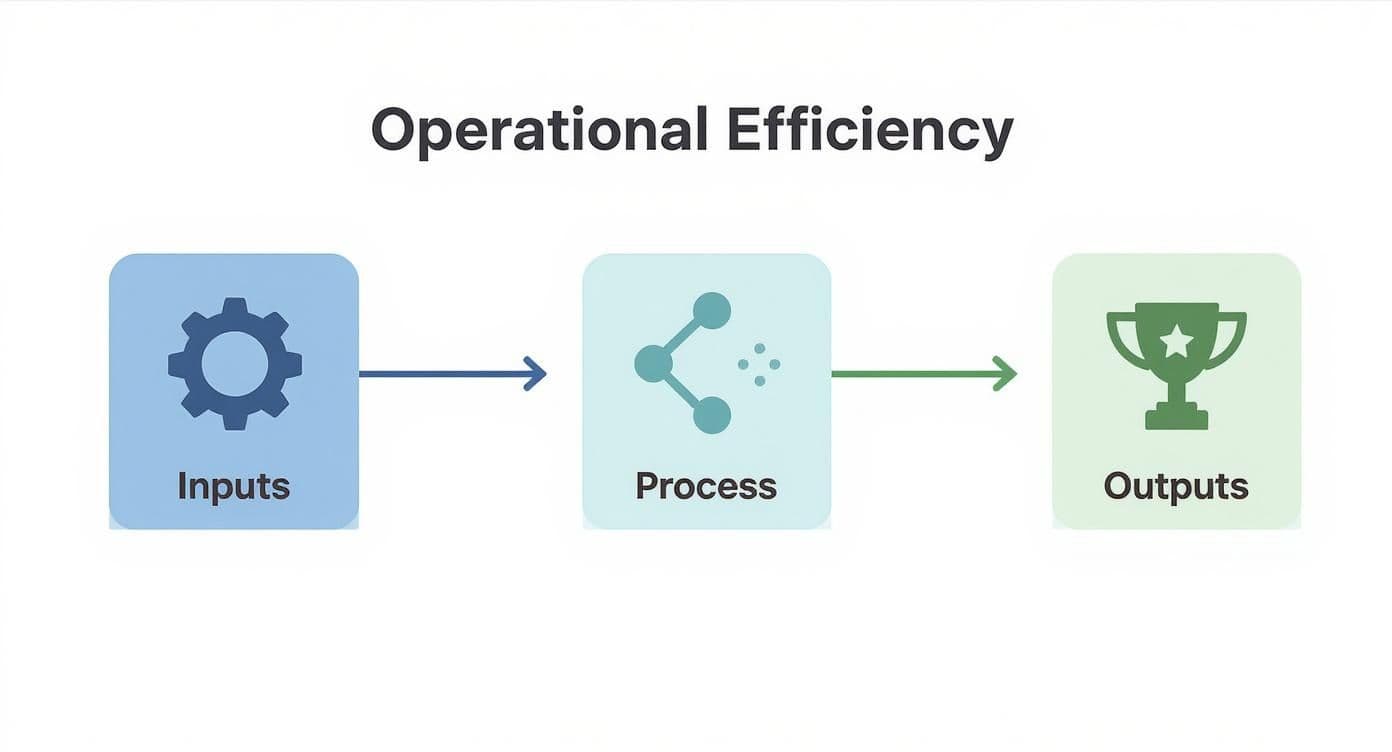
The key takeaway is that efficiency isn't just about what you produce at the end. It’s about making every single step in that journey as smart and effective as possible. Let’s look at each of these building blocks more closely.
The Core Components Explained
Inputs are simply the resources you put in. This isn't just money. It's your team's time, the software you pay for, the raw materials for a product—anything and everything you invest to get the work done.
The process is where the transformation happens. It’s the "how" of your operation—the specific steps, workflows, and actions your team takes to turn those initial inputs into something valuable. A truly efficient company has polished its processes until they're smooth, repeatable, and effective.
Finally, outputs are your results. This might be a physical product, a happy client, a launched feature, or a solved support ticket. The ultimate aim is to get the best possible output using the fewest possible inputs.
Optimizing the Process
More often than not, the "process" stage is where you'll find the biggest wins. This is the part of the equation you have the most control over, and small tweaks here can have a huge ripple effect on your results.
This is where you start looking at metrics like cycle time (how long it takes to complete one task from start to finish) and throughput (how many tasks you complete in a given period).
A great first step for many businesses is to map out their current workflows. This almost always reveals bottlenecks and friction points you didn't even know existed. Once you spot them, you can start smoothing them out. Automating routine tasks is another fantastic way to speed things up. To learn more, check out our guide on what is workflow automation and how it can help your team.
The Key Drivers and Metrics You Can Actually Use
Knowing what operational efficiency is is a great start, but making real, lasting improvements means zeroing in on the drivers and metrics that actually move the needle. You have to get past the buzzwords and focus on tangible actions that make work smoother and more predictable. It's all about building a system that just works, day in and day out.
The main drivers of efficiency are surprisingly simple, but incredibly powerful. First, standardizing workflows gives everyone a clear, repeatable playbook for common tasks. This cuts down on guesswork and mistakes. Think of it like a pilot's pre-flight checklist—it ensures nothing gets missed and the process is followed perfectly every time.
Second, automating repetitive tasks is a game-changer. It frees up your team's mental energy, allowing them to focus on the strategic, creative work that really requires a human touch.
Choosing Metrics That Tell a Story
Metrics are your scoreboard. They tell you if the changes you're making are actually working. But it's easy to get buried in data, so the trick is to pick metrics that directly tie back to your goals. Ditch the vanity metrics and focus on the numbers that give you a real pulse on your operations.
Here are a few metrics that pack a punch:
- Error Rate: This simply tracks how often mistakes pop up in a process. If this number is dropping, you know your standardization efforts are working.
- Cost Per Unit: This calculates the total cost to produce one thing, whether it's a product or a completed service. Pushing this number down is a direct sign of better efficiency.
- Customer Wait Time: For any team that deals with customers, this one is huge. It measures how long it takes to resolve a customer's request, which has a massive impact on their happiness.
Putting It All Together: A Customer Support Example
Let's imagine a customer support team that's completely overwhelmed with tickets. Response times are dragging, and everyone—both customers and agents—is feeling the frustration. Their goal is straightforward: answer every question faster and better.
First, they need a starting point. They measure their current average response time (36 hours) and their first-contact resolution rate (45%). These are their baseline numbers.
Next, they put those key drivers into action. They standardize their process by creating templates for common questions and setting up a clear system to prioritize the most urgent issues. They also bring in technology to help improve their operational efficiency.
The team automates how tickets are routed, so new questions go straight to the right person without anyone having to sort them by hand.
After just one month, they check their metrics again. The average response time has plummeted to 12 hours, and their first-contact resolution rate has shot up to 70%. These simple numbers tell a powerful story of progress. They show exactly how a few focused changes led to real, measurable improvements in their operational efficiency. This cycle—baseline, implement, measure—is a model any team can use to level up its performance.
How Real Businesses Win with Operational Efficiency
It’s one thing to talk about operational efficiency in theory, but seeing it work in the real world is where the concept really clicks. Any business strategy is only as good as its actual impact. So, let’s look at a few stories of how companies completely turned their operations around by zeroing in on efficiency.
These examples prove that it doesn't matter what industry you're in—the fundamental ideas are always the same. Find the waste, simplify your processes, and put the right technology to work. The payoff isn't just a number on a spreadsheet; it’s a real, measurable boost to the bottom line.
From Wasted Materials to Lean Manufacturing
Picture a mid-sized manufacturing plant grappling with a mountain of wasted material and constant production delays. Their assembly line was a mess, causing them to toss out an average of 15% of their raw materials as scrap. To stop the bleeding, they embraced lean manufacturing, a philosophy centered on cutting out any step that doesn’t directly add value to the customer.
They started by physically rearranging the factory floor for a more logical flow. Then, they brought in a just-in-time inventory system so materials weren't just sitting around collecting dust. The results were staggering. In just six months, they slashed material waste down to 4% and cut their average production time by 22%. That's a direct shot in the arm for their profit margins.
A Software Company’s Automated Onboarding
A fast-growing software company had a different kind of problem: new customers were leaving almost as quickly as they signed up. The reason? A clunky, manual onboarding process that took an average of two full weeks. Their support team was drowning, and that terrible first impression was killing their business.
They decided to automate and simplify the whole thing from top to bottom. Many businesses find that specialized software is the key to unlocking efficiency. For example, centralized client portal solutions are a popular way to streamline communication and get everyone on the same page. This company built a self-service portal packed with guided tutorials and automated check-in emails to keep new users engaged.
This kind of focus on getting the details right is what separates successful digital transformations from the ones that fail. Globally, only about 35% of these big initiatives actually succeed. The companies that beat the odds are the ones with solid data practices and clear goals, proving that nailing your operations is the foundation for long-term growth. To dig deeper into the stats, you can learn more about data transformation findings.
The Hidden Benefits of a More Efficient Team
Boosting operational efficiency is about so much more than hitting revenue targets or shaving a few days off a project timeline. Of course, the numbers matter. But the real, game-changing benefits are often felt on a human level. When you start clearing away the roadblocks and daily friction, you're not just saving time—you’re saving your team from a world of frustration.
Picture a brilliant marketing team that loses the first week of every single month to a soul-crushing task: manually pulling data from ten different platforms to build one performance report. It's tedious, repetitive, and a massive drain on their creative energy. The true cost isn't the hours they log; it's the brilliant campaign ideas they never have time to think up because they're stuck copying and pasting.
From Tedious Tasks to Strategic Triumphs
Now, let's say that team automates the entire reporting process. All of a sudden, that first week of the month is theirs again. Instead of fighting with spreadsheets, they're digging into the meaning of the data, spotting trends, and dreaming up their next big move. This change doesn't just make them faster. It makes their work more engaging and, frankly, more fun.
That’s the real magic of an efficient operation. It creates the space for innovation to actually happen. When your people aren't constantly putting out fires or navigating clunky, outdated systems, they can finally focus on what you hired them for—the strategic work that pushes the business forward.
The link between smooth operations and a happy, motivated team is undeniable. Right now, global employee engagement is hovering at a dismal 21%, leading to massive losses in productivity. But technology, especially AI, is making a huge difference. Companies that adopt AI tools report a 72% improvement in operational efficiency and a 59% boost in job satisfaction because their teams can finally save time and focus. You can find more stats on this in this employee productivity report from Archie.
A Culture of Continuous Improvement
Ultimately, making efficiency a priority helps build a much stronger company culture. It sends a clear message to your team: we value your time, and we're invested in making your job better. This naturally leads to higher morale, less burnout, and lower turnover. It creates a workplace where people feel empowered to bring their best ideas to the table, sparking a positive cycle of growth and improvement.
For more practical ways to build this kind of environment, check out our guide on how to improve productivity at work.
A Practical Guide to Using AI for Better Meetings
Meetings. For many of us, they're one of the biggest hidden drags on getting real work done. While they're obviously necessary for collaboration, meetings can easily turn into black holes for time, where important decisions and action items vanish the second the call ends.
Luckily, modern AI tools give us a practical way to fix this.
Using an AI meeting summarizer is one of the fastest ways to give your team’s efficiency a shot in the arm. These tools can automatically join your calls, create a full transcript, and then generate a tight summary of the most important takeaways. It’s a simple change that gives everyone on your team their valuable time back.
Think about it: no more scrambling to take notes. Instead, everyone can be fully present and contribute to the conversation, confident that a perfect record is being created in the background. This is a quick win that you’ll feel the effects of right away.
How to Choose the Right AI Tool
With so many options out there, how do you pick the right one? The trick is to focus on what your team actually needs, not just a long list of features. The best tool for a sales team trying to track customer feedback probably isn't the same one an engineering team needs to document project decisions.
Start by asking a few basic questions:
- What problem are we trying to solve? Do we just need a searchable archive of our calls, or do we need to track specific decisions and action items?
- What do we already use? The tool has to play nice with your current setup, whether it’s Zoom, Google Meet, or Microsoft Teams. Smooth integration is non-negotiable.
- What's our budget? Prices vary quite a bit, so figure out what you're willing to spend to get that time and efficiency back.
To get a head start, you can check out a detailed breakdown of the best AI meeting assistant tools of 2025 to see which one fits your team and budget.
Turning AI Summaries into Action
Here's the thing—just recording meetings isn't the endgame. The real magic happens when you turn those conversations into actual progress. A good AI tool doesn't just give you a summary; it helps you get things done.
You want a tool that can automatically spot action items and assign them to the right person, maybe even with a due date. This feature alone puts an end to the "wait, who was doing that?" confusion that kills momentum after a call.
Get into a simple post-meeting habit. As soon as a call wraps up, give the AI summary a quick once-over, confirm the action items and who owns them, and share it with everyone who was there. This one practice keeps everyone on the same page and turns all that talk into real, measurable progress.
Common Questions About Operational Efficiency
When teams first start digging into the idea of operational efficiency, a few practical questions almost always surface. Getting a handle on these common sticking points can make the whole process smoother and help you focus on what actually moves the needle.
Let's walk through a few of the most frequent ones.
Where Should a Small Team Start?
If you’re a small team, the best thing you can do is find your biggest bottleneck. Forget about trying to fix everything at once. What’s the one task or process that causes the most daily frustration?
Maybe it's that manual report someone has to pull together every Friday. Or perhaps it's your clunky process for onboarding a new client. Pinpoint one high-impact area and start there. Nailing one quick win builds momentum and shows everyone that the effort is worth it.
How Do You Get Team Members Onboard?
Getting buy-in for new processes comes down to two things: communication and inclusion. You have to clearly explain the "why" behind the change. How is this going to make their job easier, get rid of a common headache, or free them up for more meaningful work?