So, how much should you actually budget for transcription? The short answer is that prices can swing from as low as 0.10 per minute** for an AI-powered service to over **1.50 per minute for a human professional. Where you land on that spectrum really comes down to what you need—things like accuracy, how messy your audio is, and how fast you need it back.
Understanding the Core Transcription Costs

When you first start shopping around for a transcription service, the pricing can feel a bit all over the place. But it’s not random. The cost is a direct reflection of the balance between technology, human skill, and your specific project requirements. The very first decision you’ll make—and the one that impacts the price most—is whether to go with an automated AI or a professional human transcriber.
A good way to think about it is like choosing between the self-checkout and a full-service cashier at the grocery store. AI transcription is the self-checkout: it’s incredibly fast, super cheap, and works great for simple jobs with crystal-clear audio.
Human transcription, on the other hand, is your expert cashier. They can handle a complicated order, figure out that weird vegetable that has no barcode, and make sure everything is bagged perfectly. It costs more, but you’re paying for a much higher level of nuance and accuracy.
Human vs. AI: A Quick Cost Snapshot
Figuring out the core differences between these two options is the first step in getting your budget right. Each one has its place, whether you just need a quick, rough draft or a polished, legally admissible document.
- AI Transcription: This is your go-to for speed and savings. It’s perfect for turning a meeting into searchable notes, getting a first draft of an interview, or any situation where an 80-95% accuracy level is good enough.
- Human Transcription: When you can’t afford any mistakes, this is what you need. A human expert delivers 99% or higher accuracy, making it the standard for legal depositions, medical records, or any content you plan to publish.
The demand for both types of services is exploding. The U.S. transcription market was already worth USD 30.42 billion in 2024 and is expected to hit USD 41.93 billion by 2030, thanks to growing needs in the legal, media, and healthcare fields. You can read more about the U.S. transcription market growth to see just how fast this industry is moving.
To make this crystal clear, here’s a simple table breaking down what you can expect from each service.
Quick Cost Comparison: Human vs. AI Transcription
This table gives you a side-by-side look at how human and AI-powered transcription stack up on the most important factors.
| Feature | Human Transcription | AI Transcription |
|---|---|---|
| Cost Per Minute | 1.25 - 5.00+ | 0.10 - 0.50 |
| Accuracy Rate | 99% and above | 80% - 95% |
| Turnaround Time | 12 hours - several days | A few minutes |
| Ideal Use Cases | Legal, medical, podcasts, market research | Meeting notes, interviews, content drafts |
Ultimately, the choice comes down to your priorities. Are you optimizing for speed and cost, or is flawless accuracy the most important thing? Answering that question will point you in the right direction.
How Transcription Services Actually Charge You
Okay, you've got a ballpark idea of the costs. But how do companies actually calculate your bill? Understanding the pricing model is just as important as the rate itself, because it's the formula that gets you to the final number.
Think of it like getting around town. You can pay a taxi by the mile, which is based on distance, or you can rent a scooter for a flat hourly rate. Transcription services work in a similar way, usually charging by the length of your audio or, much less often, by the number of words they type out.
Per-Minute Pricing: The Industry Standard
The most common way you'll be charged is per minute. This is the bread and butter for pretty much all audio and video transcription. It’s simple: the final cost is based on the total length of your recording.
So, if you have a 30-minute podcast and the rate is 1.50 per minute**, you’ll pay **45.00 (30 minutes x $1.50). It’s predictable, which is great for budgeting. You know the length of your file before you even upload it.
Let's look at a couple of real-world scenarios:
- Example 1: A 60-Minute Webinar An AI service charging 0.25 per minute** would run you **15.00. But if you need a human for that same webinar at 1.75 per minute**, the cost jumps to **105.00.
- Example 2: A 15-Minute Client Call Using a quick AI tool at 0.15 per minute**, that transcript costs just **2.25. This is why AI has become so popular for quick, internal notes.
Most providers lay out their rates and tiers on a plans page. It's always a good idea to check out different pricing plans to see how services structure their offers before you commit. This kind of transparency makes it way easier to compare your options.
Per-Word Pricing: A Niche for Written Text
You won't see this one as often for audio, but the per-word model is the go-to for services like translation, captioning, or transcribing from handwritten notes. In this case, your bill is based on the total word count of the final, typed-out document.
This model makes sense when the source material isn't a timed recording. Let’s say you need to digitize a stack of old, handwritten letters. A service might charge 0.05 per word**. If the final document comes out to 10,000 words, your total is **500.00.
The big catch here is that you don't know the final price until the job is done. That’s precisely why it’s not great for audio. People speak at wildly different speeds—one person might talk at a breezy 130 words per minute, while another might fly at 180. That unpredictability would make budgeting a nightmare for the same 10-minute audio file.
This is also why AI meeting assistants and transcription tools almost always stick to a per-minute rate or a subscription that includes a monthly bucket of minutes. If you want to dig deeper into the costs of those specific platforms, check out our guide on how much AI meeting tools cost.
Key Factors That Influence Your Final Bill
A per-minute rate is just the starting point. The real cost of transcription services gets shaped by a few key variables that can either keep your bill nice and low or add some serious surcharges.
Think of it like booking a flight. That base fare looks great, but the final price tag changes once you add bags, pick a specific seat, or need to fly on a holiday weekend. The same idea applies here.
The condition and complexity of your audio file are the biggest drivers of your final bill. A clean, simple recording is a breeze for both AI and human transcribers to work through. But once you start throwing in challenges, the time, effort, and—you guessed it—the cost required to get an accurate transcript go up. Knowing what these factors are will help you get a much better handle on your expenses.
Audio Quality Is King
If there's one thing that matters more than anything else, it's audio quality. A crystal-clear recording with no background noise is the easiest to transcribe and will almost always get you the lowest possible rate.
But the minute you introduce audio issues, the price starts to climb. Some of the most common culprits include:
- Background Noise: A chat recorded in a quiet office is a world away from one recorded in a busy cafe full of clattering dishes and side conversations. That extra noise makes the work much harder.
- Low Volume or Muffled Sound: If the speaker is too far from the mic or the sound is muffled, the transcriber has to spend extra time just trying to figure out what’s being said, often listening to the same section over and over.
- Technical Glitches: Things like static, echo, or other electronic interference can make a file a real headache to transcribe, sometimes even requiring audio cleanup before the work can start.
The Complexity of Multiple Speakers
Another big factor is the number of speakers in your recording. A monologue or a lecture with just one person talking is the simplest and cheapest format to handle. The job gets trickier—and more expensive—with every new voice you add.
That's because the transcriber (whether human or AI) has to figure out who is speaking at any given moment, a process known as speaker identification. For a person, this means carefully tracking the conversation, which gets really tough when voices sound similar or people start talking over each other.
- One Speaker: This is your baseline cost.
- Two to Three Speakers: Expect a small price bump here. It just takes more focus to follow the back-and-forth.
- Four or More Speakers: This is where you'll often see a significant surcharge. Think focus groups, panel discussions, or busy conference calls—these are some of the most expensive files to get transcribed because of the work involved in correctly attributing every single line.
Let's break down how these variables can shift the price. A simple, one-speaker audio file in a quiet room is straightforward. But add a few more people, some background noise, and a tight deadline, and you're looking at a completely different price point.
The table below gives you a clear picture of how this works in practice.
How Different Factors Impact Your Transcription Cost
| Cost Factor | Low Cost Example (e.g., $1.25/min) | High Cost Example (e.g., $3.00+/min) |
|---|---|---|
| Speakers | 1 speaker (monologue) | 4+ speakers with crosstalk (focus group) |
| Audio Quality | Crystal-clear, professionally recorded audio | Heavy background noise, muffled voices |
| Accent | Standard, clear American or British accent | Strong, non-native accents or regional dialects |
| Turnaround | Standard 3-5 business day delivery | Rush 12-24 hour delivery |
| Transcript Type | Clean Read (edited for readability) | Strict Verbatim (includes every "um," "ah," stutter) |
As you can see, a project that checks all the boxes in the "Low Cost" column will be far more affordable than one that has several "High Cost" elements.
Turnaround Time and Urgency
How fast do you need it back? Your deadline is a huge piece of the pricing puzzle. Most transcription services offer a few different delivery speeds, and each one comes with its own price tag.
- Standard Delivery: This is your most budget-friendly choice, with turnaround times that can range from 24 hours to a few business days. If you can wait, this is the easiest way to save money.
- Rush Delivery: Need your transcript in less than 12 hours? Most companies have an expedited option for an extra fee. That rush charge is basically paying the transcriber to drop everything and prioritize your file, often meaning they have to work late or on weekends.
- Instant Delivery: While some AI services can spit out a transcript in minutes, getting a high-quality human transcript back the same day or within a few hours will always come at a premium.
A rush fee can easily add 0.50 to 1.25 per minute to your base rate. A little bit of planning ahead can save you a lot of money.
The Level of Detail You Require
Finally, the type of transcript you order has a direct effect on the cost. Not all transcripts are created equal, and you need to decide just how much detail you want to capture.
There are two main styles:
- Clean Read (or Edited Transcript): This is the most popular and affordable option. The transcriber cleans things up by removing all the little verbal tics—the "ums," "ahs," "you knows," stutters, and false starts. The result is a polished, easy-to-read text that captures the core message without the conversational clutter.
- Strict Verbatim: This is a more specialized—and more expensive—service. A verbatim transcript captures everything. We're talking every filler word, every stutter, every pause, and even non-verbal sounds like laughter or a door closing in the background. This level of detail is crucial for legal work or in-depth research where every single utterance matters.
Because strict verbatim transcription requires so much more time and intense focus, it can easily add 0.25 to 0.75 per minute to your bill. Be sure you know which type you need so you don't end up paying for detail you don't care about.
Human vs. AI: A Detailed Cost and Quality Breakdown
Picking between human and AI transcription isn't about finding one "best" option. It's about choosing the right tool for the job. This decision directly shapes your cost, accuracy, and turnaround time, so knowing the trade-offs is everything.
I like to think of it like buying a suit. Human transcription is the custom-tailored option. An expert crafts it meticulously, it fits perfectly, and every little detail is accounted for. Sure, it costs more and takes longer, but the result is flawless—perfect for those high-stakes situations.
AI transcription, on the other hand, is your off-the-rack suit. It's incredibly fast, easy on the wallet, and gets the job done for most everyday needs. It might not be perfect, but it’s ready to go when you are.
When to Choose Human Transcription: The Precision Tool
Human transcription is the gold standard when accuracy is something you just can't compromise on. A professional transcriber brings a level of contextual understanding and nuance that algorithms can't quite match yet. They can decipher complex audio, understand industry jargon, and navigate tricky accents. You're paying for a human brain to interpret, not just convert, your audio.
This is the only real choice for:
- Legal and Medical Fields: For court proceedings, depositions, or patient records, 99%+ accuracy isn't just a goal; it's a legal and ethical must. A single misinterpreted word can have serious consequences.
- Complex Audio Conditions: Humans are masters at untangling messy audio—recordings with loud background noise, multiple people talking over each other, or speakers with thick accents.
- Publishing and Media: If you're creating subtitles for a film or preparing a journalistic interview for print, you need a polished, publication-ready document right from the start.
The higher cost simply reflects the skilled, intensive labor involved. You’re not just paying for someone to type; you’re paying for their expertise in grammar, their time researching correct spellings, and the critical thinking needed to produce a perfect transcript.
When to Choose AI Transcription: The Speed and Scale Engine
AI has completely changed the game, offering incredible speed and affordability. For many common tasks, it’s more than good enough and delivers a ton of value. An AI-powered service is the perfect fit when your priorities are speed, budget, and getting a searchable, workable text document from clear audio.
The growth in this space is just staggering. The artificial intelligence transcription market is projected to jump from USD 4.5 billion in 2024 to around USD 19.2 billion by 2034, growing at a compound annual rate of 15.6%.
Automated transcription is ideal for:
- Internal Meeting Notes: Need a quick, searchable record of a team call to find action items? AI can have it ready in minutes.
- First Drafts: Researchers and writers often use AI to get a rough draft of an interview. This "good enough" transcript saves hours of manual work and just needs a quick review.
- Content Analysis: If you need to analyze huge volumes of audio for keywords or themes, AI provides a fast and scalable way to turn speech into data.
While AI is a powerhouse, you have to know its limits. Accuracy usually lands between 85-95% and can drop quite a bit if the audio quality is poor. For a deeper look at the top platforms, check out our guide on the 12 best AI transcription software options for 2025.
This infographic gives you a simple visual for making the call based on what matters most for your project.
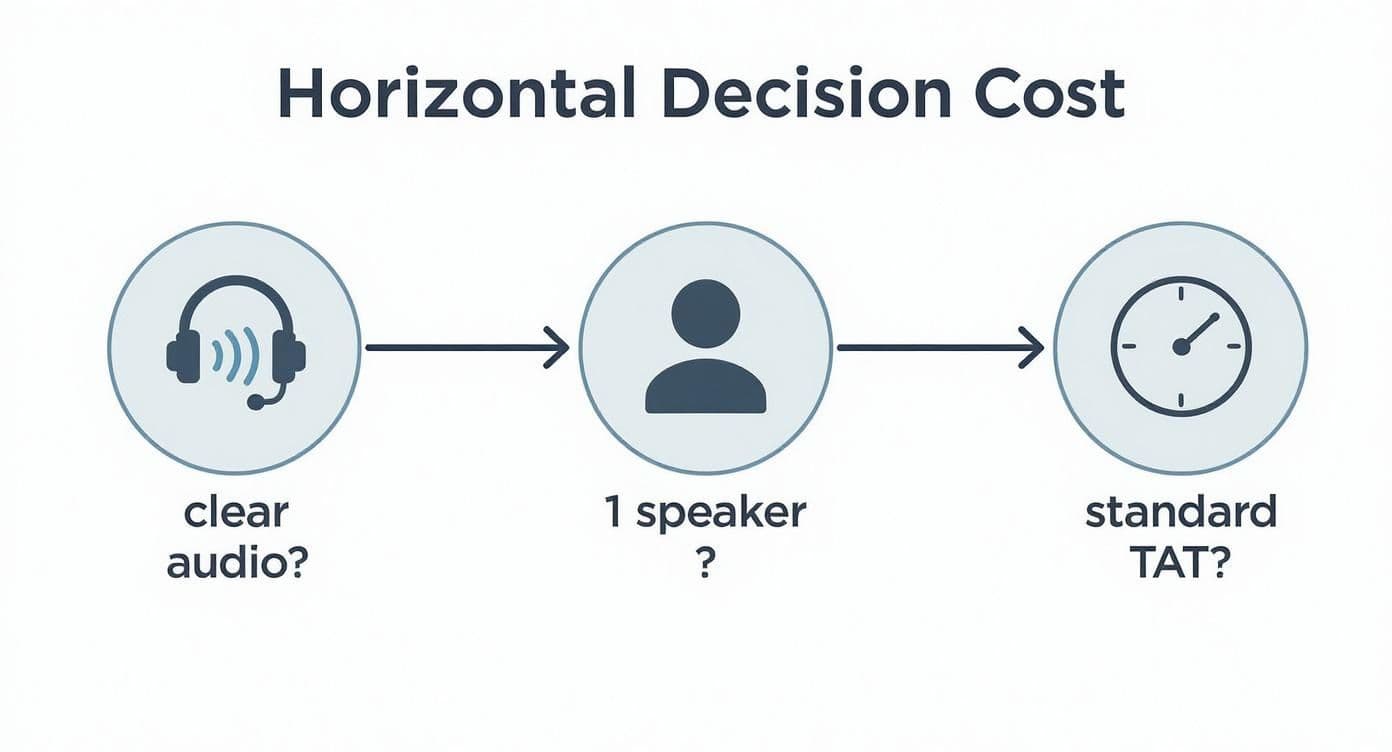
As you can see, the more complex the audio gets—with more speakers or poor clarity—the more it makes sense to lean toward a human service to guarantee accuracy.
The Hybrid Approach: Getting the Best of Both Worlds
Thankfully, you don't always have to pick one or the other. A hybrid approach is often the smartest, most cost-effective way to get high accuracy without the high price tag of a fully human service from scratch.
It’s a simple two-step process:
- Start with AI: First, run your audio through a fast, low-cost automated service. This does about 90% of the heavy lifting in just a few minutes.
- Human Polish: Then, have a human proofreader go over the AI-generated text while listening to the audio. They’ll catch any errors, fix punctuation, and make sure the speaker labels are correct.
To really nail this decision, it helps to see how different tools stack up. A good speech to text software comparison can show you which AI platforms deliver the best raw transcript. Starting with a better draft means less cleanup work for your human editor.
Ultimately, your choice comes down to balancing your budget, your deadline, and one simple question: how much does accuracy truly matter for this specific project?
How to Calculate Your Transcription Costs Step-by-Step
Alright, let's get down to brass tacks. Theory is great, but putting numbers to a real project is what really matters. Figuring out what you'll actually spend on transcription isn't complicated once you know the basic formula.