To truly level up your team's communication, you have to do more than just talk. It’s about building clear pathways for discussion, creating an atmosphere where people feel safe to speak up, and making active listening and constructive feedback a daily habit. Nail this, and you’ll see your team shift from a group of individuals into a genuinely collaborative force.
Why Better Team Communication Is Non-Negotiable

Let’s be real for a moment. Bad communication isn't just a minor headache; it’s a direct threat to your bottom line. It's the silent killer of projects, leading to blown deadlines, wasted money, and a team that’s running on fumes. When messages get garbled, misinterpreted, or simply don't get sent, the fallout can be massive.
The damage goes beyond the balance sheet, too. A communication breakdown chips away at trust, kills creativity, and fosters a culture where everyone is pointing fingers instead of taking ownership. People start holding back their best ideas or hiding mistakes because they’re worried about the backlash. This is how you create a vicious cycle of inefficiency where problems fester instead of getting solved.
The Real Payoff of Getting It Right
On the other hand, the upside of great communication is huge. Teams that are in sync are more aligned, quicker to adapt, and way more invested in their work. The numbers don't lie.
Teams with solid communication habits see employee retention rates 4.5 times higher than teams that struggle to connect. And it's not just about keeping people around—64% of business leaders say that clear communication is a direct driver of team productivity.
The Pillars of Strong Team Communication
So, how do we get there? It all comes down to a few core principles that completely change how a team operates. Think of these as the foundation for everything else.
- Set Up Clear Channels: This is all about deciding where specific conversations happen. No more digging through a dozen emails, Slack threads, and random meeting notes just to find a simple project update.
- Build Psychological Safety: This one is crucial. You have to create an environment where people feel secure enough to share their thoughts, ask "dumb" questions, and even admit they messed up without fearing they'll be shamed for it.
- Master the Art of Feedback: When you build a culture where feedback is given and received as a tool for growth—not as a personal attack—you unlock incredible potential for development.
- Bridge the Gaps Between Teams: Great communication isn't just an internal team sport. It’s about tearing down the walls between departments like marketing, sales, and engineering. If you're looking to dive deeper, we have a whole guide on how to enhance your business with cross-functional communication.
Build a Clear Communication Playbook
Tired of the digital scavenger hunt? I’ve seen it a hundred times. Information gets scattered across Slack DMs, forgotten in lengthy email chains, and buried in project management comments. This chaos isn't just frustrating; it’s a major roadblock to getting anything done efficiently.
The answer isn’t to throw another app at the problem. It’s to create a simple "Communication Playbook"—a set of ground rules that clearly defines which channel to use for which purpose. When everyone knows where to look for information, conversations become focused, and critical details stop falling through the cracks.
Defining Your Communication Channels
The first step is to assign a primary job to each tool in your stack. This brings clarity and intention to every single message your team sends. For instance, your framework might look something like this:
- Instant Messaging (Slack, Teams): This is for your quick, informal questions and urgent updates that need a fast response. Think, "Hey, is the client presentation file in the shared drive?" not a detailed project brief.
- Email: Reserve this channel for formal, official communication and anything going outside the company. It’s the right place for company-wide announcements, final client deliverables, and documented decisions that need a clear paper trail.
- Project Management Tools (Asana, Trello): All task-specific conversations belong here. Period. Discussions about deadlines, feedback on a design, or questions about a specific to-do item should live directly on the relevant card or task.
This decision tree gives a great visual for choosing the right channel based on urgency and complexity.
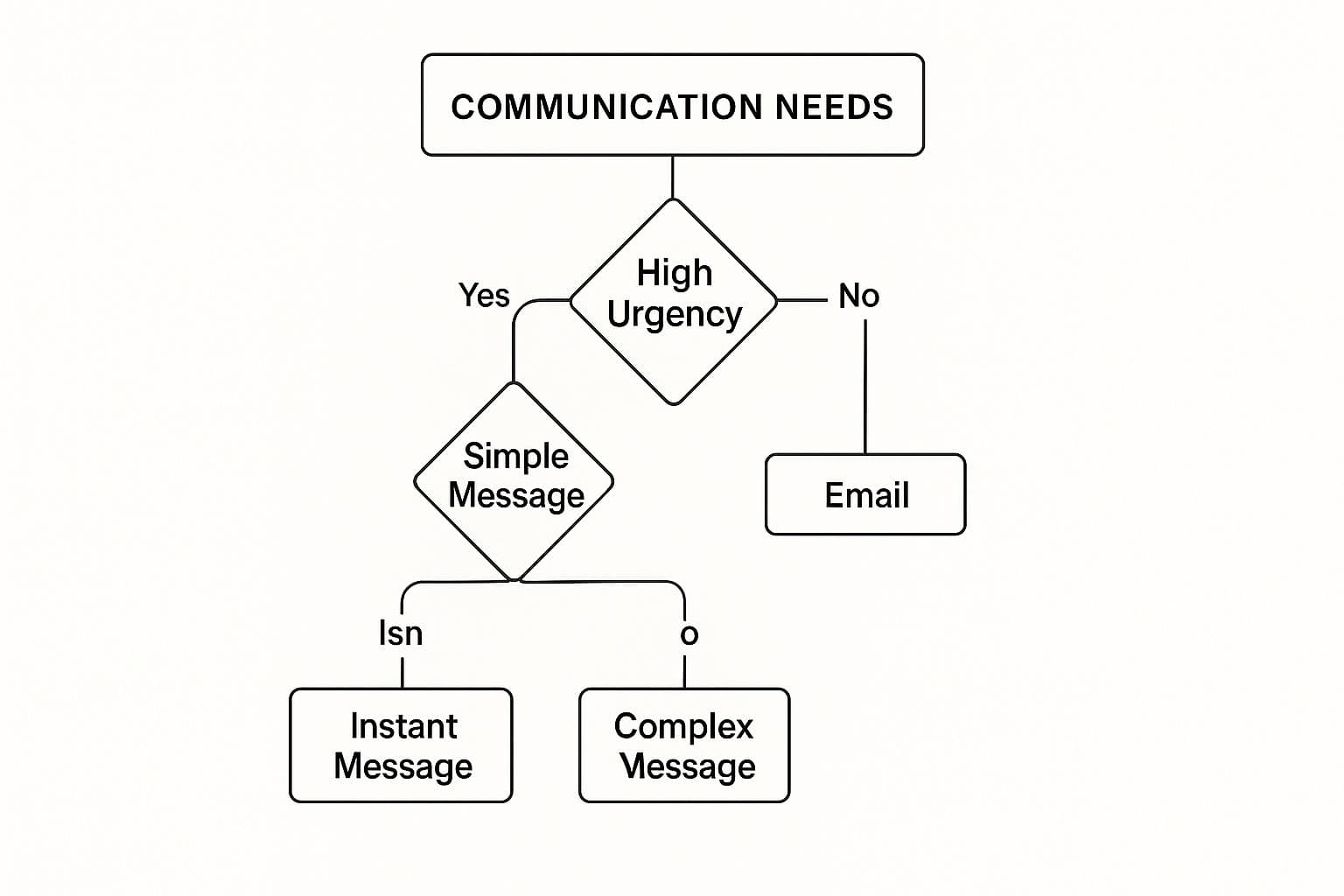
When you guide your team to match the message to the medium, you instantly reduce confusion and make workflows much smoother.
Choosing the Right Communication Channel for the Task
To make this even more practical, think about common situations your team faces daily. Having a quick-reference guide can stop people from defaulting to the wrong tool out of habit.
| Scenario | Ideal Channel | Why It Works Best |
|---|---|---|
| Quick question blocking your work | Instant Message (Slack/Teams) | Gets an immediate answer without clogging up project boards or inboxes. |
| Sharing a final report with a client | Provides a formal, time-stamped record and is the standard for external comms. | |
| Asking for feedback on a design mockup | Project Management Tool | Keeps the conversation tied directly to the work item for context and history. |
| Company-wide holiday announcement | Ensures everyone receives the official memo and it's easily searchable. |
A simple chart like this removes the guesswork, empowering your team to communicate more effectively on their own.
Taming the Email Beast
Let's face it, email isn't going anywhere. Research from EmailToolTester shows that 52.2% of workers still use it weekly, making it the most common workplace tool. But here's the kicker: employees spend an average of 5 hours a week just managing their inboxes. That adds up to nearly 11 days a year lost to email.
By clearly defining email's role for formal documentation and external messages only, you can help your team reclaim a significant chunk of that lost time.
This clarity should go beyond just tools. A good playbook also outlines expectations for response times, meeting etiquette, and how to document key decisions. Speaking of which, a clear record of meeting outcomes is crucial for follow-through. For some great, practical tips, check out our guide on how to take better meeting notes.
Ultimately, a communication playbook turns ambiguity into a clear, shared system. It’s one of the most powerful steps you can take to improve your team’s communication, ensuring everyone is on the same page and working from the same script.
Create a Culture of Psychological Safety
You can have the best communication tools and a perfectly crafted playbook, but it all falls apart if your team is afraid to speak up. The real secret to improving how a team communicates isn't about technology; it’s about trust. This foundation is built on what we call psychological safety—creating an environment where people feel secure enough to take risks, voice a wild idea, or even admit they messed up, all without fear of being shamed or blamed.
Without that safety net, communication becomes cautious and superficial. People won't challenge the status quo, offer feedback that might be hard to hear, or flag a potential disaster early on. The fallout from this is very real. Miscommunication is a massive contributor to missed deadlines and workplace stress. In fact, research shows that a staggering 28% of missed deadlines are a direct result of poor communication. You can dig into more stats on how communication impacts workplace collaboration at ProofHub.
Building this kind of culture has to start at the top. Leaders need to be the first ones to model the behavior they want to see from everyone else.
Lead with Vulnerability and Curiosity
When a leader openly admits they don’t have all the answers, it gives everyone else permission to do the same. This isn't about showing weakness; it's about building genuine trust by showing you're human. If you make a mistake, own it. If you're not sure which way to go, ask your team for their thoughts and truly listen.
This also means changing the way you ask questions. You have to shift from a tone of accusation to one of collaboration.
- Instead of: "Why did you miss that deadline?"
- Try: "I saw the deadline was missed. Can you walk me through what got in the way?"
- Instead of: "Why was this done that way?"
- Try: "Help me understand the thought process behind this approach."
This small change in phrasing completely transforms the conversation. It moves you away from a blame game and toward a shared effort to find a solution. It proves you’re more interested in understanding the context than pointing fingers.
Make Active Listening the Standard
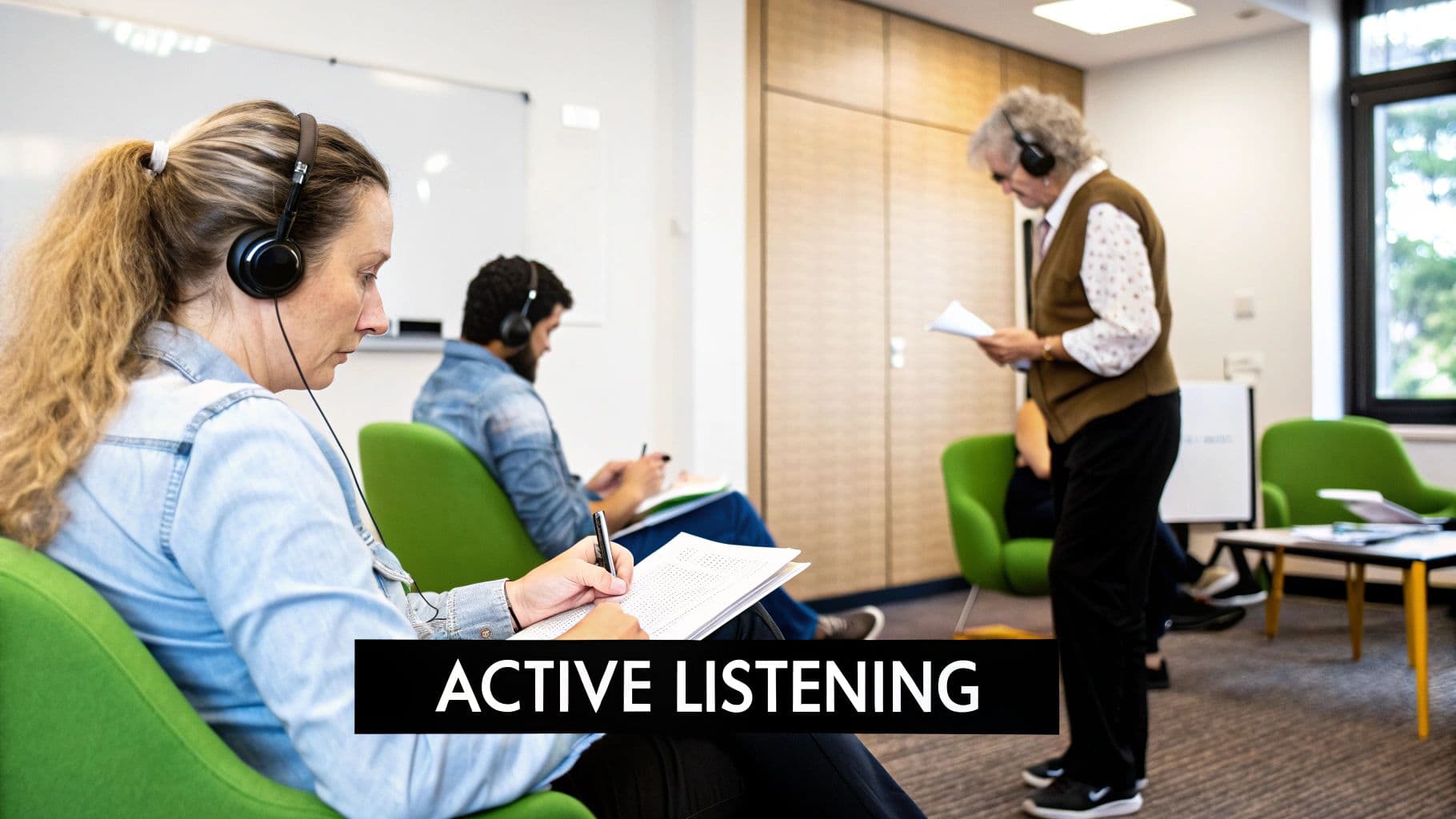
One of the most powerful things you can do to build safety is to simply listen. I mean really listen. It’s a fundamental sign of respect and shows you actually value what the other person has to say. Active listening is about giving someone your full attention, setting aside your own judgments, and reflecting on their words before you jump in.
Encourage your team to get into these habits:
- Paraphrase to Confirm: Before you offer your two cents, try restating what you heard in your own words. For example, "Okay, so if I'm tracking, you're saying the main bottleneck is the initial data collection phase?"
- Ask Open-Ended Questions: Push for deeper thinking by asking questions that require more than a "yes" or "no." Try something like, "What are your thoughts on how we could tackle this differently?"
- Acknowledge and Validate: You don’t have to agree with someone to validate their feelings. A simple, "That sounds incredibly frustrating," or "I can see why that would be a concern," goes a long, long way.
When you foster this kind of curiosity and respect, you unlock the honest, unfiltered communication that helps teams innovate and solve problems faster.
Use AI to Make Your Meetings More Effective
We’ve all been there. Meetings can feel like a communication black hole where great ideas and critical decisions get lost in the shuffle. How many times have you left a call feeling a little fuzzy on who was supposed to do what next? That confusion is a huge drag on productivity.
This is where AI meeting assistants come in. These tools are built to create a single source of truth from your conversations. They quietly join your calls, transcribe everything that’s said, and then use AI to pinpoint what actually matters—key decisions, open questions, and those all-important action items.
Automate the Grunt Work of Note-Taking
Let’s be honest, being the designated note-taker is a tough gig. When someone is frantically trying to type every word, they can't fully participate. Their focus shifts from contributing valuable ideas to just being a scribe.
When you hand off transcription and summarization to an AI, everyone on the call is free to be present and engaged. This simple change can make conversations more dynamic, creative, and collaborative. Suddenly, the focus is back where it should be: on solving problems, not just documenting them.
This example from a tool like Fireflies.ai shows how it can pull out key metrics and topics directly from the conversation.
At a glance, you can see the core themes of the discussion without having to read a wall of text. That makes getting aligned after the meeting so much faster.
Keep Everyone in the Loop, Effortlessly
What happens when team members can't make a meeting? In the past, they’d have to rely on someone’s spotty notes or a quick verbal recap. With an AI assistant, they get a detailed summary and a searchable transcript, letting them catch up completely on their own time.
This is a game-changer for remote and globally distributed teams working across different time zones. It makes sure no one gets left out of the loop just because of a calendar conflict. That level of transparency builds alignment and keeps projects moving forward without unnecessary delays.
A Real-World Scenario
Picture a fast-paced project kickoff call where tasks are being handed out left and right. By the end, two team members have different ideas about who owns the initial design mockups.
Instead of a day of back-and-forth on Slack, they just check the AI-generated summary.
It clearly states: "Action Item for Sarah: Create initial design mockups by EOD Friday." The confusion is cleared up in minutes, not hours. The project stays on track, and a little bit of friction is avoided entirely. That’s the practical, everyday value of bringing AI into your meeting workflow.
For more strategies like this, our guide on how to run effective team meetings that drive results offers even more insights.
Master Giving and Receiving Constructive Feedback

Feedback is the lifeblood of any high-performing team. But let's be honest, most of us have seen it handled poorly. It's either delivered as vague, unhelpful criticism or avoided altogether until the dreaded annual review.
To really elevate your team's communication, you need to build a culture where feedback is a continuous, supportive conversation, not some rare and stressful event. The trick is to reframe it as objective data for growth, not a personal judgment. When your team sees it as a tool to help them win, the whole dynamic shifts from defensiveness to genuine curiosity.
Start with a Simple Feedback Framework
I've seen it a thousand times. Someone gets told, "You need to be more proactive." What does that even mean? Vague feedback is impossible to act on and usually just leaves people feeling confused and demoralized.
A simple but incredibly effective way to bring clarity is the Situation-Behavior-Impact (SBI) model. It strips out personal opinions and focuses on what actually happened, which makes the feedback so much easier to hear and understand.
Here’s how it works:
- Situation: First, you set the scene. Get specific about when and where it happened. For example, "During this morning's client call..."
- Behavior: Next, you describe the exact, observable action. Stick to what you saw or heard, not what you think they were intending. For example, "...you interrupted the client three times while they were explaining their concerns."
- Impact: Finally, you explain the result. This could be how it affected you, the team, the project, or the client. For instance, "...and I noticed they became withdrawn and didn't share any more feedback for the rest of the meeting."
Using a framework like SBI turns a potentially awkward conversation into a collaborative problem-solving session. The focus is squarely on the action and its outcome, not on the person's character.
Foster a Growth Mindset for Receiving Feedback
Giving good feedback is only half the puzzle. Knowing how to receive it well is just as critical. A team’s ability to absorb and act on feedback comes down to their mindset.
You need to encourage everyone to see feedback as a chance to learn, not a final verdict on their abilities.
Leaders have to walk the talk here. When you get feedback, make a point to thank the person for their observation. Ask a few clarifying questions to make sure you get it, and then take time to reflect. Saying, "That's a really helpful perspective, thank you," instead of jumping to defend yourself with, "Well, here's why I did that..." makes all the difference.
Weave Feedback into Your Daily Workflows
Don’t save feedback for formal reviews! The best communication happens when feedback is timely, frequent, and low-stakes. It should just be a normal part of how your team operates.
Here are a few practical ways to make that happen:
- Project Retrospectives: When a project wraps, hold a quick meeting. Talk about what went well and what you can all do better next time.
- Peer Feedback Sessions: Set up short, informal chats where team members can share constructive observations with each other in a supportive way.
- One-on-One Check-ins: Managers should use their regular one-on-ones to both give and ask for feedback. It has to be a two-way street.
By building these habits into your team’s rhythm, you take the fear out of feedback. It becomes just another part of working together to get better, strengthening communication one conversation at a time.