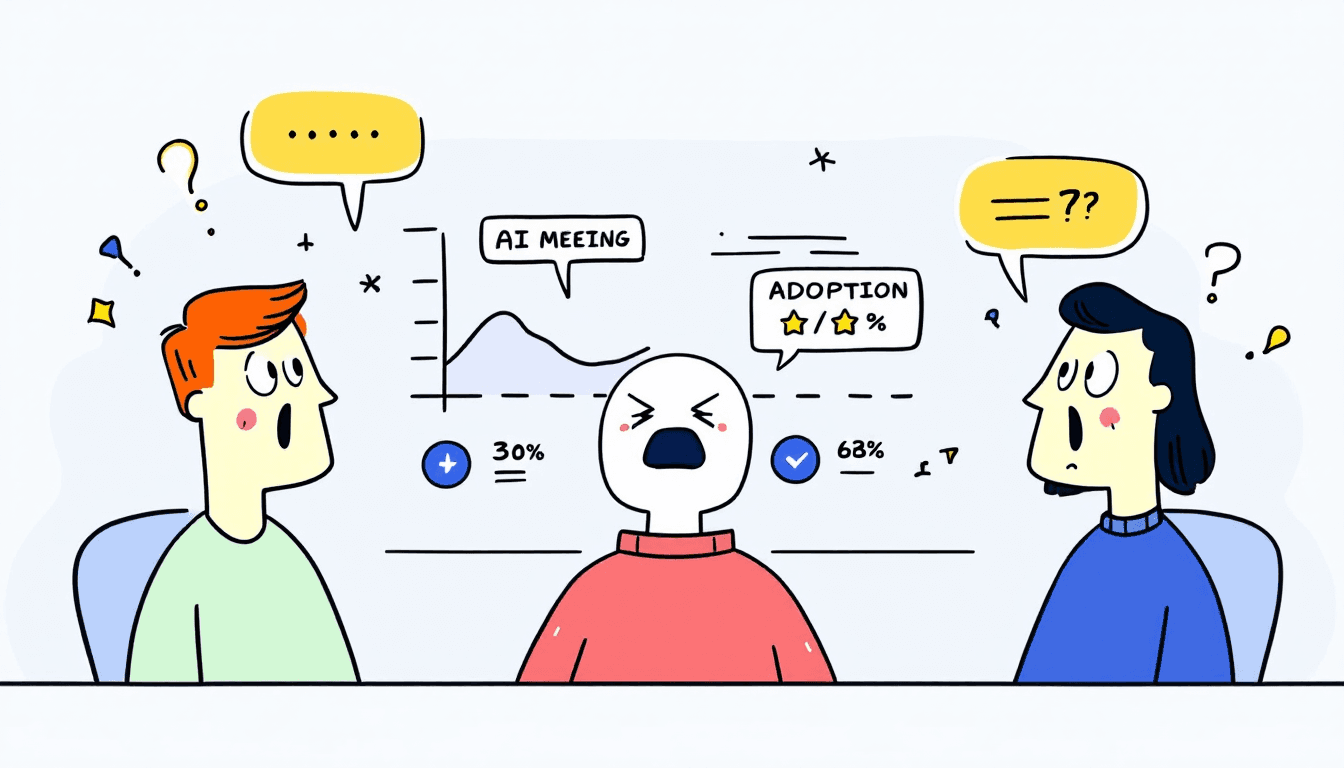
The Meeting AI Adoption Challenge 🎯
Organizations worldwide are recognizing thatmeeting AI adoption isn't just about technology—it's about fundamentally changing how teams collaborate, communicate, and capture value from their conversations. Yet 73% of AI implementations fail due to poor change management, not technical limitations.
This comprehensive guide reveals the proven strategies, frameworks, and tactics that successful organizations use to drive meeting AI adoption at scale. Whether you're a change leader, IT director, or team manager, you'll discover how to navigate the human side of technological transformation.
🚧 Understanding Adoption Barriers
Top Resistance Factors
- • Privacy and security concerns (68%)
- • Fear of job displacement (54%)
- • Technology complexity anxiety (49%)
- • Change fatigue from previous initiatives (43%)
- • Lack of clear value demonstration (39%)
Adoption Accelerators
- • Executive sponsorship and visibility
- • Clear ROI demonstration
- • Gradual, low-risk implementation
- • Peer advocacy and success stories
- • Comprehensive training and support
💡 Adoption Insight
Organizations withstructured change management see 6x higher adoption rates than those focusing solely on technology deployment. The key is addressing emotional and cultural barriers alongside technical implementation.
📋 The 4-Phase Meeting AI Adoption Framework
Phase 1: Assessment & Strategy (Weeks 1-4)
Key Activities
- • Current meeting audit and pain point analysis
- • Stakeholder mapping and influence assessment
- • Technology landscape evaluation
- • Success metrics definition
- • Change readiness assessment
Deliverables
- • Adoption strategy document
- • Stakeholder engagement plan
- • Technology selection criteria
- • Success measurement framework
Phase 2: Pilot Implementation (Weeks 5-12)
Key Activities
- • Champion group selection and training
- • Pilot group deployment (10-20% of users)
- • Intensive support and feedback collection
- • Process refinement and optimization
- • Success story documentation
Success Metrics
- • 80%+ pilot user engagement
- • 15-25% meeting time reduction
- • 90%+ accuracy in meeting summaries
- • High user satisfaction scores (8+/10)
Phase 3: Scaled Rollout (Weeks 13-24)
Key Activities
- • Department-by-department expansion
- • Comprehensive training program launch
- • Support system scaling
- • Policy and governance establishment
- • Resistance management and intervention
Target Outcomes
- • 70%+ organization adoption rate
- • Reduced support tickets over time
- • Measurable productivity improvements
- • Cultural shift indicators
Phase 4: Optimization & Evolution (Week 25+)
Key Activities
- • Advanced feature rollout
- • Integration with other business systems
- • Power user development
- • ROI measurement and reporting
- • Continuous improvement processes
Maturity Indicators
- • Self-sustaining adoption culture
- • User-driven innovation and requests
- • Measurable business impact
- • Reduced change management overhead
🎭 Proven Change Management Strategies
1. Build Your Champion Network
Identify and empowerchange champions across different departments and seniority levels. These advocates become your ground-level support system, helping peers overcome resistance and demonstrating real value.
Champion Selection Criteria:
- • High influence with peers
- • Technology early adopters
- • Strong communication skills
- • Respected problem-solvers
Champion Support:
- • Advanced training and certification
- • Direct access to product team
- • Recognition and incentive programs
- • Regular feedback and input sessions
2. Address Privacy and Security Concerns
Security concerns are the #1 barrier to meeting AI adoption. Proactive communication and transparent policies are essential for building trust and confidence.
Communication Strategy:
- • Clear data handling policies
- • Security certification documentation
- • Regular security updates and reports
- • Open Q&A sessions with security team
Trust Building Tactics:
- • Third-party security audits
- • Compliance certification displays
- • Customer reference calls
- • Gradual permission expansion
3. Demonstrate Value Early and Often
People adopt tools that make their lives easier. Create immediate, visible wins that showcase the concrete benefits of meeting AI for daily work experiences.
Quick Win Strategies:
- • Real-time meeting summaries for busy executives
- • Action item tracking that reduces follow-up emails
- • Meeting insight dashboards for managers
- • Time savings calculators and reports
4. Create Learning Pathways
Effective training goes beyond basic tool usage. Create structured learning experiences that build confidence and competence progressively.
Beginner Level:
- • Basic setup and first meeting
- • Understanding AI summaries
- • Privacy settings walkthrough
- • Custom templates and settings
- • Integration with productivity tools
- • Team collaboration features
- • Analytics and reporting
- • API integrations
- • Workflow automation
📊 Essential Success Metrics & KPIs
Successful meeting AI adoption requires measuring bothadoption metricsandbusiness impact metrics. Here's the comprehensive framework for tracking your transformation success.
Adoption Metrics
User Engagement
- • Active user rate (target: 80%+)
- • Meeting recording frequency
- • Feature utilization rates
- • Session duration and interaction depth
Behavioral Change
- • Support ticket trends (decreasing over time)
- • Self-service adoption rates
- • Feature discovery patterns
- • User feedback sentiment scores
Business Impact Metrics
Productivity Gains
- • Meeting time reduction (target: 15-25%)
- • Follow-up time savings
- • Decision-making speed improvement
- • Administrative task reduction
Quality Improvements
- • Action item completion rates
- • Meeting outcome clarity scores
- • Information retention rates
- • Cross-team collaboration effectiveness
ROI Calculation Framework
Cost Savings Formula:
(Average Hourly Rate × Time Saved per Meeting × Meetings per Week × Weeks per Year × Number of Users) - Total Implementation Costs
Example ROI Calculation:
- • 100 users saving 30 minutes per 5 meetings/week
- • Average hourly rate: $50
- • Annual time savings: 6,500 hours
- • Value created: $325,000/year
- • Implementation cost: $50,000
- • ROI: 550% in year one
📈 Measuring Success: Key Benchmarks
Excellent (90th percentile)
- • 85%+ adoption rate
- • 30%+ time savings
- • 9+ satisfaction score
Good (75th percentile)
- • 70%+ adoption rate
- • 20%+ time savings
- • 7+ satisfaction score
Needs Improvement
- • <50% adoption rate
- • <10% time savings
- • <6 satisfaction score
🚨 Common Pitfalls & Proven Solutions
❌ Pitfall: Technology-First Approach
Focusing solely on technical deployment without addressing human factors and organizational culture.
Low adoption rates, user resistance, failed implementations
✅ Solution: People-Centered Strategy
Start with understanding user needs, workflows, and pain points. Design the technology implementation around human behavior patterns.
Best Practice:Spend 60% of effort on change management, 40% on technology
❌ Pitfall: Big Bang Rollout
Attempting organization-wide deployment simultaneously without testing and refinement.
Overwhelming support demands, user frustration, quality issues
✅ Solution: Phased Rollout Strategy
Start with enthusiastic pilot groups, gather feedback, refine processes, then gradually expand to larger populations.
Best Practice:10% pilot → 30% early majority → 70% full rollout
❌ Pitfall: Insufficient Training
One-time training sessions without ongoing support or advanced skill development.
Limited feature adoption, user confidence issues, suboptimal usage
✅ Solution: Continuous Learning Program
Create learning pathways with basic, intermediate, and advanced modules plus ongoing skill development opportunities.
Best Practice:Just-in-time help, peer mentoring, regular skill-building sessions
❌ Pitfall: Ignoring Cultural Resistance
Underestimating the power of organizational culture and informal influence networks.
Passive resistance, workarounds, adoption stagnation
✅ Solution: Culture Integration Strategy
Map informal networks, engage cultural influencers, align AI adoption with existing values and behaviors.
Best Practice:Make AI adoption feel like natural evolution, not foreign imposition
🎬 Your 30-Day Getting Started Action Plan
Ready to begin your meeting AI adoption journey? This tactical 30-day plan will get you from strategy to early results with minimal risk and maximum learning.
Week 1: Foundation & Assessment
Days 1-3: Stakeholder Alignment
- □ Schedule executive sponsor meetings
- □ Define success metrics and timeline
- □ Identify change champions across departments
- □ Establish project communication plan
Days 4-7: Current State Analysis
- □ Audit current meeting practices
- □ Survey user pain points and needs
- □ Assess technical infrastructure
- □ Map integration requirements
Week 2: Technology Selection & Pilot Design
Days 8-10: Tool Evaluation
- □ Take ourAI tool selection quiz
- □ Request demos from top 3 vendors
- □ Evaluate security and compliance features
- □ Test integration capabilities
Days 11-14: Pilot Planning
- □ Select pilot group (10-20 enthusiastic users)
- □ Design pilot success criteria
- □ Create training materials
- □ Set up feedback collection system
Week 3: Pilot Launch & Early Support
Days 15-17: Deployment
- □ Configure tool for pilot group
- □ Conduct intensive training sessions
- □ Establish daily check-ins
- □ Begin pilot group meetings
Days 18-21: Active Support
- □ Daily usage monitoring
- □ Immediate issue resolution
- □ Collect user feedback
- □ Document success stories
Week 4: Optimization & Next Phase Planning
Days 22-25: Results Analysis
- □ Measure adoption metrics
- □ Calculate time savings
- □ Assess user satisfaction
- □ Identify improvement opportunities
Days 26-30: Scale Preparation
- □ Refine training materials
- □ Plan next phase rollout
- □ Secure additional resources
- □ Create expansion timeline
🎯 Success Checkpoint: 30-Day Goals
Adoption Targets
- • 90% pilot group active usage
- • 5+ meetings recorded per user
- • 80% feature engagement rate
Outcome Targets
- • 15% average time savings
- • 8+ user satisfaction score
- • 3+ documented success stories
Readiness Targets
- • Phase 2 expansion plan approved
- • Champion network established
- • Support system validated
⚙️ Technology & Platform Considerations
Choosing the right meeting AI platform significantly impacts adoption success. Consider these key factors when evaluating technologies for your organization.
Integration Ecosystem Requirements
Essential Integrations
- • Calendar systems (Outlook, Google Calendar)
- • Video conferencing (Zoom, Teams, Meet)
- • Productivity tools (Slack, Notion, Asana)
- • CRM systems (Salesforce, HubSpot)
- • Document storage (SharePoint, Google Drive)
Evaluation Criteria
- • Native vs third-party integration quality
- • Real-time sync capabilities
- • Single sign-on (SSO) support
- • API availability and documentation
- • Webhook and automation options
Security and Compliance Framework
Security Requirements
- • End-to-end encryption for recordings
- • SOC 2 Type II compliance
- • GDPR and data privacy compliance
- • Role-based access controls
- • Audit trails and logging
Data Governance
- • Data residency options
- • Retention policy customization
- • Right to deletion capabilities
- • Data export and portability
- • Third-party data sharing controls
Scalability and Performance
Scale Considerations
- • Concurrent user capacity
- • Processing time for large meetings
- • Multi-language and accent support
- • Global server availability
- • Bandwidth optimization features
Performance Metrics
- • Transcription accuracy rates (target: 95%+)
- • Processing latency (real-time vs post-meeting)
- • System uptime guarantees
- • Support response times
- • Feature release frequency
🔧 Technical Implementation Checklist
Pre-Deployment
- □ Network bandwidth assessment
- □ Security policy alignment
- □ Integration testing in sandbox
- □ User account provisioning plan
- □ Backup and recovery procedures
Post-Deployment
- □ Performance monitoring setup
- □ User access validation
- □ Integration functionality testing
- □ Security configuration review
- □ Support escalation procedures