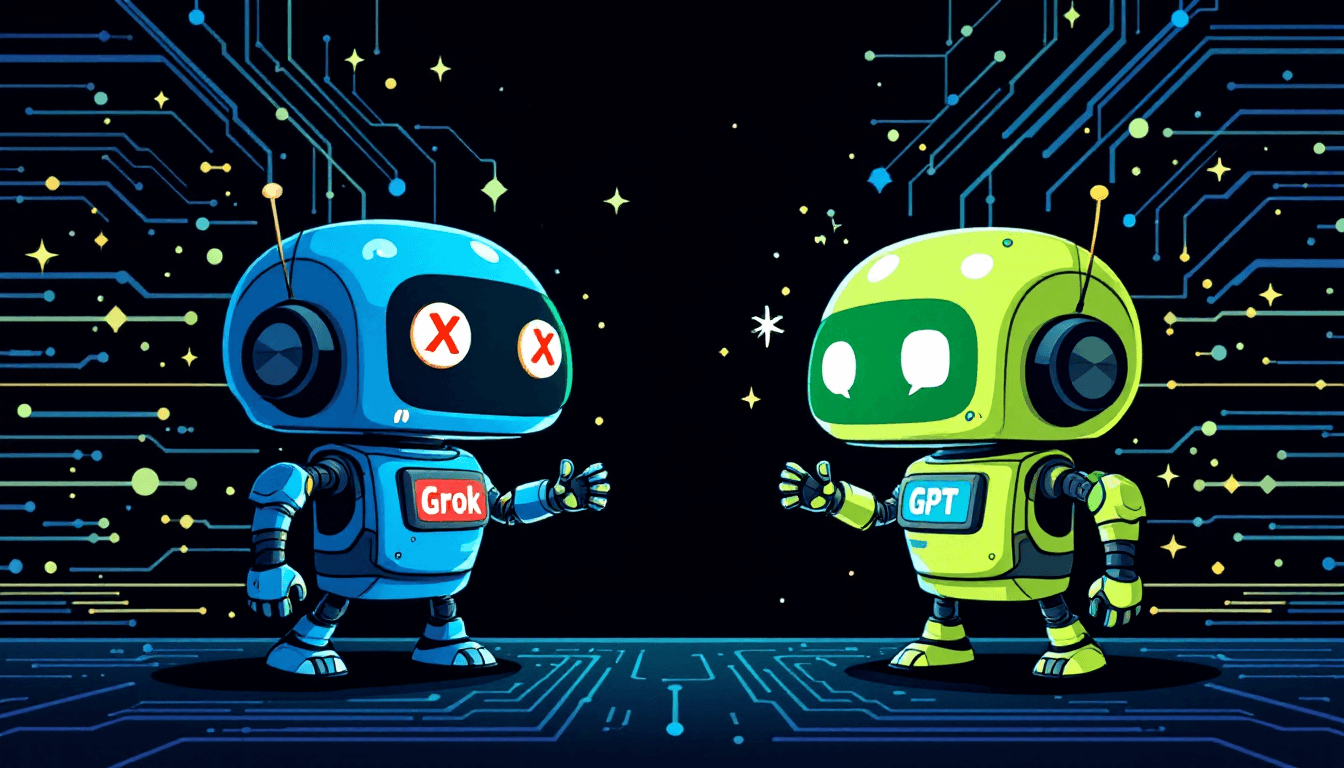
The artificial intelligence landscape has never been more competitive. Two titans stand at the forefront of conversational AI: OpenAI's ChatGPT, the platform that sparked the AI revolution in late 2022, and xAI's Grok, the challenger built by Elon Musk's ambitious team of AI researchers. As of January 2025, both platforms have evolved dramatically, with GPT-5 and Grok 4 representing the cutting edge of what large language models can achieve.
In this comprehensive comparison, we will dive deep into every aspect of these two AI powerhouses. Whether you are a business leader evaluating AI solutions, a developer choosing an API, or simply curious about the state of artificial intelligence, this guide will provide the insights you need to make informed decisions.
Let us explore what makes each platform unique, where they excel, and which one might be the right choice for your specific needs.
The Origins: Two Very Different Paths to AI Dominance
OpenAI: From Nonprofit Mission to Industry Leader
OpenAI's story begins on December 11, 2015, when a group of prominent technologists, including Elon Musk, Sam Altman, Greg Brockman, Ilya Sutskever, Peter Thiel, and Reid Hoffman, pledged $1 billion to develop artificial intelligence for the benefit of humanity. The organization launched as a nonprofit research lab with a noble mission: to ensure that artificial general intelligence (AGI) would benefit all of humanity.
In their founding statement, Musk and Altman expressed concerns about AI safety and existential risk from artificial general intelligence. They noted that while human-level AI could enormously benefit society, it could equally damage it if built or used incorrectly. This dual awareness of AI's promise and peril has shaped OpenAI's approach to development.
The company's trajectory shifted in 2018 when Elon Musk departed from the board, citing potential conflicts of interest with Tesla's own AI development. In 2019, OpenAI created a for-profit subsidiary called OpenAI LP to scale its research and deployment efforts while maintaining its broader mission through a capped-profit structure.
The release of ChatGPT in November 2022 changed everything. Within five days, more than one million users had signed up, making it the fastest-growing consumer application in history. ChatGPT reached 100 million monthly active users faster than any platform before it, cementing OpenAI's position as the leader in conversational AI.
November 2023 brought dramatic internal turmoil when Sam Altman was briefly ousted by the board of directors, only to be reinstated five days later following massive employee and investor backlash. This event highlighted the tensions between OpenAI's nonprofit origins and its commercial success.
By October 2025, OpenAI completed a significant restructuring. The nonprofit became the OpenAI Foundation, holding 26% of the newly formed OpenAI Group PBC (Public Benefit Corporation). Microsoft holds 27%, with employees and other investors holding the remaining 47%. The company closed a $40 billion funding round led by SoftBank, valuing OpenAI at roughly $300 billion.
xAI: Musk's Mission for Truth-Seeking AI
xAI emerged from Elon Musk's growing frustration with what he perceived as excessive caution and political correctness in other AI models. In April 2023, Musk told Fox News that ChatGPT was trained to be politically correct and say untruthful things. He announced plans to build an alternative called TruthGPT, which he described as a maximum truth-seeking AI that tries to understand the nature of the universe.
The company was officially incorporated in March 2023 and publicly announced on July 12, 2023. The founding team included twelve specialists, primarily former researchers from OpenAI, DeepMind, Google, and Microsoft. Notable co-founders included Igor Babuschkin, Yuhuai (Tony) Wu, Christian Szegedy, and Jimmy Ba.
xAI's stated mission is understanding the true nature of the universe, a phrase that reflects Musk's characteristic ambition. The company aims to build AI that accelerates human scientific discovery while advancing our collective understanding of reality.
Grok, xAI's flagship chatbot, launched as a preview in November 2023. Drawing inspiration from Douglas Adams' The Hitchhiker's Guide to the Galaxy, Grok was designed to be witty, rebellious, and willing to answer questions that other AIs might refuse. This personality-first approach distinguished it immediately from ChatGPT's more measured tone.
xAI's growth has been remarkable. By December 2024, the company had raised over $12 billion in funding, with support from Fidelity, BlackRock, Sequoia Capital, and other major investors. In March 2025, xAI acquired X (formerly Twitter) in an all-stock deal valuing the social media platform at $33 billion, giving Grok direct integration with real-time social data.
The company built Colossus, claimed to be the world's biggest supercomputer, in just 122 days during 2024. This infrastructure, featuring 100,000 NVIDIA H100 GPUs (later doubled), enabled the rapid development of Grok 3 and subsequent models.
Technical Architecture and Model Evolution
ChatGPT's Evolution: From GPT-3.5 to GPT-5
ChatGPT has evolved through multiple generations, each bringing significant improvements in capability, reasoning, and reliability.
- GPT-3.5 (November 2022): The original ChatGPT model that launched the AI revolution, demonstrating impressive conversational abilities but with notable limitations in accuracy and reasoning.
- GPT-4 (March 2023): A major leap in capability, with significantly improved reasoning, reduced hallucinations, and multimodal capabilities including image understanding.
- GPT-4o (May 2024): OpenAI's natively multimodal model, offering improved efficiency and the ability to process text, images, and audio in a unified architecture. GPT-4 was retired and fully replaced by GPT-4o on April 30, 2025.
- GPT-5 (August 2025): OpenAI's most capable model, featuring adaptive reasoning that automatically applies deeper thinking when beneficial. It replaced GPT-4o, o3, o4-mini, GPT-4.1, and GPT-4.5 as the default for signed-in users.
- GPT-5.2 (Late 2025): The latest flagship update, described as smarter and more useful for both work and learning while remaining enjoyable to talk to. Features clear improvements in info-seeking questions, how-tos, technical writing, and translation.
GPT-5 introduced a revolutionary approach to reasoning. Rather than requiring users to choose between quick responses and deep thinking, the model automatically determines when extended reasoning would benefit the response. Users can now choose between Auto, Fast, and Thinking modes, with most users preferring Auto for its intelligent adaptation.
Key technical specifications for GPT-5 include a context window of up to 400,000 tokens (depending on subscription tier), 128,000 max output tokens, and an August 31, 2025 knowledge cutoff. OpenAI reports that GPT-5 with thinking performs better than the o3 model while using 50-80% fewer output tokens across capabilities including visual reasoning, agentic coding, and graduate-level scientific problem solving.
Grok's Rapid Evolution: From Preview to Grok 4
xAI has demonstrated remarkable speed in model development, releasing four major versions in under two years.
- Grok 1 (November 2023): The initial preview release, showcasing xAI's approach to unfiltered, personality-driven AI.
- Grok 2 (August 2024): Introduced improved capabilities and the Aurora image generation system with fewer content restrictions than competitors.
- Grok 3 (February 17, 2025): Described by Musk as the smartest AI on Earth, featuring 10x the compute of previous models, a 1 million token context window, and breakthrough reasoning capabilities.
- Grok 4 and Grok 4 Heavy (July 9, 2025): The latest releases, featuring single-agent (Grok 4) and multi-agent (Grok 4 Heavy) architectures for different use cases.
Grok 3 was trained on xAI's Colossus supercluster with 10 times the compute of previous state-of-the-art models. Independent reports confirm it is 10 times more potent than its predecessor with a 30% improvement in processing speed. The model features an 8x larger context window than previous versions at 1 million tokens.
Grok 3 introduced several innovative features that set it apart from competitors:
- Think Mode: Using reinforcement learning, Grok 3 learned to refine problem-solving strategies, correct errors through backtracking, simplify steps, and utilize pretraining knowledge. The model can spend anywhere from a few seconds to several minutes reasoning, often considering multiple approaches.
- DeepSearch: A research-style retrieval system that actively reads, synthesizes, and cross-verifies information before responding, rather than simply pulling up search results.
- Big Brain Mode: Allocates extra computational resources for complex problem-solving to provide more accurate responses.
Grok 4 Heavy represents xAI's most advanced offering, employing parallel multi-agent collaboration for problem decomposition. This architecture allows multiple AI agents to work together on complex tasks, breaking down problems into components that can be addressed simultaneously. The context window extends to 256,000 tokens (428,000 tokens for SuperGrok Heavy subscribers).
Benchmark Performance: The Numbers Behind the Claims
Both companies regularly tout benchmark results to demonstrate superiority. However, it is essential to approach these claims with healthy skepticism, as companies often cherry-pick favorable results and use different testing conditions. That said, benchmarks provide valuable insights into model capabilities.
Mathematics and STEM Reasoning
Grok has shown particularly strong performance in mathematical benchmarks:
- AIME 2025 (American Invitational Mathematics Examination): Grok 3 scored 93.3%, while Grok 4 achieved 95%. OpenAI's models scored approximately 79% in comparison (though o1-pro achieved 86% pass@1).
- Harvard MIT Math Tests: Grok 4 achieved a perfect 100% score.
- GPQA (Graduate-Level Expert Reasoning): Grok 3 scored 84.6%, Grok 4 reached 87.5%, compared to approximately 78% for OpenAI models.
Coding and Programming
Both platforms demonstrate strong coding capabilities:
- LiveCodeBench: Grok 3 scored 79.4% on coding challenges.
- Codeforces: ChatGPT's o1 model hits roughly the 90th percentile on programming contests.
- Code Generation Speed: Grok 3 achieves an average response time of 0.8 seconds for code generation.
- Grok 4 resolves complex coding challenges 15% more effectively than previous benchmarks.
Advanced Reasoning and General Knowledge
- Humanity's Last Exam: Grok 4 scored 25.4% (beating Gemini 2.5 Pro at 21.6%), while Grok 4 Heavy with tools reached 44.4%, achieving the first-ever score above 40% on this challenging test. The text-only subset reached 50.7% accuracy.
- LMSYS Chatbot Arena: Grok 3 achieved an Elo score of 1402, securing the first position and becoming the first AI model to surpass 1400 across all categories. As of October 2025, Grok-4 maintained approximately 1,320 Elo versus GPT-4o's 1,300.
- HealthBench: GPT-5 scores significantly higher than any previous OpenAI model on realistic medical scenarios and physician-defined criteria.
Important Caveats About Benchmarks
While benchmark numbers make for compelling marketing, several factors temper their significance:
- Both companies select benchmarks that favor their models and use different testing conditions.
- xAI was reportedly caught comparing Grok running multiple attempts against OpenAI's single-pass results.
- Academic benchmarks rarely translate to noticeable real-world differences for typical business applications.
- The platforms emphasize different evaluation areas: Grok focuses on emotional intelligence and creative writing, while ChatGPT emphasizes professional knowledge work and scientific reasoning.
The honest assessment is that both are extremely powerful, and differences of a few percentage points on academic benchmarks rarely matter for everyday use cases.
Core Capabilities Compared
Writing and Conversation
Both platforms excel at natural language tasks, but with distinctly different styles:
ChatGPT produces polished, versatile output suitable for professional documents, reports, and formal communication. Its writing style is refined and adaptable, making it effective for business correspondence, academic papers, and technical documentation. GPT-5 is described as OpenAI's most capable writing collaborator yet, able to help steer rough ideas into compelling, resonant writing with literary depth. It reliably handles structural ambiguity, such as sustaining unrhymed iambic pentameter or free verse.
Grok's writing is more casual and sometimes sarcastic, reflecting its personality-first design. For creative projects, social media content, or situations where a more relaxed tone works better, Grok's style can feel more natural and engaging. Grok 4 produces more spontaneous and edgy creative output, often including humor or personality-driven commentary.
Image Generation
Visual content creation capabilities differ between platforms:
ChatGPT integrated DALL-E 3 for image generation, with image generation in GPT-4o now available to all users as the default image generator. The system emphasizes safety filtering and content moderation.
Grok 2 introduced Aurora, an image generation system with fewer content restrictions than competitors. This aligns with xAI's philosophy of providing less filtered AI tools, though xAI implemented stronger safeguards after some problematic outputs in mid-2025.
Real-Time Information Access
Access to current information is a key differentiator:
Grok featured integrated web search from inception, with direct access to X (Twitter) data providing real-time social media insights. The DeepSearch feature actively synthesizes and cross-verifies information from multiple sources.
ChatGPT added browsing capabilities through Bing integration after launch. While effective for web searches, it does not have the same direct access to social media data that Grok enjoys through X integration.
Complex Problem-Solving
Both platforms have developed sophisticated approaches to reasoning:
GPT-5 uses adaptive routing between quick and deep reasoning, automatically determining when extended thinking would benefit responses. The system is designed to produce 20% fewer major errors than previous models on hard real-world tasks.
Grok 4 Heavy employs parallel multi-agent collaboration for problem decomposition, allowing multiple AI agents to work together on complex tasks. Think Mode enables the model to spend varying amounts of time on reasoning, from seconds to several minutes.
Context Window Comparison
The ability to process large amounts of text affects many use cases:
- GPT-5: Up to 400,000 tokens (depending on subscription tier)
- Grok 4: 256,000 tokens standard
- Grok 3: 1 million tokens (8x larger than previous versions)
- Grok 4.1 Fast: Up to 2 million tokens (among the largest available)
- SuperGrok Heavy subscribers: Up to 428,000 tokens
Personality and Tone: The User Experience Difference
Perhaps the most immediately noticeable difference between these platforms is their personality and communication style.
ChatGPT's Approach
ChatGPT communicates in a professional, cheerful manner. The latest GPT-5.1 model emphasizes a warmer, more natural personality while maintaining reliability. It offers better structure and tone control, making it the stronger choice for polished writing, storytelling, and professional content.
ChatGPT is predictable but sometimes overly restrictive. Its risk-averse, ethically cautious approach ensures brand-safe responses but can frustrate users seeking more direct answers to sensitive topics.
The platform offers extensive customization, allowing users to adjust response style and tone to sound chatty, witty, straightforward, encouraging, or Gen Z.
Grok's Approach
Grok's standout feature is its tone. Its default setting is Fun Mode, where the chatbot gives sarcastic, blunt, or joke-filled answers. This deliberate personality draws inspiration from The Hitchhiker's Guide to the Galaxy, one of Elon Musk's favorite books.
Many users are delighted by Grok's more human-like, edgy tone. It cracks Monty Python-style jokes, uses casual language (including occasional profanity), and comes across as witty and alive in ways other AI systems do not. Its tone can be humorous, even snarky by design, mirroring Musk's persona.
However, this approach has drawbacks. In educational or formal setups, Grok's edgy tone can be problematic. Several reviewers note that Grok sometimes tries too hard to be charming. In one comparison, an author noted that Grok's attempts at a hip, meme-laden tone could ring hollow or cringe.
Grok users can customize with instructions for tone or choose options like concise, formal, or Socratic modes.