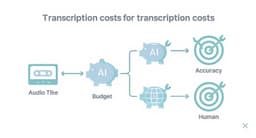
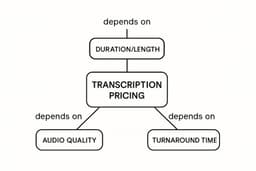
Figuring out transcription costs can feel like a moving target. Prices can swing from just a few cents per minute for an automated AI service to over $2.00 per minute for a highly skilled human transcriber. The right choice for you really boils down to how much accuracy you need, how fast you need it, and how complex your audio is.
Understanding Transcription Pricing Models
When you start shopping around for transcription, you'll quickly see two main ways services charge for their work. The most common is a per-audio-minute model. It’s simple: you pay a set rate for every single minute of audio you submit. This makes budgeting a breeze since the cost is directly tied to the length of your file.
The other popular option is a subscription plan, which is pretty common with AI-driven platforms. You pay a set monthly or annual fee that gets you a certain number of transcription minutes. If you have a steady stream of audio to transcribe each month, this can be a really budget-friendly way to go. To see how this plays out in the real world, check out voicecharts' pricing page.

Key Factors Influencing Cost
The pricing model is just the starting point. Several other factors come into play that can dramatically affect your final bill. This is why one 60-minute recording might cost 15** and another could run you **150.
- Audio Complexity: This is a big one. A recording with muffled sound, a lot of background noise, multiple people talking over each other, or thick accents is much harder to transcribe. That extra effort means a higher price tag.
- Turnaround Time (TAT): Need your transcript back yesterday? Most services offer standard delivery within 24-48 hours, but if you're in a rush and need it in a few hours, be prepared to pay a premium for that speed.
- Accuracy Guarantee: Human-powered services often promise 99% accuracy or higher, and that level of precision is what you’re paying for. AI is much cheaper but usually less accurate, meaning you'll likely need to spend time cleaning up the transcript yourself.
This need for reliable transcription isn't just a niche concern; it's driving massive industry growth. The U.S. transcription services market was valued at an impressive USD 28.19 billion in 2023 and is expected to climb to USD 41.83 billion by 2032. It's clear that accurate, written records are more important than ever.
To make the right call, you have to get into the details of each service type. By decoding the cost of transcription services, you can match your project's needs with your budget and avoid any surprises.
Quick Cost Overview AI vs Human Transcription
To give you a clearer picture, here's a quick breakdown of what you can generally expect to pay and what each service is best suited for.
| Service Type | Typical Cost Per Audio Minute | Best For |
|---|---|---|
| Automated (AI) | 0.05 - 0.25 | First drafts, internal notes, clear single-speaker audio |
| Human | 1.00 - 3.00+ | Legal proceedings, medical records, research, public-facing content |
This table should help you quickly gauge which route is likely the best fit. For quick and dirty notes where a few errors don't matter, AI is a great, affordable tool. But for anything that requires near-perfect accuracy, a professional human transcriber is the only way to go.
The True Cost of AI Transcription Services
Automated transcription has completely changed the game, making it possible for almost anyone to convert audio to text. Prices start as low as free and often hover around $0.25 per audio minute. On the surface, the low transcription services cost looks like a no-brainer.
This incredible affordability opens up doors for students, podcasters, and small businesses. Imagine a grad student transcribing hours of interview audio for their dissertation, or a content creator turning a one-hour podcast into a dozen social media snippets. The appeal is obvious: you get speed and volume without breaking the bank.
This accessibility is why the market is exploding. The global AI transcription market is expected to jump from USD 4.5 billion in 2024 to USD 19.2 billion by 2034. It all comes down to AI’s ability to churn out transcripts almost instantly for just pennies on the dollar compared to traditional methods.
What You Get for the Price
Not all AI transcription plans are created equal. Free or entry-level tiers usually give you just the basics—a raw, unformatted text file. Once you start paying, you unlock tools that really make a difference.
Some of these more advanced features include:
- Speaker Identification: The software automatically figures out who is speaking and labels their dialogue.
- Custom Vocabularies: You can train the AI to recognize specific jargon, brand names, or unusual spellings, which is a huge help for accuracy.
- Timestamping: The transcript links words or paragraphs to specific moments in the audio, making it easy to find and review key sections.
These features are incredibly powerful, but they still have their limits. For a closer look at how these tools work in highly specialized fields, check out a detailed guide to AI medical transcription.
Uncovering the Hidden Costs
Here’s the catch: the biggest "hidden cost" of AI transcription isn't about money—it's about your time. Even the most sophisticated AI rarely delivers 100% accuracy.
Think about it. A transcript that’s 95% accurate sounds great, right? But for a 10-minute audio file with about 1,500 words, that still leaves you with up to 75 errors to hunt down and correct.
This editing phase can be a real time-sink, especially if your audio quality isn't perfect. Things like background noise, people talking over each other, or heavy accents can tank an AI's accuracy, leaving you with a messy document that needs a major overhaul. When you're adding up the total transcription services cost, you have to account for this manual effort.
To see which platforms perform best under real-world conditions, take a look at our breakdown of the 12 best AI transcription software options for 2025.
Breaking Down Human Transcription Costs
While AI transcription is a great starting point, you pay a premium for human services for one simple reason: accuracy. The transcription services cost for a real person to handle your audio usually starts at 1.00 per audio minute** and can climb past **3.00, especially for complex recordings.
That higher price tag buys you a level of detail and understanding that software just can't match yet. We're talking about a guaranteed accuracy rate of 99% or higher. In professional fields where every word counts, that's not just a nice-to-have; it's a must.
The Anatomy of Premium Pricing
The price for human transcription isn't pulled out of thin air. It’s tied directly to the skill and time needed to work through challenging audio, making sure you get a transcript you can trust right away.
Several things can push the price up:
- Audio Complexity: Think about recordings with lots of background noise, people talking over each other, or speakers with heavy accents. A skilled transcriber has to meticulously pick apart these sounds, and that takes more time and focus.
- Specialized Knowledge: If you work in a technical field like law or medicine, you use jargon that most people don't know. Human services often have transcribers with expertise in these areas to make sure every term is nailed down correctly.
- Turnaround Time: Most services can get you a transcript back within 24 hours. But if you're on a tight deadline, you can pay extra to get it in just a few hours.
This attention to detail is everything. Imagine a legal deposition where "can't" is transcribed as "can." The meaning of a critical statement is completely flipped, which could have serious consequences. This is where a human ear makes all the difference. If you want to see how a major player like Rev structures their pricing, this in-depth review of their service breaks it all down.
When Add-Ons Increase the Final Cost
Your base per-minute rate isn't always the final price. Most services offer optional add-ons that can increase the total transcription services cost, but they also provide an extra layer of detail that might be essential for your project.
Here are a few common extras:
- Verbatim Transcription: This means capturing everything—filler words like "um" and "uh," stutters, and even non-verbal sounds like laughter or long pauses. It’s perfect for qualitative research or legal contexts where how something is said is just as important as what is said.
- Timestamping: This adds time codes to your transcript, usually every few seconds or each time a new person speaks. It makes it super easy to find and reference specific moments in the original audio or video.
- Rush Delivery: As mentioned, if you need that transcript back in less than 12 hours (or even 4), expect to pay a premium for the quick turnaround.
Ultimately, paying more for human transcription is an investment in certainty. You’re getting a polished final product that won't require you to spend hours editing and second-guessing, ensuring it's accurate and ready to use the moment it lands in your inbox.
Choosing the Right Service for Your Project
Picking the right transcription service isn't just about finding the cheapest rate. It’s about striking the right balance between what you're spending and what you're getting. Overpaying for pinpoint accuracy you don't need is just as wasteful as getting a cheap, error-filled transcript that's practically useless.
The whole decision really boils down to three simple questions: How accurate does this need to be? What’s my budget? And how fast do I need it? Your answers will naturally guide you to the best fit, whether that’s a pure AI solution, a professional human service, or something in between.
This decision tree gives you a great visual for how different factors—like audio quality, number of speakers, and turnaround time—should influence your choice.
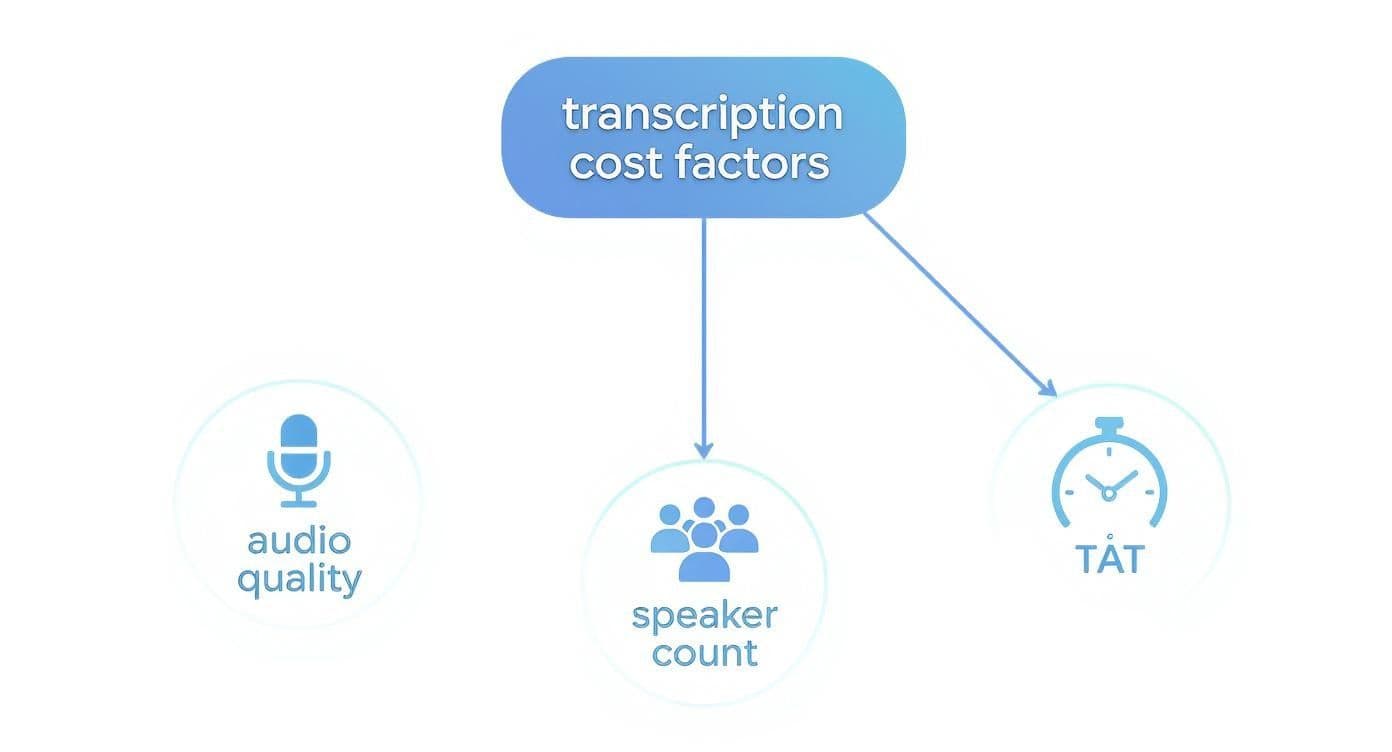
As you can see, clean audio with one speaker is a perfect job for an affordable AI. On the other hand, a messy recording with a tight deadline almost always calls for the premium touch of a human transcriber.
When to Use AI Transcription Services
Automated transcription is your best friend when speed and cost are the name of the game, and you’re okay with a few rough edges. AI is brilliant at churning through huge volumes of clear audio in minutes.
Here are a few scenarios where AI is the smart call:
- Internal Meeting Notes: You just need the main points of a discussion for teammates who missed the call.
- First Drafts: Generating a quick, rough transcript from a podcast or video to use as a starting point for a blog post. You'll edit it anyway.
- Personal Use: Transcribing your own voice memos or college lectures for studying.
For jobs like these, an accuracy rate of 85-95% is usually perfectly fine. The transcript is for internal use or a first pass, so the time you save is way more valuable than getting every single word perfect.
When Human Transcription Is Non-Negotiable
Sometimes, "good enough" just won't cut it. There are situations where 99% accuracy is the absolute minimum, and any mistake could have serious consequences. This is where professional human transcription becomes essential.
Human-powered services are the gold standard for:
- Legal Proceedings: Think depositions, court hearings, and witness interviews. Every word has legal weight.
- Medical Records: Transcribing doctor dictations or patient notes where a single error could impact someone's health.
- Qualitative Research: Capturing the subtle details of academic interviews, where even pauses and "ums" are part of the data.
- Public-Facing Content: Creating flawless subtitles for a marketing video or publishing an important interview where your brand’s reputation is at stake.
Finding the Middle Ground with Hybrid Services
Don't want to choose between cost and quality? A hybrid approach might be the answer. This model uses AI to generate the first draft, which is then cleaned up and perfected by a human proofreader.
This is a fantastic solution for projects that need to be highly accurate but are also on a tighter budget. A company might use a hybrid service to transcribe important webinars or customer feedback calls. You get a polished, reliable transcript without paying the full premium for a 100% manual job, which is a great way to manage your transcription services cost.
To make your choice even clearer, this matrix breaks down which service type works best for different scenarios.
Transcription Service Decision Matrix
| Use Case | Recommended Service | Reasoning |
|---|---|---|
| Quick Internal Meeting Recap | AI Transcription | Speed and low cost are the main priorities. A general gist of the conversation is all that's needed. |
| Podcast to Blog Post Draft | AI or Hybrid | AI is great for a rough first draft you'll heavily edit. A hybrid service gives you a cleaner starting point. |
| Legal Deposition | Human Transcription | Non-negotiable. Requires 99%+ accuracy for legal admissibility and to avoid critical errors. |
| Academic Research Interview | Human Transcription | Captures nuances, filler words, and crosstalk that are vital for qualitative analysis. |
| Public-Facing Video Subtitles | Human or Hybrid | For brand reputation, accuracy is key. Hybrid offers a good balance, but human is safest for major projects. |
| Personal Study Notes | AI Transcription | Perfect for turning lectures into searchable text for personal use, where minor errors don't matter. |
Ultimately, the goal is to match the service to the job. By evaluating your specific needs against the strengths of each transcription type, you can ensure you get the right result without overspending.
Specialized Legal and Medical Transcription Costs
When you step into the worlds of law and medicine, the standard rules for transcription pricing go out the window. The typical transcription services cost for a business meeting just doesn't apply here. What you’re really paying for is deep expertise, strict compliance, and a level of accuracy that simply cannot be compromised.
In these high-stakes fields, a mistake is far more than a simple typo. An error could lead to a life-altering misdiagnosis or completely change the meaning of a legal document. That’s why these services command higher rates—they rely on certified professionals who have a masterful grasp of complex, industry-specific terminology, from dense medical jargon to intricate legal phrasing.
On top of that, security is a massive factor. Medical transcriptionists must adhere to rigid HIPAA (Health Insurance Portability and Accountability Act) guidelines to protect patient data. Likewise, legal transcribers deal with incredibly confidential information from court cases and depositions. This need for secure, compliant handling adds to the operational cost, which you’ll see reflected in the price.
Medical Transcription Pricing Models
Medical transcription often ditches the usual per-minute model. Instead, it’s common to see pricing per line, which is typically defined as 65 characters. In the U.S., you can expect to pay anywhere from 0.07 to 0.16 per line. This approach makes a lot of sense when you consider how doctors dictate—they often pause to think, so charging by the actual text produced is fairer than charging by audio length.
Technology is definitely shaking things up, though. The global market for medical transcription software is projected to balloon from USD 2.55 billion in 2024 to an estimated USD 8.41 billion by 2032. This explosive growth comes from healthcare providers using AI to create structured medical records more efficiently and at a lower cost. You can learn more about the rapid growth of medical transcription software and its impact on the industry.
Legal Transcription Pricing Standards
In the legal arena, you’ll most often find pricing calculated per page. This model aligns perfectly with how legal documents are formatted and filed. For a standard double-spaced page, costs can range from 2.00 to 5.00 or more, with the final price depending on the complexity of the material and how quickly you need it back.
Legal transcription frequently demands a verbatim transcript. This means capturing every single "um," stutter, and pause, because these small details can be surprisingly important in a deposition or court hearing. It's a much more meticulous and time-consuming process, and that's reflected in the higher cost.
Frequently Asked Questions
When you're looking into transcription, a few key questions always pop up, especially around pricing and security. Getting these details straight is the first step to choosing the right service without overspending. Let's walk through some of the most common queries.
What Is an Audio Minute and How Is It Calculated?
You'll see the term "audio minute" everywhere in the transcription world. It's the industry-standard way to bill, and it simply means one minute of your actual audio or video recording. It has nothing to do with how long it takes a human or an AI to type it out.
This is great for budgeting because it's completely predictable. For instance, if you have a 20-minute recording and the rate is 1.25 per minute**, your total cost is a flat **25. No hidden fees, no complex calculations—the price is tied directly to the length of your file.
How Can I Reduce My Transcription Costs?
The single best way to lower your transcription bill is to improve your audio quality. If you can record in a quiet room, use a decent microphone, and make sure people aren't talking over each other, you'll make the transcriber's job much easier. This often translates into lower costs, particularly with human-powered services.