We’ve all been there. Staring at the clock, wondering what the point of this meeting even is, while the conversation spirals into topics that have nothing to do with anything. Let's be honest: most meetings are a complete waste of time. But there's a simple, powerful fix: a solid meeting agenda. Think of it less as a to-do list and more as a roadmap to get you from point A to point B without any detours.
Why Most Meetings Are Broken (And How an Agenda Is the Fix)
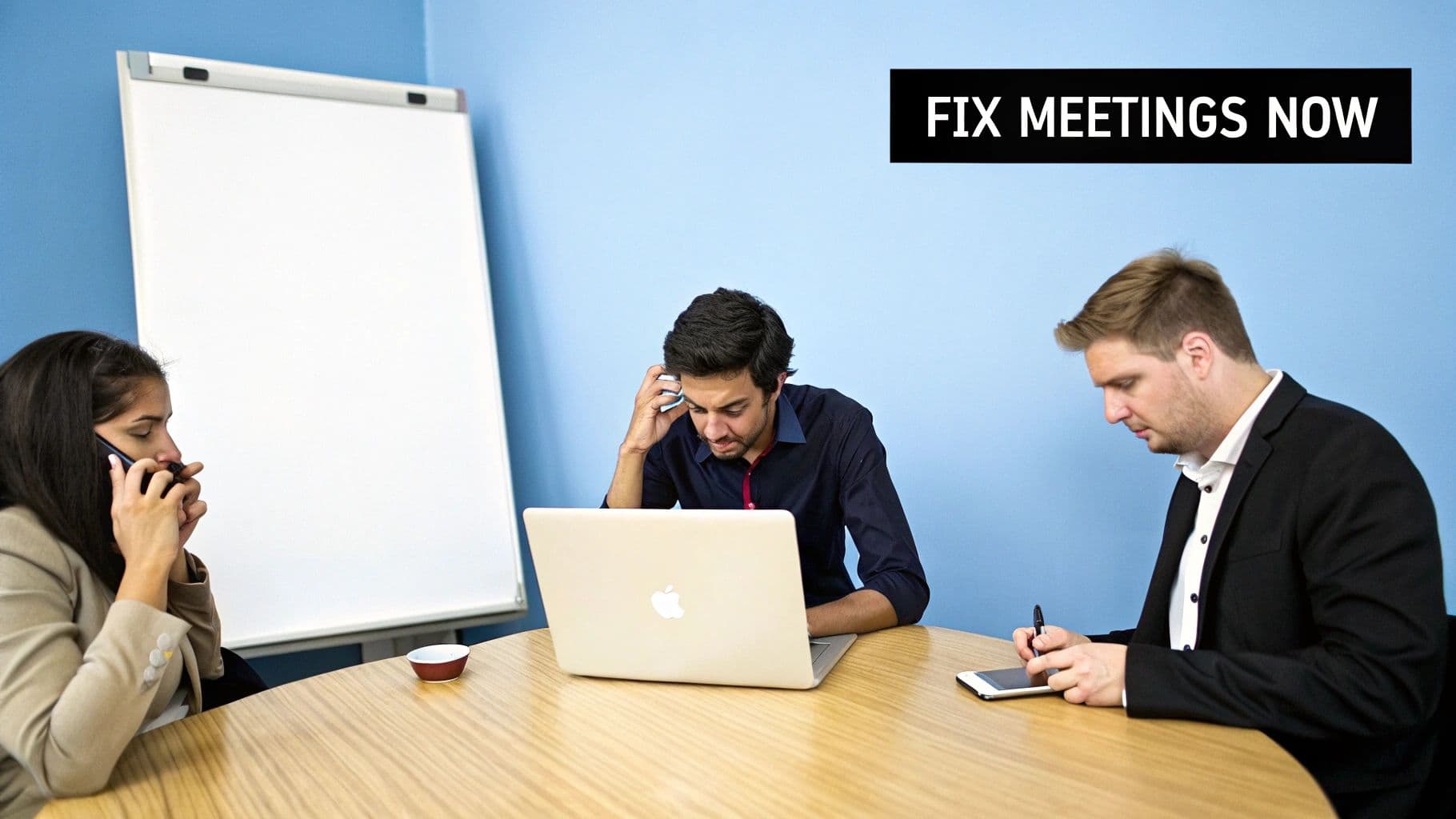
If you walk out of a meeting feeling like nothing was actually accomplished, the problem isn’t usually the people. It’s the lack of a plan. When there's no agenda, there’s no clear purpose. Conversations drift, the loudest voices take over, and important decisions get pushed to "the next meeting." It’s a perfect recipe for frustration and inefficiency.
The numbers back this up. An analysis of over a million meetings found that a shocking 63% had no agenda whatsoever. This is a huge reason why 65% of professionals say meetings waste their time, costing U.S. businesses an estimated $37 billion every year. For senior leaders, it's even worse—some spend nearly 23 hours a week in meetings that go nowhere. You can find more eye-opening statistics about meeting effectiveness to see just how deep this problem runs.
An Agenda Isn't a To-Do List—It's a Game Plan
A simple meeting agenda format brings much-needed order to the chaos. Just by defining why you're all gathered in the first place, you immediately set clear expectations. This simple document is a game-changer.
Here's how a well-crafted agenda transforms your meetings:
- It creates accountability. When topics are clearly listed, everyone knows what needs to get done and who owns it. No more vague maybes.
- It forces everyone to prepare. Sending the agenda ahead of time gives people a chance to pull their numbers and organize their thoughts, which means better, smarter contributions.
- It shows respect for people's time. Assigning time blocks to each item keeps the discussion on track and ensures you actually finish on time.
- It drives toward decisions. A good agenda is all about outcomes, not just talk. It guides the conversation toward tangible action items.
Ultimately, making an agenda a non-negotiable part of your routine turns meetings from a necessary evil into a genuinely valuable tool for making progress. Every minute you spend together starts moving the needle.
Building Your Agenda From the Ground Up
Putting together a solid meeting agenda doesn't need to be complicated. You don't need fancy software or a rigid template. It all boils down to one simple, powerful question that cuts right through the noise: What is the one thing we absolutely must decide or accomplish in this meeting?
Answering that question forces you to get crystal clear on the meeting's purpose. You stop just listing random topics and start defining a specific, measurable outcome. This central goal becomes the North Star for every other decision you make, from who needs to be there to how much time you dedicate to each point.
Identify the Right People
Once you know your core objective, figuring out who to invite gets a lot easier. This isn't about inviting everyone just to be inclusive; it's about being strategic. The real goal is to get the smallest possible group in the room that has the authority and knowledge to make the decision.
For every person you consider inviting, ask yourself:
- Is their input absolutely essential for this decision? If not, they can probably just get the summary afterward.
- Are they the one who will actually have to do the work? If so, they need to be there for buy-in and clarity.
- Do they have unique information or data we can't get otherwise? Bring them in for their expertise.
Being ruthless with your guest list is one of the most respectful things you can do. It protects everyone's time and keeps the conversation focused so you can actually get things done.
Define Topics and Assign Time Blocks
With your objective set and your attendees confirmed, you can start mapping out the conversation. Break down your main goal into 3-5 logical discussion points. For each of those points, assign a realistic time block and, just as importantly, a designated owner—the person responsible for leading that part of the discussion.
This kind of structure has become non-negotiable in today's work environment. The shift to remote work means we have to be more deliberate about how we communicate. While virtual meetings shot up from 48% to 77% between 2020 and 2022, our productivity didn't always keep pace.
A mind-boggling 55 million meetings happen every week in the US, yet only 37% result in a clear decision, mostly because they lack any real structure. These meeting productivity statistics paint a clear picture: a simple, well-thought-out agenda can make all the difference.
Ultimately, a great agenda is all about being intentional. When you define your purpose, curate your attendee list, and map out the flow, you're setting the stage for a successful outcome. For a deeper dive, check out our guide on how to write a meeting agenda that actually works.
Real-World Agendas For Common Business Meetings
An agenda template is great in theory, but where it really shines is in practice. The simple format we've discussed isn't a rigid rulebook; think of it more as a flexible framework you can mold to fit just about any type of meeting you have on your calendar.
Let's break down how to apply this framework to four common meetings you probably have all the time, from quick daily huddles to more formal executive check-ins.
This visual lays out the fundamental questions you need to answer before you even start building your agenda: What are we doing here? Who needs to be involved? And how much time do we really need?
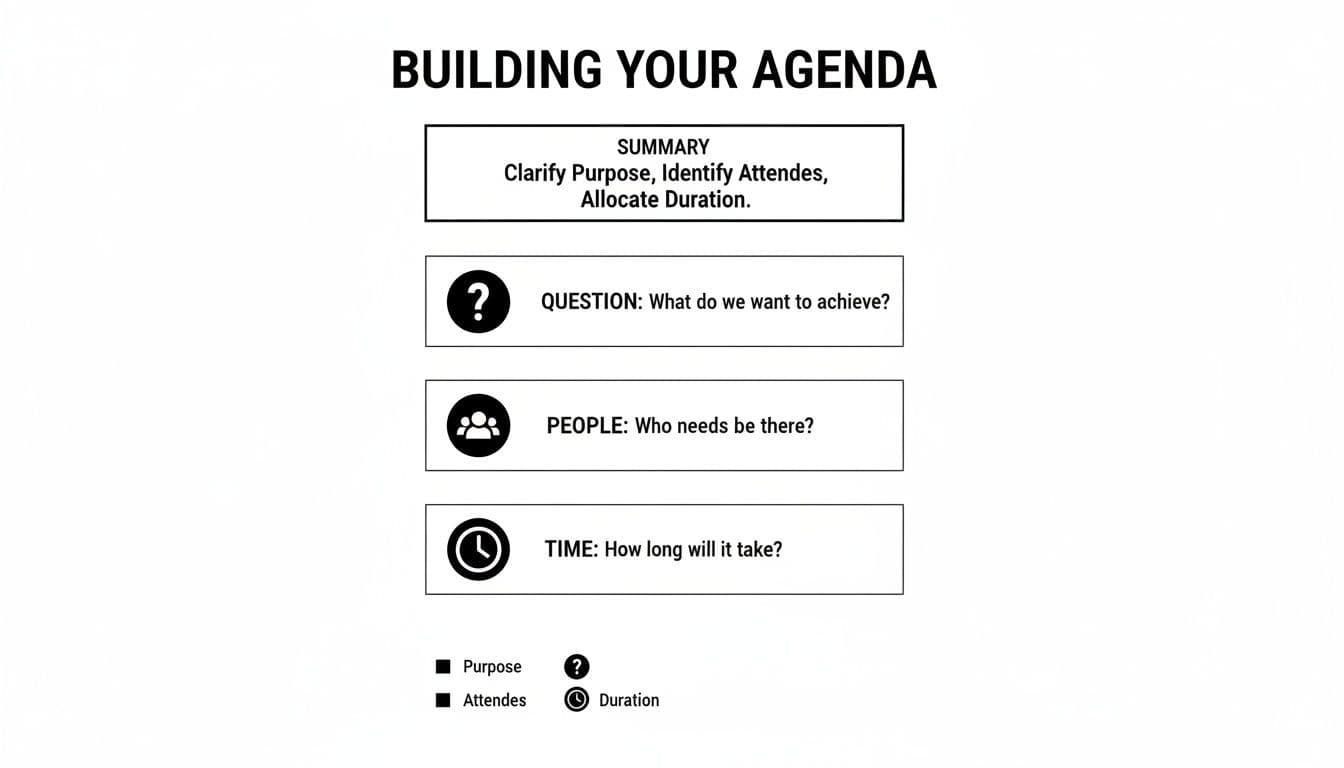
Nailing down the purpose, attendees, and timing first is the secret to a meeting that actually accomplishes something.
The 15-Minute Daily Stand-Up
The whole point of a stand-up is to get in, get aligned, and get out. Speed is the name of the game, so your agenda needs to be brutally efficient.
- Objective (1 minute): Quickly sync on today's priorities and flag any critical roadblocks.
- Team Updates (10 minutes): Go around the room, with each person answering the big three: What I finished yesterday, what I'm tackling today, and what's slowing me down.
- Parking Lot (4 minutes): This is crucial. Identify blockers and decide who needs to talk after the stand-up to solve them. Don't let problem-solving derail the meeting itself.
This structure is what keeps a 15-minute sync from creeping into a 45-minute tangent-filled discussion.
The Monthly Sales Review
This meeting is where data meets strategy. The agenda's job is to drive a conversation that moves beyond just reading numbers on a screen and gets into the "why" behind them.
- Objective (5 minutes): Review last month's numbers against targets and set clear, actionable priorities for the month ahead.
- Performance Analysis (25 minutes): This is the core of the meeting. Dig into the metrics—wins, losses, pipeline velocity, deal size. This is also the time for reps to share what’s working and what’s not.
- Action Plan (15 minutes): Based on the data, what are we going to do differently? Brainstorm specific plays, and get firm commitments from the team.
- Next Steps (5 minutes): Assign owners to every action item and confirm deadlines. No ambiguity allowed.
The Client Kick-Off Call
First impressions matter. A client kick-off call sets the tone for the entire relationship, so the agenda needs to build confidence and establish crystal-clear alignment from the get-go.
- Introductions & Goals (10 minutes): Go beyond names and titles. Have both teams share what a "successful project" looks like to them. This ensures everyone is aiming for the same target.
- Project Scope & Timeline Review (20 minutes): Walk through the statement of work, key deliverables, and major milestones. This is the time to clarify any gray areas before they become problems.
- Roles & Communication (10 minutes): Define the primary points of contact on both sides and establish a communication rhythm (e.g., weekly check-in calls, monthly reports).
- Immediate Next Steps (5 minutes): End the call with a clear "who-does-what-by-when" for the first week.
The Quarterly Executive Update
When you're presenting to leadership, time is their most valuable asset. Your agenda must be concise, high-level, and focused on strategic outcomes. They don't need a play-by-play; they need to know if the ship is headed in the right direction.
- Objective & Executive Summary (5 minutes): Start with the conclusion. Briefly state the quarter's highlights, lowlights, and the primary takeaway.
- Key Results vs. Goals (15 minutes): Present a high-level overview of performance against the quarter's main objectives (OKRs). Use visuals and focus on the impact of the numbers, not just the numbers themselves.
- Strategic Discussion (20 minutes): This is where you bring up key challenges, opportunities, or strategic decisions that require leadership input. Frame it with data and a clear "ask."
- Forward-Looking Plan (5 minutes): Briefly outline the top 1-3 priorities for the upcoming quarter.
Agenda Timing Guide For Common Meetings
While every meeting is different, you can use some general guidelines for allocating time. Over time, you'll get a feel for the natural rhythm of your team and can adjust accordingly.
This table provides a simple cheat sheet for structuring your time across these common meeting types.
| Meeting Type | Welcome & Objectives (Mins) | Main Topics (Mins) | Action Items & Wrap-up (Mins) | Total Time (Mins) |
|---|---|---|---|---|
| Daily Stand-Up | 1 | 10 | 4 | 15 |
| Client Kick-Off | 10 | 30 | 5 | 45 |
| Monthly Sales Review | 5 | 40 | 5 | 50 |
| Quarterly Exec Update | 5 | 35 | 5 | 45 |
Use this as a starting point, but don't be afraid to customize it. The goal is to make time an intentional part of the plan, not an afterthought.
A solid agenda is also essential for other important meetings, like one-on-ones, which are a cornerstone of any modern performance management process. If you're looking for more inspiration, you can find dozens of great examples by exploring these meeting agenda templates for every situation.
Running the Meeting and Keeping It on Track

Your agenda is the roadmap, but someone still needs to drive the car. Even the most perfectly crafted plan can get thrown off by a long-winded tangent or a surprise debate. This is why having clear roles is just as important as having a clear agenda.
Think of it as creating a system of checks and balances. By assigning a facilitator, a timekeeper, and a note-taker, you distribute the responsibility for keeping things moving. The facilitator, in particular, does more than just lead; their real job is to guide the conversation, make sure everyone gets a chance to speak, and pull the discussion back when it starts to stray.
The Art of Gentle Redirection
Keeping a meeting focused is a delicate skill. You don't want to kill creativity or shut down a potentially great idea, but you absolutely have to protect the meeting's purpose and everyone's time. A few simple, polite phrases are all you need to gently steer things back on course.
Try using phrases like these:
- "That's a really interesting point. Let's make sure it's captured in the notes so we can follow up on it after the meeting."
- "I want to be mindful of our time, so let's stick with the current topic for now and circle back to that later if we can."
This kind of active management is the key to how you can run effective meetings that actually accomplish what they set out to do.
From Agenda to Action: How AI Can Help
Let's be honest, the real test of any meeting is what happens after it ends. A solid agenda does more than just guide the conversation; it sets the stage for turning talk into action. This is where AI meeting tools are changing the game.
When you lay out your agenda with clear, simple topics like "Q3 Pipeline Review" or "Client Feedback Analysis," you're giving an AI summarization tool a perfect roadmap. Tools like Notta or Fireflies.ai use these agenda items to make sense of the conversation, pinpoint key decisions, and even pull out action items from the discussion. Your prep work suddenly becomes the foundation for an automated follow-up.
Making Every Minute Count
This link between a structured agenda and AI-powered notes is a huge relief for overloaded teams. Think about it: in the U.S. alone, we're holding 36 to 56 million meetings daily. The bad ones are costing businesses around $37 billion a year. And that frustrating feeling when one meeting just leads to another? That's the reality for 77% of them. You can dig into more of these meeting statistics to see just how big the problem is.
This is where the AI steps in to do the heavy lifting after the call wraps up:
- Smart Summaries: It drafts a quick, easy-to-read summary organized by your agenda topics.
- Action Items, Captured: It spots tasks as they're mentioned and helps you assign them to the right person.
- A Searchable History: The entire conversation becomes a searchable transcript, so you can find anything you need later.
This simple process closes the gap between talking about something and actually getting it done. If you're looking to get better at turning conversations into clear next steps, the world of AI in content creation offers some great lessons on how to automate summaries and action items effectively.
Got Questions? Let’s Talk About Real-World Agenda Problems
Even with the best template, you're going to run into some tricky situations. Making agendas a real, sustainable habit means knowing how to handle these common hiccups when they pop up.
When should I actually send the agenda?
This one's simple: get it out at least 24 hours ahead of time. That’s the bare minimum. It gives people a chance to actually read it, gather their thoughts, and show up ready to contribute instead of just reacting.
If you’re planning a bigger, more strategic session—like a quarterly review or a project kickoff—give your team even more runway. Sending it out 48 to 72 hours in advance is a pro move that shows you respect their time and input.
How do I stop conversations from going off the rails?
It happens to everyone. A conversation starts drifting, and suddenly you're way off topic and burning through the clock. The best way I've found to handle this is with a "parking lot."
It's just a simple spot in your notes where you can jot down important, but unrelated, ideas that come up.
The meeting facilitator can gently steer things back on track by saying something like:
This little trick works wonders. It validates the person's contribution without letting the whole meeting get derailed.