Meetings often get a bad reputation. They can feel like a drain on time, energy, and productivity. The real culprit, however, isn't the meeting itself but the lack of a clear, purposeful structure. A well-crafted agenda is the single most powerful tool for transforming chaotic discussions into focused, actionable sessions. Without a solid plan, meetings wander, decisions are delayed, and participants leave wondering what was accomplished. A thoughtfully prepared agenda sets clear expectations, keeps the conversation on track, and ensures everyone is aligned on the objectives and desired outcomes.
This guide provides six battle-tested meeting agenda outlines designed for specific business scenarios. We'll break down the strategic purpose behind each one, offering tactical tips for implementation and giving you replicable templates to immediately improve your team's efficiency. For more in-depth strategies on ensuring your meetings are productive and purposeful, explore our guide on running effective meetings.
From the quick daily huddle to the critical project launch, mastering these outlines will ensure every minute spent in a meeting room is a minute well invested. You will learn not just what to discuss, but how to structure those discussions for maximum impact.
1. Standard Business Meeting Agenda
The Standard Business Meeting Agenda is a classic, structured format that brings order and predictability to formal discussions. It's the go-to for many organizations because its linear, step-by-step process ensures all critical business is covered systematically, from official preliminaries to final action items. This format is ideal for meetings where official records are paramount and procedural correctness is essential, like board or committee meetings.

The structure emphasizes clear documentation and accountability. It typically follows Robert's Rules of Order or a similar parliamentary procedure, making it a reliable choice for corporate board meetings, nonprofit committees, and even homeowners association gatherings where decisions must be transparent and officially recorded. Its strength lies in its formality, which minimizes ambiguity and keeps the focus strictly on the business at hand.
Strategic Breakdown
- Purpose: To provide a formal, documented, and sequential framework for decision-making and official business. It prioritizes order and legal or procedural compliance.
- Structure: Linear and predictable. It begins with a "Call to Order," moves to "Approval of Previous Minutes," tackles "Old Business," then "New Business," and concludes with "Adjournment." Each item has a designated time slot.
- Key Benefit: This format creates an official record. The minutes generated from this agenda serve as a legal or historical document of the group’s decisions and discussions. Proper note-taking is crucial here, and you can learn how to take better meeting notes to master this skill.
Actionable Takeaways
To make the most of this traditional meeting agenda outline, follow these best practices:
- Distribute Early: Send the agenda and previous meeting minutes at least 24-48 hours in advance. This gives attendees time to review materials and prepare for discussions.
- Prioritize Ruthlessly: Place the most critical discussion items or decisions early in the "New Business" section. This ensures you address them when participants' energy and focus are at their peak.
- Assign Roles: Designate a facilitator to guide the conversation, a timekeeper to maintain the schedule, and a note-taker to document everything. This division of labor keeps the meeting efficient and on track.
2. Stand-up Meeting Agenda (Daily Scrum)
The Stand-up Meeting Agenda, often called the Daily Scrum, is a staple of Agile methodologies designed for quick, high-energy team synchronization. Its core principle is brevity, with meetings typically lasting no more than 15 minutes. Participants often stand to reinforce the need for speed, focusing on progress, plans, and impediments without getting sidetracked into deep problem-solving.

This format is used by fast-paced teams across various industries, from Spotify's engineering squads to HubSpot's marketing teams. The agenda revolves around each member answering three fundamental questions to maintain alignment and tackle blockers swiftly. Its strength lies in fostering daily transparency, accountability, and adaptive planning, making it one of the most effective meeting agenda outlines for dynamic project environments. For teams utilizing the Daily Scrum, it's essential to learn more about effective stand-up meetings to maximize their impact.
Strategic Breakdown
- Purpose: To provide a rapid, daily check-in for team members to synchronize activities, report progress, and identify obstacles. It prioritizes communication and immediate problem awareness.
- Structure: Fast-paced and conversational. Each team member answers three key questions: What did I do yesterday? What will I do today? What blockers are in my way?
- Key Benefit: This format fosters radical transparency and peer-to-peer accountability. By publicly sharing progress and blockers, the team can quickly self-organize to resolve issues and maintain momentum without managerial intervention.
Actionable Takeaways
To execute a flawless stand-up meeting, focus on these tactical best practices:
- Start on Time, Every Time: Begin exactly at the scheduled time, even if not everyone has arrived. This reinforces the importance of punctuality and respects the time of those present.
- Use a "Parking Lot": Designate a whiteboard or digital space for topics that require deeper discussion. This prevents the stand-up from derailing into a problem-solving session and ensures those issues are addressed later by the relevant people. If you're looking for ways to keep your daily check-ins fresh, you can find inspiration with new morning meeting questions that still align with the core goals.
- Keep It Brief with a Timer: Display a visible timer for the 15-minute duration. This creates a shared sense of urgency and helps train the team to be concise and focused with their updates.
3. Project Kickoff Meeting Agenda
The Project Kickoff Meeting Agenda is the foundational blueprint for launching a new initiative successfully. Its primary function is to align all stakeholders, from team members to clients, on the project's core objectives, scope, timeline, and individual roles. This is more than just an informational session; it's a strategic alignment meeting that sets the tone for collaboration, establishes clear expectations, and builds initial momentum.

This agenda format is essential for any project where clarity and shared understanding are critical from day one. It’s used extensively by consulting firms like Deloitte when starting client engagements, software companies like Microsoft launching new product development cycles, and marketing agencies kicking off major campaigns. The goal is to move from abstract ideas to a concrete, shared vision, ensuring everyone leaves the room knowing exactly what success looks like and how they contribute to achieving it.
Strategic Breakdown
- Purpose: To officially launch a project by aligning all key stakeholders on goals, scope, roles, responsibilities, and processes. It aims to build a shared understanding and excitement.
- Structure: The agenda moves from high-level vision to tactical details. It typically starts with introductions and project background, defines the problem and goals, outlines the scope and deliverables, clarifies roles, reviews the timeline and milestones, and ends with immediate next steps.
- Key Benefit: It minimizes future misunderstandings, scope creep, and misaligned efforts by establishing a single source of truth from the very beginning. This proactive alignment saves significant time and resources down the line.
Actionable Takeaways
To execute a powerful project kickoff using one of these meeting agenda outlines, consider these best practices:
- Send Pre-Reading Materials: Distribute a project brief, charter, or other essential documents at least a week in advance. This ensures participants arrive informed and ready to contribute, rather than just absorb information.
- Define Success Clearly: Dedicate a specific agenda item to discussing and agreeing upon the Key Performance Indicators (KPIs) and success metrics. Ask, "What does a successful outcome look like for everyone involved?"
- Assign Immediate Next Steps: End the meeting by assigning clear, actionable tasks with owners and due dates for the next 1-2 weeks. This transforms the meeting's energy into tangible forward progress and maintains momentum right after the kickoff.
4. Tactical Meeting Agenda (EOS Level 10)
The Tactical Meeting Agenda, popularized by Gino Wickman's Entrepreneurial Operating System (EOS), is a highly structured, 90-minute weekly format designed to keep leadership teams in sync and focused on solving real-time business issues. Its primary purpose is to maintain organizational momentum by addressing immediate challenges head-on, preventing them from escalating. This format is ideal for fast-growing companies and leadership teams that need to cut through the noise and drive accountability.
The Level 10 meeting agenda gets its name from the goal of having participants rate every meeting on a scale of 1 to 10, striving for a perfect score. Its rigid, time-boxed structure ensures that conversations are disciplined, productive, and focused on tactical execution rather than long-term strategic planning. This makes it a powerful tool for organizations like mid-market companies, scaling startups, and professional services firms that require a consistent pulse on operational health.
This infographic illustrates the core flow of the Level 10 meeting, emphasizing its focus on data, progress, and problem-solving.
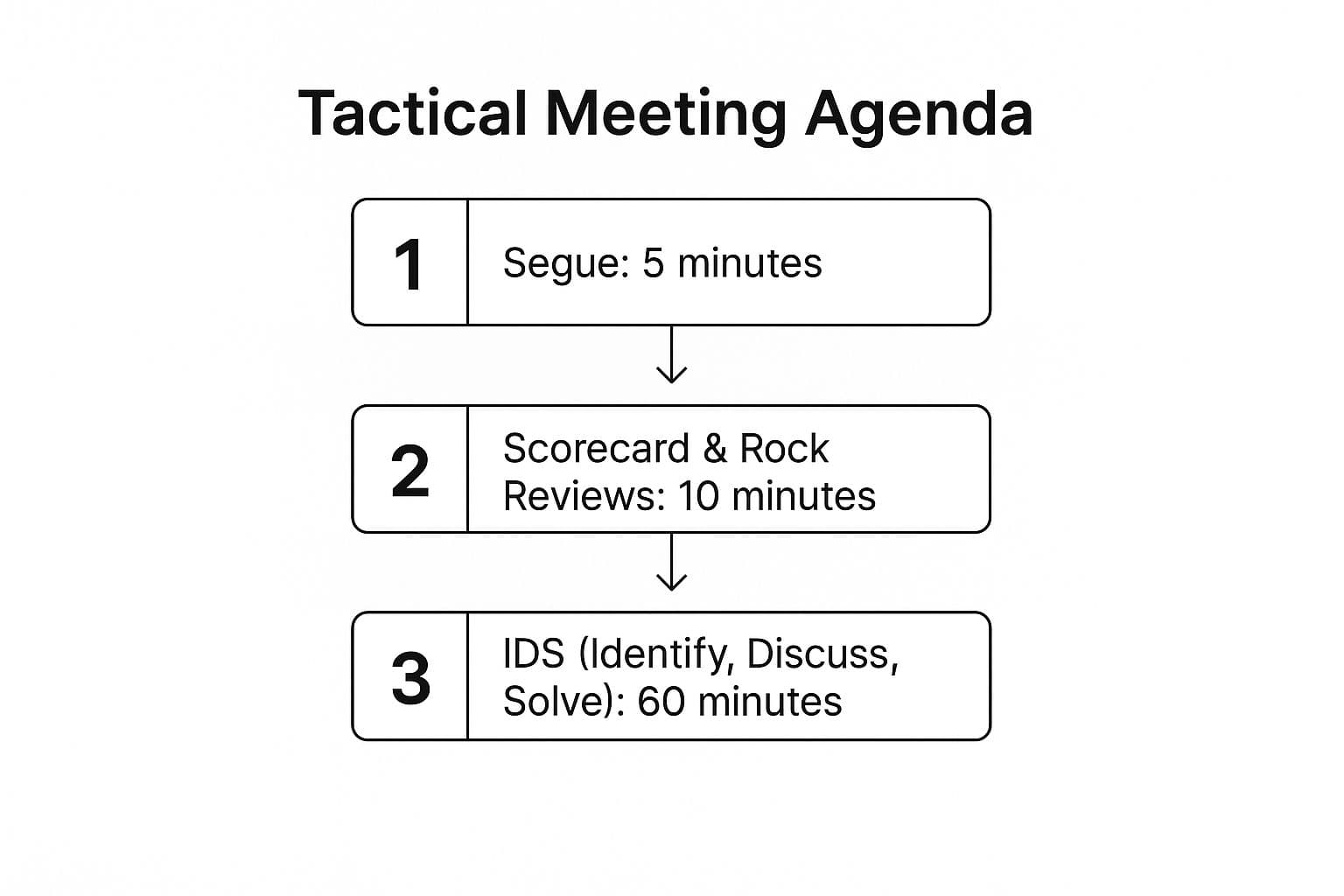
The visualization highlights how the bulk of the meeting is dedicated to IDS (Identify, Discuss, Solve), ensuring that the team spends its energy tackling the most pressing issues.
Strategic Breakdown
- Purpose: To maintain team alignment, track progress on key metrics and quarterly goals (Rocks), and solve tactical issues in a disciplined, weekly cadence.
- Structure: A strict 90-minute, seven-part agenda that includes a Segue, Scorecard review, Rock review, Customer/Employee Headlines, To-do List review, IDS session, and Conclude. The sequence is non-negotiable.
- Key Benefit: It forces teams to confront and resolve the most important operational problems every week. The IDS (Identify, Discuss, Solve) component is a masterclass in prioritization and effective problem-solving, preventing issues from festering.
Actionable Takeaways
To execute a successful Level 10 meeting, your team must embrace its structure and discipline:
- Start and End on Time: This is a non-negotiable rule. Starting and ending precisely on schedule, regardless of who is present, builds discipline and respect for everyone's time.
- Master the IDS Process: The heart of the meeting is the IDS session. Team members must learn to identify the root cause of an issue, discuss it openly and honestly, and then commit to a tangible solution with a clear owner. Avoid "solving" on the discussion phase.
- Maintain the Issues List: The agenda is driven by a living "Issues List" that any team member can add to throughout the week. This ensures that important topics are captured as they arise and are ready for prioritization during the meeting.
5. Retrospective Meeting Agenda
The Retrospective Meeting Agenda, a cornerstone of Agile methodologies, is designed for teams to reflect on their processes, identify improvements, and continuously evolve their ways of working. It creates a safe, structured space for honest feedback and focuses on learning rather than blame. This format is ideal for any team looking to foster a culture of continuous improvement, such as the engineering teams at Google or the product teams at Shopify who use it to refine their sprint cycles.
This agenda moves beyond simply reviewing what was done; it explores how it was done. By asking what went well, what didn't, and what can be improved, it empowers teams to take ownership of their own processes. The emphasis on psychological safety makes it one of the most effective meeting agenda outlines for building trust and driving meaningful change from the ground up.
Strategic Breakdown
- Purpose: To facilitate a structured reflection on a recent work period (like a sprint or project) to identify actionable improvements. Its goal is to refine team processes, not to assign blame.
- Structure: Typically follows a five-stage process: Set the Stage, Gather Data, Generate Insights, Decide What to Do, and Close the Retrospective. This guides the team from reflection to action.
- Key Benefit: It builds a powerful feedback loop for continuous improvement. By regularly examining their own workflows, teams can adapt to challenges, innovate their practices, and prevent recurring problems, ultimately boosting both productivity and morale.
Actionable Takeaways
To run an effective retrospective that generates real change, implement these tactics:
- Establish Ground Rules: Start every session by agreeing on rules that promote psychological safety, such as "We assume everyone did the best job they could with the knowledge they had at the time." This encourages open and honest participation.
- Vary the Format: Avoid monotony by using different retrospective techniques. Formats like "Start, Stop, Continue," "Mad, Sad, Glad," or the "4Ls" (Liked, Learned, Lacked, Longed For) can uncover different types of insights and keep engagement high.
- Focus on Actionable Items: Guide the team to identify 2-3 high-impact improvements they can implement immediately. Always start the next retrospective by reviewing the progress on these action items to create accountability and demonstrate the value of the meeting.
6. One-on-One Meeting Agenda
The One-on-One Meeting Agenda is a personalized, recurring format designed to foster a strong, productive relationship between a manager and their direct report. Unlike a simple status update, its primary purpose is coaching, career development, and removing roadblocks. This agenda type transforms the meeting from a top-down report into an employee-driven conversation, ensuring individuals feel heard, supported, and aligned with team goals.
This framework is crucial for building trust and maintaining open communication, especially in remote or hybrid work environments. Pioneered by leaders like Intel's Andy Grove and championed by modern tech giants such as Meta and Google, the one-on-one is recognized as a cornerstone of effective management. Its power lies in its consistent, private nature, creating a safe space for honest feedback and genuine connection that drives both employee engagement and performance.
Strategic Breakdown
- Purpose: To build rapport, provide personalized coaching, discuss career growth, and proactively address challenges. The focus is on the employee's needs, not just project status.
- Structure: Flexible and collaborative. A common model is the 10-10-10 framework: 10 minutes for the employee's topics, 10 minutes for the manager's topics, and 10 minutes to discuss future goals and action items. The employee typically sets the initial agenda.
- Key Benefit: It dramatically improves employee retention and engagement by showing that leadership is invested in their individual success and well-being. It also serves as an early warning system for potential issues, from burnout to project obstacles.
Actionable Takeaways
To execute this agenda effectively, managers should adopt the following practices:
- Empower the Employee: Let your direct report own the agenda. Ask them to add their discussion points to a shared document 24 hours in advance so you can prepare thoughtful responses.
- Never Cancel: Treat one-on-ones as sacred. Rescheduling is acceptable if absolutely necessary, but frequent cancellations send a message that the employee is not a priority.
- Focus on Open-Ended Questions: Avoid simple yes/no questions. Instead, ask things like, "What's one thing we could change about our team to make it better?" or "What skills are you interested in developing next?" This encourages deeper, more meaningful dialogue.
- Document and Follow Through: End each meeting by defining clear action items for both parties. Using a dedicated meeting action items template ensures that commitments are tracked and revisited in the next session, creating a powerful cycle of accountability and progress.
Meeting Agenda Types Comparison
| Meeting Type | Implementation Complexity 🔄 | Resource Requirements ⚡ | Expected Outcomes 📊 | Ideal Use Cases 💡 | Key Advantages ⭐ |
|---|---|---|---|---|---|
| Standard Business Meeting Agenda | Moderate: structured, formal process | Moderate: timekeeper, agenda prep | Clear documentation, orderly progression | Formal governance, board meetings, nonprofit meetings | Familiar, organized, continuity between meetings |
| Stand-up Meeting Agenda (Daily Scrum) | Low: brief, daily, simple format | Low: timer, facilitator rotation | Team alignment, blocker identification, quick updates | Fast-paced teams, agile software development, daily sync | Time-efficient, promotes transparency, prevents fatigue |
| Project Kickoff Meeting Agenda | High: comprehensive prep and content | High: multi-stakeholder coordination | Stakeholder alignment, defined roles and scope | New projects, cross-functional initiatives, client launches | Sets clear expectations, reduces conflicts early |
| Tactical Meeting Agenda (EOS Level 10) | High: disciplined weekly routine | Moderate-High: leadership involvement, data tracking | Tactical problem-solving, accountability | Executive teams, leadership meetings, disciplined execution | Structured, problem-focused, self-improving via ratings |
| Retrospective Meeting Agenda | Moderate: facilitation skill needed | Low: facilitation and data gathering | Continuous improvement, team learning | Agile teams, project phases, process improvement | Promotes honesty, psychological safety, team cohesion |
| One-on-One Meeting Agenda | Moderate: requires coaching skill | Moderate: manager time and prep | Strengthened relationships, feedback loops | Manager-employee alignment, coaching, career development | Builds trust, quick blocker removal, engagement boost |
Putting Your Agendas into Action
Transitioning from knowing about effective meeting structures to actively using them is the most critical step in reclaiming your team’s time and focus. Throughout this guide, we've deconstructed various meeting agenda outlines, from the high-energy daily stand-up to the deeply strategic project kickoff. Each example serves not as a rigid cage, but as a flexible framework designed to bring clarity and purpose to your collaborations.
The core lesson is simple: the right agenda is a strategic tool. It’s not just a list of topics; it's a roadmap that guides conversation, aligns participants, and drives toward a predetermined outcome. By choosing the appropriate outline, you are intentionally shaping the meeting's energy and objectives before anyone even joins the call.
From Blueprint to Reality: Key Takeaways
Remembering the "why" behind each agenda type is essential for successful implementation. Let's recap the strategic value we've uncovered:
- Structure Creates Freedom: A well-defined agenda, like the EOS Level 10 or the Retrospective format, prevents conversations from derailing. This structure doesn't stifle creativity; it channels it productively, ensuring all critical points are addressed without getting lost in tangents.
- Context is King: The most effective meeting agenda outlines are tailored to their specific purpose. A one-on-one agenda prioritizes individual growth and feedback, while a project kickoff focuses on creating shared vision and clear next steps. Using a generic template for every situation is a recipe for disengagement.
- Preparation is a Shared Responsibility: An agenda is a pact between the organizer and the attendees. Distributing it ahead of time transfers the responsibility of preparation to everyone involved. It signals that their time is valued and their contribution is expected.
Your Action Plan for Better Meetings
Reading about great agendas is one thing; implementing them is another. Here are your immediate next steps to put these principles into practice and build a culture of meeting excellence.
- Start Small, Win Big: Don't try to overhaul every meeting at once. Pick one recurring meeting type that consistently feels unproductive, perhaps your weekly team sync or a specific client check-in.
- Select and Adapt: Choose the most relevant agenda outline from our list and customize it. Add or remove sections to fit your team’s specific needs and workflow. Solicit feedback from your team on the new structure.
- Leverage Technology: The power of a great agenda is amplified when paired with smart tools. The real value of a meeting lies in its outcomes: decisions made, tasks assigned, and clarity achieved. Manually capturing this can be tedious and prone to error.
This is where AI-powered summarization tools become a non-negotiable part of the modern meeting workflow. After you've run a focused meeting using one of these strategic meeting agenda outlines, these platforms can instantly create accurate transcripts, highlight key decisions, and generate a concise summary with clear action items. This closes the accountability loop, ensuring the momentum built during the meeting translates directly into post-meeting action. By automating the follow-up, you reinforce the value of the agenda itself, creating a powerful, self-sustaining cycle of productivity.
Ready to ensure the valuable outcomes from your perfectly structured meetings are never lost? Summarize Meeting uses AI to automatically transcribe, summarize, and identify action items from your calls. Stop spending time on manual note-taking and start focusing on execution. Try Summarize Meeting today and turn your conversations into clear, actionable results.