So, how much does it actually cost to get your audio transcribed? The answer can be anything from just 0.10 per audio minute** for an AI service to over **2.50 per minute for a top-tier human transcriptionist. The final price tag really boils down to what you need: speed, pinpoint accuracy, or the ability to handle complex audio.
Decoding Transcription Pricing
Figuring out transcription costs is a bit like choosing between a quick fast-food meal and a sit-down gourmet dinner. Both solve the hunger problem, but the quality, experience, and cost are completely different. There's no single price for transcription; it's a spectrum that depends on the method you choose and the quality you demand. Your two main paths are human-powered services and automated AI platforms.
This choice—human versus AI—is the biggest single factor that will shape your budget. And it's a choice more and more businesses are making. The global transcription market is expected to balloon from USD 23.78 billion to around USD 35.5 billion by 2031, a clear sign that turning spoken words into useful data is more important than ever.
Quick Cost Comparison: Human vs AI Transcription
Let's break down the two main options. Human transcription is exactly what it sounds like: a professional listens to your audio and types out every word. This approach delivers incredible accuracy, often hitting 99% or higher, because a person can decipher tricky accents, understand context, and separate speakers talking over each other. It's the gold standard for legal, medical, or academic work where every single word counts.
AI transcription, on the other hand, uses software to convert speech to text in a flash and for a fraction of the price. The technology has gotten impressively good, but it can still stumble over poor audio quality, heavy jargon, or multiple speakers. If you want to see how these different service tiers are priced in the real world, you can Explore Screenask's pricing.
To make this crystal clear, here’s a quick side-by-side look at what you can expect to pay and what you get for your money.
| Service Type | Cost Per Audio Minute | Cost Per Audio Hour | Typical Accuracy | Best For |
|---|---|---|---|---|
| Human Transcription | 1.00 - 3.00+ | 60 - 180+ | 99%+ | Legal, medical, academic research, high-stakes interviews. |
| AI Transcription | 0.10 - 0.50 | 6 - 30 | 85-95% | Meeting notes, content creation, quick drafts, internal use. |
This table gives you a solid starting point. As you can see, the cost difference is significant, but so are the results and ideal use cases.
Human vs. AI: A Head-to-Head Cost Comparison
Picking a transcription method can feel like choosing between a master craftsman and a high-speed assembly line. Each has its place, a different way of working, and—most importantly—a very different price tag. Getting a handle on these differences is the first step to managing your transcription costs effectively.
Human transcription is the artisan approach. A trained professional listens carefully, picking up on context, navigating tricky accents, and figuring out who’s speaking, even when people talk over each other. It’s the gold standard for accuracy, making it the go-to for anything mission-critical.
AI transcription, on the other hand, is all about modern efficiency. It chews through audio files at lightning speed for a fraction of the price, making it perfect for everyday tasks. The trade-off? It’s not quite as precise and can stumble over the nuances and poor audio that a human ear can handle.
The True Cost of Human Precision
When accuracy is absolutely non-negotiable, you need a human. This is the service you rely on for legal depositions, sensitive medical files, or academic research where one wrong word could have serious consequences. What you're paying for is peace of mind and near-perfect results.
Human-powered services typically run between 1.00 and 3.00 per audio minute, which translates to 60 to 180 per hour of audio. The demand is real—the global online transcription market was valued at 4.8 billion** and is expected to more than double to **10.2 billion by 2033. It’s clear that people are willing to pay for quality.
That higher price covers the detailed work involved. A transcriber does more than just type; they listen, rewind, research technical terms, and make sure the final text is a true reflection of the original recording.
The Speed and Scalability of AI
AI transcription has been a game-changer for businesses that need to process tons of audio quickly and without breaking the bank. It's the perfect engine for turning internal meetings, brainstorms, and early content drafts into searchable text. Its main draws are speed and price.
A human might take several hours to transcribe a one-hour recording, but an AI can often spit out a draft in just a few minutes. That fast turnaround is a huge plus for teams that need to act on information right away.
This diagram breaks down the cost difference in a simple way.
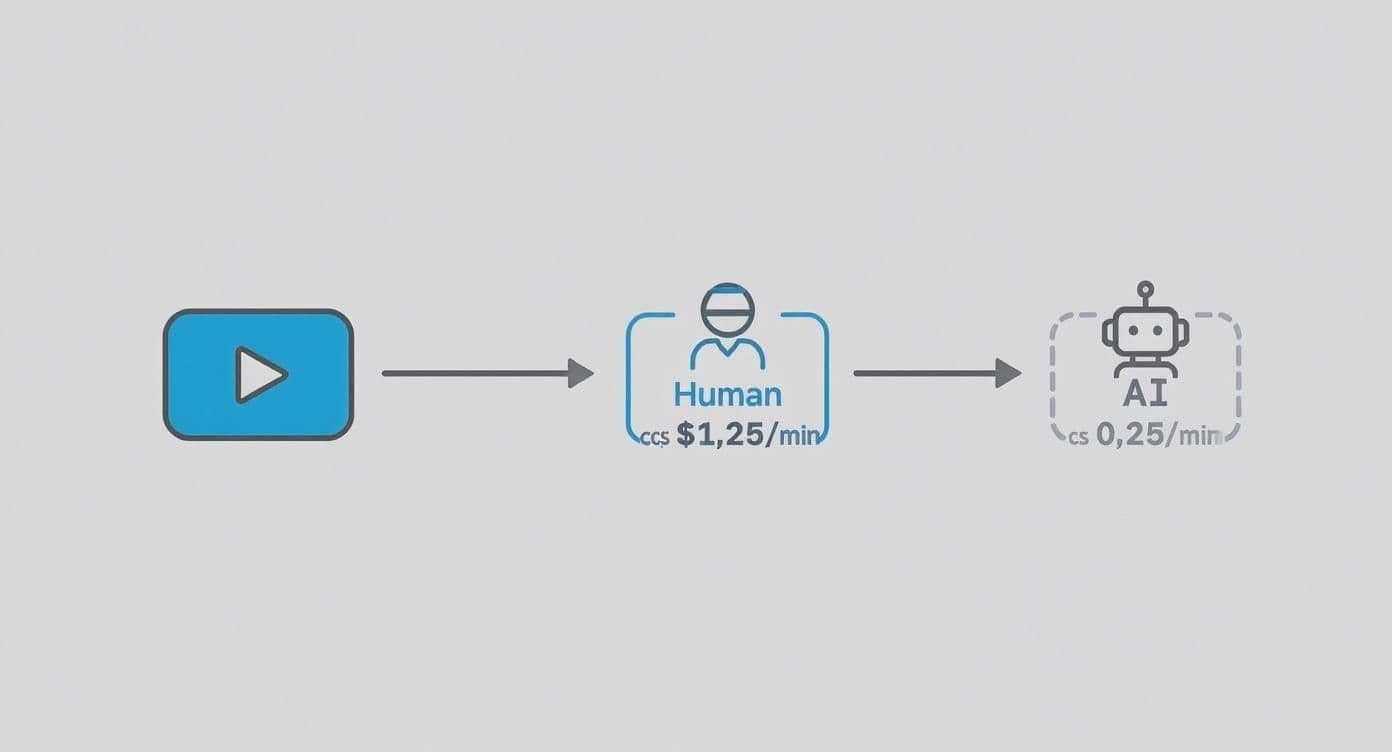
As you can see, AI transcription is often about five times cheaper than a human service. This makes it an incredibly powerful tool for projects on a tight budget.
But that low sticker price can come with a hidden cost: your own time. AI-generated transcripts almost always need a human to look them over—to fix errors, correct speaker labels, and clean up clunky phrasing. It's a crucial factor to weigh in your decision. For a closer look at the numbers, check out our AI vs. human pricing guide for transcription.
Feature and Cost Showdown: Human vs. AI Services
So, how do the two stack up when you look beyond just the price per minute? This table breaks down the key differences to help you see where each service truly shines.
| Factor | Human Transcription | AI Transcription |
|---|---|---|
| Accuracy | 99%+; the gold standard for precision. | 80%-95%; accuracy drops with poor audio. |
| Cost | 1.00 - 3.00 per minute. | $0.25 per minute or less; often subscription-based. |
| Turnaround Time | 24-48 hours is standard; rush jobs cost more. | Minutes; delivers near-instant results. |
| Contextual Understanding | Excellent; captures nuance, sarcasm, and intent. | Limited; struggles with context and non-literal speech. |
| Handling Poor Audio | Can navigate background noise and accents. | Often produces errors with noise, accents, or crosstalk. |
| Speaker Identification | Highly accurate, even with multiple overlapping speakers. | Varies; can mislabel speakers or fail to distinguish them. |
| Best For | Legal, medical, academic, and final-version content. | Internal meetings, research notes, first drafts, and quick reviews. |
| Hidden Costs | Rush fees for faster turnaround. | Time spent editing and correcting the transcript. |
This side-by-side comparison makes it clear: the "better" option isn't about which one is universally superior, but which one is the right fit for your specific job.
Making the Right Choice for Your Needs
So, how do you decide? It all comes down to what you need the transcript for. There's no single right answer, but here are a few scenarios to guide you.
- Choose Human Transcription If:
- You're dealing with legal proceedings, medical dictation, or financial reports where 99%+ accuracy is a must.
- Your recording quality is poor, with lots of background noise, or features multiple speakers with heavy accents.
- The content is highly technical and loaded with industry jargon that an AI is likely to get wrong.
- Choose AI Transcription If:
- You just need a quick, searchable draft of a meeting or interview for your team's internal use.
- Budget is your top priority, and you have someone available to edit the transcript for accuracy.
- The audio is crystal clear, with minimal background noise and speakers who are easy to tell apart.
Ultimately, knowing the strengths and weaknesses of each lets you spend your money wisely. For some projects, the impeccable accuracy of human transcription is a non-negotiable expense. For others, the speed and low cost of AI provide more than enough value, even if it means a little cleanup work on your end.
What Really Drives Up Your Transcription Bill
Ever gotten a quote for a 30-minute recording and wondered why it was so much higher than another file of the exact same length? The answer has very little to do with the runtime and everything to do with what’s in the recording. A few key variables can dramatically inflate the time and effort needed, and that’s what really determines your final bill.
Think of it like hiring a painter. A clean, empty room is a straightforward job. But a room full of furniture to move and walls that need patching? That’s going to cost you more. The same logic applies to the cost of transcribing.
When you understand these cost drivers, you're back in the driver's seat. Knowing what makes a file a headache to transcribe means you can take a few simple steps to clean up your audio and keep your budget in check. Let's dig into the main culprits.
Audio Quality: The Biggest Cost Factor
Hands down, poor audio quality is the number one reason your transcription bill gets bigger. If a human transcriber has to constantly rewind, strain to hear muffled words, or make educated guesses, their work slows to a crawl. For an AI, bad audio is even worse—it just produces a garbled mess that’s nearly useless without heavy editing.
What exactly makes audio "poor quality"? It usually comes down to a few things:
- Background Noise: The clatter of a coffee shop, chatter from the next cubicle, or a whirring fan can make it incredibly difficult to isolate the voices. Filtering all that out takes time and adds to the cost.
- Speaker Distance: When someone is too far from the microphone, their voice sounds faint and hollow. This makes deciphering their words a real chore.
- Bad Equipment: Relying on a basic laptop mic instead of a dedicated one is a classic mistake that results in muffled, unclear sound.
Improving your audio is the lowest-hanging fruit for saving money. A crisp, clean recording is faster and easier for anyone—or any algorithm—to process, which means a lower price for you.
Speaker Complexity and Language Nuances
The conversation itself is a huge piece of the pricing puzzle. A simple one-on-one interview between two clear speakers is about as easy as it gets. But the minute you start adding more people or complexity, the difficulty—and the price—climbs.
Keep an eye on these factors:
- Multiple Speakers: The more people talking, the harder it is to tell them apart. Transcribing a file with five or more speakers almost always costs more because of the extra work needed to accurately label who said what.
- Crosstalk: When people talk over one another, untangling the conversation is a painstaking process. This is a common problem in lively team meetings and panel discussions.
- Heavy Accents: Strong or unfamiliar accents can be tough for both human ears and AI models to parse, often requiring a specialist or extra review time to get right.
Each of these adds another layer of work. For a human, it means more time spent listening and re-listening. For an AI, it sends the error rate through the roof, forcing you to spend more time cleaning up the text later.
The Impact of Technical Jargon
Finally, what you’re actually talking about matters a lot. If your recording is packed with niche terminology, it requires a transcriber with specialized knowledge. That expertise doesn't come free.
For instance, a surgeon dictating operative notes or a lawyer conducting a deposition will use language that a generalist transcriber simply won't know.
- Medical and Legal: These fields often require certified transcribers who are familiar with specific vocabulary, formatting, and compliance standards.
- Engineering and Tech: Conversations about software development are often dense with acronyms and jargon that can easily trip up standard AI tools.
- Academic Research: Scholarly interviews can involve highly specific language that might even require the transcriber to do a little research to ensure accuracy.
You can often bring these costs down by providing a simple glossary of terms or a list of speaker names beforehand. It gives the transcriber a cheat sheet, which reduces guesswork and speeds up their work. In the end, the more specialized the content, the more you can expect the cost of transcribing to reflect that.
Uncovering the Hidden Costs of Transcription

The advertised per-minute rate is often just the tip of the iceberg when figuring out the real cost of transcribing. A lot of services have extra charges and indirect costs that can sneak up on you if you’re not looking for them. To create a realistic budget and avoid sticker shock, you have to know what these are.
It’s a bit like booking a flight. The initial price looks like a great deal, but once you add on fees for your bag, picking a decent seat, and maybe boarding early, the final cost is suddenly much higher. Transcription pricing often works the same way, with extra costs that aren't always obvious upfront.
These hidden expenses can pop up with both human and AI services, just in different forms. With a human transcriber, you might pay extra for a rush job or a perfectly verbatim transcript. With AI tools, the costs are usually more subtle—and often tied directly to your own time.
The Hidden Cost of "Cheap" AI: Your Time
The biggest hidden cost with automated transcription is, without a doubt, the value of your own time. An AI transcript that’s 85% accurate might sound pretty good on paper. But think about it: that means 15 out of every 100 words could be wrong. Cleaning up all those mistakes on a long recording is a real grind.
A low per-minute rate stops being a bargain when you or your team sink hours into editing out gibberish, fixing speaker labels, and correcting misunderstood jargon. That "cheap" transcript becomes expensive fast when you factor in the cost of your labor. This is a huge deal when you’re looking at different tools—some that seem free really aren't when you add in this "time tax." If you want to see how this works with specific platforms, you can learn more about the pricing truths of popular AI meeting tools.
Platform Fees and Subscription Tiers
Beyond just the raw transcription rate, many platforms layer on costs through their subscription models. What you get in a basic plan can be quite limited, often pushing you to upgrade just to get features you actually need.
Keep an eye out for these common add-ons and limitations that can drive up your total spending:
- Team Collaboration: Most entry-level plans are built for a single user. If you want to add team members to share, edit, and comment on transcripts, you’ll almost always need a pricier business or enterprise plan.
- Software Integrations: Need to automatically send your transcripts to Slack, Salesforce, or your project management tool? Those handy connections are frequently locked behind higher-priced tiers.
- Data Storage: Many services put a cap on how much audio or transcript data you can store. If you go over that limit, you might have to pay for more space or get bumped up to the next plan.
- Export Formats: Getting a plain text file might be free, but if you need to export in a specific format like SRT for video captions or a detailed document with timestamps, it could cost extra or require a premium subscription.
These platform-related fees are a huge part of the overall cost of transcribing, especially for teams that need smooth workflows. Always read the fine print on a pricing page to see what's really included in the price they're advertising.
How to Lower Your Transcription Costs
Now that you know what drives the cost of transcription, it's time to take back control of your budget. With a few smart tweaks to how you record and what you send off, you can seriously reduce your final bill without compromising on quality.
Think of it like prepping a room before you paint. A little effort upfront—moving furniture, laying down drop cloths, taping the edges—makes the actual job faster, cleaner, and ultimately, less expensive. The same idea works perfectly here.
Start with Better Audio Quality
The most powerful way to lower your costs, hands down, is to start with clean, clear audio. When a transcriber—whether it’s a person or an AI—can easily hear every word, they work much faster and make far fewer mistakes. That directly translates into savings for you.
Here are a few simple things you can do to immediately improve your audio:
- Use an external microphone. Seriously, even an inexpensive USB mic is a massive upgrade from the one built into your laptop or phone.
- Record in a quiet space. Shut the door, silence your phone notifications, and find a spot away from humming air conditioners or background chatter.
- Get closer to the mic. The farther someone is from the microphone, the more echoey and difficult they become to understand.
These small changes make a huge difference, often eliminating the "difficult audio" fees that many services tack on.
Prepare Your Transcriber for Success
Giving your transcription provider a little bit of context can prevent a lot of headaches and speed up the whole process. A transcriber shouldn't have to guess how to spell your CEO's last name or a technical term unique to your industry.
Just create a simple "cheat sheet" to include with your audio file. It only takes a minute and can include things like:
- A list of speaker names (and how to spell them).
- A short glossary of jargon, acronyms, or product names.
- The name of your company or specific project.
This tiny bit of prep work cuts down on the time they spend on research and corrections, which trims your final bill.