Let's be honest, business communication skills training isn't just about teaching people to write better emails or avoid saying "um" in meetings. It's a focused program designed to fundamentally improve how your team interacts, collaborates, and gets their ideas across. We're talking about core skills here: active listening, crystal-clear writing, and persuasive speaking. Mastering these is what fuels real productivity and builds the kind of professional relationships that last.
Why Effective Communication Training Is Non-Negotiable
Think of great communication as the lifeblood of your organization. When it's flowing smoothly, projects click into place, teams are in sync, and new ideas flourish. But when it gets clogged, the problems start immediately—and they're expensive.
Misunderstandings lead to wasted time and frustrating rework. A poorly handled client conversation can damage revenue. And a persistent lack of clarity? That's a recipe for a frustrated, disengaged team.
This isn't just a "soft skills" problem; it has a direct, measurable impact on your bottom line. Poor communication drains resources, sinks projects, and is a major reason why good people quit. Investing in a solid communication training program is one of the smartest ways to shore up your business and build a more efficient, collaborative, and resilient organization.
The Tangible Business Impact of Clear Communication
The ripple effects of well-structured training go way beyond just having "better meetings." When your people learn to communicate with purpose and precision, the entire company gets stronger.
Just picture these scenarios:
- A Leap in Productivity: A developer clearly explains a technical roadblock to the sales team, preventing them from over-promising to a client. That single conversation saves dozens of hours of coding the wrong thing.
- Happier, Stickier Clients: A customer support specialist uses active listening to truly understand an angry client's issue, turning a potential cancellation into a story of incredible service.
- Tighter, More Cohesive Teams: A manager gives constructive feedback that builds an employee up instead of tearing them down. Trust grows, and the team starts innovating faster because they feel safe to take risks.
Meeting the Demands of the Modern Workplace
With so many teams working remotely or in a hybrid model, the need for sharp communication skills has skyrocketed. Without the benefit of face-to-face cues, the chances of an email, Slack message, or video call being misinterpreted are incredibly high. The right training gives your team the playbook for navigating these digital channels without friction.
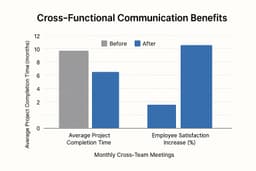
On top of that, modern business is all about collaboration between departments. Silos are where good ideas go to die. That's why the ability to communicate across different teams is so critical. If you're looking to dive deeper, you can learn how to enhance your business with cross-functional communication in our guide.
The market sees this trend loud and clear. The global demand for soft skills training has exploded, reaching USD 33.4 billion and on track to hit USD 92.6 billion by 2033. Why? Because leaders know that a staggering 86% of workplace failures come down to bad collaboration and communication. The data is in: great communication is directly tied to great performance.
Finding Out Where Your Team Is
Before you even think about rolling out a business communication skills training program, you have to do some detective work. Jumping into training without first figuring out the real problems is like a doctor prescribing medicine without a diagnosis—it's just expensive guesswork. The whole point is to get past assumptions and find the specific communication roadblocks that are actually slowing your team down.
This isn't about relying on gut feelings or one-off complaints. Are projects constantly late because of confusing Slack updates? Do meetings drone on forever without any clear decisions because no one is really listening? Nailing down these specific pain points is the only way to build a training plan that actually pays off.
Your Diagnostic Toolkit: How to Get to the Truth
To get a real, honest picture of what's going on, you need to look at the problem from a few different angles. Trusting just one source of information can give you a pretty warped view. Instead, try combining a few simple but effective tools to get a mix of hard numbers and human insights.
An anonymous survey is a great place to start. You can ask specific, targeted questions about the communication challenges people face day-to-day. For example, ask them to rate the clarity of project briefs on a scale of 1 to 5, or to describe a time they felt a message got completely lost in translation.
Then, back that up with some old-fashioned observation. With permission, sit in on a few different team meetings and just watch the dynamics unfold.
- Who does most of the talking?
- Are people constantly cutting each other off?
- Do conversations stay on topic or go off the rails?
- Is there an agenda, and are clear action items set before everyone leaves?
You’ll be surprised by the patterns you spot that would never show up in a survey.
Digging into Your Existing Data
Believe it or not, you probably already have a ton of data that can tell you about your team's communication habits. Your project management tools are a treasure trove. Are tasks constantly being reopened because of misunderstandings? Do the comment threads on tickets show a lot of confusion or people asking the same questions over and over? These are huge red flags.
Take a look at your customer support tickets or client feedback, too. If you see recurring complaints about slow responses or getting different answers from different people, you can often trace that right back to messy internal communication. When you can connect these business results directly to communication breakdowns, it makes a very strong case for focused training.
The effort you put in here is well worth it. Communication is consistently the most sought-after soft skill for employers—in fact, 57% say it's their top priority. Teams that communicate well can see their productivity jump by as much as 25%. On the flip side, 63% of professionals admit they waste time at work simply because of poor communication. You can find more stats on the impact of workplace communication at Pumble.
From Gaps to Actionable Training Topics
Once you've gathered all this info from surveys, observations, and your own data, it's time to connect the dots. This is where you translate all that raw information into a clear, actionable plan. A great way to do this is by mapping your findings to specific communication skills.
This is where a simple breakdown can really help you see the patterns.
Core Business Communication Competencies to Assess
Here's a breakdown of key communication skills to evaluate within your team. Use this to help identify specific areas that require training.
| Competency Area | Key Indicators of Strength | Common Signs of a Gap |
|---|---|---|
| Written Communication | Messages are clear, concise, and professional. Emails and chat messages have a clear purpose. | Vague project updates, frequent typos, long and rambling emails, misunderstandings in Slack. |
| Verbal & Presentation Skills | Team members speak confidently and clearly in meetings. Ideas are presented logically and persuasively. | Mumbling or speaking too quickly, presentations lack a clear structure, low engagement from the audience. |
| Active Listening | People ask clarifying questions, summarize key points, and build on others' ideas. | Team members interrupt each other, conversations go in circles, action items are missed or forgotten. |
| Non-Verbal Communication | Positive body language in meetings (eye contact, open posture). Tone in written messages is appropriate. | Team members seem disengaged, crossed arms, lack of eye contact. Written messages come across as passive-aggressive. |
| Giving & Receiving Feedback | Feedback is specific, constructive, and delivered respectfully. Team members are open to receiving critique. | Feedback is vague ("do better"), overly critical, or avoided altogether. Team gets defensive about suggestions. |
By organizing your findings this way, you can move past the idea of a generic "communication workshop." Instead, you can design highly targeted training modules like "Writing Project Updates That Get Action," "How to Run a 30-Minute Meeting," or "Giving Feedback That Actually Helps." This focused approach ensures your business communication skills training hits the exact weaknesses you uncovered, leading to much faster and more obvious improvements.
Building a Training Program That Actually Works
Let's be honest: generic, off-the-shelf training modules rarely hit the mark. A one-size-fits-all video series on "better communication" isn't going to fix the specific friction points that frustrate your team day in and day out. If you want to create a program that delivers real, lasting change, you need to build a custom experience that speaks directly to their unique challenges.
The first step is to ditch vague goals like "improve communication" and get specific. What does success actually look like? Is it knocking 20% off the average response time for client emails? Or maybe it's seeing a 50% drop in project revisions because the initial briefs are finally clear.
These hard numbers do more than just guide your curriculum—they give you a benchmark. Down the line, you'll be able to prove the training’s value instead of just hoping for the best.
Defining Your Core Learning Objectives
Once you have a clear picture of the problems, it's time to turn those gaps into concrete learning objectives. These are the pillars of your entire program. They're the specific, actionable skills you want your team to have when they walk out the door.
For example, if your analysis shows that meetings are a black hole for time and energy, a weak objective would be "Be better at meetings." That's not helpful. A much stronger objective is: "Participants will be able to create a concise, outcome-driven agenda and facilitate a meeting that ends on time with clear action items."
See the difference? Let's look at a couple more.
- Weak: Improve email writing.
- Strong: Participants will be able to write professional emails under 150 words that state a clear purpose, required action, and deadline.
- Weak: Get better at giving feedback.
- Strong: Managers will be able to use the Situation-Behavior-Impact (SBI) model to deliver constructive feedback that is specific and actionable.
Strong objectives are the blueprint for your training. They dictate the content, the activities, and even the format you'll use. For more on this, it’s worth digging into the details of creating a training programme that actually works to ensure your efforts pay off.
Selecting the Right Training Mix
You wouldn't use a hammer to turn a screw. In the same way, not all skills can be taught the same way. The best business communication skills training programs blend different formats to match the learning goal.
Interactive, in-person workshops are perfect for skills that demand hands-on practice, like navigating tough conversations or public speaking. In these sessions, people can role-play scenarios in a safe environment and get instant feedback from facilitators and peers. It just works.
On the flip side, for straightforward knowledge transfer—like learning new digital etiquette rules or understanding company-wide communication protocols—self-paced e-learning modules are far more efficient. They let people learn on their own time and are easy to scale across the whole organization.
Here’s a look at how this process flows, from surveying your team to pinpointing the exact communication gaps and mapping them to specific training needs.
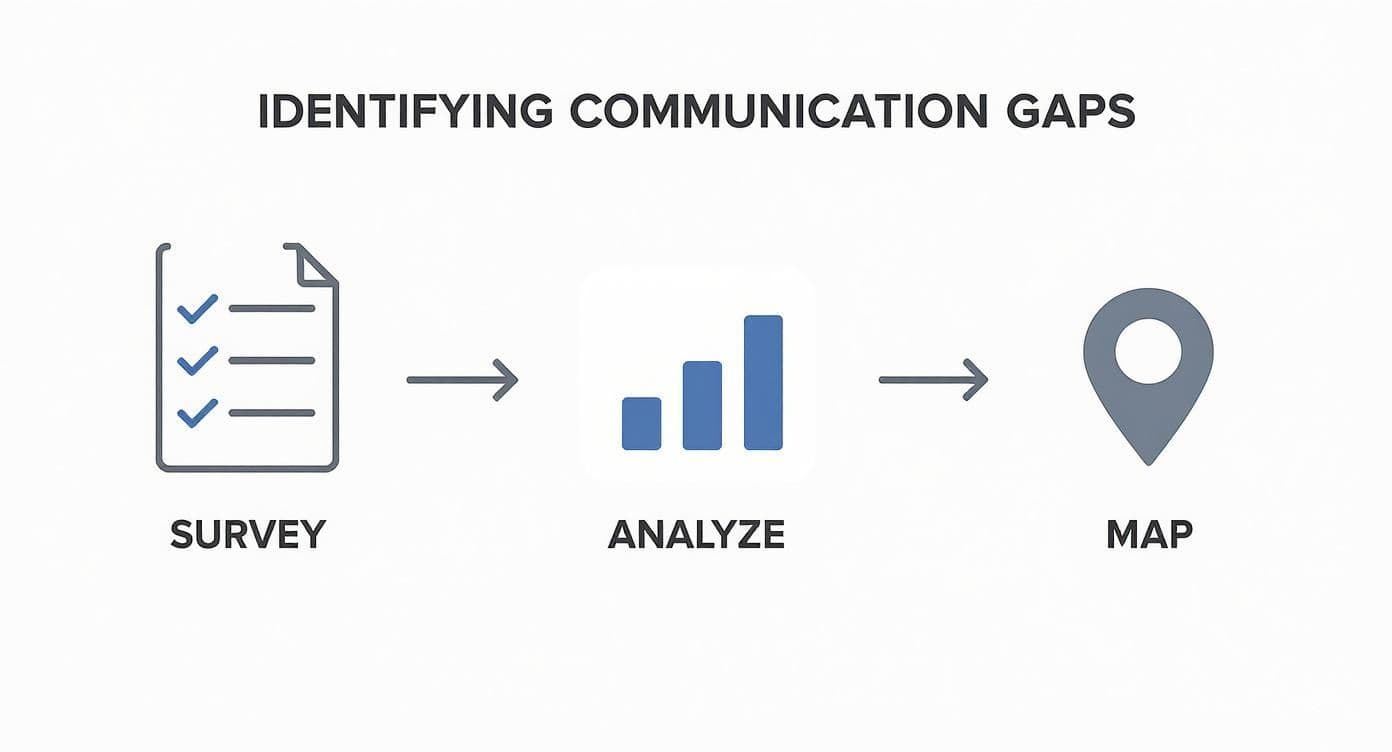
This kind of structured approach guarantees that the training you design is directly tied to the real-world problems your team is facing.
Crafting a Curriculum Around Real Scenarios
The secret to making training stick is simple: relevance. Your curriculum has to be built around the real-world challenges your employees face every single day. Abstract theories are forgotten the moment they leave the room, but a practical technique for de-escalating a tense client call? That gets used immediately.
Talk to department managers. Ask them for actual examples of communication breakdowns. Of course, you’ll want to anonymize them, but use these real situations as the foundation for your role-playing exercises, case studies, and group discussions.
Imagine a training session built around these scenarios:
- For Sales: Role-play a response to a tough prospect objection, using a real email exchange that went sideways as the script.
- For Engineering: Analyze a project brief that caused mass confusion and rewrite it as a group until it’s crystal clear.
- For Customer Support: Practice active listening techniques using the transcript from a notoriously difficult customer call.
When people see their own daily struggles reflected in the training, they buy in. The skills stop being abstract concepts and become practical tools they can use the second they’re back at their desks. This is what separates training that’s simply attended from training that’s actually absorbed, applied, and ultimately changes how your business communicates.
What to Teach: The Core Skills for a Modern Communication Curriculum
Putting together a great business communication skills training program isn't just about polishing presentation skills anymore. The modern workplace is far more complex. To be truly effective, your training needs to give people the tools to connect, influence, and collaborate—whether they're in the same room or on different continents.
Let's move past the theory. A curriculum that sticks is one that tackles the real-world communication hurdles your team faces every single day. The goal is to build practical skills that lead to immediate wins in teamwork, clarity, and overall productivity.
Mastering Feedback and Active Listening
One of the most powerful, yet often overlooked, skills is the ability to handle feedback. This is a two-way street. Training shouldn't just focus on how to give constructive criticism, but also on how to receive it without getting defensive. When you get this right, you create a culture where feedback is seen as a tool for growth, not a personal attack.
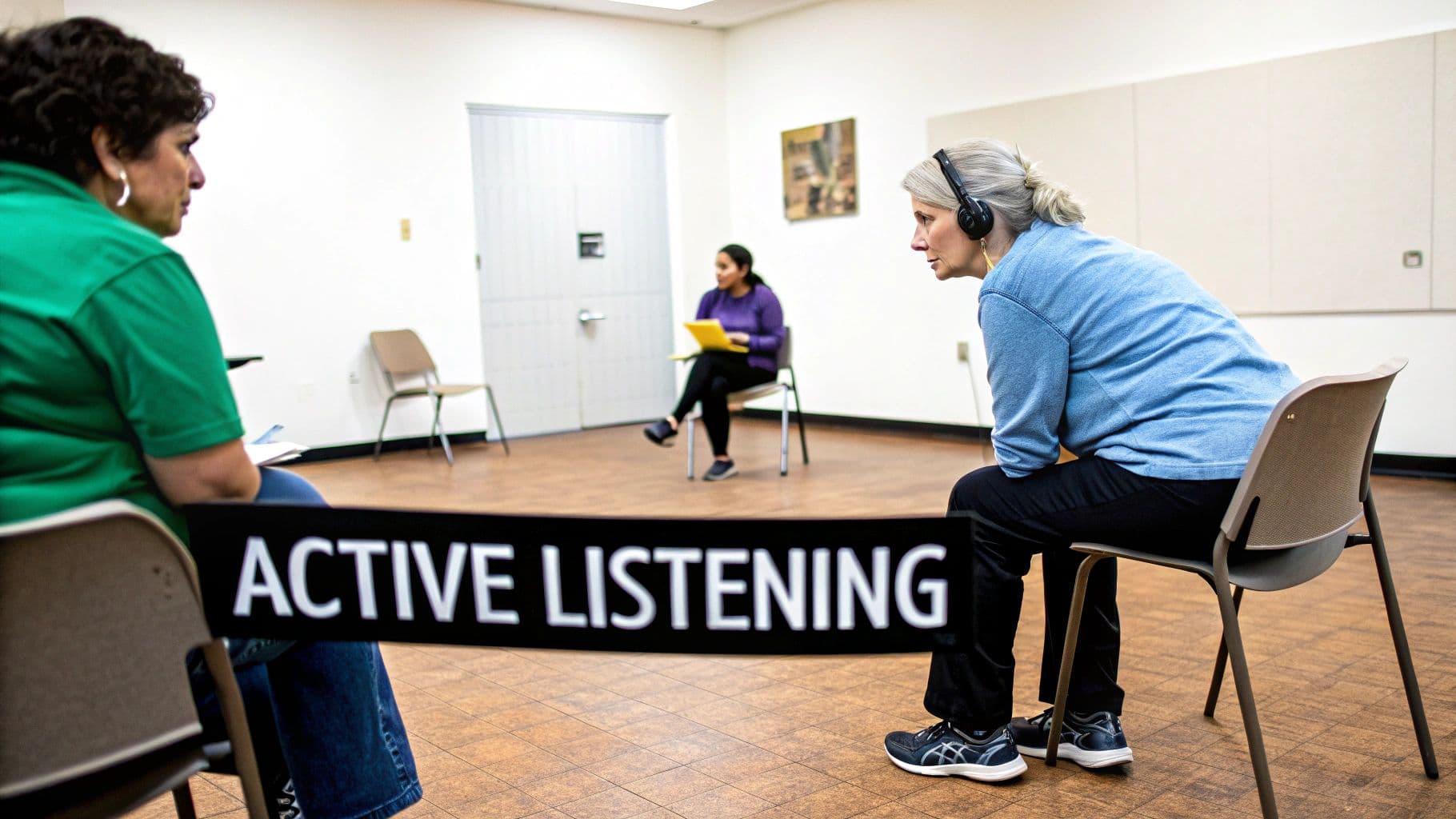
Hand-in-hand with feedback is the art of active listening. Hearing isn't listening. True active listening means you're absorbing the speaker's intent, picking up on non-verbal cues, and making them feel genuinely understood. Teams that master this skill have better meetings, fewer misunderstandings, and stronger professional relationships.
If you're looking for more ways to strengthen team dynamics, these essential tips to improve team communication skills offer a fantastic roadmap for your training agenda.
Excelling in the Virtual Arena
With remote and hybrid work here to stay, mastering the virtual meeting is non-negotiable. It’s a completely different ballgame than in-person communication. Your curriculum has to give people clear, practical guidance on how to actually engage an audience through a screen.
You’ll want to cover topics like:
- Camera and Mic Discipline: Simple things like knowing when to mute, how to set up good lighting, and keeping background noise to a minimum make a huge difference.
- Digital Body Language: How to use gestures, maintain "eye contact" with the camera, and show you're paying attention with facial expressions.
- Running Online Discussions: Techniques for making sure everyone contributes and using tools like polls or virtual whiteboards to keep the energy up.
Nailing this helps prevent the all-too-common "Zoom fatigue" and turns virtual meetings from a necessary evil into a genuinely productive part of the workday.
Navigating Cross-Cultural Communication
As businesses go global, communicating across different cultures becomes mission-critical. What’s considered direct and efficient in one culture might come across as blunt and rude in another. These subtle differences can easily cause friction if your team isn't prepared.
Your business communication skills training absolutely needs a module on this. According to research on workplace communication statistics from Simon and Simon, misunderstandings from cultural or language differences are a major cause of lost productivity and innovation in global teams. A solid program teaches people how to spot these differences and adapt their own style. This focus on cultural intelligence doesn't just prevent problems—it builds more inclusive, effective, and harmonious teams.
How to Measure the True Impact of Your Training
Getting your training program off the ground is a fantastic achievement, but it's really just the beginning. The next, and arguably most important, step is to prove it actually worked. Without hard data showing real results, you're just spending budget and hoping for the best, which is a tough sell for future investment.

To make a real case for your business communication skills training, you have to look beyond whether people simply enjoyed the sessions. What leadership really wants to see is how improved communication moves the needle on business goals. That means digging into the key performance indicators (KPIs) that connect training to tangible outcomes.
This is how you calculate a real return on investment (ROI). It’s what turns a "nice-to-have" training initiative into an essential part of the business strategy.
Moving Beyond Smile Sheets to Real Metrics
We've all used them. The "smile sheets" or post-training surveys are the easiest feedback to get. They’re great for a quick pulse check on engagement, but they don't tell you if anyone is actually doing anything differently back at their desks.
To get the real story, you need to measure behavior change. And that starts with knowing where you began.
Before you even kick off the training, you have to establish a baseline. This is non-negotiable. Without a "before" snapshot, you have absolutely no way to measure the "after." For instance, if you're trying to make meetings more efficient, you must know the average meeting length before anyone learns new facilitation skills.