Meetings have become a necessary evil: marathons of distraction, tangents, and unresolved issues that drain energy and stall progress. The problem isn't the meeting itself, but the lack of a shared playbook. Without clear expectations, even well-intentioned teams descend into unproductive chaos. Establishing ground rules for a meeting isn't about rigid bureaucracy; it's about creating a framework for respect, focus, and psychological safety that allows everyone to contribute their best work.
This guide provides eight non-negotiable rules, complete with practical templates and enforcement strategies for in-person, hybrid, and fully remote teams. By implementing these principles, you can transform your meetings from time sinks into powerful engines of decision-making and alignment, ensuring every minute spent together moves your goals forward.
These rules create a foundation for effective collaboration. To further understand how to elevate the quality of your discussions and prevent common pitfalls, delve into these 10 Meeting Management Best Practices. Following this guide will equip you with a straightforward system to define clear expectations, improve focus, and hold everyone accountable for contributing to a successful outcome. We will cover the essentials, from timely starts to assigning clear ownership of action items.
1. Start and End on Time
This foundational ground rule establishes a non-negotiable pact: meetings will begin and conclude at their scheduled times. Punctuality is more than a courtesy; it's a core component of effective time management and a clear sign of mutual respect for everyone's packed schedules. When a meeting starts late, it creates a domino effect, delaying subsequent tasks and meetings for every attendee. Committing to a strict start and end time is one of the most impactful ground rules for a meeting you can implement.

This practice demonstrates discipline and ensures that the designated time is used productively. Companies like Google and Amazon have built cultures where strict adherence to schedules is standard practice. Similarly, agile methodologies like Scrum rely on precisely timed ceremonies (e.g., the 15-minute daily stand-up) to maintain momentum.
How to Implement This Rule
- Assign a Timekeeper: Designate a participant (on a rotating basis) to monitor the clock. Their role is to provide gentle reminders when time is running short on an agenda item or when the meeting is nearing its end.
- Use Visual Timers: For remote or hybrid meetings, share a countdown timer on screen. This visual cue keeps everyone aware of the remaining time without constant verbal interruptions.
- Start Without Latecomers: Begin the meeting at the scheduled time, even if key people haven't arrived. This sets a firm precedent that punctuality is expected and valued. A brief recap can be provided later if necessary.
- Schedule Shorter Meetings: Default to 25- or 50-minute meetings instead of 30 or 60. This builds in a natural buffer for attendees to transition between calls without being late for their next commitment.
2. Participate Actively and Respectfully
This ground rule establishes a dual mandate for all attendees: to contribute their unique perspectives while ensuring all interactions remain civil and constructive. Active participation prevents groupthink and ensures decisions are well-rounded, while respectful dialogue creates the psychological safety needed for honest conversation. This balance is crucial; without it, meetings can be dominated by a few voices or devolve into unproductive conflict, making it one of the most vital ground rules for a meeting.
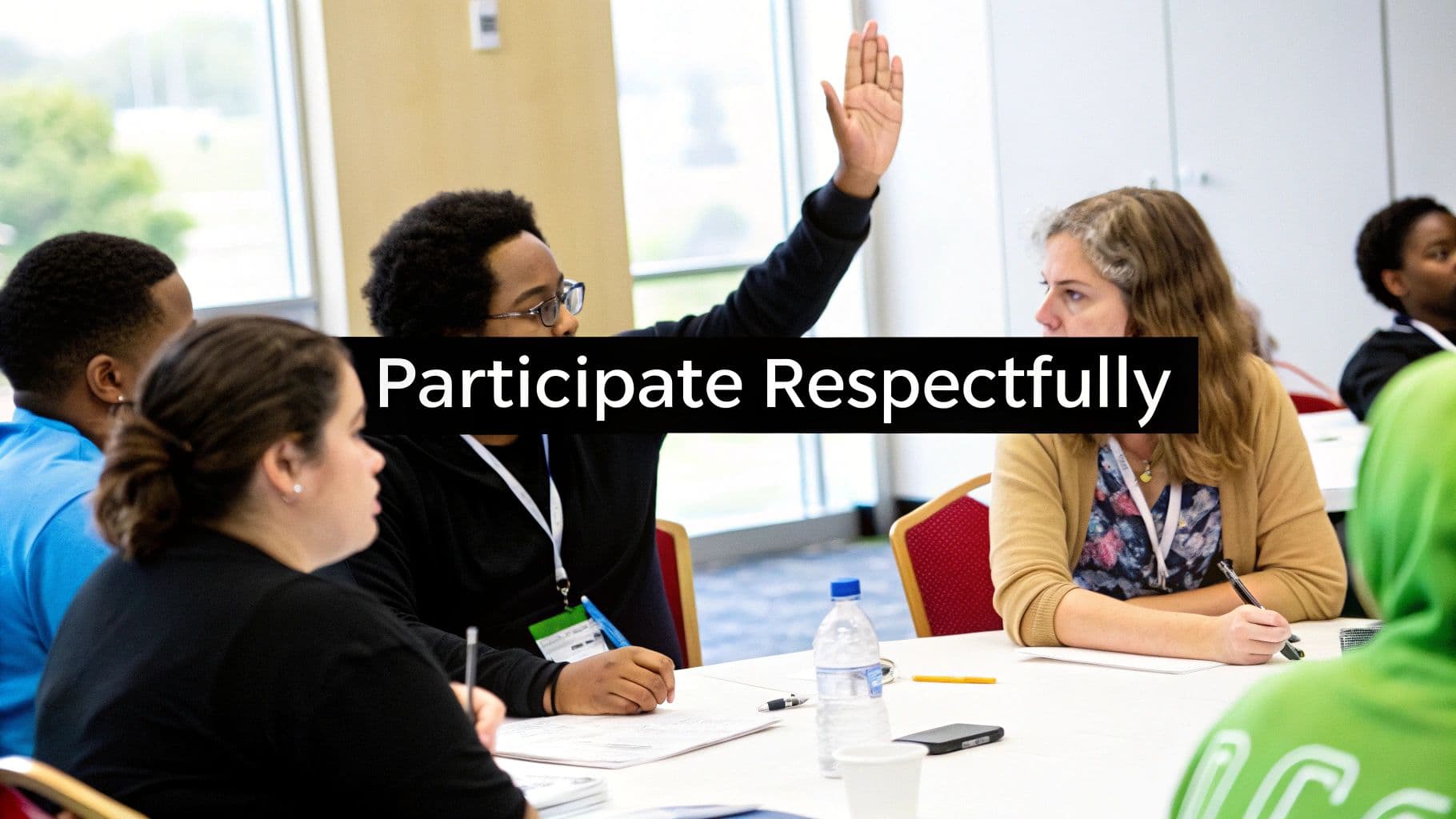
This principle is the cornerstone of innovative cultures. Pixar’s famous "Braintrust" meetings thrive on candid, respectful feedback, allowing creatives to challenge ideas without personal attacks. Similarly, Google’s "Project Aristotle" identified psychological safety, where team members feel safe to take risks and be vulnerable, as the single most important dynamic in effective teams. This rule directly fosters that environment.
How to Implement This Rule
- Use a Round-Robin Method: Go around the room (or virtual room) and give each person an uninterrupted minute to share their thoughts on a specific topic. This ensures even the quietest voices are heard.
- Establish a "No Interruptions" Policy: Make it clear that each person should be allowed to finish their thought completely. The meeting facilitator should gently enforce this by saying, "Let's let Sarah finish her point first."
- Encourage Building on Ideas: Promote the use of "yes, and..." language to build upon colleagues' suggestions rather than immediately shutting them down. This collaborative approach fosters a more positive and creative atmosphere.
- Practice Active Listening: Ask clarifying questions before disagreeing. Phrases like, "What I hear you saying is... is that correct?" show respect and prevent misunderstandings, ensuring a more productive discussion.
3. One Conversation at a Time (No Side Discussions)
This rule establishes that all participants must focus on a single, unified conversation. It explicitly prohibits side discussions, private chats, or multitasking that splits the group's attention and undermines collective focus. When multiple conversations happen simultaneously, key information is missed, decisions are fragmented, and the meeting's core purpose is diluted. Enforcing a one-conversation-at-a-time policy is one of the most critical ground rules for a meeting to ensure everyone is engaged and aligned.
This principle ensures every voice can be heard without competition, fostering a more inclusive and respectful environment. Disciplined practices like medical rounds in hospitals or Toastmasters club meetings rely on this single-thread focus to guarantee clarity and equal participation. Similarly, Six Sigma's DMAIC methodology requires strict facilitation to prevent tangential discussions from derailing problem-solving sessions.
How to Implement This Rule
- Appoint a Strong Facilitator: The meeting leader or a designated facilitator is responsible for gently steering the conversation back on track. They can use phrases like, "That's a great point, let's hold that for a moment and return to [current topic]."
- Use a 'Parking Lot': Create a visual space (a whiteboard or a shared digital document) to "park" important but off-topic ideas. This acknowledges the idea's value without derailing the current discussion and ensures it will be addressed later.
- Manage Turn-Taking Visually: In virtual meetings, encourage the use of the "raise hand" feature in platforms like Zoom or Microsoft Teams. For in-person meetings, a simple talking stick or token can visually signify whose turn it is to speak.
- Establish a 'Laptops Down' Policy: For in-person meetings, ask attendees to close laptops unless they are presenting. For remote meetings, request that cameras stay on and private chat be used only for logistical issues, not side conversations.
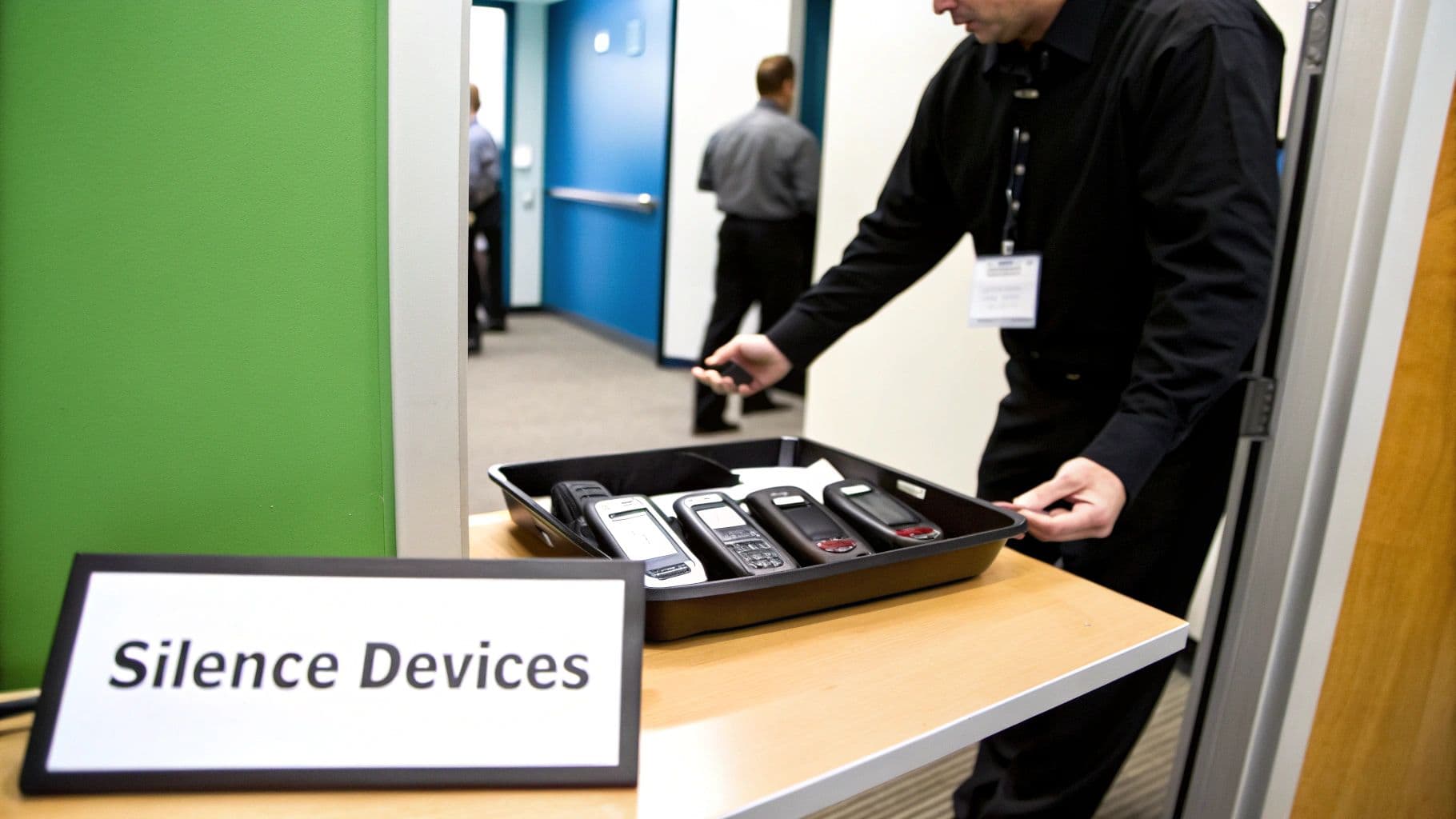
4. Silence Devices or Use 'Do Not Disturb' Mode
This essential ground rule requires all participants to silence their phones, close unnecessary applications, and turn off notifications. It directly tackles the pervasive issue of digital distractions, which are proven to fragment attention, reduce information retention, and compromise the quality of decision-making. By creating a focused, single-tasking environment, this rule ensures that every attendee's cognitive resources are dedicated to the meeting's objectives, not to incoming emails or social media alerts.
This practice is standard in high-stakes environments where full attention is non-negotiable. For instance, Apple’s executive meetings under Steve Jobs were famously device-free zones to foster deep engagement. Similarly, many creative agencies and law firms enforce strict no-device policies during client brainstorming sessions and strategy meetings to protect the integrity of the conversation and ensure undivided focus.
How to Implement This Rule
- Set Expectations Upfront: Include a clear note in the calendar invitation (e.g., "This will be a device-free meeting to ensure focus. Please silence all notifications.").
- Lead by Example: As the meeting leader, visibly silence your own phone and put it away at the start. This simple action models the expected behavior for everyone else.
- Create a "Phone Basket": For in-person meetings, place a tray or basket near the entrance where attendees can deposit their phones. This physical separation is highly effective.
- Schedule Tech Breaks: For meetings longer than 60 minutes, schedule a 5-minute break for participants to check urgent messages. This acknowledges real-world demands without derailing the meeting flow.
- Establish On-Call Exceptions: Clearly define exceptions for team members who are on-call or need to monitor critical systems, asking them to step out if they need to respond. If persistent phone use is a challenge for some team members, providing resources with practical phone addiction help can be a supportive measure to improve focus.
5. Stay on Topic and Respect the Agenda
This essential rule ensures that valuable meeting time is dedicated to its intended purpose. By committing to the agenda, teams prevent discussions from veering into tangents, personal anecdotes, or unrelated business, a common pitfall that derails productivity. Respecting the agenda is about honoring the collective time invested by participants and driving the meeting toward its specific, predetermined goals. Adhering to this principle is one of the most effective ground rules for a meeting to guarantee efficiency.
This disciplined approach is central to highly structured methodologies. Agile and Scrum meetings, for instance, rely on strict time-boxing for each topic to maintain momentum. Similarly, formal proceedings like board meetings often use Robert's Rules of Order to ensure every item is addressed in a structured manner without deviation, demonstrating a commitment to focused, outcome-driven conversation.
How to Implement This Rule
- Circulate the Agenda in Advance: Send out a detailed agenda with clear objectives and time allocations for each item at least 24 hours beforehand. This allows attendees to prepare their thoughts and contributions. For a deeper dive, explore this guide on how to write a meeting agenda that actually works on summarizemeeting.com.
- Use a "Parking Lot": Designate a space on a whiteboard or a shared digital document as the "parking lot." When an interesting but off-topic idea arises, capture it here. This acknowledges the idea's value without derailing the current discussion.
- Assign a Facilitator or "Drift-Catcher": This person's role is to gently guide the conversation back to the agenda item if it starts to stray. A simple phrase like, "That's an excellent point. Let's add it to the parking lot and stick to our current topic for now," is highly effective.
- Use Transition Statements: The meeting leader should signal the end of one topic and the beginning of another. For example, "We've spent our allocated 10 minutes on the budget review. Now, let's move on to the next item: Q4 projections."
6. Practice Active Listening and Avoid Interrupting
This ground rule establishes a culture of respect where participants listen fully before speaking. It requires attendees to avoid interrupting, talking over one another, or formulating a response while someone else is still talking. This commitment is crucial for fostering psychological safety, ensuring all voices are heard, and improving the overall quality of discussion and decision-making. Adopting this as one of your core ground rules for a meeting can fundamentally change the dynamic from adversarial to collaborative.
Renowned methodologies like Stephen Covey's "Seek First to Understand, Then to Be Understood" and the techniques in Crucial Conversations are built on this very principle. They recognize that true understanding precedes effective problem-solving. By prioritizing listening, teams can uncover deeper insights and build stronger consensus, preventing misunderstandings that often derail productivity.
How to Implement This Rule
- Introduce a Pause: Encourage a brief, three-second pause after someone finishes speaking before the next person jumps in. This small buffer prevents accidental interruptions and gives participants time to process what was said.
- Practice Reflective Listening: Ask participants to occasionally paraphrase what they heard before adding their own point. For example, "What I hear you saying is... Is that correct?" This confirms understanding and shows genuine engagement.
- Use Non-Verbal Cues: In-person, nodding and making eye contact signal engagement. Remotely, using the "raise hand" feature or sending a quick chat message to be added to a speaking queue can manage the flow of conversation without interruptions.
- Take Notes: Encourage attendees to jot down their thoughts while others are speaking instead of interrupting. This helps them remember their point without derailing the current speaker's train of thought. You can learn more about how to improve active listening with focused techniques.
7. Assume Positive Intent
This essential ground rule fosters an environment of psychological safety by asking participants to presume that everyone is contributing in good faith. It means interpreting questions, feedback, and even criticism through a lens of constructive collaboration, not personal attack. This mindset prevents defensive reactions, reduces interpersonal friction, and shifts the focus from winning an argument to collectively solving a problem. Adopting this as one of your core ground rules for a meeting transforms potential conflicts into opportunities for deeper understanding.
This principle is a cornerstone of high-performing teams. Google's Project Aristotle research found that psychological safety, which is directly supported by assuming positive intent, was the most critical factor in a team's success. Similarly, the concept of "charitable interpretation" is central to frameworks like Kim Scott's Radical Candor, where you must believe the other person has good intentions to give and receive effective feedback.
How to Implement This Rule
- Model the Behavior: Leaders and facilitators must consistently demonstrate this behavior. When faced with a challenging comment, respond with curiosity instead of defensiveness, for example, by saying, “That's an interesting point, can you help me understand your perspective on that?”
- Use Framing Language: Actively use phrases that reinforce this rule. Start responses with, “Assuming we're all trying to get to the best outcome here...” or “My understanding is that you're concerned about X, is that right?” This frames the conversation collaboratively.
- Create Response Prompts: Coach the team on specific phrases to use when they feel a negative reaction brewing. Simple prompts like, “Help me understand what you mean by that,” or, “What’s the underlying goal you’re trying to achieve with that idea?” can de-escalate tension.
- Address Violations Privately: If a team member consistently fails to assume positive intent, address the behavior in a private one-on-one conversation. This protects the individual while reinforcing the importance of the rule for the group.
8. Decide on Action Items and Assign Ownership
This rule transforms discussion into action by ensuring every meeting concludes with tangible outcomes. It mandates that before anyone leaves, the group must clearly identify all decisions made, define specific next steps (action items), assign a responsible owner to each, and set a firm deadline. This practice is one of the most critical ground rules for a meeting, as it prevents the common pitfall of conversations that lead nowhere, creating a culture of accountability and forward momentum.

Without this structured conclusion, ambiguity thrives, and valuable insights are lost. Project management methodologies like RACI and agile sprint retrospectives are built around this principle of assigning clear ownership to drive progress. Similarly, executive teams at Fortune 500 companies often use standardized decision logs to ensure every strategic choice is documented with a corresponding action plan, owner, and timeline, leaving no room for misinterpretation.
How to Implement This Rule
- Use an Action Item Template: Dedicate the last 5-10 minutes of the meeting to review a simple template with four columns: Action, Owner, Deadline, and Status. For a deeper dive, you can learn more about creating a powerful meeting action items template.
- Assign Ownership in Real-Time: Do not defer assignments. The meeting facilitator should ask, "Who will own this?" and get a verbal commitment during the session. Follow up by asking, "Can you commit to completing this by [date]?"
- Review and Distribute: The meeting notes, featuring the finalized action items, should be sent to all attendees within 24 hours. The start of the next meeting should begin with a quick review of the status of these items.
- Track in a Central System: For ongoing projects, log all action items in a shared task management tool like Asana, Monday.com, or Jira. This creates a persistent, transparent record of all commitments and their progress.
8-Point Meeting Ground Rules Comparison
| Rule | Complexity 🔄 | Resources & Setup ⚡ | Expected Outcomes ⭐ / 📊 | Ideal Use Cases | Key Advantages 💡 |
|---|---|---|---|---|---|
| Start and End on Time | Low–Medium 🔄 (policy + timekeeper) | Minimal ⚡ (calendars, timers, buffers) | ⭐⭐⭐⭐ / 📊 Fewer delays; improved schedule adherence | Back-to-back schedules, daily standups | Respects time; reduces cascade delays |
| Participate Actively and Respectfully | Medium–High 🔄 (facilitation, norms) | Moderate ⚡ (facilitator, training) | ⭐⭐⭐⭐ / 📊 More creative solutions; better decisions | Brainstorms, strategic discussions | Inclusive input; stronger psychological safety |
| One Conversation at a Time (No Side Discussions) | Medium 🔄 (facilitator enforcement) | Low–Moderate ⚡ (token systems, visual cues) | ⭐⭐⭐ / 📊 Clearer focus; fewer repetitions | Large meetings, safety-critical briefings | Improves comprehension; reduces fragmentation |
| Silence Devices / Use Do Not Disturb | Low–Medium 🔄 (policy + modeling) | Low ⚡ (signage, trays, reminders) | ⭐⭐⭐⭐ / 📊 Higher attention; shorter meetings | Focus sessions, confidential meetings | Reduces interruptions; boosts retention |
| Stay on Topic and Respect the Agenda | Medium 🔄 (prep + timeboxing) | Moderate ⚡ (pre-distributed agendas, timekeepers) | ⭐⭐⭐⭐⭐ / 📊 More efficient, outcome-driven meetings | Project updates, board meetings | Ensures objectives are met; measurable outcomes |
| Practice Active Listening & Avoid Interrupting | Medium–High 🔄 (training + practice) | Moderate ⚡ (coaching, facilitation) | ⭐⭐⭐⭐ / 📊 Better decisions; fewer conflicts | Feedback, mediation, coaching sessions | Enhances understanding and trust |
| Assume Positive Intent | Medium–High 🔄 (culture change) | Low–Moderate ⚡ (modeling, coaching) | ⭐⭐⭐⭐ / 📊 Reduced defensiveness; improved collaboration | Cross-functional teams, feedback loops | Encourages candid, constructive dialogue |
| Decide on Action Items & Assign Ownership | Medium 🔄 (documentation + follow-up) | Moderate ⚡ (templates, tracking tools) | ⭐⭐⭐⭐⭐ / 📊 Higher execution; clear accountability | Retrospectives, project meetings | Prevents meeting amnesia; ensures follow-through |
Making the Rules Stick: Implementation, Enforcement, and Automation
Establishing a clear set of ground rules for a meeting is a foundational step, but it's the consistent application of these principles that transforms frustrating, time-wasting gatherings into productive, collaborative sessions. The eight rules we've explored, from starting on time to assigning clear action items, are not just a checklist; they are the building blocks of a new meeting culture. This culture is one built on mutual respect, focused attention, and a shared commitment to achieving a specific outcome. Moving from theory to practice is where the real work begins, and it requires a deliberate, collective effort.
The true value of these rules is unlocked when they become an invisible, guiding force rather than a rigid set of restrictions. Success hinges on a few critical factors: shared ownership, gentle but firm enforcement, and the smart use of technology to automate administrative burdens. When every participant, from the newest team member to the senior executive, understands and upholds these standards, you create an environment where psychological safety thrives and great ideas can emerge.
Your Action Plan for Better Meetings
Ready to implement these changes? Here’s how to get started today and ensure your new rules become ingrained habits:
- Conduct a "Meeting on Meetings": Don't just email the new rules. Schedule a dedicated session to discuss them with your team. Get their feedback, make adjustments, and secure collective buy-in. This makes the rules ours, not just yours.
- Assign a Rotating Facilitator: Designate a facilitator for each meeting (it doesn’t have to be the leader). This person's role is to gently guide the conversation back to the agenda, remind participants of the rules if needed, and ensure everyone has a chance to speak. Rotating the role gives everyone a stake in the process.
- Perform Regular Check-ins: At the end of your meetings, take just 60 seconds to ask, "How did we do with our ground rules today?" This simple act of reflection reinforces their importance and allows for continuous improvement.
- Lead by Example: As a leader or participant, you must model the behavior you want to see. Arrive on time, silence your notifications, listen actively, and hold yourself accountable. Your actions will always speak louder than any written rule.
By embracing these ground rules for a meeting, you are not just optimizing a process; you are investing in your team’s most valuable assets: their time, their focus, and their collaborative energy. You are choosing to replace chaos with clarity and inefficiency with impact, creating a workplace where every voice is heard and every meeting moves the mission forward.
Ready to supercharge your meeting efficiency and ensure no action item gets lost? Summarize Meeting uses AI to automatically transcribe, summarize, and identify key decisions from your calls, perfectly complementing your new ground rules. Visit Summarize Meeting to see how you can automate follow-ups and focus on the conversation, not the note-taking.