When you hear the term synchronous communication, think “in sync.” It’s any conversation that happens in real-time, where everyone involved is present and participating at the exact same moment.
It’s the back-and-forth of a live conversation, where you get an immediate response. Whether you're hashing out an idea over a video call or grabbing a colleague for a quick chat at their desk, you're communicating synchronously.
Understanding Real-Time Communication
So, what is synchronous communication at its heart? It’s simply a live, two-way dialogue.
Think of it like watching a live concert. You and thousands of other fans are all experiencing the same guitar solo at the same time. That shared, simultaneous experience is the essence of synchronous communication. Watching a recording of that concert later on YouTube? That’s asynchronous—you're getting the information on your own time, not as it happens.
This real-time dynamic is a game-changer for certain kinds of work. It’s the spontaneous energy of a brainstorming session where one idea instantly sparks three more. It’s the quick phone call that untangles a complicated problem in five minutes, saving an hour of back-and-forth emails. The magic ingredient is immediacy. There’s no delay between the message sent and the response received.
Core Principles of Synchronous Interaction
To really get it, let's break synchronous communication down into three core principles. These are the foundational elements you'll find in every synchronous exchange, from a casual coffee chat to a formal, all-hands meeting.
Knowing these principles helps you decide when it's the right tool for the job.
- Immediacy: The conversation flows without any real lag. This is critical for making urgent decisions or solving problems where waiting for an answer would grind everything to a halt.
- Presence: Everyone has to be there, tuned in at the same time. This shared focus—whether you’re in the same room or on the same Zoom call—creates a sense of connection that’s tough to replicate any other way.
- Interactivity: The format is built for a dynamic, fluid exchange. People can jump in, ask for clarification, build on each other's ideas, and react to non-verbal cues like tone of voice and body language. This adds a ton of context that text-based communication often misses.
Synchronous Communication At a Glance
To tie it all together, here’s a quick summary table. Think of this as a cheat sheet for managers and team leads trying to figure out where synchronous communication fits into their workflow.
| Attribute | Description | Example |
|---|---|---|
| Timing | Information is exchanged instantly, in real time. | A live video conference call. |
| Expectation | Participants expect an immediate response. | A colleague asking a question via instant message. |
| Best For | Urgent issues, complex problem-solving, and team building. | An emergency meeting to address a client crisis. |
Ultimately, synchronous communication is all about carving out a shared moment for focused interaction. It’s about closing the distance, whether your team is across the hall or across the globe.
While it isn't always the most efficient choice for every task, its true power lies in aligning teams, solving tough problems, and building genuine relationships through live conversation.
Synchronous vs Asynchronous Communication: Key Differences
To really get a handle on smart team collaboration, you have to understand the core differences between synchronous and asynchronous communication. They both get information from point A to point B, but they work on completely different timelines and create wildly different workflows.
Think of it like this: synchronous is a live concert. Everyone has to be in the same place at the same time to experience it together. Asynchronous is like listening to that concert's album later—you can press play whenever it suits you.
Synchronous communication is all about the "right now." It requires everyone to be present and tuned in at the exact same moment. On the flip side, asynchronous communication has a built-in delay. You send a message knowing the other person will see it and get back to you on their own schedule.
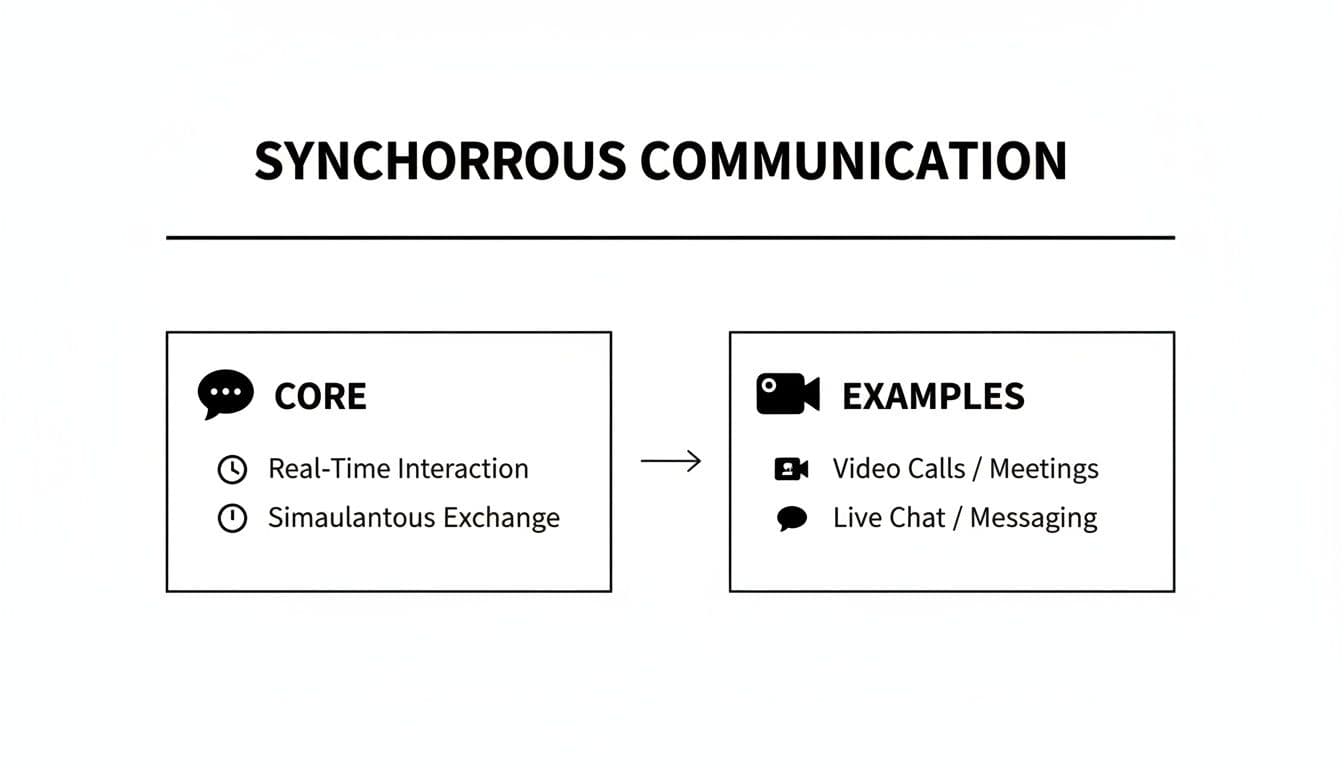
This diagram gets to the heart of it: synchronous is all about that immediate, real-time exchange, with video calls and live chats being the classic examples.
The Expectation of a Response
The biggest dividing line between these two styles is the expectation of an immediate response.
Synchronous methods create a social contract that you'll reply instantly. When you jump on a video call or a colleague taps you on the shoulder, the unspoken rule is to engage now. This is fantastic for emergencies. If a server crashes, a quick sync-up with the dev team is the fastest way to get things back online.
Asynchronous communication, however, lifts that pressure completely. Sending an email or dropping a comment in Asana signals that it's okay for the recipient to reply when they have a natural break. This approach respects everyone's focus time and is perfect for things that aren't on fire, like asking for feedback on a document.
Impact on Workflow and Deep Work
The way we communicate has a direct and powerful impact on our ability to focus. Synchronous communication is, by its very nature, an interruption. Every ping from Slack or unscheduled video call yanks people out of what they were doing, shattering their concentration.
Asynchronous methods are the guardians of deep work. By letting team members check and respond to messages on their own terms, they can block out hours for uninterrupted focus. This is a game-changer for roles that depend on concentration, like developers, writers, and designers. You can explore more about workflows that support this through async meeting tools.
Suitability for Decision Making
The right communication style often depends on the type of decision you need to make. Synchronous is king when decisions are messy, complex, and need a rapid-fire exchange of ideas.
Picture a brainstorming session for a new product feature. A live video call lets ideas bounce off each other, with the group's energy building momentum. You can read the room and riff off non-verbal cues in a way that a sterile email chain just can't replicate.
But for decisions that need careful thought, asynchronous wins every time. When you're finalizing a legal contract or a technical spec, giving people the space to review every detail and write a thoughtful response leads to a much stronger outcome. No one feels pressured to give a half-baked opinion on the spot.
Synchronous vs Asynchronous: A Detailed Comparison
To make it even clearer, let's break down the core differences in a simple table. This really highlights how each approach serves a different purpose within a team's workflow.
| Factor | Synchronous Communication | Asynchronous Communication |
|---|---|---|
| Pace | Fast and immediate, happening in real-time. | Slower and deliberate, with built-in delays. |
| Response Expectation | Immediate reply is expected. | Response is expected when the recipient is available. |
| Best For | Urgent crises, complex brainstorming, building rapport. | Detailed feedback, routine updates, cross-time zone work. |
| Workflow Impact | Can be highly disruptive and interrupt deep work. | Protects focus and allows for thoughtful responses. |
| Example Scenario | An all-hands video call to address a server outage. | Sharing weekly project status updates in a shared doc. |
In the end, this isn't about crowning one method as "better" than the other. The goal is to build a communication playbook that uses the right tool for the job. A healthy, productive team knows when to jump on a call for an urgent huddle and when to post an update that lets everyone else stay in the zone.
Benefits and Drawbacks for Modern Teams
Real-time communication is a powerful tool, but let's be honest—it's a double-edged sword. For any team that isn't sitting in the same room, knowing when to connect live versus when to let people work is critical.
Used well, synchronous communication is the glue holding a distributed team together. It fuels fast decisions and builds real human connection. But lean on it too heavily, and you'll find your team drowning in notifications and burnout. The trick is finding that sweet spot.

The Clear Advantages of Real-Time Interaction
The biggest win for synchronous communication is its immediacy. When a critical bug pops up or a client has an urgent request, you can’t beat jumping on a quick call to sort it out. That immediate feedback loop is exactly what you need for complex problems that would take days to unravel over email.
It’s also about connection. Video calls and even a fast-paced chat in a Slack channel can replicate some of that in-office spontaneity that remote teams miss. You get to see faces, hear laughter, and build the kind of trust that makes working together feel less like a transaction.
Here’s where it really shines:
- Faster Problem-Solving: A 30-minute meeting can resolve an issue that might otherwise spawn a 50-message email thread.
- Stronger Team Bonds: Actually seeing your teammates builds a sense of community that text alone just can't match.
- Reduced Misunderstanding: Tone of voice and body language add layers of context, heading off the misinterpretations that are so common in written messages.
- Creative Brainstorming: Ideas flow and build on each other in real-time, creating a collaborative spark that’s nearly impossible to replicate asynchronously.
The Significant Downsides and Hidden Costs
For all its benefits, a synchronous-first culture can create some serious problems, especially for global teams. The number one headache? Time zones. Trying to find a meeting slot that works for people in San Francisco, London, and Tokyo usually means someone is dialing in at a ridiculous hour.
This creates a constant pressure to be "on." The endless pings and last-minute meeting invites shatter deep focus, making it incredibly difficult to get meaningful work done.
And then there's the infamous "Zoom fatigue." Back-to-back video calls are mentally exhausting. Our brains have to work overtime to interpret digital cues, which is why you feel so drained after a day of virtual meetings. It’s a real problem, and understanding strategies for reducing meeting fatigue is crucial for any team's well-being.
Navigating the Trade-Offs
The challenge for any leader is to be deliberate. Ask yourself: does this really need to be a meeting? A team that defaults to a live call for every small update is burning through its most valuable resource: its employees' time and focus.
On the flip side, a team that saves synchronous time for high-stakes conversations, complex brainstorming, and genuine relationship-building will see far better results.
Think about the companies that have successfully cut internal meeting time by 50%. They didn't see alignment crumble. Instead, they saw a massive productivity boost as people reclaimed hours of focused time each week, using shared docs and project tools for routine updates.
The goal isn't to get rid of live communication. It's to treat it like a valuable resource—to be used thoughtfully for the moments that truly matter.
When to Choose Synchronous Communication
Figuring out when to pull your team into a real-time conversation is one of the most important calls a leader can make these days. It’s a constant balancing act between the need for instant connection and the high cost of derailing deep, focused work. The goal isn't to get rid of live meetings, but to save them for when they'll actually make the biggest impact.
Simply knowing what synchronous communication is isn't enough. The real skill is knowing when to use it—that's what separates truly productive teams from ones heading straight for burnout. A meeting or a call should always be a deliberate choice, not just a knee-jerk reaction to every little question. This mindset protects your team's most precious resource: their uninterrupted time.
Scenarios for Maximum Impact
Some situations are just built for the energy and clarity of a live conversation. In these moments, trying to use email or Slack would be slow, clunky, or just plain ineffective. Think of synchronous communication like a specialized tool in your toolkit—you pull it out for the specific, high-stakes jobs it was designed for.
Here are the prime moments when you should absolutely default to a live, synchronous approach:
- Complex Brainstorming Sessions: When you need that creative spark and want ideas to bounce off each other in real-time, nothing beats a live session. That back-and-forth dynamic creates a kind of energy that a shared document or comment thread just can't replicate.
- Urgent Crisis Management: A server is down. A major client is unhappy. When something critical goes wrong, you need to get the right people together to align, decide, and act—fast. Real-time communication cuts through the noise and ensures everyone is on the exact same page, instantly.
- Sensitive One-on-One Conversations: Talking about performance reviews, personal challenges, or career goals demands nuance and empathy. So much is communicated through tone of voice and facial expressions, which are vital for building trust and making sure the message lands the right way.
- Project Kickoff Meetings: Getting a new project started on the right foot is everything. A live kickoff meeting gives the team a chance to ask questions, agree on goals, and build a shared sense of excitement and ownership from the very beginning. A great kickoff can save you weeks of confusion later on. For more on this, check out our guide on what meeting facilitation looks like in practice.
Navigating Time Zone Challenges
For teams spread across the globe, this decision gets a lot trickier. Time zones can turn even the most essential meeting into a logistical headache. Asking colleagues to hop on a call late at night or before the sun comes up is a surefire way to cause burnout and resentment. The data on this is pretty stark.
This friction just underscores why a thoughtful policy is so important. If a meeting absolutely has to span difficult time zones, it better be for a very, very good reason. Offering alternatives, like recording the session for those who can't make it, should be standard procedure.
A Quick Decision-Making Framework
Not sure whether to schedule that meeting? Run through this quick checklist. If you can answer "yes" to one or more of these questions, a synchronous call is probably the right move.
- Is the Topic Emotionally Charged? If the conversation is sensitive, delicate, or could easily be misread in writing, do it live.
- Is the Goal to Build Relationships? For team-building events, welcoming new hires, or strengthening a client partnership, you can't beat face-to-face interaction.
- Is the Problem Unstructured and Complex? If you don't even know the right questions to ask yet, a live discussion is the best way to untangle the mess together.
- Is an Immediate Decision Required from Multiple People? When you need a verdict now and several people need to weigh in, a meeting is the fastest path to a resolution.
By using a simple framework like this, you can stop treating meetings as a constant interruption and start using them as a powerful tool for solving your most important challenges.
How to Optimize Your Synchronous Workflow
Having the right communication tools is just the start. The real test is learning how to use platforms like Zoom, Slack, and Microsoft Teams without letting them hijack your team’s focus and kill productivity. An optimized workflow isn’t about having more live conversations; it’s about making them count and ensuring they add value long after everyone has logged off.
Let’s be honest, throwing another meeting on the calendar rarely solves anything. A much smarter approach is to start treating your real-time chats as valuable assets for the whole team, not just the people who were in the room. This is where the right tools can make a world of difference, bridging the gap between a live discussion and the asynchronous work that follows.

The setup above is familiar to most of us, but the secret isn't in the hardware—it's in the process. Optimizing how you work in real-time means moving beyond just hosting calls and toward building a reliable system of record for every important conversation.
Transform Meetings into Asynchronous Assets
The biggest mindset shift you can make is to stop treating meetings as disposable, one-and-done events. A game-changer here is using an AI meeting assistant to automatically record, transcribe, and summarize every single call.
With this one change, you create a searchable, permanent record of what was discussed. The impact this has on your team's day-to-day is huge.
Think about it: a teammate in a different time zone who missed a critical project update no longer has to chase down secondhand notes. They can simply review the full transcript, scan a concise AI-generated summary, and see a clear list of action items, all on their own schedule. This immediately eases the pain of meeting overload and clashing time zones. If you want to dig deeper, you can find more tips for how to improve team communication here.
Choosing the Right Tools for the Job
Not all sync tools are created equal, and the key is playing to their strengths. The goal is to build a tech stack that supports both quick connections when you need them and deep, focused work when you don't.
Here’s how you can think about it:
- High-Stakes Decisions (Video Conferencing): Use platforms like Zoom or Google Meet for tricky problem-solving, project kickoffs, and important one-on-ones where seeing someone's reaction matters. Just make sure you always hit record.
- Quick Questions (Instant Messaging): A tool like Slack or Microsoft Teams is perfect for those quick, informal questions that need a fast answer but don't require a whole meeting. The trick is to set clear team expectations around response times to avoid creating a culture of constant pings.
- Collaborative Work (Shared Digital Spaces): For things like brainstorming or design sprints, tools like Miro or FigJam's huddle feature are fantastic. They create a virtual whiteboard where people can work together in real time, just like an in-person workshop.
Being intentional about which tool you use for what prevents "Zoom fatigue" and ensures that when your team does meet live, it's for something that truly matters. Even the physical environment plays a role. For hybrid or in-office teams, looking into collaborative furniture options can create dedicated spaces that help make real-time interaction more focused and productive.