It’s easy to get these two mixed up, but the core difference is pretty straightforward. Transcription is all about turning spoken words into written text—all in the same language. On the other hand, translation is about taking content from one language and converting it into another.
Think of it this way: transcription creates a written record, while translation builds a bridge between two different languages.
Transcription vs Translation A Quick Comparison
While they often go hand-in-hand, especially in global business, transcription and translation are fundamentally different jobs that require completely different skills. Getting this right is key for any company working across different regions and languages.
Defining the Core Processes
Transcription is a single-language job. The entire focus is on accuracy—creating a word-for-word written version of what was said in an audio or video file. The person doing this, a transcriptionist, needs an incredible ear and a sharp eye for detail. If you're curious about this career, we have a detailed guide on what a transcriptionist job involves.
Translation, however, is a multi-language process where meaning is everything. It involves taking content, whether it's written or spoken, and getting its message across accurately in a new language. This isn't just about swapping words; it demands a deep understanding of culture, idioms, and context to get it right.
This difference is reflected in their market sizes, too. The global transcription market was valued at around 21.01 billion** in 2022. In contrast, the much broader language services industry, which includes translation, was valued at a massive **60.68 billion. You can dig deeper into these industry trends and statistics.
To make this crystal clear, here’s a simple breakdown of the key differences.
Key Differences at a Glance
This table offers a high-level summary, comparing the fundamental characteristics of transcription and translation to help you see the differences immediately.
| Attribute | Transcription | Translation |
|---|---|---|
| Primary Goal | To create an accurate written record of audio content. | To convey the original meaning in a different language. |
| Language | Works within a single language (e.g., English audio to English text). | Works between two or more languages (e.g., English text to Spanish text). |
| Input Source | Primarily audio or video files. | Can be spoken audio, video files, or written documents. |
| Core Skill | Exceptional listening ability, typing speed, and attention to detail. | Bilingual fluency, cultural understanding, and subject matter expertise. |
Ultimately, transcription is about documentation, while translation is about communication. Both are vital, but they solve very different problems.
Comparing Core Workflows and Processes
To really get the difference between transcription and translation, you have to look at how each one actually gets done. They follow completely different paths, each with its own set of steps, hurdles, and quality checks that shape the final result.
Transcription is a fairly straight shot from spoken audio to a written document. It all starts with capturing what was said in a meeting or video and turning it into text. Simple enough.
But that first draft is never the final word. The real world is messy—background noise, people talking over each other, or heavy industry jargon can easily trip up even the best automated systems.
The Transcription Workflow Explained
The real work in transcription is in the cleanup. Once an automated tool or a person creates the initial text, a human editor has to step in to polish it. This proofreading stage is where accuracy and readability are locked in.
A standard transcription process looks something like this:
- Audio Intake: The process kicks off when you provide the audio or video file.
- Speech-to-Text Conversion: An AI or a human typist gets the words down in a first pass.
- Speaker Identification: The dialogue is matched to the correct speakers, often with timestamps.
- Proofreading and Editing: A human editor cleans up grammar, corrects misheard words, and formats the text so it’s easy to read.
This last step is absolutely essential for creating a document you can actually rely on. If you're curious about what a good transcript can do, it's worth checking out how transcripts can enhance video searchability and content workflows.
The Translation Workflow Unpacked
Translation, on the other hand, is a whole different beast. It’s a much more layered and intricate process. You’re not just swapping out words; you’re rebuilding meaning for an entirely new audience, complete with its own cultural context.
The journey starts with a source text, which is often a completed transcript. The translator's first job isn't to translate but to understand—to fully absorb the message, tone, and any subtle cultural cues.
This is where things get interesting. A marketing slogan that’s a hit in one country could fall completely flat or, worse, be offensive in another if you just translate it word-for-word.
Finally, the translated text gets a thorough review, usually by a second native speaker. This isn't just a spell-check; it's a quality control step to ensure the final text is accurate, natural, and truly captures the spirit of the original. It’s this deep, multi-stage process that really separates the two: one creates a record, while the other builds a bridge between cultures.
How AI Is Changing Each Field Differently
When you look at how AI is shaking things up, transcription and translation tell two very different stories. For transcription, it’s all about speed and precision within a single language—a task that AI has absolutely nailed. Translation, on the other hand, demands a deep understanding of context, culture, and subtlety, which is a much bigger mountain for any technology to climb.
AI's big win in transcription comes from Automatic Speech Recognition (ASR). Think of ASR as an engine trained on countless hours of audio, learning to turn spoken words into written text in the blink of an eye. This has completely flipped the script, turning what used to be a tedious, manual job into a streamlined, automated process. The main goal here is simple: recognize sounds, figure out who’s talking, and spit out a word-for-word record.
The economic impact of this efficiency is massive. The AI-powered transcription market is expected to rocket from 21.01 billion** in 2022 to around **35.8 billion by 2032. If you want to dive deeper into how this works, check out our complete guide to automated meeting transcription.
AI in Translation: A Deeper Challenge
In the world of translation, the game-changer is Neural Machine Translation (NMT). This isn't just a word-for-word swap like old translation tools. NMT models look at entire sentences to get a feel for grammar, context, and what the speaker actually means. The result is a much more natural and fluent translation.
Still, the job is fundamentally harder. A machine has to do more than just translate a word; it needs to grasp its cultural weight and any idiomatic quirks. That’s a level of nuance that almost always needs a human expert to get just right. The goal isn't just to convert words, but to truly communicate an idea.
As you’d expect, the demand for better cross-language communication is driving major growth. The machine translation market was pegged at about 9 billion** in 2024 and is projected to hit **23.53 billion by 2032. You can learn more about the trends driving this growth.
At the end of the day, the difference is crystal clear. For transcription, AI is a workhorse, cranking out accurate raw material at an incredible pace. For translation, it’s more like a brilliant assistant, helping a human expert navigate the delicate art of carrying meaning from one culture to another. Zooming out, it's fascinating to see how broader content creation automation strategies powered by AI are changing how we all communicate.
Choosing the Right Service for Business Meetings
Deciding between transcription and translation for a business meeting really just boils down to one simple question: do you need to document what was said, or do you need to bridge a language gap? That’s it. Your answer will point you directly to the right service, ensuring everyone is on the same page and the meeting actually accomplishes something.
Think of it this way: transcription is all about creating a word-for-word written record of a conversation in its original language. It's the perfect tool for internal documentation—think team meetings, legal depositions, or training sessions where everyone speaks the same language. The end goal is a clear, searchable text file for your records, for compliance, or just to refer back to later.
Translation, on the other hand, is your go-to when you have people in the room who don't speak the same language. It's the process of converting speech from one language into another, making sure the original meaning and cultural nuances stay intact. This is absolutely critical for international sales calls, global town halls, or any situation where understanding hinges on breaking down linguistic barriers. Don’t underestimate its power; a staggering 76% of global consumers say they prefer to buy products with information in their own language. You can dig into more stats about how localization impacts sales at Sonix.ai.
The infographic below really nails how AI tackles the different goals of each service—it’s speed and accuracy for transcription versus meaning and context for translation.
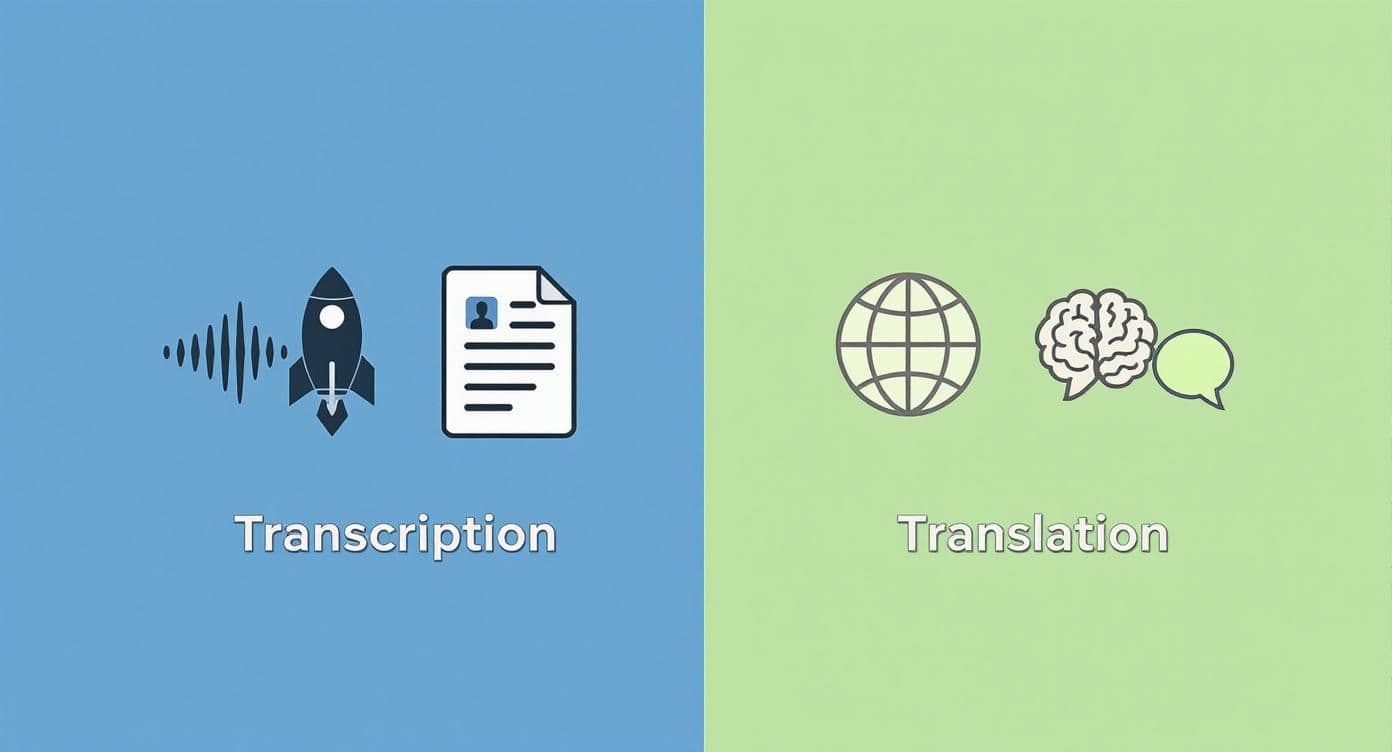
As you can see, AI's role in transcription is to churn out text from audio as fast as possible. With translation, the AI has a much tougher job: it has to interpret context and meaning across different languages.
Scenario-Based Recommendations
Let’s get practical. To make this choice even clearer, here are a few real-world business scenarios where you’d pick one over the other. Getting this right directly impacts how useful and accessible the meeting is for everyone involved.
- Internal Team Brainstorming: Picture your team riffing on ideas for a new project. Everyone speaks English, and you just need a way to capture all the great suggestions for the project summary.
- Recommendation: Transcription. The goal here is pure documentation, not crossing language barriers. A clean transcript gives you a searchable, reliable record of the conversation.
- Quarterly All-Hands with a Global Team: Your company has offices in the US, Germany, and Japan, and the CEO is giving a major update. You need every single employee to understand the message clearly.
- Recommendation: Translation (and maybe transcription too). You’ll need live interpretation or real-time translated subtitles so everyone can follow along. Afterward, you can transcribe the original audio and then translate that transcript for anyone who couldn't attend live.
Matching Service to Meeting Goals
To help you map your specific meeting needs to the right solution, I've put together a quick reference table. It’s a straightforward guide to help you make the right call based on your primary objective.
Service Recommendation by Meeting Type
| Meeting Scenario | Primary Goal | Recommended Service |
|---|---|---|
| Legal Deposition | Create a legally binding, verbatim record of testimony. | Transcription |
| International Sales Pitch | Ensure a potential client understands your product's value. | Translation |
| Employee Training Session | Document the session for employees to review later. | Transcription |
| Global Product Launch | Communicate marketing messages to diverse audiences. | Translation |
Ultimately, aligning your choice with the meeting's purpose is what matters most. Choose correctly, and you’ll ensure your communication is effective and your meeting outcomes are solid.
A Look at the Top AI Transcription and Translation Tools
Picking the right AI tool means cutting through the marketing fluff and focusing on what it actually does for you. The difference between transcription and translation becomes crystal clear when you look at the tools designed for each. One is all about capturing every word with precision in one language, while the other is busy navigating the tricky world of meaning between two different languages.
When you’re looking at transcription tools, you care about accuracy, especially with different accents. You need to know who said what (speaker identification), and you want it to play nice with your meeting software like Zoom or Microsoft Teams. For translation, the game changes. It’s all about whether the tool gets the context right, how many languages it supports, and if it can handle a huge document or a live conversation without falling apart.
What to Look For in AI Transcription Services
The whole point of a transcription tool is to get a clean, reliable text file that you don't have to spend hours editing. The best ones have their own sweet spots, so think about what you’ll be using it for day-to-day.
Here are a few of the heavy hitters:
- Otter.ai: This is a go-to for live meetings and interviews. Its real-time transcription and knack for figuring out who’s talking make it a solid choice for teams that need notes on the fly.
- Rev: Rev gives you the best of both worlds—fast AI transcription with an option to have a human double-check it. If you're working on something where mistakes are not an option, like legal depositions or academic research, this is your safety net.
- Descript: Descript is more than just a transcriber; it's a full-on audio and video editor. It's perfect for content creators who want to turn a meeting recording into a polished podcast or video clips.
So, which one is for you? If your team just needs fast, searchable meeting notes, Otter.ai is a fantastic choice. But if that transcript is going to be the foundation for a global marketing campaign, you’ll want the human-verified accuracy that Rev provides. For a deeper dive, check out our guide on the 12 best AI transcription software options for 2025.
What to Look For in AI Translation Services
With translation tools, it's all about preserving meaning and nuance. A simple word-for-word swap just doesn't work. The best tools understand the context and deliver something that sounds like a person actually wrote it.
Here are some of the top contenders:
- DeepL: People rave about DeepL because its translations just sound more natural, especially for European languages. It’s surprisingly good at catching idioms and phrases that other tools mangle.
- Google Translate: Nothing beats Google when it comes to the sheer number of languages it supports. It's the king of quick, on-the-spot translations and can handle entire documents with ease.
- MemoQ or Smartcat: These aren't just translators; they're full-blown Translation Management Systems (TMS). Professionals use them for big projects because they mix machine translation with tools for quality control and team collaboration.
For a quick internal email, Google Translate gets the job done. But if you’re translating website copy or marketing materials for a new audience, you need the subtlety of a tool like DeepL. It all comes down to a simple question: do you need to just understand, or do you need to communicate professionally?
Building a Global Content Workflow
Knowing the difference between transcription and translation isn't just about definitions. It's about building a smart, effective global communication strategy. These two services aren't competitors; they're partners. Think of them as two essential steps in a single, powerful process that ensures your message is clear and consistent, no matter the language.
The path to great multilingual content always starts with a high-quality transcript. Whether you're working with a recorded team meeting, a public webinar, or a new marketing video, the first move is to turn that audio into a clean, accurate text file. That’s the critical role of transcription.
Starting with a Solid Foundation
This initial transcript acts as your "source of truth." It's the verbatim record of what was said in the original language. But let's be realistic—raw AI transcripts are rarely perfect. They can have misheard words, wonky punctuation, or confused speaker labels. Before a single word gets translated, a human needs to review and edit that document.
For any important content, this editing step is non-negotiable. It’s where you fix technical jargon, correct brand names, and make sure the conversation makes sense. By finalizing the source text first, you create a verified foundation to build on.
The Seamless Handoff to Translation
Once you have a polished, approved transcript, it's ready for the next stage. This clean document is handed off to your translators, who can now focus on what they do best: adapting the meaning and nuance for a new audience. They won't be left guessing what a speaker really meant or trying to work from a garbled text.
This two-step workflow—transcribe first, then translate—is your best defense against errors spreading through your international content. It makes the entire process more efficient and ensures the final translations are accurate, culturally on-point, and true to your original message. It’s simply the most reliable way to scale your communications and make sure your message connects, every single time.
Frequently Asked Questions
You've probably still got a few questions buzzing around. Let's tackle some of the most common ones that pop up when people are trying to figure out the best way to handle their meeting content.
Can One AI Tool Do Both Transcription and Translation?
Yes, many modern platforms can handle both, but it's rarely a single, seamless process. Think of it as a two-step dance. First, the tool’s transcription engine turns the audio into text in the original language. Then, a separate translation engine takes that text and converts it into another language.
The catch is that a tool might be amazing at transcription but just so-so at translation, or the other way around. You really have to test both functions independently to see if the quality meets your standards.
Is Human Review Still Necessary with Modern AI Tools?
For anything important? Absolutely.
With transcription, a human is crucial for catching those tricky industry-specific terms, correctly identifying who said what, and cleaning up the punctuation. AI gets you 90% of the way there, but a person provides that final polish, especially if the audio quality isn't perfect.
When it comes to translation, human oversight is even more critical. AI often fumbles with cultural nuances, brand voice, and idioms—the very things that make communication feel authentic. It can translate the words, but it often misses the meaning.