Meetings are the heartbeat of collaboration, yet they're often a source of frustration, inefficiency, and wasted time. The problem isn't the meeting itself, but the lack of a shared agreement on how to behave within it. When attendees talk over each other, arrive unprepared, or focus on their laptops instead of the discussion, the entire purpose of gathering is lost. This common scenario leads to disengaged teams, stalled projects, and a calendar full of appointments that feel more like obligations than opportunities.
Establishing clear ground rules for meeting conduct transforms chaotic discussions into productive powerhouses. These rules create a framework for respect, focus, and accountability, ensuring that every participant contributes effectively toward a shared objective. To address the root causes of these unproductive gatherings, managers can benefit from a comprehensive guide on how to run effective team meetings, which provides a solid foundation for operational excellence.
This guide moves beyond generic advice to provide a comprehensive roundup of the 8 most critical rules that will redefine your team's approach to collaboration. You won't just learn what the rules are; you'll get actionable scripts to introduce them, practical enforcement tips for leaders, and role-specific guidance for in-person, virtual, and hybrid environments. We will cover everything from starting on time to eliminating multitasking, equipping you with the tools needed to make every meeting an engine for progress. Prepare to reclaim your calendar and drive real value from every conversation.
1. Start and End on Time
This foundational ground rule dictates that every meeting must begin and conclude at its scheduled time, without exception. It’s more than just a matter of courtesy; it’s a non-negotiable pact that respects every participant's schedule and signals that their time is valued. Enforcing punctuality creates a culture of reliability and efficiency, preventing the common "domino effect" where one late meeting disrupts an entire day's calendar.

This rule is universally applicable, from quick team syncs to high-stakes board meetings. It establishes a predictable rhythm for collaboration, ensuring that discussions are focused and agendas are completed. When people know a meeting will end precisely on time, they are more motivated to stay on topic and contribute effectively.
Real-World Examples
- Google's Speedy Meetings: To combat calendar fragmentation, Google encourages "speedy meetings" that end five minutes early (e.g., a 25-minute meeting instead of 30), giving attendees a built-in buffer to get to their next commitment.
- Agile Scrum Standups: These daily meetings are strictly time-boxed to 15 minutes. This forces the team to share only the most critical updates, keeping the session high-energy and productive.
- Executive Boardrooms: Many Fortune 500 companies project a visible countdown timer during board meetings to keep each agenda item on track, ensuring the entire schedule is respected.
How to Implement This Rule
Putting this rule into practice requires proactive steps and clear communication. It’s not enough to simply state it; you must build systems that support it.
- Assign a Timekeeper: Designate a specific person, other than the meeting leader, to monitor the clock. This person has the authority to give time warnings, such as "10 minutes left," to keep the group on pace.
- Use Visible Timers: For both virtual and in-person meetings, display a shared timer on the screen. This visual cue makes time tangible and creates a shared sense of urgency.
- Protect the Final Five Minutes: Reserve the last five minutes exclusively for summarizing key decisions, clarifying action items, and confirming next steps. Do not introduce new topics during this time.
- Start with Who's There: Begin the meeting at the scheduled start time, even if some attendees are late. Waiting for stragglers penalizes those who were punctual and sets a precedent that start times are flexible.
2. One Conversation at a Time
This critical ground rule mandates that only one person speaks at a time, preventing interruptions, side-conversations, and the chaos of competing voices. It fosters an environment of active listening and respect, ensuring that every idea is fully heard and considered without being cut short. By eliminating cross-talk, this rule allows complex thoughts to be articulated completely, which leads to clearer understanding and more thoughtful discussions.

Adhering to this principle is essential for inclusive and equitable meetings. It ensures that quieter or more contemplative team members have the space to contribute, rather than being overshadowed by more assertive personalities. When every participant knows they will get an uninterrupted turn to speak, the quality of contributions improves, and the group can fully process one point before moving to the next.
Real-World Examples
- Toastmasters International: This global organization for public speaking builds its club meetings around this foundational rule, where each speaker is given the floor without interruption to practice their delivery.
- Support Groups: Facilitators in therapy and support groups religiously enforce this rule to create a safe, non-judgmental space where individuals can share sensitive information without being spoken over.
- Town Hall Meetings: To manage large crowds and ensure fairness, government town halls often use a structured queue and microphone system, allowing one citizen to speak at a time to an official.
How to Implement This Rule
Successfully enforcing "one conversation at a time" requires clear mechanisms, especially in dynamic or virtual settings. These practical steps can help build this discipline into your team's culture.
- Use a Talking Object: For in-person meetings, a physical item like a ball, marker, or "talking stick" can be passed around. Only the person holding the object is permitted to speak.
- Implement a Hand-Raising System: In virtual meetings, utilize the "raise hand" feature common in platforms like Zoom or Microsoft Teams. The facilitator can then call on people in the order they raised their hands.
- Pause Between Speakers: The meeting leader should actively create a brief, deliberate pause after someone finishes speaking. This allows the group to process the information and prevents immediate interjections.
- Acknowledge and Transition: Use simple transition phrases to signal a speaker's turn is over and a new one is beginning. Statements like, "Thank you, Sarah. Now let's hear from Tom," create a structured flow.
3. Come Prepared
This essential ground rule mandates that all participants review materials, understand the agenda, and gather relevant information before the meeting begins. It transforms meetings from passive information-sharing sessions into active, high-value discussions. When attendees are prepared, the group can skip background explanations and dive straight into substantive analysis, debate, and decision-making, significantly improving efficiency and outcomes.

This rule is critical for any meeting where decisions are made or complex topics are discussed, from project kickoffs to strategic planning sessions. It fosters a culture of accountability and respect, showing that everyone is invested in making the best use of the collective time. Proper preparation ensures that conversations are informed, contributions are thoughtful, and the meeting achieves its intended purpose without wasting a minute.
Real-World Examples
- McKinsey & Company: The consulting firm’s culture demands rigorous pre-reading. Consultants are expected to have mastered all case materials and data before a client meeting, enabling them to focus on strategic insights rather than basic facts.
- Venture Capital Firms: Partners at firms like Andreessen Horowitz often receive detailed investment memos at least 48 hours before a partnership review. This allows for deep diligence and ensures the discussion is focused on critical deal-making questions.
- Medical Grand Rounds: In hospitals, physicians are required to review patient histories and lab results beforehand. This preparation is non-negotiable, ensuring that the collaborative discussion about patient care is efficient, accurate, and safe.
How to Implement This Rule
Enabling preparation is as important as demanding it. The meeting organizer must provide the necessary tools and time for participants to get up to speed.
- Distribute Materials Early: Send all necessary documents, reports, and a clear agenda at least 48 hours in advance. This gives everyone adequate time to review the information. For more on creating an effective roadmap, explore this complete guide to writing a meeting agenda.
- Mark Required Reading: Clearly distinguish between "must-read" materials essential for the discussion and "optional" resources for deeper context. This helps attendees prioritize their efforts.
- Provide an Executive Summary: For dense reports, include a one-page summary highlighting the key findings, questions to be addressed, and decisions to be made.
- Confirm at the Start: Begin the meeting with a quick check-in like, "Does anyone have clarifying questions about the pre-read materials before we dive in?" This reinforces the expectation of preparedness.
4. Respect Confidentiality
This essential ground rule establishes a firm boundary: information shared within the meeting stays within the meeting, unless explicit permission is granted for wider distribution. It's the cornerstone of trust, creating a "safe space" where participants feel secure enough to engage in honest, vulnerable, and innovative discussions. Upholding confidentiality protects proprietary data, respects personal privacy, and prevents misinformation from spreading.
This rule is critical in any context involving sensitive topics, from financial forecasting and product strategy to personnel reviews and client negotiations. By creating an environment of psychological safety, teams can tackle difficult problems without fear of judgment or premature disclosure. It ensures that internal deliberations remain internal, allowing the organization to control its narrative and strategic positioning.
Real-World Examples
- Executive Leadership Teams: Meetings discussing unannounced financial results or potential acquisitions operate under strict confidentiality. Information is carefully controlled to comply with securities laws and prevent market speculation.
- Healthcare Case Reviews: In clinical settings, patient information is protected by HIPAA and other regulations. All discussions are confidential to safeguard patient privacy.
- HR Performance Calibrations: When managers meet to discuss employee performance and compensation, the details of those conversations are kept strictly confidential to protect individual privacy and maintain trust in the process.
How to Implement This Rule
Enforcing confidentiality requires more than just a verbal reminder; it demands clear, consistent protocols that leave no room for ambiguity.
- State Expectations Clearly: Begin sensitive meetings by explicitly stating the confidentiality level. For example, say, "Everything discussed in this room is confidential and should not be shared outside this group without approval."
- Use Confidentiality Tiers: For clarity, classify information discussed. Define what is "Public," "Internal Only," or "Strictly Confidential" so participants know exactly what can and cannot be shared.
- Require Signed Agreements: For highly sensitive projects or external collaborations, require participants to sign a non-disclosure agreement (NDA) before the meeting begins. This adds a layer of legal commitment.
- Establish Breach Protocols: Define and communicate the consequences of a confidentiality breach. This could range from a formal warning to more severe disciplinary action, ensuring the rule has tangible weight.
5. Silence All Devices or Use Silent Mode
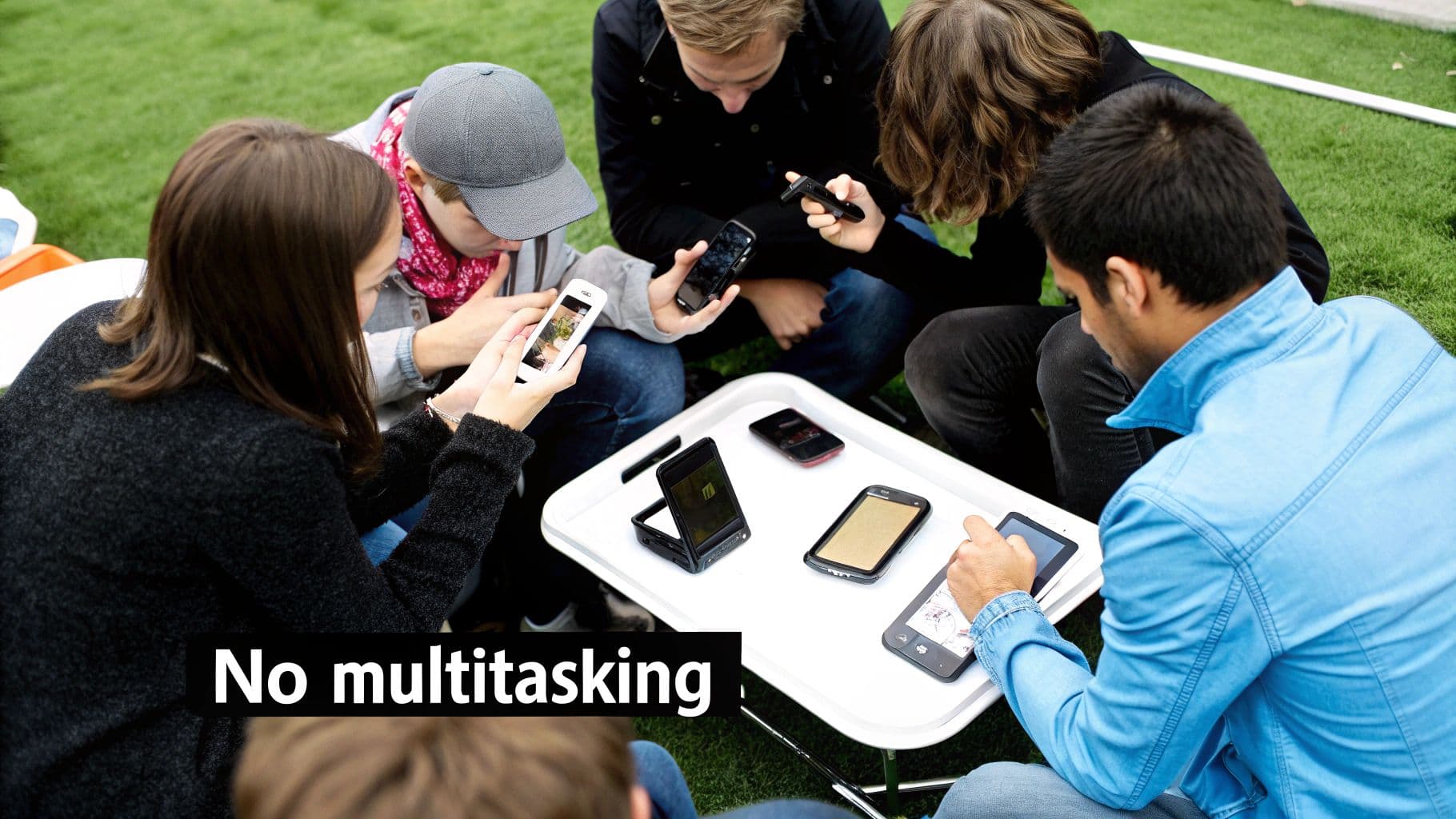
This essential ground rule mandates that all participants silence their personal devices, including phones, laptops, and smartwatches, for the duration of the meeting. This means turning off audible notifications, disabling vibrations, and closing irrelevant tabs. The goal is to eliminate digital distractions, ensuring that everyone’s full attention is dedicated to the discussion at hand. It’s a powerful act of respect for both the speaker and the collective focus of the group.
A single notification buzz can derail a train of thought and diminish engagement, not just for the device owner but for those around them. By establishing a no-distraction zone, teams can achieve deeper focus, leading to more productive conversations and faster decision-making. This rule is especially critical in hybrid environments where digital distractions are already heightened. For more guidance on digital conduct, explore these rules for professional video calls.
Real-World Examples
- Courtroom Proceedings: Judges strictly instruct jurors and attendees to silence or turn off all electronic devices before a session begins to maintain decorum and prevent any disruption to the legal process.
- Secure Government Meetings: In high-security military or government briefings, attendees are often required to leave all personal devices in lockers outside the meeting room to prevent both distractions and potential security breaches.
- Google's Meeting Room Signage: Many of Google’s conference rooms include visual reminders, such as signs or screen prompts, asking participants to put their phones on silent before a meeting starts.
How to Implement This Rule
Successfully creating a distraction-free environment requires clear expectations and consistent reinforcement. It's about building a shared habit of focused attention.
- Create a "Device Check-in": Start the meeting with a simple verbal reminder: "As we begin, let's all take a moment to silence our devices." This makes it a collective, routine action.
- Place Devices Face-Down: Encourage participants to place their phones face-down on the table or put them away entirely in a bag or pocket. Out of sight truly helps keep it out of mind.
- Establish a "Phone-Free Zone": For critical brainstorming or strategic sessions, designate the meeting room as a phone-free zone. Set up a small basket or tray near the door where participants can leave their devices.
- Lead by Example: As the meeting facilitator, be the first to visibly silence your phone and put it away. Your actions set the standard for everyone else in the room.
6. Focus on Issues, Not Personalities
This essential ground rule for meeting success demands that all discussions, critiques, and debates center on behaviors, ideas, or problems, not on individuals. It establishes a clear boundary between constructive conflict and destructive personal attacks, ensuring that conversations remain professional, respectful, and solution-oriented. Adhering to this principle builds psychological safety, allowing team members to challenge ideas openly without fear of personal judgment or retribution.
By separating the person from the problem, this rule prevents emotional escalation and keeps the team aligned on a shared goal. Instead of assigning blame, participants work together to analyze the issue at hand, leading to more innovative and effective outcomes. It transforms potentially tense disagreements into valuable opportunities for growth and improvement.
Real-World Examples
- Radical Candor Framework: Popularized by Kim Scott, this leadership philosophy trains managers to "challenge directly" while "caring personally." The focus is always on the work, not the individual's character, enabling tough feedback that is both effective and humane.
- Google's Project Aristotle: Research at Google identified psychological safety as the top predictor of high-performing teams. A key component of this safety is the team's ability to engage in difficult conversations about work-related issues without making them personal.
- Academic Peer Review: Formal peer-review processes in academia use structured feedback forms that guide reviewers to critique the methodology, data, and conclusions of a study, intentionally steering them away from commenting on the author's capabilities.
How to Implement This Rule
Fostering an issue-focused culture requires deliberate language and consistent reinforcement from the meeting leader and participants.
- Use "I" Statements: Encourage participants to frame feedback from their own perspective. For example, say, "I felt confused by the data on slide five," instead of, "Your presentation was confusing."
- Focus on Specific Behaviors and Impact: Address observable actions and their consequences. Use phrasing like, "When the deadline was missed, it delayed the client launch," rather than, "You are unreliable."
- Separate the Problem from the Person: Frame challenges as separate entities to be solved collectively. Say, "We have a gap in our process here," not, "You failed to complete the process correctly."
- Ask Clarifying Questions: Before jumping to conclusions about someone's intent, ask questions to understand their perspective. For instance, "Can you walk me through your thinking on this decision?" This shifts the focus from accusation to understanding.
7. Contribute Actively and Respectfully
This ground rule establishes a dual expectation for all attendees: to actively participate by sharing relevant ideas and questions, while simultaneously doing so with respect for diverse viewpoints. It is designed to combat two common meeting dysfunctions: passive observation, where attendees don't contribute, and disrespectful debate, where conflict stifles collaboration. Enforcing this rule creates an environment of psychological safety where every voice is heard and valued.
This rule is critical for problem-solving, innovation, and decision-making sessions where the best outcomes depend on collective intelligence. It ensures that the meeting benefits from the full range of expertise and perspectives in the room, not just those of the most dominant personalities. When people feel safe to both contribute and dissent, the group can uncover blind spots and generate more robust solutions.
Real-World Examples
- Pixar's "Braintrust" Meetings: In these sessions, a group of directors and storytellers provides candid, critical feedback on a film in development. The rule is absolute honesty, delivered respectfully, with the understanding that the feedback is about the project, not the person.
- Agile Retrospectives: These meetings explicitly ask every team member to contribute thoughts on what went well, what didn't, and what to improve. This structured format ensures active participation from everyone.
- Amazon's "Disagree and Commit": This leadership principle encourages team members to voice their dissenting opinions respectfully and vigorously during discussion. However, once a decision is made, they are expected to commit to it fully.
How to Implement This Rule
To make active and respectful contribution a reality, you need to create both the structure and the culture for it. These ground rules for meetings require intentional facilitation.
- Use Round-Robin Sharing: Go around the room (or virtual meeting) and give each person an uninterrupted turn to speak. This guarantees equal airtime and brings quieter voices into the conversation.
- Ask Open-Ended Questions: The facilitator should pose questions that invite broad participation, such as, "What perspective are we missing?" or "Let's hear from someone who hasn't spoken yet."
- Separate Idea Generation from Evaluation: Create distinct phases in the meeting. First, focus only on generating ideas without any criticism. Later, move to a phase of respectful evaluation. This prevents new ideas from being shut down prematurely.
- Explicitly Value Dissent: When someone offers a different viewpoint, thank them for it. Say something like, "Thank you for bringing up that counterpoint; it's important we consider that angle." This reinforces that disagreement is a healthy part of the process.