Picking new software can feel like a high-stakes bet. A cost-benefit analysis (CBA) for software is your playbook for making a smart one. It's a straightforward framework for weighing the total projected costs of a new tool against all the good stuff you expect to get out of it.
Honestly, it's the best way to make sure your investment actually pays off and you don't end up with a bad case of buyer's remorse.
Why You Need a Cost-Benefit Analysis for Software
Let's face it, the old way of picking software—getting wowed by a flashy demo and just looking at the price tag—is a recipe for disaster. The business world today is just too complex, and financial traps are everywhere.
A formal cost-benefit analysis isn't just a "nice-to-have" exercise anymore; it's a critical tool for dodging those hidden financial bombshells and unlocking the real value from your tech. It forces you to look past the monthly subscription fee and see the entire financial picture, both good and bad.
This kind of structured thinking is a cornerstone of any successful digital transformation strategy, ensuring technology is there to serve your business goals, not the other way around.
Dealing with Modern Software Headaches
The need for a solid CBA has become even more urgent because of two big trends. First, there's "shadow IT"—when teams start using unauthorized software without getting approval. It's a sneaky source of massive, unmanaged spending.
Second, more and more software is moving to usage-based pricing models. This makes your costs unpredictable and a real pain to forecast.
Imagine a sales team starts using a cool new AI meeting assistant on their own. Without a proper analysis upfront, the costs for transcription minutes or extra AI features can spiral out of control fast. Suddenly, that helpful tool becomes a major budget drain. This is exactly where a formal analysis acts as your financial safeguard.
The chart below breaks down the core idea of a CBA: you're just weighing the potential benefits against the total costs to make a clear-headed decision.

As the visual makes clear, for any project to be worth it, the sum of its benefits has to be much greater than the sum of its costs.
This discipline is more critical than ever, especially as we head toward 2025. Research has found that in some companies, a staggering 48% of app usage is shadow IT. On top of that, over 50% of SaaS vendors are expected to use usage-based pricing, making unmanaged costs a huge risk for any business.
Uncovering the True Cost of New Software
The sticker price on a new piece of software is rarely the full story. It’s just the tip of the iceberg. To do a proper cost benefit analysis for software, you have to look past the monthly subscription and uncover all the hidden expenses that can ambush your budget down the road. It's a classic mistake I've seen countless times—getting wooed by a low entry price only to face a flood of unexpected bills.
The key is to calculate the Total Cost of Ownership (TCO). This isn't just about the initial purchase; it’s about adding up every single dollar you’ll spend throughout the software’s entire lifecycle. These costs usually fall into a few key areas that are easy to miss when you're excited about a new tool.
Direct and Implementation Costs
First up are the most immediate costs—the ones you’ll face just to get the software up and running. These go way beyond the license fee.
Don't forget to budget for:
- Setup and Configuration: This is the time and money it takes to get the software tailored to your team’s specific workflow. Will your IT team handle it, or will you need to pay the vendor for professional services? Those hours add up.
- Data Migration: Moving information from an old system to a new one is almost never a simple copy-and-paste. It can be a complex, time-consuming project that requires specialized skills to make sure nothing gets lost or corrupted.
- Integration with Existing Systems: How well will this new tool play with your current tech stack, like your CRM or project management platform? Custom integrations can introduce significant and often unexpected costs.
For smaller businesses, particularly those without a deep bench of technical experts, high upfront licensing and implementation fees can be a major roadblock. In these cases, user-friendly software and stellar customer support aren't just nice-to-haves; they become critical factors in the overall cost.
Operational and People Costs
Once the software is live, a whole new set of ongoing expenses kicks in. These are all about the human side of the equation—the people who will use, manage, and rely on this tool every single day.
Think about these long-term expenses:
- Training and Onboarding: How much productive time will your team lose while getting up to speed? You need to factor in the cost of any formal training, the time spent creating internal documentation, and the inevitable productivity dip that comes with any learning curve.
- Maintenance and Support: Does the vendor charge extra for premium support or ongoing maintenance? For certain tools, like transcription services, these costs can fluctuate quite a bit. We break this down further in our guide on the hidden costs of transcription services.
- Technical Debt: A rushed or sloppy implementation creates problems that will haunt you later. Taking shortcuts during setup is like taking out a loan; you create "technical debt" that you'll eventually have to repay with interest, usually in the form of frustrating bug fixes and costly overhauls. Understanding How To Reduce Technical Debt is crucial for keeping future expenses in check.
How to Measure Software Benefits in Real Dollars
Once you’ve wrestled with all the potential costs, you get to the fun part: figuring out the value you’ll get back. This is where you build the "why" behind your software investment.
Benefits aren't always as clear-cut as costs. They generally fall into two buckets: tangible and intangible.
Tangible benefits are the straightforward, easy-to-measure gains. These are the numbers that make finance teams happy because you can see them on a balance sheet. They represent real dollars saved or earned.
Intangible benefits are a bit trickier. They're the "softer" improvements, like a boost in team morale or faster, smarter decisions. You can't always slap a precise dollar amount on them, but they're absolutely critical to the long-term health of your business. If you ignore them, you're only telling half the story.
Monetizing Tangible Gains
Let's start with the easy wins. The key here is translating specific actions into cold, hard cash. With an AI meeting summarization tool, the most direct benefit is almost always cutting out manual work.
It's actually pretty simple to calculate. Just use this formula:
Time Saved (hours per month) x Employee's Hourly Rate = Monthly Savings
For example, say your team collectively spends 30 hours a month transcribing meeting notes. If the average loaded cost for an employee is 50 per hour**, that new software just saved you **1,500 every single month. That's a powerful and undeniable number for any analysis.
Don't stop there. Other tangible benefits to look for include:
- Reduced outsourcing costs: Did this new tool replace a pricy third-party transcription service? Add those savings directly to your benefit column.
- Increased sales or conversions: Can you show that faster follow-ups from your sales team led to a measurable bump in closed deals?
- Lower employee turnover: Burnout from tedious admin work is real. If the software reduces that friction, it can lead to better retention. Considering it can cost 50-60% of an employee's annual salary to replace them, this is a huge potential saving.
Putting a Price on Intangible Improvements
Now for the real challenge. How do you measure something like "faster decision-making"? While you can't assign an exact dollar figure, you can use what are called proxy metrics to estimate its value.
For instance, if your AI tool delivers meeting summaries instantly instead of a day later, projects might kick off 24 hours sooner. What’s the value of launching a marketing campaign a day earlier? This kind of thinking requires a deeper dive into data-driven decision-making to connect faster information with positive business outcomes.
To help you get started, here's a practical way to think about and assign value to both types of benefits.
Tangible vs Intangible Benefits of an AI Meeting Tool
| Benefit Type | Example | How to Quantify (Monetize) |
|---|---|---|
| Tangible | Reduced manual transcription time | Calculate employee hours saved multiplied by their fully-loaded hourly cost. |
| Tangible | Elimination of third-party services | Add up the monthly invoices from the cancelled transcription or note-taking service. |
| Intangible | Faster decision-making | Estimate the value of accelerating project timelines or getting to market faster. |
| Intangible | Improved team collaboration | Survey team members on efficiency gains and link those to higher project success rates. |
| Intangible | Better employee morale and focus | Connect reduced admin work to lower burnout rates and higher employee engagement scores. |
By combining the hard numbers with well-reasoned estimates for these softer gains, you create a much more complete and honest picture of the software's true value. This balanced approach is crucial for getting buy-in from everyone involved, not just the people holding the purse strings.
Building Your Cost-Benefit Analysis Framework
Now that you've got your costs and benefits lined up, it's time to pull them all together. This is where you transform those lists of numbers into a decision-making tool that tells a clear story. Think of it as building the business case, the final step in a solid cost-benefit analysis for software.
The goal here isn't to create some ridiculously complex spreadsheet that no one understands. It’s about translating your data into financial metrics that leadership can grasp instantly.
To make your case truly compelling, you need a solid foundation. Understanding how to build robust financial models is what elevates a simple comparison into a predictive tool for your business.
Demystifying Key Financial Metrics
You don't need a finance degree to get a handle on the core metrics. They’re all just different ways of answering the big question: "Is this worth the money?" Let's walk through the three most important ones you'll use.
- Return on Investment (ROI): This is the one everyone knows. It’s a simple percentage that shows how much you get back for every dollar you put in. A positive ROI is a green light—it means your benefits are bigger than your costs.
- Payback Period: This one answers a very practical question: "How long until we get our money back?" It's a fantastic metric for talking about short-term risk and how the investment will affect cash flow.
- Net Present Value (NPV): NPV is a little more sophisticated but incredibly useful. It recognizes that a dollar today is worth more than a dollar a year from now. It calculates the total value of the software investment in today's money, giving you a truer picture of its long-term profitability. A positive NPV is what you're looking for.
This infographic breaks down exactly how you turn a soft benefit into a hard number, which is the whole point of this exercise.
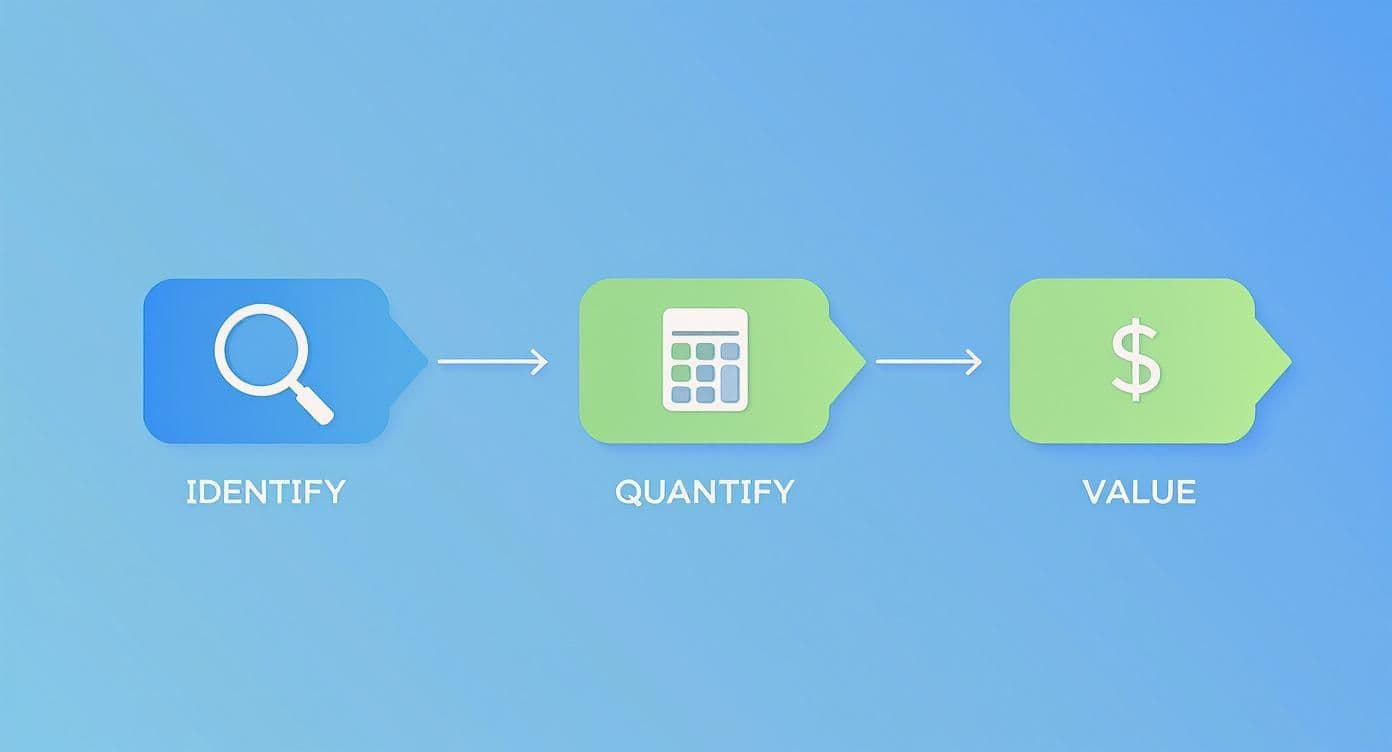
This flow—from identifying a benefit to quantifying its impact and finally putting a dollar sign on it—is what gives your analysis real credibility.
Putting It Into Practice: The AI Meeting Tool
Let’s get practical and plug in the numbers for our AI meeting tool example. We'll keep the math straightforward to see how it works in the real world.
Costs (Year 1):
- Subscription Fees: $12,000
- Implementation & Training: $3,000 (one-time)
- Total Year 1 Cost: $15,000
Benefits (Year 1):
- Time Savings (Productivity): $24,000
- Reduced Outsourcing Costs: $6,000
- Total Year 1 Benefit: $30,000
With these figures, we can run the numbers:
- ROI: We calculate this with the formula: (Net Benefit / Cost) x 100. So, ((30,000 - 15,000) / $15,000) x 100 = 100% ROI. For every dollar you put in, you get a dollar back in profit within the first year. Simple as that.
- Payback Period: This is just Cost / Annual Benefit. (15,000 / 30,000) x 12 months = 6 months. The software literally pays for itself in half a year.
This kind of clear-eyed analysis is essential. The software development market is projected to be worth around 524 billion in 2025** and is on track to hit over **1.03 trillion by 2032. With enterprise software leading the charge, making smart choices isn't just a good idea—it's critical for staying competitive.
Common Mistakes to Avoid in Your Software Analysis

Learning from others' mistakes is always cheaper. I've seen even the most detailed cost benefit analysis for software get derailed by a few common, but critical, oversights. Think of this as a final gut check to make sure your analysis is realistic, thorough, and ready to be challenged.
One of the biggest traps we all fall into is confirmation bias. It's that natural pull to favor information that confirms what we already believe. If you’ve already fallen in love with a particular tool, it's easy to subconsciously downplay its costs or inflate its benefits.
The best way to fight this? Actively seek out dissenting opinions. Find that skeptical colleague who loves to poke holes in things and ask them to review your numbers. Go read the one- and two-star reviews of the software. A solid analysis is one that can stand up to a bit of scrutiny.
Overlooking Hidden and Long-Term Costs
It's so easy to get fixated on the upfront subscription fee and completely miss the expenses that sneak in later. A lot of analyses fall apart because they don't paint the whole financial picture.
Here are the costs I see people miss most often:
- Underestimating Training Time: New software always comes with a learning curve. Don’t just budget for the formal training session; you have to factor in the weeks, or even months, of reduced productivity as your team adjusts to new ways of working.
- Forgetting Long-Term Maintenance: What does year two and three look like? Subscription prices can jump after an introductory period, and you might find yourself needing to pay extra for premium support or mandatory upgrades. Always ask vendors for a multi-year cost projection, not just the shiny first-year price.
- Ignoring Integration Headaches: A new tool that doesn't play nice with your current tech stack can create more problems than it solves. I once saw a project's entire ROI get wiped out by an integration that ended up costing three times the initial software price. The cost of building custom APIs or dealing with manual workarounds can erase your projected savings in a heartbeat.
At the end of the day, a successful analysis is an honest one. It accounts for the human side of things, prepares for future expenses, and isn't afraid to challenge its own conclusions. By steering clear of these common pitfalls, you're building your software investment on a foundation of reality, not just optimism.
Got Questions? We’ve Got Answers
Once you’ve crunched the numbers and laid out your cost-benefit analysis, a few lingering questions usually surface. Think of this as the final check-in to make sure you've covered all your bases and can move forward with confidence.
What Do I Do with Benefits I Can’t Put a Price Tag On?
This is the million-dollar question, isn't it? It's a classic snag in any cost benefit analysis for software. Things like a boost in team morale or a stronger company reputation feel important, but they don't come with a neat price tag.