Meetings are the lifeblood of collaboration, yet they often devolve into unproductive, time-wasting sessions. The culprit isn't the meeting itself, but the lack of a clear framework for how people should interact. Without structure, discussions drift, decisions are delayed, and participants leave feeling frustrated and drained. This is where a clear set of meeting ground rules becomes essential.
Establishing these non-negotiable guidelines transforms chaos into order, ensuring every minute is spent on what truly matters: making decisions, solving problems, and driving progress. These rules create a foundation of respect, focus, and accountability, which is especially critical for remote and hybrid teams where clear communication protocols are paramount. When everyone understands and agrees to the same standards of conduct, meetings become more efficient, inclusive, and effective.
In this guide, we'll break down eight essential meeting ground rules that will redefine your team’s culture. We won’t just list them; we'll provide actionable tips, sample phrasing for your meeting invites, and show how modern tools like AI meeting summarizers can help enforce and amplify the impact of each rule. By the end, you'll have a complete toolkit to run meetings that people actually want to attend, armed with clear examples and strategies to implement immediately. This isn’t just about having better meetings; it’s about reclaiming valuable time and making collaborative work more productive for everyone involved.
1. Start and End On Time
Establishing punctuality as a non-negotiable ground rule is one of the most impactful changes a team can make. This rule dictates that meetings begin and conclude precisely at their scheduled times, without exception. It’s a foundational principle of respect for everyone's time, preventing the common problem of one delayed meeting causing a cascade of schedule disruptions throughout the day.

When teams commit to this rule, they build a culture of reliability and mutual respect. This is especially critical for remote and distributed teams working across different time zones, where a 10-minute delay can disrupt someone’s morning or late evening. For teams using automated meeting summarization tools, starting on time ensures the AI captures the complete context from the very beginning, preventing gaps in the final transcript and summary.
How to Implement This Rule
- Sample Phrasing for Your Team Charter:
- "We respect each other's time by starting and ending all meetings as scheduled. The first agenda item begins at the meeting's start time."
- "All meetings will conclude at the designated end time to allow for transitions. If discussion is ongoing, we will schedule a follow-up."
- Enforcement and Best Practices:
- Use the "50-Minute Hour": Schedule 60-minute meetings for 50 minutes and 30-minute meetings for 25. This builds in a natural buffer for attendees to transition between calls without being late.
- Establish a "Late-Joining" Protocol: Agree that the meeting starts on time, and latecomers are responsible for catching up by reviewing the agenda or meeting notes. The first five minutes should not be spent waiting or repeating information.
- Automate Punctuality: Leverage features in tools like Microsoft Teams and Google Meet that can automatically end a meeting at its scheduled time. To help enforce punctuality and ensure attendees are prepared, explore using effective meeting reminder emails.
- End on Time, Even if Unfinished: If the agenda isn't complete when time is up, the facilitator should quickly summarize the next steps and schedule a follow-up. This reinforces the rule's importance. You can learn more about how to run shorter, more effective meetings to avoid this scenario.
2. One Conversation at a Time (No Side Discussions)
This essential ground rule establishes that only one person speaks at a time, ensuring that all participants can clearly follow a single, unified conversation. It actively discourages parallel discussions, whether they are verbal interruptions in a conference room or side chats in a video call. By focusing the group's collective attention, this rule ensures every voice is heard and important points are not lost in the noise.
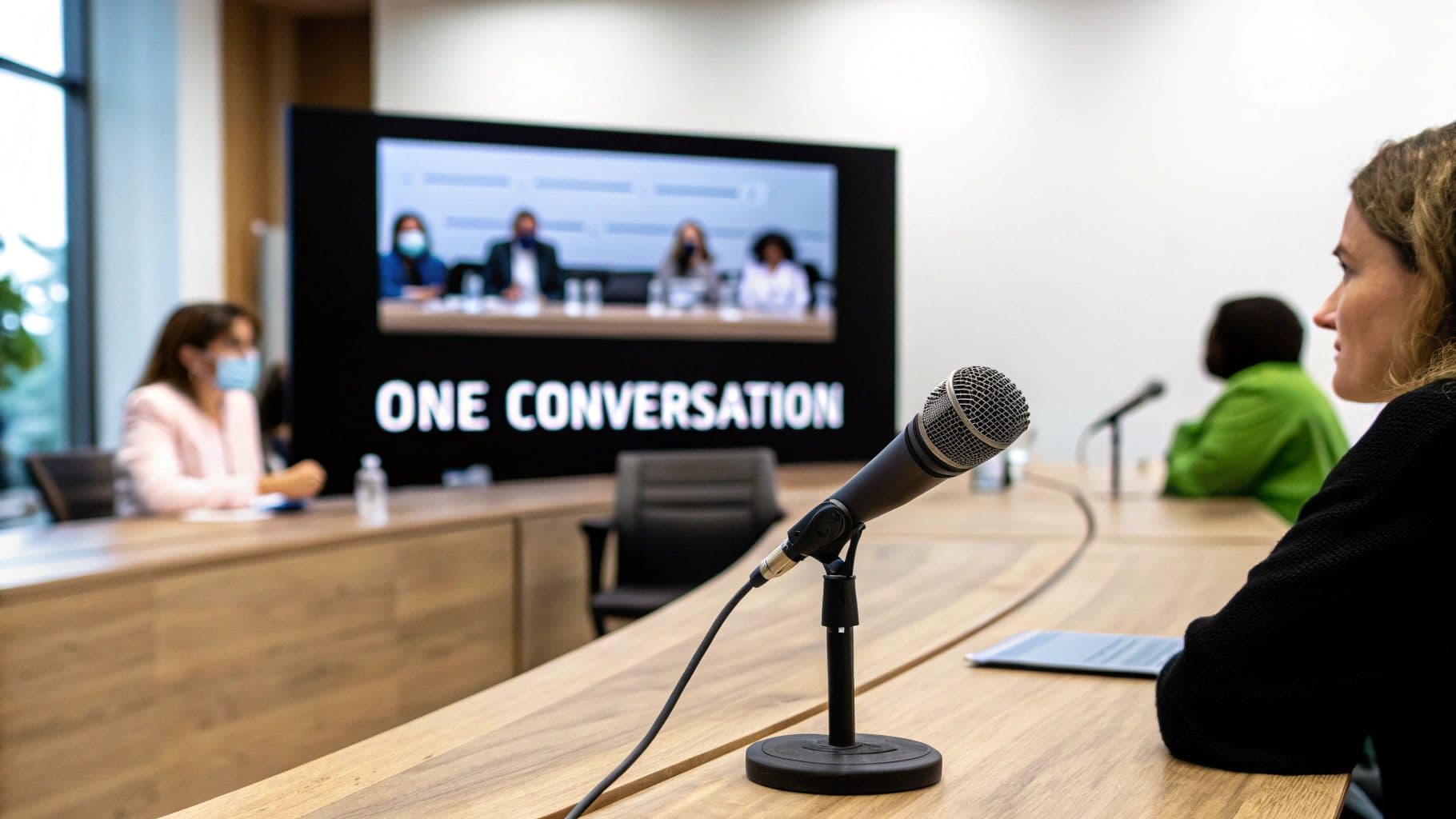
Adhering to this principle is critical for hybrid and remote teams where audio clarity is paramount. For teams using automated meeting transcription tools like Notta or Otter.ai, this rule is non-negotiable for accuracy. These tools struggle to parse overlapping dialogue, leading to garbled transcripts and unreliable summaries. Clean, single-speaker audio ensures the AI can generate a precise and useful record of the discussion, making the meeting's output valuable for everyone, especially those who couldn't attend.
How to Implement This Rule
- Sample Phrasing for Your Team Charter:
- "We practice focused communication by having only one person speak at a time. Please use the 'raise hand' feature or wait for a natural pause to contribute."
- "To ensure all contributions are heard and our records are accurate, we will avoid side conversations. Offline discussions can be managed in designated chat channels or follow-up threads."
- Enforcement and Best Practices:
- Utilize Platform Features: Actively use the "raise hand" feature in Microsoft Teams, Zoom, and Google Meet to create an orderly speaking queue. The facilitator can then call on people in turn.
- Assign a Facilitator: Designate a meeting facilitator whose role includes managing the speaker order and gently redirecting anyone who interrupts. This takes the burden off individual participants.
- Create Space for Asynchronous Input: Encourage the use of chat features for quick questions or comments that don't require interrupting the speaker. For deeper, parallel discussions, move them to a Slack thread or a document comment section.
- Review and Coach: If cross-talk is a recurring issue, review meeting transcripts to identify patterns. Use these moments as a coaching opportunity to reinforce the importance of this rule and improve active listening skills. To go deeper, you can explore strategies on how to improve active listening with our practical guide.
3. Come Prepared and Set Clear Agendas
This ground rule establishes a dual responsibility: the organizer must provide a clear, outcome-oriented agenda beforehand, and attendees must arrive having reviewed any necessary materials. This shifts meetings from passive updates to active working sessions, preventing wasted time on bringing people up to speed. An agenda acts as the meeting’s roadmap, ensuring every discussion point serves the overall objective.
When this rule is followed, discussions are more focused, decisions are made faster, and engagement skyrockets. For teams using AI summarization tools, a structured agenda is critical. The AI can use the agenda to better segment the transcript, identify key topics, and generate a more accurate and organized summary. For instance, Fireflies.ai users report 35% better summary quality when meetings follow a prepared agenda, as the tool can map conversations directly to predefined topics.
How to Implement This Rule
- Sample Phrasing for Your Team Charter:
- "All meeting invitations must include a clear agenda with specific goals. Participants are expected to review any pre-reading materials before joining."
- "We commit to outcome-focused meetings. Agendas will be sent at least 24 hours in advance, and we will arrive prepared to contribute."
- Enforcement and Best Practices:
- Define Clear Outcomes: Label each agenda item with its purpose, such as "Decision Needed," "For Brainstorming," or "Information Only." This sets clear expectations for participation.
- Assign Pre-Work: If background reading is required, explicitly state it and share materials at least 48 hours in advance. As seen at companies like Buffer, this lead time is crucial for thoughtful preparation.
- Use Agenda-Based AI Tools: Leverage features in tools like Notta or Summarize Meeting that can link the agenda to the transcript, automatically organizing the final summary around the planned topics.
- Timebox Each Item: Allocate a specific number of minutes to each agenda topic and display it on the agenda itself. The facilitator is responsible for keeping the conversation on track and moving to the next item when time is up. You can discover more about this and other techniques by learning how to write an effective meeting agenda with templates.
4. No Multitasking or Distractions
This rule requires participants to be fully present and engaged by putting away devices, closing unnecessary applications, and minimizing other interruptions. Enforcing a no-multitasking policy is one of the most effective meeting ground rules because it directly improves the quality of discussion, reduces misunderstandings, and ensures decisions are made with the group's complete intellectual capital. It shows respect for the facilitator and other attendees, signaling that their contributions are valued.

Inspired by Cal Newport's "Deep Work" philosophy, this rule acknowledges that divided attention leads to shallow contributions. In a remote setting, where a Slack study found 47% of workers multitask during virtual meetings, focused attention is even more critical. When participants are engaged, they provide clearer, more contextual input, which is essential for automated summarization tools to generate accurate and meaningful meeting recaps. A distracted team provides disjointed data, leading to a confusing summary.
How to Implement This Rule
- Sample Phrasing for Your Team Charter:
- "We commit to being fully present in all meetings. This means no email, chat, or other unrelated work. Laptops are for note-taking or presenting only."
- "To ensure productive discussions, we will operate in a distraction-free zone. Please silence notifications and close all irrelevant tabs and applications before joining."
- Enforcement and Best Practices:
- Set Clear Expectations: The meeting facilitator should briefly state, "This is a focused, no-multitasking session," at the beginning of important meetings to set the tone.
- Implement a Video-On Policy: For remote teams, requiring video encourages participants to stay engaged and makes multitasking more difficult.
- Close Unnecessary Applications: Ask all participants to close chat applications, email clients, and unrelated browser tabs before the meeting begins. This small action significantly reduces the temptation to get sidetracked.
- Use Recordings for Catch-Up: Reassure team members that the meeting will be recorded. This allows anyone who was legitimately distracted or had to step away to catch up later without derailing the live conversation.
5. Respect Confidentiality and Recording Consent
Establishing clear protocols around confidentiality and recording is crucial for protecting sensitive information while leveraging modern meeting tools. This rule ensures that all participants are aware of and consent to being recorded or having their conversations transcribed, addressing critical legal, ethical, and privacy concerns. It builds a foundation of trust, particularly when using AI-based summarization tools.
When teams formalize this rule, they prevent accidental breaches and ensure compliance with regulations like GDPR and CCPA. This is especially vital for customer-facing, HR, or legal discussions where sensitive data is shared. For automated meeting summarization tools, explicit consent ensures the AI is used responsibly and that the generated records are handled with appropriate care, maintaining both privacy and data integrity.
How to Implement This Rule
- Sample Phrasing for Your Team Charter:
- "All participants must be notified if a meeting is being recorded or transcribed. Verbal or written consent is required from all attendees, especially external guests, before recording begins."
- "Confidential information discussed in meetings will not be shared outside the intended audience. Recordings and summaries are subject to role-based access controls."
- Enforcement and Best Practices:
- Announce at the Start: Begin every recorded session with a clear verbal announcement, such as, "Just so everyone is aware, this meeting is being recorded and will be summarized."
- Obtain Explicit Consent: Don't assume silence is consent. For external participants, include a notice in the calendar invitation and verbally confirm at the start. Many tools, like Zoom and Fireflies.ai, have built-in disclosure features that automate this.
- Establish a "Pause Recording" Protocol: Create a standard practice to pause the recording and transcription when highly sensitive topics arise, such as performance reviews or proprietary financial data. This creates a safe space for candid discussion.
- Control Access to Records: Use your summarization tool's privacy features to implement role-based access. Ensure that only relevant team members can view or edit meeting transcripts and summaries.
- Educate Your Team: Train employees on what constitutes confidential information and the legalities of recording conversations. For more detailed guidance, refer to resources like a practical guide to recording meetings to understand the nuances of compliance.
6. Encourage Active Participation and Psychological Safety
Creating an environment where every attendee feels safe to contribute ideas, ask questions, and respectfully challenge assumptions is a cornerstone of effective meetings. This ground rule establishes psychological safety, a concept popularized by Harvard's Amy Edmondson, which allows for candor and innovation without fear of negative consequences. It transforms a meeting from a passive reporting session into a dynamic forum for collaborative problem-solving.
This principle is vital for uncovering diverse perspectives and avoiding groupthink. When team members, especially quieter individuals or those in junior roles, feel empowered to speak up, the quality of decisions improves dramatically. For automated meeting transcription and summarization tools, this increased participation enriches the data, ensuring that the AI-generated summary and action items reflect the full spectrum of the team's input, not just the loudest voices.
How to Implement This Rule
- Sample Phrasing for Your Team Charter:
- "We commit to an environment where every voice is heard and valued. We encourage open questions, constructive challenges, and diverse ideas to reach the best outcomes."
- "Participation from everyone is expected. We will actively create space for all attendees to contribute, and we will listen with respect and curiosity."
- Enforcement and Best Practices:
- Use a Round-Robin Approach: Go around the virtual or physical room to give each person a dedicated, uninterrupted turn to speak on a topic. This ensures everyone contributes.
- Explicitly Invite Input: Directly and gently ask quieter participants for their thoughts. A simple, "Sarah, we haven't heard from you yet, what's your perspective on this?" can be very effective.
- Model Vulnerability: Leaders should set the tone by admitting what they don't know, sharing mistakes as learning opportunities, and asking for help. This makes it safer for others to do the same.
- Leverage Technology for Safety: Utilize anonymous polls, Q&A features, or the meeting chat to allow people to contribute ideas without immediately attaching their name. This is especially useful for sensitive topics or for team members with language barriers.
- Acknowledge All Contributions: Thank participants for their input, even if the idea isn't adopted. Capturing all suggestions in the meeting notes and ensuring they are visible in the summary shows that every contribution was valued.
7. Follow Up with Action Items and Accountability
A meeting without clear outcomes is just a conversation. This ground rule ensures every discussion translates into tangible progress by establishing a formal process for capturing, assigning, and tracking action items. It transforms meetings from simple talk sessions into engines of productivity, making sure that decisions and ideas lead to concrete results.

When teams commit to this rule, they create a culture of ownership and eliminate ambiguity. For sales and operations teams, this practice is non-negotiable; it ensures that critical follow-ups with clients or key project milestones are never missed. Automated meeting summarization tools are especially powerful here, as they can auto-extract action items from the conversation, assign them to participants mentioned in the transcript, and even sync them with project management software like Asana or Jira. This closes the loop between discussion and execution.
How to Implement This Rule
- Sample Phrasing for Your Team Charter:
- "No meeting ends without a verbal recap of action items, owners, and deadlines. A written summary will be distributed within 24 hours."
- "Every action item will be documented using the format: Action: [Task], Owner: [Name], Due: [Date]. We will track these in our shared project management tool."
- Enforcement and Best Practices:
- Reserve the Final 5 Minutes: Dedicate the end of every meeting to explicitly state each action item, confirm the owner, and agree on a realistic due date.
- Automate Capture and Distribution: Use AI meeting tools like Otter.ai or Fireflies.ai to automatically highlight and list action items. Configure these tools to send a summary email and integrate directly with platforms like Slack or Monday.com.
- Create a Central Tracking System: Maintain a shared dashboard, Slack channel, or project board where all action items are visible. This transparency increases accountability.
- Start with a Review: Begin subsequent meetings with a quick review of the status of action items from the previous session. This reinforces the importance of completion and keeps momentum going.
- Set Up Automated Reminders: Implement workflows in tools like Slack or your project management system to send automated reminders to owners 48 hours before an action item is due.
8. Embrace Asynchronous Documentation and Accessibility
Adopting a rule for comprehensive documentation transforms meetings from temporary events into lasting assets. This principle ensures every meeting is recorded, transcribed, and summarized, making the information accessible to everyone, regardless of whether they could attend live. It's a cornerstone of effective asynchronous collaboration, particularly for global and remote teams where time zones and diverse work schedules make real-time attendance a challenge.
When teams commit to this ground rule, they build a culture of transparency and inclusivity. It levels the playing field, giving all team members equal access to information and context. For organizations using automated meeting summarization tools like Fireflies.ai or Otter.ai, this rule becomes a superpower. These tools automatically capture conversations, identify speakers, and generate searchable transcripts, turning spoken words into a queryable knowledge base that prevents information loss and empowers team members to catch up efficiently.
How to Implement This Rule
- Sample Phrasing for Your Team Charter:
- "All key meetings will be recorded and an automated summary and transcript will be shared within 24 hours to support our asynchronous-first culture."
- "We document decisions and discussions to ensure accessibility for all team members. Meeting recordings and summaries are our primary source of truth for post-meeting reference."
- Enforcement and Best Practices:
- Automate Everything: Use meeting summarization tools that integrate with your calendar to automatically record, transcribe, and summarize every session. This removes the manual burden and ensures consistency.
- Create a Central Repository: Store all meeting assets (recordings, transcripts, summaries) in a centralized, searchable location like a Notion database, Confluence space, or a shared team drive. This prevents information silos.
- Standardize Summary Formats: Agree on a consistent template for meeting summaries that includes key decisions, action items with owners, and a link to the full recording and transcript. This makes the information quick to scan and digest.
- Promote Accessibility: Always enable captions and subtitles for recordings to support accessibility for team members who are hard of hearing or are non-native speakers. Sharing a transcript serves the same purpose and allows for easy searching. You can learn more about creating an inclusive environment by exploring the W3C Web Accessibility Guidelines.
8-Point Meeting Ground Rules Comparison
| Rule | Implementation Complexity 🔄 | Resource Requirements ⚡ | Expected Outcomes 📊 | Ideal Use Cases 💡 | Key Advantages ⭐ | Quick Tip 💡 |
|---|---|---|---|---|---|---|
| Start and End On Time | 🔄 Low — set/ enforce start/end times and buffers | ⚡ Low — calendar settings, reminders | 📊 +20–30% productivity; better transcription completeness | 💡 Back-to-back schedules; global teams | ⭐ Respects time zones; reduces delays; cleaner recordings | 💡 Schedule meetings 5 min shorter; add buffers |
| One Conversation at a Time (No Side Discussions) | 🔄 Medium — needs facilitation and rules | ⚡ Low — use mute/raise-hand features | 📊 Much higher transcription accuracy (95%+ reported) | 💡 Recorded meetings, webinars, stand-ups | ⭐ Clear audio; fewer misunderstandings; inclusive speaking | 💡 Use "raise hand" and assign a facilitator |
| Come Prepared and Set Clear Agendas | 🔄 Medium — templates and prep discipline | ⚡ Medium — time for pre-reading and docs | 📊 +40–50% meeting effectiveness; better key-point extraction | 💡 Decision meetings, technical reviews, execs | ⭐ Focused discussion; faster decisions; structured summaries | 💡 Share agenda 24–48 hrs before with time per item |
| No Multitasking or Distractions | 🔄 Medium–High — cultural change and enforcement | ⚡ Low–Medium — policies, reminders, video-on | 📊 +25–40% productivity; improved retention and decisions | 💡 Presentations, critical reviews, stakeholder meetings | ⭐ Higher attention; fewer errors; authentic records | 💡 Send 10‑min reminders; request full‑screen/video on |
| Respect Confidentiality and Recording Consent | 🔄 High — legal/policy design and training | ⚡ High — consent tracking, access controls, retention rules | 📊 Compliance assurance; reduced legal risk; trust building | 💡 HR, customer calls, legal/regulated discussions | ⭐ Protects IP and privacy; compliant use of AI tools | 💡 Announce recording at start; document explicit consent |
| Encourage Active Participation & Psychological Safety | 🔄 High — sustained leadership and culture work | ⚡ Medium — training, facilitation, inclusive tools | 📊 Fewer errors; +40% innovation; richer inputs for summaries | 💡 Brainstorms, cross-functional teams, creative work | ⭐ Diverse perspectives; better decisions; retention gains | 💡 Use round‑robin and explicitly invite quieter members |
| Follow Up with Action Items and Accountability | 🔄 Medium — process + tracking routines | ⚡ Medium — PM integrations, automated extraction tools | 📊 +60–70% completion rates; prevents "meeting amnesia" | 💡 Ops, sales, project teams, sprints | ⭐ Clear ownership; measurable outcomes; seamless tracking | 💡 Confirm owners at close; auto-extract action items |
| Embrace Asynchronous Documentation & Accessibility | 🔄 Medium — workflows for capture & storage | ⚡ Medium–High — transcription/summarization tools, KM systems | 📊 Better onboarding, accessibility, searchable knowledge base | 💡 Distributed/global teams; async-first organizations | ⭐ Searchable archives; inclusive access; reduces recaps | 💡 Share transcripts within 24 hrs; provide 1‑min + detailed summaries |
Turning Rules into Rituals: Your Next Steps
You've just explored a comprehensive toolkit of meeting ground rules, from the foundational principle of starting and ending on time to the modern necessity of embracing asynchronous documentation. We've dissected why each rule matters, provided sample phrasing for easy adoption, and offered strategies for enforcement across different team types, including remote, sales, and executive leadership. The common thread connecting all these principles is a commitment to transforming meetings from time-consuming obligations into focused, productive, and respectful collaborations.
The journey doesn't end with simply reading a list. The real value emerges when you transition from understanding these rules to actively embedding them into your team's DNA. This is where rules evolve into rituals, becoming second nature to every participant. It’s the difference between a team that knows they should have an agenda and a team that instinctively declines meetings without one. This cultural shift is the ultimate goal, creating an environment where efficiency and psychological safety are the default, not the exception.
From Knowledge to Action: Your Implementation Roadmap
Making this transition requires a deliberate and collaborative effort. It’s not about imposing a rigid new doctrine overnight. Instead, it’s about a gradual, collective process of improvement. Here are your actionable next steps to turn these ideas into lasting habits:
- Start Small and Build Momentum: Don’t try to implement all eight rules at once. In your very next team huddle, choose just one or two that address your biggest pain points. Is punctuality the issue? Focus solely on the "Start and End On Time" rule for a week. Are discussions getting derailed? Introduce "One Conversation at a Time."
- Facilitate a "Rule-Setting" Session: Dedicate 15-20 minutes of a team meeting to discuss these ground rules. Present them not as mandates, but as a menu of options. Ask your team: "Which of these would have the biggest positive impact on our meetings?" Co-creating your rules ensures collective ownership and buy-in, making enforcement a shared responsibility rather than a top-down directive.
- Model the Behavior, Consistently: As a leader or influential team member, your actions speak louder than any written rule. Arrive prepared, silence your notifications, actively listen, and ensure follow-ups are sent. When others see you taking the meeting ground rules seriously, they are far more likely to follow suit.
- Leverage Technology as Your Ally: Manually enforcing rules can be taxing. This is where modern tools become indispensable. AI meeting assistants, for example, can automatically reinforce several key rules. They create a clear record (supporting Confidentiality and Recording Consent), automatically extract key decisions and action items (powering Follow Up with Action Items), and make the entire conversation accessible (championing Asynchronous Documentation). By automating the administrative lift, you free up human energy to focus on the high-value conversation itself.
The Lasting Impact of Better Meeting Habits
Mastering your meeting culture is one of the highest-leverage activities a team can undertake. It has a ripple effect that extends far beyond the conference room or the Zoom call. Well-run meetings lead to clearer decisions, faster project execution, and reduced employee frustration. They build trust, foster an inclusive environment where every voice can be heard, and ultimately give your team back its most valuable resource: time.
By thoughtfully implementing and reinforcing a strong set of meeting ground rules, you’re not just making meetings less painful; you are building a more effective, respectful, and high-performing organization from the ground up.
Ready to supercharge your new meeting culture with the right technology? Many of the rules we've discussed, from accountability to accessibility, are made effortless with a smart AI assistant. Explore unbiased reviews and detailed comparisons on Summarize Meeting to find the perfect tool that can automatically transcribe, summarize, and track action items, ensuring your new ground rules stick. Visit Summarize Meeting to find the right fit for your team.